






Bletchley Park Turned Codebreaking into Intelligence
 By Dhiraj Sharma · Published
Share Post
Loading…
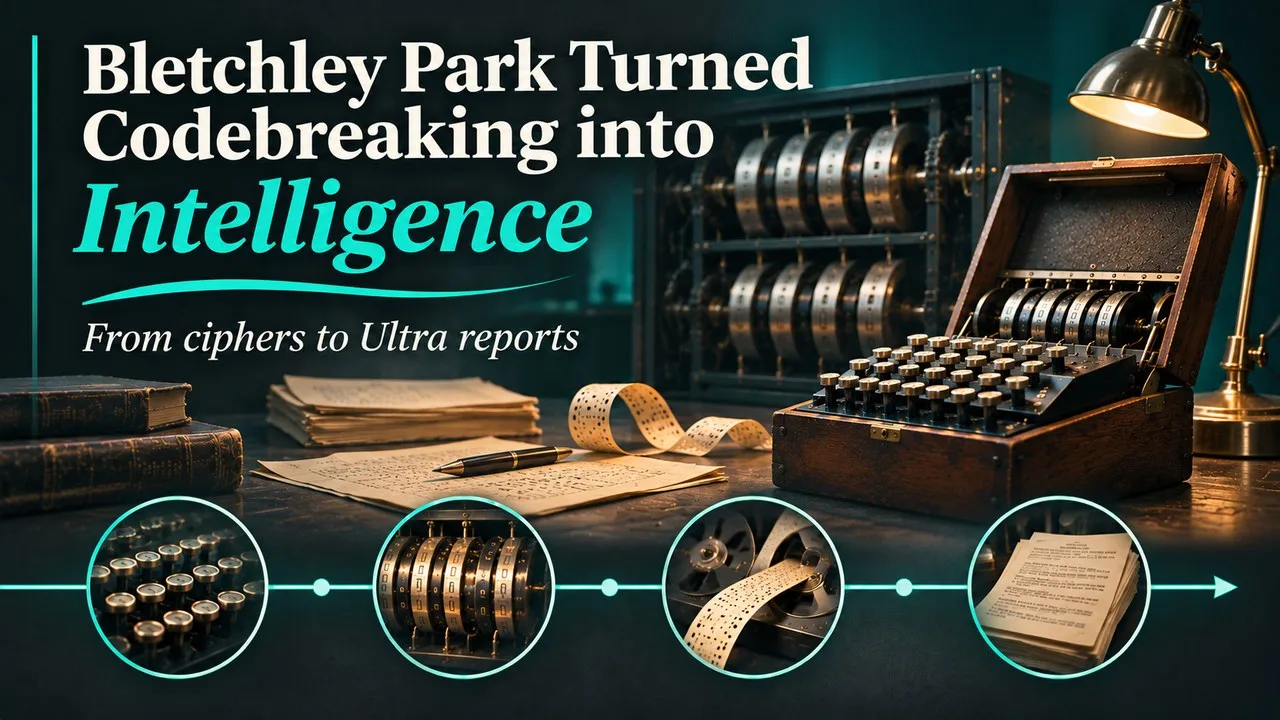
Bletchley Park turned codebreaking into intelligence by linking Britain's cipher breakers with analysts who made decrypted enemy messages into usable reports.[1][2]
This Finepedia guide, updated in November 2026, explains how a country estate in Buckinghamshire became Britain's wartime signals intelligence centre, how its huts divided the work from interception to finished report, which battles its output influenced and why its story stayed secret for three decades. It is number 3 in Top 20 World War II Facts: Little-Known Details.
Key Facts
| Attribute | Detail |
|---|---|
| What it was | Wartime home of the Government Code and Cypher School (GC&CS) |
| Location | Bletchley, Buckinghamshire, now part of Milton Keynes, England |
| Wartime move | Staff told to arrive by 15 August 1939 |
| Staff in 1939 | About 150 |
| Peak staff | About 9,000 to 12,000, depending on source and what is counted |
| Share of women | About three-quarters by 1945 |
| Main targets | German Enigma and Lorenz ciphers; Italian and Japanese codes |
| Key machines | Bombe (electromechanical) and Colossus (electronic) |
| Intelligence codename | Ultra |
| First wartime Enigma break | January 1940 |
| Later identity | GC&CS renamed GCHQ in 1946 |
| Today | Museum and heritage site run by the Bletchley Park Trust |
Sources: Bletchley Park, IEEE and Wikipedia.[1][2][3][4]
Background: Britain's Codebreakers Before the War
Britain's codebreaking agency was created after World War I from the Admiralty's Room 40 and the War Office's cipher branch.[4] Through the 1920s and 1930s it worked from central London, recruiting classicists, linguists and puzzle solvers, several of them veterans of the earlier war, among them Dilly Knox and Nigel de Grey.[1]
By 1938 London looked vulnerable to bombing, so GC&CS began planning a move to the country. The IEEE history recalls that a small group arrived at the Bletchley mansion in late August 1938 under the cover name "Captain Ridley's Shooting Party".[2][4] Bletchley's position on the railway between Oxford and Cambridge, close to main line connections to London, made it convenient for staff and couriers.[4]
The Move and Rapid Growth
On 2 August 1939 staff were ordered to pack their papers into lockable cupboards by 14 August, to be moved overnight, and to report at Bletchley by ten in the morning on 15 August.[3] Curious locals were to be told the work was connected with London's air defence.[3]
The organisation started with only around 150 people.[1] Early recruits were found through Oxford and Cambridge contacts, including the mathematicians Alan Turing, Gordon Welchman and later Bill Tutte.[1][5] As the volume of intercepts grew, Bletchley recruited much more widely, especially from the women's services.
How Big Did It Get?
Figures for the workforce vary. Bletchley Park puts the wider organisation at almost 10,000 people, while Wikipedia cites 8,995 staff across Bletchley and its out-stations in January 1945.[1][4] The IEEE Milestone plaque at the site gives 12,000 men and women, a figure that likely counts everyone who served during the war.[2]
| Measure | Figure | Source |
|---|---|---|
| Staff when the war began | About 150 | Bletchley Park[1] |
| Workforce around D-Day, June 1944 | About 7,000 | Bletchley Park[6] |
| Personnel in January 1945 | 8,995 | Wikipedia[4] |
| People in the wider organisation | Nearly 10,000 | Bletchley Park[1] |
| Total who served (plaque) | 12,000 | IEEE[2] |
From Raw Signal to Usable Intelligence
Breaking a cipher was only one step. Bletchley's real innovation was to organise a production line that turned intercepted letters into reports commanders could act on.
Interception
Most messages were picked up by "Y" stations, a chain of radio listening posts in Britain and overseas staffed by civilians and service personnel, many of them women.[2] Operators logged every letter of enemy transmissions and sent the material to Bletchley, known by the cover name Station X.[2] For eight weeks around D-Day, Bletchley even intercepted messages on site to save time.[6]
Related: The Enigma Secret Was Shared Weeks Before the War
Breaking
For security, sections were referred to simply by the number of their hut. Hut 6 attacked army and air force Enigma, and Hut 8, led for a time by Turing, attacked naval Enigma.[4][5] Their output depended on finding each day's settings quickly, which is where the Bombe came in.
Translation and Analysis
Welchman devised an arrangement in which army and air force officers in a neighbouring hut turned the decrypted messages into intelligence reports.[2] That hut, Hut 3, became the centre of Bletchley's intelligence work, while Hut 4 handled naval translation and analysis.[4][7] Indexes and cross-references let analysts explain technical terms and spot patterns across thousands of messages.[4]
Distribution and Cover
Intelligence from high-level decrypts was given the codename Ultra.[7] To hide its true origin, reports were sometimes made to look as if they came from a fictional spy network, nicknamed Boniface.[2] Bletchley Park says that around D-Day decrypts were intercepted, broken, translated and teleprinted to Allied commanders, the whole cycle taking roughly 2.5 hours.[6]
The Machines
The Bombe
Enigma settings typically changed every 24 hours, and Bletchley Park puts the possible daily combinations at about 103 sextillion.[8] Turing designed the Bombe, refined with Welchman, to test possible settings mechanically. It built on the Polish bomba and on knowledge shared by Polish cryptologists in July 1939.[9][5] GCHQ says the first British Bombe was working in time for the German offensive in the West in 1940.[9]
Wrens, the members of Britain's naval women's service, ran hundreds of Bombes in long shifts in hot, stuffy rooms.[8][10] Bletchley Park describes them as the first mass-produced machine built specifically for codebreaking.[8]
Colossus
Not all German traffic used Enigma. The top-level Lorenz cipher, codenamed Tunny, linked Hitler's headquarters with senior commanders.[11][5] Colossus took the engineer Tommy Flowers eleven months to design and build at the Post Office's Dollis Hill research centre, and it was working at Bletchley in early February 1944.[11] Ten Colossus machines were eventually in use, and with their help 550 staff decrypted some 63 million characters of top-level German messages, the National Museum of Computing says.[11][4]
Related: Polish Mathematicians Broke Enigma Before the War
Notable Successes
Bletchley's intelligence influenced campaigns on land, at sea and in the air. A few well-documented cases are listed below.
- Norway, April 1940: the IEEE history says the German "Yellow" Enigma key was broken within a week of the invasion of Denmark and Norway.[2]
- Cape Matapan, March 1941: breaking Italian naval Enigma helped the Royal Navy win a battle that limited the Italian fleet for the remainder of the conflict.[12][7]
- Battle of the Atlantic, from 1941: Hut 8's break into the U-boat key let the Admiralty steer convoys away from wolf packs, except during part of 1942, when the U-boat signals could not be read.[12][5]
- El Alamein, 1942: Bletchley Park credits intelligence gathered before the battle with contributing to victory in Egypt.[8]
- D-Day, June 1944: decrypts revealed German defensive preparations and reactions to the landings, and Bletchley was handling close to 5,000 Enigma messages daily.[6][8]
The People
Bletchley's workforce was far more varied than its famous names suggest. By 1945, about 75 per cent of the staff were women, and six in ten of them were in uniform; the rest came through the Civil Service.[1][4] Wrens began working at Bletchley and its outstations in 1941, running codebreaking machines.[10]
A small group of American personnel joined later and were integrated into several sections.[1] In December 1942 Turing crossed to America to advise its intelligence services on the Bombe, a sign of how the British effort fed into wider Allied cooperation.[5]
Timeline
| Date | Event |
|---|---|
| Late August 1938 | "Captain Ridley's Shooting Party" visits Bletchley[2][4] |
| July 1939 | Polish codebreakers share Enigma methods with Britain and France[9] |
| 15 August 1939 | GC&CS staff ordered to report at Bletchley[3] |
| January 1940 | First wartime Enigma messages broken at Bletchley[2][13] |
| 1940 | First British Bombe in service[9][5] |
| March 1941 | Battle of Cape Matapan[12][7] |
| 1941 | Hut 8 breaks the U-boat Enigma key[12][5] |
| Early February 1944 | Colossus working at Bletchley[11] |
| June 1944 | About 7,000 staff support D-Day[6] |
| 1946 | GC&CS becomes GCHQ[9][4] |
| 1975 | First details of Colossus declassified[11] |
Comparison With Other Codebreaking Centres
Bletchley Park was not the only wartime codebreaking centre, but it was the largest in Europe. A rough comparison shows how it fitted into Allied efforts.
| Centre | Country | Period | Main targets |
|---|---|---|---|
| Polish Cipher Bureau, Warsaw | Poland | 1932 to 1939 | German Enigma before the war |
| PC Bruno and Cadix | France (Franco-Polish) | 1939 to 1942 | German Enigma in exile |
| Bletchley Park | United Kingdom | 1939 to 1946 | Enigma, Lorenz, Italian and Japanese codes |
| US Navy codebreakers, Washington | United States | 1941 to 1945 | Japanese naval codes and naval Enigma support |
Sources: Bletchley Park, GCHQ and IEEE.[1][9][2]
Why It Mattered
Harry Hinsley, who wrote the official history of wartime British intelligence, judged that Ultra cut two to four years off the war, a claim that other historians consider too high because Ultra played a smaller role on the Eastern Front.[7] The IWM is more cautious, noting estimates that Turing and his colleagues brought the end of the war forward by several years.[5]
Beyond the war, Bletchley left a technical legacy. Colossus was among the first programmable electronic digital computers, and Bletchley Park describes the Bombes as the start of industrial-scale codebreaking.[11][8]
Related: Midway Turned the Tide in the Pacific
Key Figures
- About 150: staff when GC&CS moved to Bletchley in 1939.[1]
- 75 per cent: share of women among Bletchley staff by 1945.[1][4]
- About 103 sextillion: possible daily Enigma settings, as given by Bletchley Park.[8][13]
- About 5,000: Enigma messages decrypted per day around D-Day.[6]
- About 2.5 hours: time from interception to teleprinted report around D-Day.[6]
- 10: Colossus machines in use by the end of the war.[11][4]
- 63 million: characters of Lorenz traffic decrypted with Colossus.[11]
Common Misconceptions
A common belief is that Alan Turing broke Enigma alone. In reality the work rested on Polish breakthroughs, on teams in Huts 6 and 8, and on thousands of operators, translators and analysts.[9][1] Another misconception is that Bletchley read every German message instantly. Naval Enigma could not be read for part of 1942, and the Bombes still had to search for settings each day.[5][8]
It is also mistaken to think Bletchley's only product was decrypted text. Its distinctive contribution was the process of analysis, indexing and distribution that turned raw decrypts into intelligence.[2][4]
Legacy and Today
Secrecy shaped Bletchley's afterlife. Its wartime work stayed classified until the 1970s, and the complete picture only appeared in the 1990s.[5] Colossus details were not declassified until 1975.[11] GC&CS was renamed GCHQ in 1946 and later moved away from the site.[9][4]
Today Bletchley Park is a museum run by the Bletchley Park Trust, with restored huts, the Bombe breakthrough gallery in Hut 11A and an annual programme of events, including commemorations of the Polish contribution.[8][14]
Frequently Asked Questions
What was Bletchley Park used for in World War II?
It was the wartime headquarters of Britain's Government Code and Cypher School. Staff there broke German Enigma and Lorenz ciphers as well as Italian and Japanese codes, then translated and analysed the messages to produce intelligence, codenamed Ultra, for Allied commanders.[2][7]
How many people worked at Bletchley Park?
It began with about 150 staff in 1939. Bletchley Park gives a figure of almost 10,000 for the wider organisation, Wikipedia cites 8,995 in January 1945, and the IEEE plaque gives 12,000 who served over the whole war. About three-quarters were women.[1][2][4]
Related: The Battle of the Atlantic Lasted the Whole War
What was Ultra?
Ultra was the British codename for intelligence obtained from breaking high-level enemy ciphers, chiefly Enigma and Lorenz. Its source was closely guarded, and reports were sometimes disguised as coming from a fictional spy network to protect the secret.[2][7]
Did Bletchley Park build the first computer?
Colossus, designed by Tommy Flowers and working at Bletchley from early 1944, is described by the National Museum of Computing as the first machine to be at once electronic, digital and programmable. Earlier calculating machines existed, and a stored-program computer came later, in 1948.[11]
Can you visit Bletchley Park today?
Yes. The site is open daily as a museum run by the Bletchley Park Trust, with exhibitions in the restored huts and blocks, including the Bombe gallery in Hut 11A.[8][14]
Conclusion
Bletchley Park mattered not only because its staff solved hard ciphers but because it built an organisation that turned those solutions into timely intelligence. Interception, breaking, translation, indexing and secure distribution all had to work together, and they did so on an industrial scale.
That machinery rested on Polish foundations, depended on thousands of mostly female staff, and produced some of the first electronic computers along the way.
See all 20 in Top 20 World War II Facts: Little-Known Details
See also
- Top 20 World War II Facts: Little-Known Details
- Top 10 Real Intelligence Operations That Sound Like Fiction
- Top 10 Inventions That Changed Warfare: Chariots to Drones
- Top 10 Overlooked Events of World War II
- ^ [1] "Who were the Codebreakers?". Bletchley Park. Bletchley Park: Who were the Codebreakers
- ^ [2] "Milestones: Code-breaking at Bletchley Park during World War II, 1939-1945". IEEE / Engineering and Technology History Wiki. ETHW: Bletchley Park Milestone
- ^ [3] "The First Huts". Bletchley Park. Bletchley Park: The First Huts
- ^ [4] "Bletchley Park". Wikipedia. Wikipedia: Bletchley Park
- ^ [5] "How Alan Turing Cracked The Enigma Code". Imperial War Museums. IWM: How Alan Turing Cracked the Enigma Code
- ^ [6] "Bletchley Park and D-Day". Bletchley Park. Bletchley Park: Bletchley Park and D-Day
- ^ [7] "Ultra (cryptography)". Wikipedia. Wikipedia: Ultra
- ^ [8] "6 facts about the Bombe". Bletchley Park. Bletchley Park: 6 facts about the Bombe
- ^ [9] "The Pyry Forest Meeting". GCHQ. GCHQ: The Pyry Forest Meeting
- ^ [10] "The Vital Role Of Women In World War Two". Imperial War Museums. IWM: Women's roles
- ^ [11] "Colossus". The National Museum of Computing. TNMOC: Colossus
- ^ [12] "Sea". Bletchley Park. Bletchley Park: Sea
- ^ [13] "Enigma". Bletchley Park. Bletchley Park: Enigma
- ^ [14] "Our story". Bletchley Park. Bletchley Park: Our story
























Discussion
Log in with