






 By
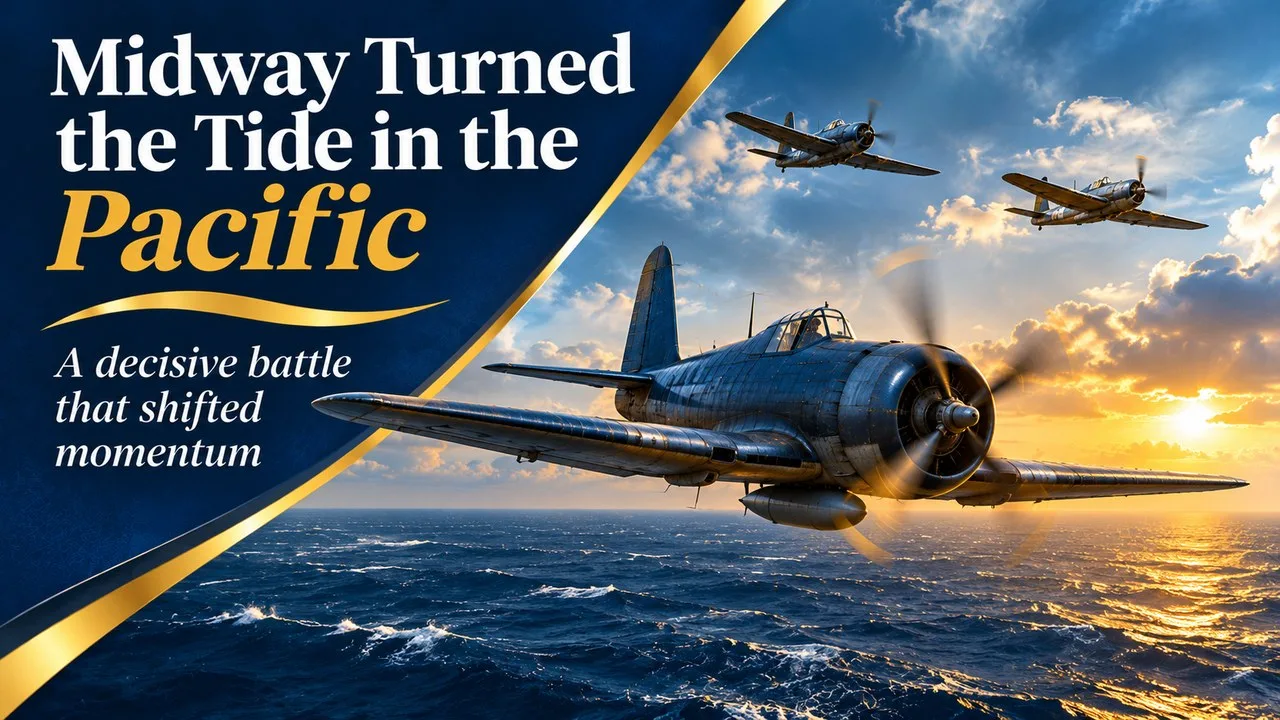
Midway turned the tide in the Pacific: in June 1942 US codebreakers and carrier aircraft sank four Japanese fleet carriers and halted Japan's run of conquests.[1][2]
This Finepedia guide, updated in November 2026, explains how the Battle of Midway was fought, why American intelligence mattered so much, what each side lost and why historians see it as the moment the Pacific War turned. It is number 14 in Top 20 World War II Facts: Little-Known Details.
Key Facts
| Attribute | Detail |
|---|---|
| Dates | 3–6 June 1942 (Britannica); NHHC counts 3–7 June, ending with the loss of USS Yorktown |
| Place | Midway Atoll, central Pacific, about 1,770 km (1,100 miles) northwest of Hawaii |
| Commanders | Admiral Chester Nimitz, Rear Admirals Frank Jack Fletcher and Raymond Spruance (US); Admiral Isoroku Yamamoto and Vice Admiral Chuichi Nagumo (Japan) |
| Japanese carriers sunk | Akagi, Kaga, Soryu and Hiryu |
| US ships lost | Carrier Yorktown and destroyer Hammann |
| Japanese dead | About 3,000 (Britannica, History.com) or 3,057 (Wikipedia, National WWII Museum) |
| US dead | 307 to 362, depending on the source |
| Result | Decisive American victory; Japan cancelled planned moves on Fiji, Samoa and New Caledonia |
Sources: NHHC, Britannica, Wikipedia, National WWII Museum and History.com.[1][2][3][4][5]
Six Months After Pearl Harbor
The battle came almost exactly half a year after the raid on Pearl Harbor of 7 December 1941. In that attack Japan had used six heavy carriers, and four of them would be lost at Midway.[6][1] By March 1942 Japan held Malaya, Singapore, the Philippines, the Dutch colonies in the East Indies and many Pacific islands, according to the Naval History and Heritage Command (NHHC), the US Navy's official history office.[1][3]
The First Check at Coral Sea
The advance was first checked in the Coral Sea on 7–8 May 1942, the first battle between aircraft carriers. The Americans lost the carrier Lexington and Japan lost the light carrier Shoho, but Japan called off its seaborne move on Port Moresby.[1][3] Yorktown was badly damaged in that battle, and the Japanese believed it had sunk.[2][3]
Why Midway Mattered
Midway is a small coral atoll of two islands, Sand and Eastern, covering only about 6.2 square km (2.4 square miles) of land.[2] Before the war it was already a refuelling stop for flights across the Pacific, and from 1940 the US Navy built an air and submarine base there.[2] Britannica notes that in Japanese hands it could have threatened Hawaii and the supply route from the United States to Australia.[2]
Yamamoto's Plan
Admiral Isoroku Yamamoto, head of Japan's Combined Fleet, won approval for his Midway and Aleutians operation on 16 April 1942.[1] The National WWII Museum says Japan hoped to destroy the US Pacific Fleet, use Midway as a base against Pearl Harbor and then force a negotiated peace.[4][5]
A Trap for the Pacific Fleet
The plan relied on a feint towards Alaska, followed by landings on Midway. When the Americans came out to defend the island, Japanese carrier and battleship groups waiting to the west would destroy them.[1][5] NHHC adds that the Doolittle Raid on Tokyo on 18 April strengthened Japan's wish to push its defensive line further east and brought the operation forward.[1]
The Japanese Force
The striking force under Vice Admiral Chuichi Nagumo was built around four big carriers: Hiryu, Soryu, Kaga and Akagi. NHHC puts their aircraft at 229.[1] Britannica lists support from two light carriers, seven battleships, 15 cruisers, 42 destroyers and 10 submarines, and Yamamoto himself sailed in the battleship Yamato.[2][1]
Codebreakers Uncover the Plan
The United States was not caught by surprise. Navy cryptanalysts had been reading parts of Japan's main naval code, which the Americans called JN-25, since early 1942.[3][4][2]
Related: The Battle of the Atlantic Lasted the Whole War
Station Hypo and "AF"
Two American radio units did most of the work: one at Pearl Harbor, known as Hypo, and one in Melbourne.[1] In March the letters "AF" began to show up in decoded Japanese traffic, and analysts suspected it meant Midway.[1][4] On 19 May, Commander Joseph Rochefort, who ran Hypo, and Nimitz's intelligence officer, Lieutenant Commander Edwin Layton, identified the targets as Midway and Dutch Harbor, Alaska.[1]
The Fresh-Water Ruse
To be sure, the Americans had Midway send out a false report that its fresh-water plant had broken down. Japan then signalled that "AF" was short of water, confirming the target.[4][5] Hypo also worked out the Japanese date cipher and predicted an attack around 4 June.[1][4] The National WWII Museum says Hypo was able to give the date and the Japanese order of battle.[4]
Yorktown Back in Three Days
Nimitz had only two carriers ready, Enterprise and Hornet, and no battleships to spare.[2] Engineers estimated that Yorktown needed three months of repair, but Nimitz gave them three days; the carrier sailed from Pearl Harbor on 30 May, having spent under 72 hours in the dock.[2][3] The three American carriers met roughly 560 km (350 miles) to the northeast of Midway at a spot code-named "Point Luck".[2][1]
The Battle
On 3 June American planes from Midway found Japanese transports west of the atoll, but B-17 bombers caused no damage.[1][2] The main action came the next day.
The Morning of 4 June
Early on 4 June, Japanese carrier aircraft struck the base on Midway. Defending Marine fighters, outnumbered and outclassed by the Zero, suffered heavy losses, but the island's runways remained usable.[2][1] Bombers and torpedo planes from Midway then attacked Nagumo's carriers in waves and scored no hits.[1][2]
Nagumo's Dilemma
Nagumo had ordered his reserve aircraft rearmed with bombs for a second strike on Midway when a scout reported American ships nearby. He then reversed the order and chose to recover his returning aircraft before attacking the American fleet.[2][5] For a crucial period his hangar and flight decks were crowded with fuelled planes and loose bombs and torpedoes.[2][3]
The Torpedo Squadrons
From about 9:20 a.m., slow Devastator torpedo bombers from all three American carriers attacked. Almost all were shot down, and none hit a carrier.[1][2] Torpedo Squadron 8 from Hornet lost every plane, and Ensign George Gay was its only survivor.[2][3] Britannica says only six of the 41 Devastators launched in the battle came back.[2] Their sacrifice still mattered: Japanese fighters were drawn down to sea level, leaving the sky open above.[1][2]
Related: Top 10 Overlooked Events of World War II
Six Minutes That Changed the War
Around 10:20 a.m., Dauntless dive bombers from Enterprise, led by Lieutenant Commander Wade McClusky, and from Yorktown arrived over the Japanese fleet almost together.[2][1] Within minutes Kaga, Akagi and Soryu were burning.[1][4] McClusky had kept searching after missing the Japanese at the expected point, a choice Nimitz later called one of the most important of the battle.[2]
Hiryu Strikes Back
Hiryu, the one carrier spared that morning, launched two attacks on Yorktown. Bombs disabled the carrier around noon, and torpedoes in the afternoon forced the crew to abandon ship.[1][4] Around 5 p.m., Dauntlesses from Enterprise found Hiryu and left it a burning wreck.[1][2] Yamamoto then gave up the invasion and the Japanese fleet turned west.[1]
The Final Days
On 6 June American dive bombers sank the heavy cruiser Mikuma.[1][2] That same day the Japanese submarine I-168 torpedoed the damaged Yorktown during salvage work and sank the destroyer Hammann alongside it. Yorktown finally sank early on 7 June.[1][2][4]
Counting the Losses
The sources agree on ships but differ on people and planes. Japan lost four fleet carriers and a heavy cruiser; the United States lost one carrier and one destroyer.[1][2][3]
Men Killed
Britannica and History.com give about 3,000 Japanese dead, while Wikipedia and the National WWII Museum give 3,057.[2][5][3][4] For the American side, Britannica gives 317, Wikipedia about 307, the National WWII Museum about 362 and History.com about 360.[2][3][4][5]
Aircraft and Pilots
Estimates of Japanese aircraft lost range from 248 (Wikipedia, citing the historians Parshall and Tully) to nearly 300 (History.com) and more than 320 (Britannica).[3][5][2] American losses are given as about 150, 145 or 144 aircraft.[2][3][5][4] NHHC says Japan lost more than 100 trained aviators it was unable to replace, while History.com says more than 200 of its most experienced pilots died.[1][5]
Why It Was a Turning Point
NHHC sums up the outcome as a heavy defeat for the Imperial Japanese Navy, won through code intelligence, sound carrier tactics and a good deal of luck.[1] Britannica calls it the worst naval defeat Japan had suffered since 1592.[2]
Related: Stalingrad Was a Major Turning Point
Parity, Then Initiative
According to Britannica, Midway left the two navies at rough parity in the Pacific, and Japan shelved its planned landings in Fiji, Samoa and New Caledonia.[2][1] Wikipedia notes that the Americans did not gain clear naval superiority until after months more of hard fighting, but Midway let the Allies take the initiative and opened the way to the landings on Guadalcanal in August 1942.[3][2]
The Long Shadow on Japan's Navy
The four lost carriers had all taken part in the Pearl Harbor raid.[1][6] Britannica and NHHC both stress the loss of Japan's best-trained aircrew, and Wikipedia notes that Japan could not train pilots as fast as it was losing them.[2][1][3] The National WWII Museum says the victory let the United States start rolling back Japan's empire through years of island-hopping campaigns.[4]
Comparison: Japan and the United States at Midway
| Aspect | Japan | United States |
|---|---|---|
| Fleet carriers present | 4 (Akagi, Kaga, Soryu, Hiryu) | 3 (Enterprise, Hornet, Yorktown) |
| Carrier aircraft | 229 (NHHC) | 234 afloat, plus about 110 to 115 on Midway |
| Intelligence | Did not know US carriers were at sea | Read enough of JN-25 to know target and date |
| Carriers lost | 4 | 1 (Yorktown) |
| Other warships lost | Heavy cruiser Mikuma | Destroyer Hammann |
| Men killed | About 3,000 to 3,057 | About 307 to 362 |
| Aftermath | Lost the strategic initiative | Moved to the offensive at Guadalcanal |
Sources: NHHC, Britannica, Wikipedia and the National WWII Museum.[1][2][3][4]
Timeline
| Date | Event |
|---|---|
| 7 December 1941 | Six Japanese carriers attack Pearl Harbor |
| March 1942 | "AF" appears in Japanese radio traffic |
| 16 April 1942 | Yamamoto's Midway plan is approved |
| 18 April 1942 | Doolittle Raid on Tokyo |
| 7–8 May 1942 | Battle of the Coral Sea |
| 19–22 May 1942 | US analysts confirm Midway as the target |
| 30 May 1942 | Repaired Yorktown leaves Pearl Harbor |
| 3 June 1942 | First contact west of Midway |
| 4 June 1942 | Three Japanese carriers hit in the morning; Hiryu hit in the afternoon |
| 6 June 1942 | Mikuma sunk; I-168 torpedoes Yorktown and Hammann |
| 7 June 1942 | Yorktown sinks |
| August 1942 | US landings on Guadalcanal |
Sources: NHHC, Britannica and Wikipedia.[1][2][3][6]
Key Figures
- 6 months: time between Pearl Harbor and Midway.[6][1]
- 4: Japanese fleet carriers sunk, all veterans of the Pearl Harbor raid.[1][3]
- 3 days: the repair time Nimitz allowed for Yorktown, against an estimate of three months.[2][3]
- 6 of 41: Devastator torpedo bombers that returned, according to Britannica.[2]
- About 3,000 or 3,057: Japanese dead, depending on the source.[2][3][4]
- 307 to 362: range of American death tolls given by different sources.[2][3][4][5]
The Commanders
On the American side, Admiral Chester Nimitz acted on the intelligence and placed his carriers northeast of Midway. Rear Admiral Frank Jack Fletcher, the senior officer afloat, commanded Task Force 17 around Yorktown, and Rear Admiral Raymond Spruance commanded Task Force 16 with Enterprise and Hornet, taking tactical charge after Yorktown was disabled.[1][2] Commander Joseph Rochefort ran the codebreaking at Hypo.[1][3] On the Japanese side, Yamamoto designed the plan and Nagumo commanded the carriers, and his rearming decision proved costly.[1][2][5]
Common Misconceptions
One misconception is that the American torpedo attacks were wasted. No torpedo plane hit a carrier, but the attacks pulled Japanese fighters down to low altitude, leaving the dive bombers free to strike from above.[1][2]
Another is that intelligence alone won Midway. Britannica notes that the US Navy's own narrative called it a victory of intelligence, yet it also credits sound carrier tactics and command decisions, and NHHC adds a good measure of luck.[2][1]
A third is that Midway ended the Pacific War, or that Japan lost its whole navy there. The war went on for more than three years, and Japan's battleships and much of its surface fleet survived; Wikipedia notes that clear American naval superiority came only after months of further hard fighting.[3][2]
Frequently Asked Questions
When was the Battle of Midway?
It was fought in early June 1942. Britannica dates it 3–6 June, while NHHC extends it to 7 June, when Yorktown sank.[2][1]
Related: Pearl Harbor Did Not Happen in a Vacuum
How did the Americans know about the attack?
US Navy codebreakers had partly broken Japan's naval code. A false report about a fresh-water shortage on Midway confirmed that "AF" meant Midway.[1][4][5]
How many carriers did Japan lose at Midway?
Four: Akagi, Kaga, Soryu and Hiryu, all veterans of the Pearl Harbor raid.[1][3]
How many people died at Midway?
Japanese deaths are given as about 3,000 or 3,057. American deaths range from about 307 to 362, depending on the source.[2][3][4][5]
Why is Midway called a turning point?
Japan lost the heart of its carrier force and many skilled aircrew. Japan never recovered the initiative, and the Allies went on the offensive.[1][2][3]
Conclusion
Midway was won by a mix of codebreaking, risk-taking and timing. Six months after Pearl Harbor, the US Navy sank the four carriers that had led that raid and lost only one of its own.
The exact human cost is still counted differently, but historians agree on the result: Japan's expansion in the Pacific was halted and the Allies took the initiative they kept until 1945.[1][2][4]
See all 20 in Top 20 World War II Facts: Little-Known Details
See also
- Top 20 World War II Facts: Little-Known Details
- Top 10 Real Intelligence Operations That Sound Like Fiction
- Top 10 Inventions That Changed Warfare: Chariots to Drones
- ^ [1] "Battle of Midway, 3–7 June 1942". Naval History and Heritage Command. NHHC
- ^ [2] "Battle of Midway" (Michael Ray). Encyclopaedia Britannica. Britannica
- ^ [3] "Battle of Midway". Wikipedia. Wikipedia
- ^ [4] "The Battle of Midway". The National WWII Museum. National WWII Museum
- ^ [5] "Battle of Midway". History.com. History.com
- ^ [6] "Overview of The Pearl Harbor Attack, 7 December 1941". Naval History and Heritage Command. NHHC






















Discussion
Log in with