






The Eastern Front Was the Largest Theatre of the War
 By Dhiraj Sharma · Published
Share Post
Loading…
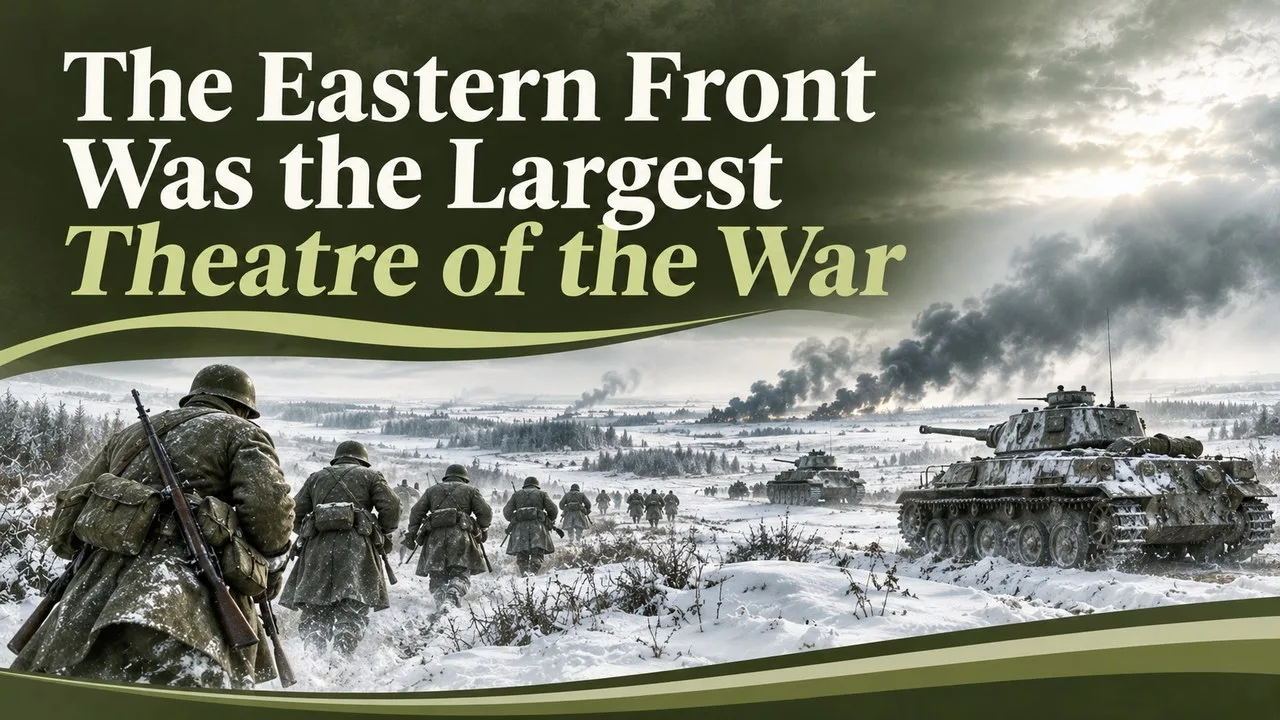
The Eastern Front was the biggest theatre of World War II: Germany and its allies fought the USSR there from June 1941 to May 1945 across much of Europe.[1][2]
This Finepedia guide, updated in November 2026, explains how the war in the east began, why it grew larger and deadlier than any other theatre, how its turning points unfolded, and why its human cost remains hard to measure precisely. It is number 10 in Top 20 World War II Facts: Little-Known Details.
Key Facts
| Attribute | Detail |
|---|---|
| Dates | From 22 June 1941 until 9 May 1945 |
| Opening offensive | Operation Barbarossa, the German attack on the USSR |
| Invasion force | About 3 to 3.8 million German and Axis troops |
| Share of the German Army committed | About 80 per cent in June 1941 |
| Initial front | About 1,800 miles, Baltic coast to Black Sea |
| Major turning points | Moscow (1941), Stalingrad (1942–43), Kursk (1943), Bagration (1944) |
| Soviet deaths | About 24 million or more, military and civilian |
| Soviet prisoners who died in German hands | About 3.3 million |
| End | Fall of Berlin in May 1945 |
Sources: Britannica, Imperial War Museums, the National WWII Museum, the US Holocaust Memorial Museum and Wikipedia.[2][3][1][4][5]
From Partners of Convenience to Enemies
In 1939 Germany and the USSR signed a non-aggression pact, which let Hitler invade Poland without facing a war on two fronts.[2][6] Britannica notes that Hitler saw the agreement as a matter of expediency. Hostility to Bolshevism remained his deepest conviction, and Soviet moves in 1940 into the Baltic states and towards the Romanian oil fields that Germany relied on made him more suspicious of Stalin.[2]
Conquest in the east was also central to Nazi ideology. Hitler wanted Lebensraum, or "living space", for Germans, and he aimed to destroy the Red Army, seize Soviet resources and enslave the population.[3][2] According to IWM, Hitler started planning the attack in July 1940, even before the air battle over Britain had been fought.[3][6] Wikipedia records that the formal order, Directive 21, was issued on 18 December 1940.[6]
Operation Barbarossa
Germany attacked on 22 June 1941. Three army groups advanced: North towards Leningrad, Centre towards Moscow and South into Ukraine.[2][3] Britannica and IWM both describe it as the largest invasion force in history up to that point.[2][3]
Sources give different figures for its size:
- Britannica: almost 150 German divisions with about three million men, about 3,000 tanks and 2,500 aircraft, plus more than 30 Finnish and Romanian divisions.[2]
- IWM: over three million men.[3]
- The US Holocaust Memorial Museum (USHMM): three million German soldiers, joined by contingents from Finland, Romania, Hungary, Italy, Slovakia and Croatia.[5]
- Wikipedia: about 3.8 million Axis personnel at the front, and some 3.77 million German troops in the east, roughly four-fifths of Germany's army.[6][1]
Germany's Partners and Japan's Absence
Germany did not fight alone. Finland and Romania joined the invasion from the start, and Hungary, Italy, Slovakia and Croatia also sent troops.[5][1] Japan, however, stayed out. The National WWII Museum points out that Tokyo had agreed a non-aggression treaty with Moscow in April 1941, so the USSR never had to fight a second war in the Far East while the Germans advanced.[7]
Early Success
The attack along a front of about 1,800 miles took the Soviet leadership by surprise.[2] German tanks raced ahead while the Luftwaffe controlled the skies, and huge encirclements trapped Soviet armies.[3][2] Britannica counts 300,000 prisoners taken around Minsk and 520,000 men caught in the pocket behind Kiev by the end of September.[2] By mid-July the Germans were only about 200 miles from Moscow.[2][6]
Failure at Moscow
Hitler argued with his generals through August over whether Moscow or the south should come first, and he delayed the drive on the capital.[2][3] When it came, autumn rain turned roads to mud and winter arrived early. German troops got within about 20 miles of Moscow before the Red Army counter-attacked in early December; Wikipedia's Barbarossa article dates this to 5 December, while its Eastern Front article places the start just after 6 December.[3][6][1] IWM calls the result Hitler's first defeat on land.[3]
Why Barbarossa Stalled
Several weaknesses combined to stop the German advance.
Underestimated Reserves
German intelligence expected about 150 Soviet divisions in the west and perhaps 50 more. Britannica says that by mid-August the Red Army had brought forward over 200 new divisions, for a total of 360.[2] Wikipedia's figures likewise show Soviet strength of 5.5 million on the day of the attack, with 12 million reserves that could be mobilised.[1]
Related: Stalingrad Was a Major Turning Point
Distance and Supply
IWM points to immense distances and difficult terrain, which soon caused supply problems.[3] Britannica adds that Soviet railway track used a different gauge from German track, so captured lines could not easily be used, and that retreating Soviet forces destroyed crops and bridges.[2]
Industry Moved East
Whole factories in the western USSR were taken apart, moved east by train and restarted beyond German reach.[2][1] This helped the Red Army replace its enormous early losses.
A Short-War Plan
The German plan relied on winning in a few months. IWM notes that Germany lacked the reserves of men and materials for a long war of attrition, and Britannica says the generals expected victory within two or three months.[3][2]
Why It Was the Largest Theatre
Several measures support the claim that the Eastern Front was the largest theatre of World War II.
Scale and Area
Millions of soldiers fought on each side for almost four years. The fighting stretched from the Arctic and Baltic coasts down to the Black Sea and the Caucasus, and in 1942 German forces pushed as far as Stalingrad on the Volga.[1][2]
Share of the Fighting
Wikipedia states that the Eastern Front involved more land combat than every other theatre of the war put together, and that about 80 per cent of German military deaths occurred there.[1] IWM likewise argues that the campaign launched in June 1941 was the one that settled the outcome of the war.[3]
Related: Germany's Invasion of Poland Began the War in Europe
Comparison: Eastern and Western Fronts
| Feature | Eastern Front | Western Europe, 1944–45 |
|---|---|---|
| Duration | About 4 years | About 11 months |
| Main opponents | Germany and allies against the USSR | Germany against the western Allies |
| Character | A war of annihilation against civilians and prisoners | Largely fought within the laws of war |
| Prisoner deaths | About 57 per cent of Soviet prisoners died | About 3.6 per cent of British and US prisoners died |
| Share of German military deaths | About 80 per cent | A much smaller share |
Sources: USHMM, IWM and Wikipedia.[5][3][1]
A War of Annihilation
What set the Eastern Front apart was not only its size but its purpose. Hitler intended a war of annihilation in the east, and civilians suffered from the start, Soviet Jews above all.[3][5][8]
Mobile Killing Units
Behind the advancing troops came the Einsatzgruppen, mobile killing squads of the German security police. With help from other German units and local collaborators, they murdered over 500,000 people, most of them Jews, during the first nine months after the invasion.[8][1] USHMM estimates that between 1.5 million and over 2 million Jews and other victims on Soviet soil were killed by shooting or in gas vans.[8]
Soviet Prisoners of War
Soviet prisoners suffered on a scale without parallel in the west. USHMM says that about 5.7 million Soviet soldiers were captured by Germany and some 3.3 million of them, about 57 per cent, had died by 1945. By contrast, about 8,300 out of 231,000 British and US prisoners in German hands died.[5][1] Wikipedia gives a range of 2.25 to 3.3 million Soviet prisoner deaths out of 5.25 to 5.7 million taken.[1]
The Turning Points
After Moscow, Germany struck again in the south in summer 1942, aiming for Stalingrad and the Caucasus oil fields.[1][2] The battle of Stalingrad, which ended with the destruction of a German army in early 1943, is often called the bloodiest battle in history.[1]
In July 1943, Germany's last great offensive in the east was stopped at Kursk, which included a huge tank clash near Prokhorovka.[1] From then on the Red Army held the initiative. Operation Bagration, launched on 22 June 1944, soon after the Normandy landings, destroyed German Army Group Centre.[9][1] Soviet forces reached Berlin in April 1945, and its defenders surrendered on 2 May.[1]
The western Allies sent no ground troops to the east, but the United States and Britain supplied the USSR with large amounts of material through Lend-Lease. The National WWII Museum notes that American aid alone was worth billions of dollars by 1945.[1][7]
Related: Germany Declared War on the United States
Timeline
| Date | Event |
|---|---|
| August 1939 | German–Soviet non-aggression pact signed[2][6] |
| July 1940 | Planning for an invasion of the USSR begins[3][6] |
| 22 June 1941 | Germany invades the USSR[2][3] |
| December 1941 | Soviet counter-offensive at Moscow[3][6] |
| Summer 1942 | German offensive towards Stalingrad and the Caucasus[1][2] |
| July 1943 | Battle of Kursk[1] |
| 22 June 1944 | Operation Bagration begins[9][1] |
| 2 May 1945 | Berlin surrenders to Soviet forces[1] |
| 9 May 1945 | Fighting in the east formally ends[1][4] |
The Human Cost
No other theatre approached the Eastern Front's death toll, but estimates vary widely.
| Measure | Estimate | Source |
|---|---|---|
| Total Soviet deaths, military and civilian | About 24 million | National WWII Museum[4] |
| Soviet military deaths | 8.7 to 10.7 million | National WWII Museum, Wikipedia[4][1] |
| Soviet civilian deaths | 18 to 24 million | Wikipedia[1] |
| Deaths on the Eastern Front, all nations | Around 30 million | Wikipedia[1] |
| Soviet prisoners who died in German custody | 2.25 to 3.3 million | USHMM, Wikipedia[5][1] |
The National WWII Museum warns that estimates of wartime deaths differ greatly between sources.[4] The gaps arise from incomplete wartime records, changing borders and whether deaths from famine and disease are counted. Germany's own losses were also immense: the museum lists about 5.5 million German military deaths in the whole war, and Wikipedia attributes roughly four in five German military deaths to the east.[4][1]
Key Figures
- About 3 million: German soldiers in the invasion force, before allied contingents.[2][3]
- About 80 per cent: share of the German Army committed to the east in June 1941.[1]
- About 20 miles: closest German approach to Moscow, according to IWM.[3]
- About 57 per cent: share of Soviet prisoners who died in German custody.[5][1]
- About 24 million: Soviet military and civilian deaths, by the National WWII Museum's estimate.[4][1]
Common Misconceptions
One misconception is that the eastern war was a sideshow to Normandy and Italy. By most measures, including troops engaged, length and German losses, the Eastern Front was larger than all other European fronts combined.[1][3]
Another is that winter alone defeated the Germans. Weather slowed them, but IWM and Britannica also point to stubborn Soviet resistance, underestimated reserves, supply problems and Hitler's quarrels with his generals.[3][2]
Frequently Asked Questions
When did the Eastern Front begin and end?
It began with the German invasion of the USSR on 22 June 1941 and ended with Germany's surrender in May 1945, marked in Russia on 9 May.[2][1]
Why is the Eastern Front called the largest theatre of the war?
No other theatre matched its numbers of soldiers, length of front, intensity of fighting or death toll, and most German military deaths occurred there.[1][3]
Related: The Atomic Bombings Occurred in August 1945
How many people died on the Eastern Front?
Estimates vary. The National WWII Museum puts total Soviet deaths at about 24 million, and Wikipedia gives around 30 million deaths on the Eastern Front overall.[4][1]
What was Operation Barbarossa?
It was the codename for Germany's invasion of the USSR, launched on 22 June 1941 with about three million German troops and allied forces.[2][3]
How were Soviet prisoners of war treated?
Brutally. Some 3.3 million of about 5.7 million Soviet prisoners died in German custody, mostly from starvation, exposure and mass shootings.[5][1]
Conclusion
The Eastern Front dwarfed all the other theatres of the war. It drew in most of the German Army, lasted almost four years, stretched across thousands of miles and cost tens of millions of lives.
It was also a war of annihilation, in which civilians and prisoners died on a scale unknown elsewhere, and its outcome did more than any other campaign to decide the defeat of Nazi Germany.
See all 20 in Top 20 World War II Facts: Little-Known Details
See also
- Top 20 World War II Facts: Little-Known Details
- Top 10 Overlooked Events of World War II
- Top 10 Forged Documents That Saved Lives in World War II
- ^ [1] "Eastern Front (World War II)". Wikipedia. Wikipedia: Eastern Front
- ^ [2] "Operation Barbarossa" (John Graham Royde-Smith). Encyclopaedia Britannica. Britannica
- ^ [3] "What Was Operation Barbarossa?". Imperial War Museums. IWM
- ^ [4] "Research Starters: Worldwide Deaths in World War II". The National WWII Museum. National WWII Museum
- ^ [5] "Nazi Persecution of Soviet Prisoners of War". Holocaust Encyclopedia, US Holocaust Memorial Museum. USHMM
- ^ [6] "Operation Barbarossa". Wikipedia. Wikipedia: Operation Barbarossa
- ^ [7] "Hitler's Declaration of War on the United States" (Sean Scanlon). The National WWII Museum. National WWII Museum
- ^ [8] "Einsatzgruppen". Holocaust Encyclopedia, US Holocaust Memorial Museum. USHMM
- ^ [9] "10 Facts About D-Day You Need To Know". Imperial War Museums. IWM
























Discussion
Log in with