






Germany's Invasion of Poland Began the War in Europe
 By Dhiraj Sharma · Published
Share Post
Loading…
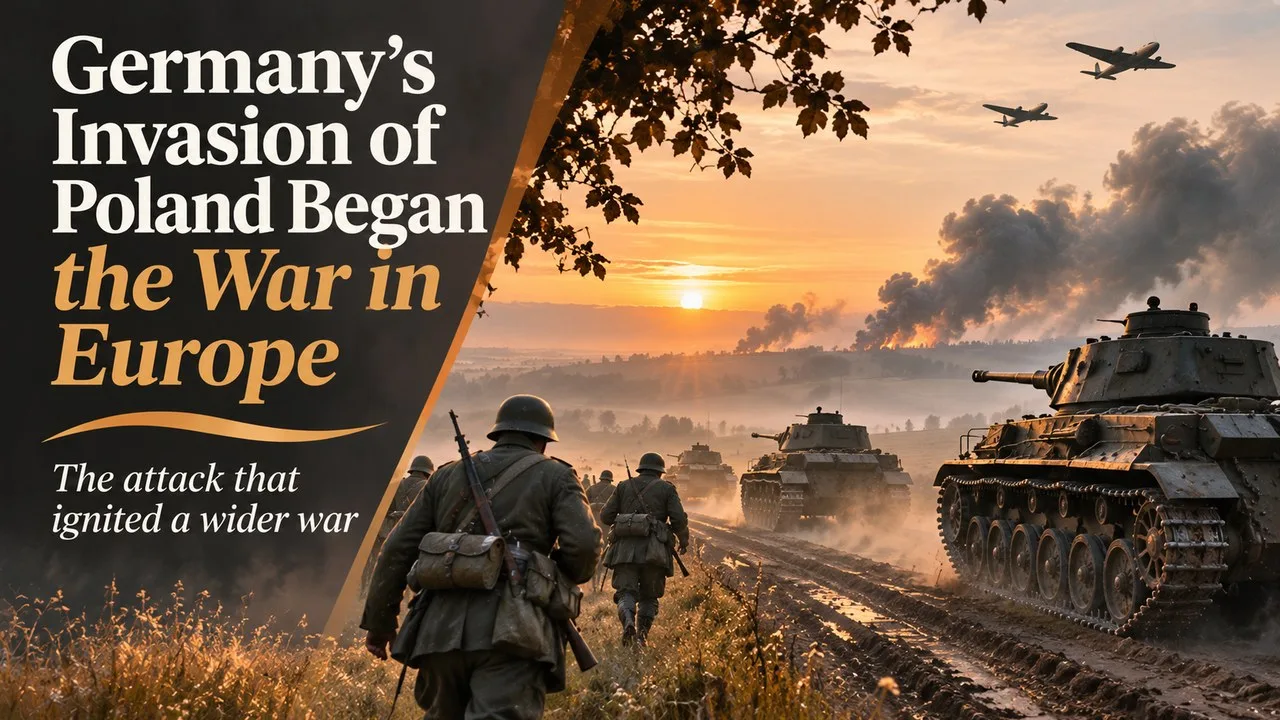
When Germany invaded Poland on 1 September 1939, the war in Europe began, because Britain and France responded two days later by declaring war on Germany.[1][2]
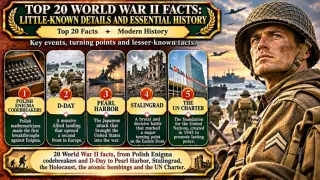
This Finepedia guide, updated in November 2026, explains why Poland became Hitler's target, how the campaign unfolded, what part the USSR played, and why historians still debate when World War II truly started. It is number 11 in Top 20 World War II Facts: Little-Known Details.
Key Facts
| Attribute | Detail |
|---|---|
| Date | 1 September to 6 October 1939 |
| Attackers | Germany and Slovakia, with the USSR from 17 September |
| German force | About 1.5 million soldiers in 50 to 60 divisions |
| Opening shots | Around 4.45 in the morning, 1 September |
| Western response | Britain and France declared war on 3 September |
| Warsaw surrendered | 28 September 1939 |
| Last major Polish resistance | Ended at Kock on 6 October 1939 |
| Result | Poland divided between Germany and the USSR |
Sources: US Holocaust Memorial Museum, The Second War, Imperial War Museums and Wikipedia.[1][3][2][4]
The Road to September 1939
Poland was one of the new states created after the First World War. It was given access to the Baltic Sea through a corridor of former German land, and the largely German city of Danzig, now Gdańsk, became a Free City under the League of Nations. According to the Imperial War Museums (IWM), the loss of Danzig and the existence of an independent Poland caused lasting resentment in Germany.[2][4]
From Pact to Pressure
Ironically, one of Hitler's first foreign policy moves was a 1934 non-aggression agreement with Warsaw, signed in January partly to block a French-Polish alliance while Germany rearmed.[1] From October 1938 he pressed for Danzig's return. The Poles refused, and the US Holocaust Memorial Museum (USHMM) notes that Hitler renounced the 1934 pact on 28 April 1939.[2][1]
Appeasement Ends
Britain and France had accepted Germany's earlier gains, including the Sudetenland under the Munich Agreement of September 1938.[1][2] When German troops occupied the rest of Czech territory in March 1939, both countries concluded that Hitler's ambitions had no limit, and they guaranteed Polish independence. In April Hitler ordered preparations to invade Poland.[2][1]
The Nazi-Soviet Pact
The decisive move came on 23 August 1939, when Germany and the USSR signed a non-aggression pact negotiated by the foreign ministers Joachim von Ribbentrop and Vyacheslav Molotov.[5][2]
The public part was a ten-year promise that neither country would attack the other or help a third power against it. A secret protocol carved eastern Europe into zones where each dictatorship would have a free hand, with Poland to be split along the Narew, Vistula and San rivers.[5][4] This freed Hitler to attack Poland without fear of Soviet intervention.[5][1] Britain answered by signing a formal military alliance with Poland on 25 August.[2][3]
Pretext and First Shots
The invasion was originally planned for 26 August, but Hitler postponed it at the last minute, then fixed the new start time in his Directive No. 1 at noon on 31 August.[3] That evening SS men staged a fake Polish raid on a German radio station at Gleiwitz, now Gliwice, which Nazi propaganda used to present the invasion as retaliation.[1][3][4]
Fighting began around 4.45 in the morning of 1 September, when the old training battleship Schleswig-Holstein began firing on the Polish depot at Westerplatte near Danzig.[3][2] German ground troops crossed the border at the same hour from Pomerania, East Prussia, Silesia and Slovakia, while German aircraft struck railway junctions, river crossings, airfields and towns.[3][1] Germany issued no declaration of war, which The Second War notes was a breach of the 1907 Hague Convention.[3]
Related: The War Ended on Different Dates in Europe and Asia
The Bombing of Wieluń
The small town of Wieluń, which had no military value, was one of the first places bombed. Local tradition puts the raid at 4.40 a.m., before Westerplatte, but researchers using German air force records date it to about 5.30 to 5.40 a.m. Whatever the exact time, the raid wrecked much of the centre of Wieluń and became a symbol of war waged against civilians.[3]
The Forces Involved
Sources differ on the exact size of both armies.
| Measure | USHMM | The Second War | Wikipedia |
|---|---|---|---|
| German soldiers | Nearly 1.5 million | About 1.5 million (some say 1.8 million) | Not compared here |
| German divisions | 60 | More than 50 | Not compared here |
| German tanks | More than 2,000 | Over 2,500 | 2,750 |
| German aircraft | About 900 bombers and 400 fighters | About 1,600 to over 2,000 | 2,315 |
| Polish aircraft | Little more than 300 | About 400 combat aircraft | 800 |
Sources: USHMM, The Second War and Wikipedia.[1][3][4]
Fully mobilised, Poland could put roughly 1.3 million men in the field, but general mobilisation was ordered only on 30 August after pressure from its allies. It lacked modern equipment and had few armoured or motorised units.[3][1]
The Campaign
German army groups attacked from the north and south and drove towards Warsaw in a vast pincer movement.[1][3] Slovakia, a German client state, also sent three divisions over the southern frontier, although the Slovak government never issued a formal declaration of war.[3][4]
Polish units fought hard. At Mława one division held up a German army for three days, and at Mokra a cavalry brigade fought off a panzer division for a whole day.[3] The Germans were on the edge of Warsaw by 8 and 9 September, and after the Polish defeat on the Bzura in mid-September the Germans held a clear advantage.[1][4]
The Soviet Invasion
The Red Army crossed Poland's eastern border on 17 September, acting on the secret protocol. The Polish government left the country the same day.[1][5] Facing a second front, Polish commanders abandoned the plan to hold a bridgehead near Romania.[4]
Surrender and Partition
Warsaw surrendered on 28 September after weeks of bombing and artillery fire. USHMM dates the formal German-Soviet partition to 29 September, with the line along the Bug River, and the last Polish units stopped fighting at Kock on 6 October.[1][3][4] Poland never formally surrendered.[4]
Related: Pearl Harbor Did Not Happen in a Vacuum
Was It Really Blitzkrieg?
USHMM writes that the speed of the German victory gave the world a new word, Blitzkrieg or "lightning war", to describe surprise attacks by fast armoured units backed by strong air power.[1] Wikipedia notes that some historians reject this label for Poland, arguing that German tanks were still mainly used to support the infantry in traditional encircling battles.[5] Either way, the campaign showed how effectively Germany could combine aircraft and armour.[1][2]
The British and French Response
On the morning of 3 September, the British ambassador in Berlin delivered an ultimatum demanding a German withdrawal from Poland by 11 a.m. No reply came, and at 11.15 a.m. Prime Minister Neville Chamberlain told the nation by radio that Britain was at war with Germany. France followed later the same day.[2][1]
In practice, help for Poland was very limited. France made only a small advance into the Saar, and the Polish army was largely defeated before British troops could reach the Continent.[4][3] This lull in the west is often called the Phoney War.[4]
Comparison: Two Invaders
| Feature | Germany | USSR |
|---|---|---|
| Date of attack | 1 September 1939 | 17 September 1939 |
| Justification offered | A staged border incident | Said it was protecting Ukrainians and Belarusians after Poland collapsed |
| Area taken | The west and much of the centre | Eastern Poland |
| What followed | Annexation of the west and a General Government in the centre | Annexation of the east into Soviet republics |
| Later events | Invaded the Soviet-held east in June 1941 | Lost the area to Germany in 1941 |
Sources: USHMM and Wikipedia.[1][5][4]
Timeline
| Date | Event |
|---|---|
| January 1934 | German-Polish non-aggression pact[1][4] |
| 28 April 1939 | Hitler renounces the pact with Poland[1] |
| 23 August 1939 | Nazi-Soviet pact signed in Moscow[5][2] |
| 25 August 1939 | Britain and Poland sign a military alliance[2][3] |
| 31 August 1939 | Staged raid at Gleiwitz[3][1] |
| 1 September 1939 | Germany invades Poland[1][3] |
| 3 September 1939 | British and French declarations of war[2][1] |
| 17 September 1939 | USSR invades eastern Poland[1][5] |
| 28 September 1939 | Warsaw surrenders[1][3] |
| 6 October 1939 | Last Polish resistance ends at Kock[3][4] |
Occupation and Resistance
Both occupiers moved quickly to remake the territory they had seized.
The German Zone
In October 1939 Germany annexed western Poland, including West Prussia, Poznań, Upper Silesia and Danzig. The rest of the German-held area became the General Government, run from Kraków by the Nazi lawyer Hans Frank.[1][5] Einsatzgruppen units of the security police moved in behind the troops, carrying the names of Poles to be seized or killed.[2][1]
The Soviet Zone
The USSR folded its share of Poland into its Belarusian and Ukrainian republics and began imposing Soviet rule at once.[5][4] In June 1941 Germany invaded this area too, and by the end of that campaign it occupied all of prewar Poland.[1][4]
Poland Fights On
Defeat did not end Polish resistance. An underground state grew up inside the occupied country, and many soldiers who escaped joined Polish forces in the West under a government-in-exile.[5][2]
Related: Germany Declared War on the United States
Did the War Begin in 1939?
Most Europeans, and Poles above all, treat 1 September 1939 as the opening day of World War II.[3] Yet Japan and China had been at full-scale war since July 1937, after fighting broke out at the Marco Polo Bridge outside Beijing, and some historians therefore date the global conflict from events in Asia.[6][3] The Second War points out that the German attack was what pulled Europe's great powers into the fighting.[3] That is why this fact is best described as the start of the war in Europe.
The Cost to Poland
Estimates of Polish military dead in the campaign range from about 65,000 to 70,000, and Germany and the USSR together captured several hundred thousand prisoners. Wikipedia estimates around 690,000 captured.[3][4] Both occupiers then imposed terror, expulsions and arrests.[3][1]
Over the whole war, the National WWII Museum estimates that about 5.6 million Polish citizens died, one of the highest tolls of any country.[7]
Key Figures
- 4.45 a.m.: start of the attack on 1 September 1939.[3][2]
- 2 days: the gap between the invasion and the British and French declarations of war.[2][1]
- 17 September: the day the Red Army invaded from the east.[1][5]
- About 65,000 to 70,000: Polish soldiers killed in the campaign.[3][4]
- About 5.6 million: total Polish deaths in the war, by the National WWII Museum's estimate.[7]
Common Misconceptions
One famous story says Polish cavalry charged German tanks with lances and sabres. Wikipedia and The Second War both trace it to a cavalry charge against German infantry at Krojanty, after which Italian journalists who saw the battlefield invented the tank legend.[4][3]
Another claim is that German bombers wiped out the Polish air force on its airfields at the start. USHMM says the Luftwaffe destroyed most Polish planes early in the campaign, but Wikipedia and The Second War say Polish squadrons had already moved to hidden field airstrips and were not caught parked on their bases.[1][4][3]
Frequently Asked Questions
When did Germany invade Poland?
The attack opened at about 4.45 on the morning of Friday, 1 September 1939.[3][2]
Related: Stalingrad Was a Major Turning Point
Why did Britain and France declare war?
They had guaranteed Polish independence in 1939. When Germany ignored their demand to withdraw, both declared war on 3 September.[2][5]
Did the USSR also invade Poland?
Yes. Under the pact's hidden protocol, the Red Army invaded eastern Poland on 17 September 1939.[5][1]
How long did the Polish campaign last?
About five weeks, from 1 September until the final Polish units stopped fighting on 6 October 1939.[3][4]
What was the Gleiwitz incident?
It was a fake raid on the radio transmitter at Gleiwitz, staged by the SS late on 31 August, used as a pretext for the invasion.[1][3]
Conclusion
Germany's attack on Poland turned years of crisis into open war. Backed by its secret deal with the USSR, Germany crushed Polish resistance within weeks, while Britain and France declared war but could do little to help.
Although fighting in Asia had begun earlier, 1 September 1939 remains the date that marks the start of World War II in Europe.
See all 20 in Top 20 World War II Facts: Little-Known Details
See also
- Top 20 World War II Facts: Little-Known Details
- Top 10 Overlooked Events of World War II
- Top 10 Real Intelligence Operations That Sound Like Fiction
- ^ [1] "Invasion of Poland, Fall 1939". Holocaust Encyclopedia, US Holocaust Memorial Museum. USHMM
- ^ [2] "How Europe Went To War In 1939". Imperial War Museums. IWM
- ^ [3] "Germany invades Poland (1 September 1939)". TheSecondWar.pl. The Second War
- ^ [4] "Invasion of Poland". Wikipedia. Wikipedia
- ^ [5] "German-Soviet Pact". Holocaust Encyclopedia, US Holocaust Memorial Museum. USHMM
- ^ [6] "Japan, China, the United States and the Road to Pearl Harbor, 1937–41". Office of the Historian, US Department of State. Office of the Historian
- ^ [7] "Research Starters: Worldwide Deaths in World War II". The National WWII Museum. National WWII Museum
























Discussion
Log in with