






 By
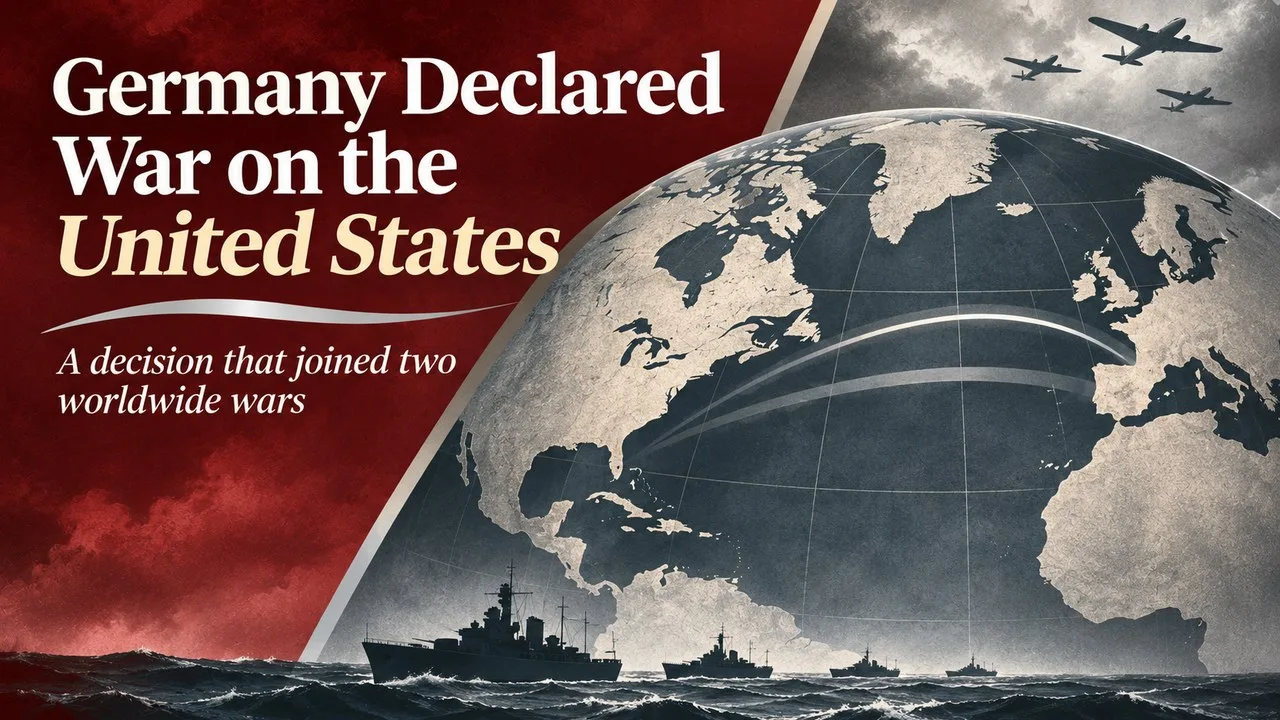
Germany declared war on the United States on 11 December 1941, four days after Pearl Harbor, merging the wars in Europe and the Pacific into one conflict.[1][2]
This Finepedia guide, updated in November 2026, explains how the declaration was delivered, why Hitler chose war with America when no treaty required it, how Washington responded, and why many historians now see 11 December as one of the most important days of the war. It is number 9 in Top 20 World War II Facts: Little-Known Details.
Key Facts
| Attribute | Detail |
|---|---|
| Date | 11 December 1941 |
| Delivered by | Joachim von Ribbentrop, German foreign minister, in Berlin |
| Received by | Leland B. Morris, US chargé d'affaires in Berlin |
| Announced publicly | By Adolf Hitler to the Reichstag, Kroll Opera House, Berlin |
| Italy | Also at war with the United States from the same day |
| US response | Congress declared war on Germany and Italy the same day, without a vote against |
| Legal obligation | None; the Tripartite Pact was defensive |
| Main German grievance | US naval action against U-boats in the Atlantic |
| Strategic result | A single world war; Allied "Germany first" strategy |
Sources: US Office of the Historian, the National WWII Museum and the Avalon Project.[1][2][3][4]
A Declaration Nobody Had to Make
The United States declared war on Japan on 8 December 1941, the day after the attack on Pearl Harbor. It did not declare war on Germany. Roosevelt had warned Americans in a radio fireside chat on 9 December that the Axis powers saw the world as one battlefield, yet he did not ask Congress for war with Germany.[2][5]
It was Germany that took the step. The National WWII Museum notes that the declaration ended years in which Hitler had tried to secure his aims in Europe while avoiding war with America. The historian Martin Gilbert went further, describing it as the biggest single error Hitler made in the whole war.[2]
The Background: an Undeclared War at Sea
By late 1941 the United States was neutral in name only. It had swapped elderly destroyers for British bases, adopted Lend-Lease in March 1941, taken over the protection of Iceland and agreed the Atlantic Charter with Churchill in August.[5][6]
At sea, the two countries were already clashing. After a U-boat fired on the destroyer USS Greer, Roosevelt announced on 11 September 1941 that US warships would fire on German warships on sight. USS Kearny was torpedoed in October, and on 31 October USS Reuben James was sunk with heavy loss of life.[5][1] Germany's formal note later listed these same ships as evidence of American aggression.[1][4]
Hitler had nonetheless ordered his U-boat commanders throughout 1941 not to attack American warships unless in self-defence. Until the USSR was defeated, he had no wish for a war with America.[5][2]
No Treaty Obligation
Germany, Italy and Japan had signed the Tripartite Pact on 27 September 1940. Its central article offered mutual aid only when a member came under attack from a country that was still outside the war.[2][7] Because Japan struck first at Pearl Harbor, Germany had no treaty obligation to join in.[2][5]
Related: The War Ended on Different Dates in Europe and Asia
The real commitment was made privately. On 28 November 1941, Ribbentrop told Japan's ambassador in Berlin, Hiroshi Ōshima, that Germany would immediately enter any Japanese war against America. American codebreakers later intercepted Ōshima's report of the conversation.[2][6][5]
11 December 1941
In Berlin
Ribbentrop summoned the American chargé d'affaires, Leland B. Morris, and read him the German note. It charged Washington with breaching neutrality and committing open aggression, and closed by stating that Germany regarded itself as being at war with America "as from today".[1][4] Accounts differ on timing: an editorial note in the State Department's published records gives 2:15 in the afternoon, Berlin time, while other accounts put the meeting at 2:18 to 2:21 p.m., and the National WWII Museum places it in the morning.[1][6][2]
At 3 p.m., Hitler addressed the Reichstag in the Kroll Opera House. The speech ran for roughly 90 minutes: a review of German victories followed by a lengthy personal assault on Roosevelt.[6][5] He also revealed a new agreement, signed that day, under which the three Axis powers would fight to the end and none would settle separately with Washington or London.[5][2]
In Rome
Italy followed Germany's lead. Mussolini proclaimed it that afternoon to a crowd below his balcony at the Palazzo Venezia in Rome, in a speech of only a few minutes, to some irritation in Berlin that he had spoken before Hitler.[6][5]
In Washington
In Washington, Germany's chargé d'affaires Hans Thomsen brought the same text. Secretary of State Cordell Hull refused to receive him, and the note was taken at around 9:30 in the morning by Ray Atherton, head of the State Department's Division of European Affairs.[1][6]
Roosevelt sent Congress a brief written message, which opened by saying that what had long been known and expected had now happened. He asked it to recognise a state of war with both Germany and Italy.[3][2] Both houses sat from midday and approved the resolutions unopposed, though a few members abstained.[6][5] The US State Department's records give the time the war resolution against Germany was approved as 3:05 p.m. Eastern time; other accounts say Roosevelt signed at about 3 p.m.[8][6]
Related: Pearl Harbor Did Not Happen in a Vacuum
What the German Note Said
The text Ribbentrop read was short and legalistic. It claimed that the United States had broken every rule of neutrality in favour of Germany's enemies since 1939 and had finally turned to open military aggression.[1][7] As proof it cited Roosevelt's broadcast of 11 September 1941, in which he said he had ordered the US Navy and air forces to shoot at German warships on sight, and his speech of 27 October confirming that the order still stood.[1][7]
The note also complained that American naval forces had seized German merchant ships on the high seas, contrary to international law. It concluded that Washington had "virtually created a state of war", broke off diplomatic relations and declared that Germany now regarded itself as at war.[1][7] The American diplomats in Germany were interned and only exchanged for German diplomats in 1942.[5]
The End of American Isolationism
Before December 1941, a large part of American opinion opposed entering the European war. The German declaration removed that debate almost overnight. Wikipedia notes that it ended any remaining serious domestic opposition to US involvement in Europe, and the leading isolationist group, the America First Committee, decided to dissolve itself on 11 December.[6][5] Roosevelt had prepared the ground in his radio talk of 9 December, telling listeners that Germany and Italy already regarded themselves as at war with the United States, whatever the formal position. Once Berlin made it official, there was little left to argue about.[5][2]
Why Hitler Did It
Historians have long debated the decision. Several explanations appear in the sources.
- Ideology: Hitler viewed the United States through racial and conspiratorial prejudice and underrated its military strength.[2][6]
- A war already under way: He argued that America was in practice already fighting Germany in the Atlantic.[5][1]
- Keeping Japan in the war: Declaring war honoured his private pledge and tied Japan to the Axis.[2][5]
- U-boats: He hoped that an all-out U-boat campaign against American ships, with Japan keeping US forces busy in the Pacific, would weaken Britain's supply line.[5][6]
- Timing: Pearl Harbor came in the same week as the Red Army's winter counter-attack near Moscow, and Hitler still expected to defeat the USSR soon.[5][2]
Comparison: Before and After 11 December
| Aspect | Before 11 December 1941 | After 11 December 1941 |
|---|---|---|
| US status in Europe | Officially neutral, aiding Britain | At war with Germany and Italy |
| Atlantic | Undeclared clashes with U-boats | Open war; U-boats off the US coast |
| Isolationism | A powerful domestic force | Opposition to the European war largely ended |
| Allied strategy | Separate wars in Europe and Asia | One war; defeat of Germany first |
| Axis satellites | Not at war with America | Several declared war on the United States |
Sources for the table: The Second War, Wikipedia and IWM.[5][6][9]
The Consequences
One World War
From then on, the fighting in Europe, at sea and in the Pacific formed one war.[5][2] German ambassadors were told the same day to obtain matching declarations from the other Tripartite Pact members, and Romania, Slovakia, Bulgaria, Hungary and Croatia followed within days.[6][5]
Related: Germany's Invasion of Poland Began the War in Europe
Germany First
Britain greeted the news with relief. Churchill had worried about two unconnected wars, one against Germany in Europe and another against Japan in Asia.[6] The western Allies treated the defeat of Germany as their main war aim from December 1941, a principle known as "Germany first".[9][5] Without Hitler's declaration, Roosevelt might have struggled to commit American forces to Europe while the public's anger was focused on Japan.[2][6]
The Cost for Germany
In the short term the U-boats profited. With restrictions lifted, they struck American shipping along the US East Coast in early 1942, and 1942 became the worst year of the war for Allied shipping losses.[6][5] In the long term the decision brought the world's largest economy fully into the war against Germany.[2][5] Brendan Simms and Charles Laderman go so far as to argue that the declaration reshaped the world's strategic picture more than Pearl Harbor did.[2]
Timeline
| Date | Event |
|---|---|
| 27 September 1940 | Germany, Italy and Japan sign the Tripartite Pact[2][7] |
| 11 September 1941 | Roosevelt orders US warships to fire on German raiders on sight[1][5] |
| 28 November 1941 | Ribbentrop privately promises Japan German support[2][6] |
| 7 December 1941 | Japan attacks Pearl Harbor[2][5] |
| 8 December 1941 | United States declares war on Japan[2][5] |
| 11 December 1941 | Germany and Italy declare war; Congress responds the same day[1][3][8] |
| 12 to 14 December 1941 | Axis partners in Europe follow Germany's lead[5][6] |
Key Figures
- 4 days: the gap between Pearl Harbor and Germany's declaration.[2][5]
- 3 minutes: approximate length of the Ribbentrop–Morris meeting, by most accounts.[5][6]
- About 90 minutes: the length of Hitler's Reichstag speech.[6][5]
- 0: votes in Congress against war with Germany.[5][6]
- 3: the Axis powers that pledged on 11 December not to make a separate peace.[5][2]
Common Misconceptions
A common misconception is that the United States declared war on Germany after Pearl Harbor. In fact Congress declared war only on Japan on 8 December; war with Germany followed Germany's own declaration three days later.[2][3]
Another is that the Tripartite Pact forced Germany to act. The pact covered attacks on its members, not wars a member started, and Japan had not even told Germany the date or target of its strike.[2][5]
Frequently Asked Questions
When did Germany declare war on the United States?
On 11 December 1941. Ribbentrop gave the formal note to the senior American diplomat in Berlin, and Hitler told the Reichstag that afternoon.[1][2]
Did the United States declare war on Germany first?
No. Germany moved first. Roosevelt then asked Congress to recognise a state of war, and it did so the same day.[3][8]
Related: The Atomic Bombings Occurred in August 1945
Was Germany obliged to support Japan?
Not by treaty. The Tripartite Pact promised help only if a member was attacked, but Ribbentrop had secretly assured Japan that Germany would fight alongside it against America.[2][7][5]
Why is the declaration considered a mistake?
It brought the United States, with its huge industrial capacity, fully into the war in Europe while Germany was already fighting Britain and the USSR. Martin Gilbert called it Hitler's greatest error.[2][6]
Did any other countries declare war on the United States?
Yes. Italy declared war the same day, and under German pressure Romania, Slovakia, Bulgaria, Hungary and Croatia did the same within days.[5][6]
Conclusion
Germany's declaration of war on the United States was a choice, not a treaty obligation. Hitler made it four days after Pearl Harbor, believing America was already fighting him at sea and that Japan would keep it busy in the Pacific.
The result was the opposite of what he hoped. The declaration united the separate conflicts into one world war and allowed the Allies to concentrate on defeating Germany first.
See all 20 in Top 20 World War II Facts: Little-Known Details
See also
- Top 20 World War II Facts: Little-Known Details
- Top 10 Overlooked Events of World War II
- Top 10 Forged Documents That Saved Lives in World War II
- ^ [1] "The German Minister for Foreign Affairs (Ribbentrop) to the American Chargé in Germany (Morris)". Foreign Relations of the United States, 1941, Vol. I, Office of the Historian, US Department of State. Office of the Historian
- ^ [2] "Hitler's Declaration of War on the United States" (Sean Scanlon). The National WWII Museum. National WWII Museum
- ^ [3] "Message of President Roosevelt to the Congress, December 11, 1941". Foreign Relations of the United States, 1941, Vol. I, Office of the Historian. Office of the Historian
- ^ [4] "The German Declaration of War with the United States: December 11, 1941". The Avalon Project, Yale Law School. Avalon Project
- ^ [5] "Germany and Italy declare war on the United States (11 December 1941)". The Second War. The Second War
- ^ [6] "German declaration of war against the United States". Wikipedia. Wikipedia
- ^ [7] "Three-Power Pact Between Germany, Italy, and Japan, Signed at Berlin, September 27, 1940". The Avalon Project, Yale Law School. Avalon Project
- ^ [8] "Joint Resolution Declaring That a State of War Exists Between the Government of Germany and the Government and the People of the United States". Foreign Relations of the United States, 1941, Vol. I, Office of the Historian. Office of the Historian
- ^ [9] "10 Facts About D-Day You Need To Know". Imperial War Museums. IWM

























Discussion
Log in with