






The War Ended on Different Dates in Europe and Asia
 By Dhiraj Sharma · Published
Share Post
Loading…
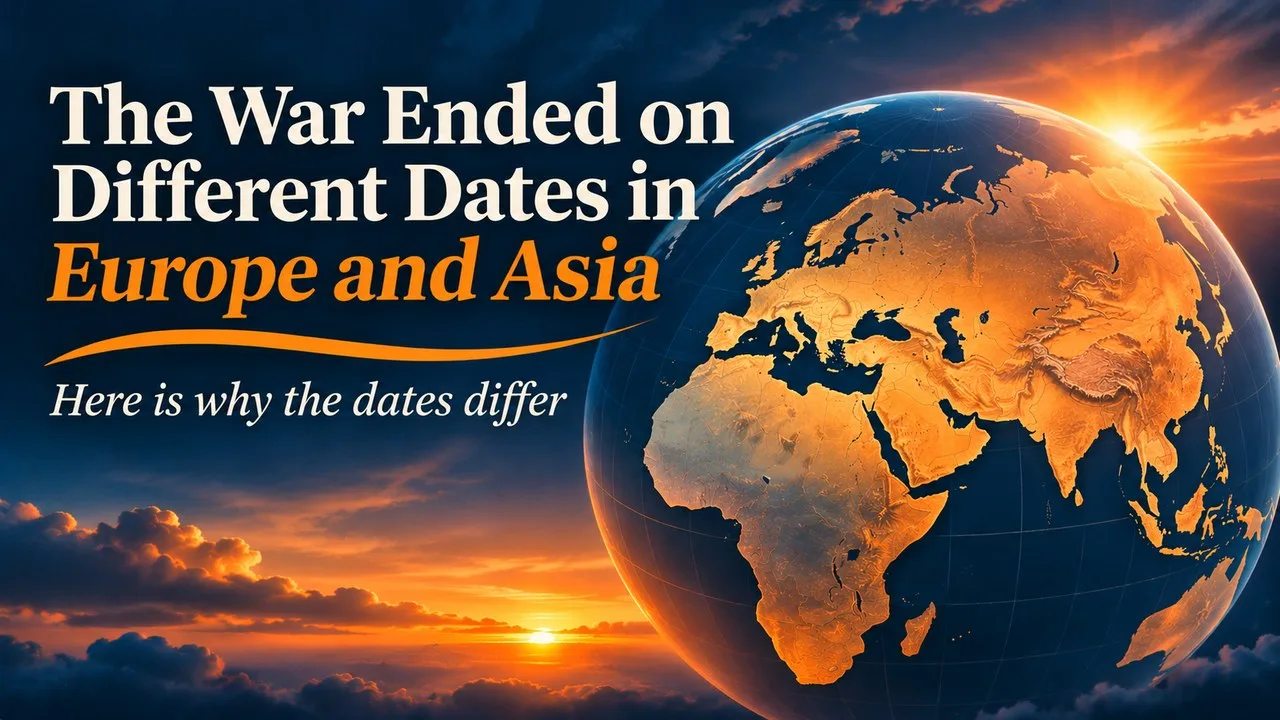
The war ended on different dates in Europe and Asia: Germany surrendered in May 1945, but Japan's surrender came in August and was signed on 2 September 1945.[1][2][3]
This Finepedia guide, updated in November 2026, explains why World War II has several end dates, how Germany's two surrender ceremonies produced both 8 May and 9 May, why Japan's surrender is marked on 15 August, 2 September and 3 September, and why formal peace took years longer. It is number 5 in Top 20 World War II Facts: Little-Known Details.
Key Facts
| Attribute | Detail |
|---|---|
| German surrender signed (Reims) | 7 May 1945, early morning, by General Alfred Jodl |
| Ceasefire time in Europe | 23:01 Central European time, 8 May 1945 |
| Second German signing (Berlin) | 8 May 1945, by Field Marshal Wilhelm Keitel |
| Victory in Europe (VE) Day | 8 May in most Western countries; 9 May in Russia and several other states |
| Japan's acceptance announced | 15 August 1945, by Emperor Hirohito's radio broadcast |
| Japanese surrender signed | 2 September 1945, aboard USS Missouri in Tokyo Bay |
| VJ Day | 15 August in the UK; 2 September in the United States |
| Surrender in China | 9 September 1945, at Nanking |
| Peace treaty with Japan | Signed at San Francisco, September 1951; in force 28 April 1952 |
| Gap between the two victories | About three months |
Sources: US National Archives, Imperial War Museums and Wikipedia.[1][2][4][5]
Why the War Had More Than One Ending
World War II was really several wars fought at once. The conflict in Europe began when Germany invaded Poland in September 1939, while Japan was already at war in China and attacked American, British and Dutch territories in December 1941.[6][7] Each enemy had to be defeated, and each surrendered separately.
The IWM points out that VE Day did not end the conflict, since the war against Japan continued until August 1945.[2] Even within each theatre, surrenders happened in stages, with local capitulations before and after the main ceremonies.
The End in Europe
The Collapse of Germany
With Berlin surrounded, Adolf Hitler killed himself on 30 April 1945, and Grand Admiral Karl Dönitz became head of state.[2][8] Dönitz tried to end the war in the West while keeping as many Germans as he could away from Soviet captivity.[2]
Partial surrenders came first. On 4 May, German forces in the Netherlands, north-west Germany and Denmark surrendered at Lüneburg Heath to Field Marshal Bernard Montgomery.[2] German forces in Italy had already surrendered to the Allies days earlier, according to Stars and Stripes.[3]
Reims, 7 May
The general surrender was signed in the early hours of 7 May 1945 in Reims, France, at the headquarters of General Dwight D. Eisenhower. General Alfred Jodl signed for the German High Command, and the US National Archives notes that he also signed copies for Britain, the USSR and France.[1][2]
The document required every German unit to stop fighting and hold its position from 23:01 Central European time on 8 May.[1] News reached Britain late on 7 May, and the BBC declared the following day a national holiday.[2]
Related: Germany's Invasion of Poland Began the War in Europe
Berlin, 8 May
The Soviet command worried that the Reims ceremony looked like a separate Western peace, and it wanted a fuller signing in Berlin.[1] On 8 May, Field Marshal Wilhelm Keitel signed a further act of surrender at the Soviet headquarters in the Karlshorst district.[2][3] The National Archives notes that the Berlin text changed little from the Reims document, but the Soviets regarded it as the official, legal surrender.[1]
Why Russia Marks 9 May
The difference between 8 May and 9 May is mainly a matter of clocks. In Central Europe the ceasefire began at 23:01 on 8 May, by which time it was already 9 May in Moscow.[8][4] Stars and Stripes adds that delays over the wording pushed the Berlin signing to around midnight, and celebrations in Moscow began as soon as the news arrived.[3]
The Deutschlandmuseum in Berlin notes that time zones are why Russia and the West still commemorate the end of the war on different days.[4] Some countries have changed their date over time. Poland, for example, marked 9 May from 1945 to 2014 and has officially recognised 8 May since 2015.[8]
VE Day Around the World
| Country or group | Main commemoration | Notes |
|---|---|---|
| United Kingdom | 8 May | Not an annual public holiday; holidays moved for the 50th and 75th anniversaries |
| France | 8 May | National public holiday |
| Czech Republic | 8 May | Liberation Day |
| Russia | 9 May | Victory Day |
| Poland | 8 May (since 2015) | Previously 9 May |
| East Germany (until 1990) | 8 May | Marked as a day of liberation from 1949 |
Sources: Wikipedia and the Deutschlandmuseum.[8][4]
Fighting After VE Day
The surrender did not end every battle at once. Stars and Stripes reports that fighting continued in Prague until 11 May and that the last battle on European soil, between Yugoslav partisans and retreating German troops, took place on 15 May 1945.[3]
The End in Asia and the Pacific
The Final Weeks
The Allied Potsdam Declaration of 26 July 1945 demanded Japan's unconditional surrender.[5][9] Atomic bombs struck Hiroshima on 6 August and Nagasaki on 9 August, and on 9 August the USSR declared war on Japan and invaded Manchuria.[9][7]
The Emperor's Broadcast, 15 August
The Japanese government decided to accept the Potsdam terms, and the emperor's statement ending the war was issued on 14 August 1945.[10] Hirohito recorded it that day, and it went out on Japanese radio at noon on 15 August.[10][6] No Japanese emperor had spoken to the nation over the radio before, and the word "surrender" never appeared in his statement.[6]
Related: The Atomic Bombings Occurred in August 1945
Because of time zones, the news broke on 14 August in the Americas. Newspapers in the United States, Britain, Australia, New Zealand and Canada called the day VJ Day or VP Day.[7]
The Signing, 2 September
The formal Instrument of Surrender was signed on 2 September 1945 on the deck of the battleship USS Missouri, anchored in Tokyo Bay. Foreign Minister Mamoru Shigemitsu and General Yoshijiro Umezu signed for Japan at about 9:04 in the morning, and General Douglas MacArthur then signed as Supreme Commander for the Allied Powers.[5] President Harry S. Truman declared 2 September the official VJ Day for the United States.[7]
Regional Surrenders
Japanese forces across Asia surrendered on separate dates. The surrender in China was signed at Nanking on 9 September, Japanese forces in Singapore surrendered on 12 September, and the Hong Kong surrender followed on 16 September.[9] Some Japanese soldiers on remote islands refused to believe the war was over and held out for years.[9]
Comparison of the Two Endings
| Feature | Europe | Asia and the Pacific |
|---|---|---|
| Defeated power | Germany | Japan |
| Key announcement | 7 May (news), 8 May (VE Day) | 15 August (emperor's broadcast) |
| Formal signing | Reims, 7 May; Berlin, 8 May | USS Missouri, 2 September |
| Signed for the defeated side | Jodl (Reims); Keitel (Berlin) | Shigemitsu and Umezu |
| Accepted by | Eisenhower's command and the Soviet High Command | MacArthur for the Allied Powers |
| Main commemoration dates | 8 May and 9 May | 15 August, 2 September, 3 September |
| Formal peace | Settled in stages after the war | Treaty of San Francisco, in force 1952 |
Sources: US National Archives, IWM and Wikipedia.[1][2][5][7]
Timeline
| Date (1945 unless stated) | Event |
|---|---|
| 30 April | Hitler dies in Berlin[2][8] |
| 4 May | Surrender at Lüneburg Heath to Montgomery[2] |
| 7 May | General surrender signed at Reims[1][2] |
| 8 May | Ceasefire at 23:01 CET; Berlin signing; VE Day in the West[1][8] |
| 9 May | Victory Day in Moscow[3][8] |
| 26 July | Potsdam Declaration[5][9] |
| 6 and 9 August | Atomic attacks on Hiroshima and Nagasaki[9][7] |
| 9 August | USSR enters the war against Japan and invades Manchuria[9][7] |
| 15 August | Hirohito's broadcast announces acceptance[10][6] |
| 2 September | Instrument of Surrender signed in Tokyo Bay[5][7] |
| 9 September | Surrender ceremony in Nanking[9] |
| September 1951 | Treaty of San Francisco signed by 49 nations[11][9] |
| 28 April 1952 | Treaty comes into force, formally ending the war for most Allies[9][7] |
Why Formal Peace Took Longer
A surrender ends the fighting, but a peace treaty settles the legal state of war. For Japan this came only with the Treaty of San Francisco. The US Office of the Historian records that 52 nations met in San Francisco in September 1951 and that 49 of them signed, with the USSR, Poland and Czechoslovakia among those that did not.[11] It entered into force on 28 April 1952.[9][7]
Japan and the USSR made peace separately four years later, in 1956.[9][7] In Europe, the occupation and division of Germany meant that a final settlement also came in stages long after 1945.[2]
Related: Germany Declared War on the United States
Key Figures
- 23:01 CET, 8 May 1945: time the German ceasefire took effect.[1][8]
- 4: German surrender documents Jodl signed at Reims, one for each major Allied power.[1]
- About 3 months: gap between VE Day and Japan's announced surrender.[2][7]
- 9:04 a.m.: recorded time of the Japanese signatures on 2 September.[5]
- 49 of 52: nations that signed the Treaty of San Francisco out of those attending.[11]
- 28 April 1952: the Treaty of San Francisco enters into force.[9][7]
Common Misconceptions
One misconception is that World War II ended on a single day. In fact it ended in stages, with different surrender ceremonies, different national holidays and a formal peace years later.[2][7]
Another is that 9 May reflects a different event from 8 May. Both mark the same German surrender, seen from different time zones and through the Soviet insistence on a Berlin ceremony.[1][4] A third is that VJ Day is one fixed date. Britain marks 15 August, the United States 2 September, and China holds its victory commemoration on 3 September.[7]
Legacy and Commemoration
The different dates still shape how countries remember the war. In Britain, VE Day remains a major national event even though it is not a yearly bank holiday.[8] Russia's 9 May Victory Day has long been one of its most important national occasions.[3]
In Germany, attitudes changed over time. East Germany marked 8 May as a day of liberation from 1949, while West Germany paid it little attention until a landmark 1985 speech by President Richard von Weizsäcker described it as a day of liberation.[4]
Frequently Asked Questions
When did World War II officially end?
The fighting in Europe ended with Germany's surrender, effective on 8 May 1945. Japan announced its acceptance of Allied terms on 15 August and signed the formal document on 2 September 1945, which is often treated as the end of the war as a whole.[1][5][7]
Why does Russia celebrate Victory Day on 9 May?
The German ceasefire took effect at 23:01 Central European time on 8 May, which was already after midnight in Moscow. The USSR also insisted on a second signing in Berlin, which ran late into the night. Russia has marked 9 May ever since.[3][8]
Related: Pearl Harbor Did Not Happen in a Vacuum
What is the difference between VE Day and VJ Day?
VE Day, Victory in Europe Day, marks Germany's surrender in May 1945. VJ Day, Victory over Japan Day, marks Japan's surrender: 15 August in Britain, when the emperor's broadcast was made, and 2 September in the United States, when the formal document was signed.[2][7]
Who signed Japan's surrender?
Foreign Minister Mamoru Shigemitsu and General Yoshijiro Umezu signed for Japan aboard USS Missouri in Tokyo Bay on 2 September 1945. General Douglas MacArthur signed as Supreme Commander for the Allied Powers, accepting the surrender on behalf of the Allies.[5]
When was the peace treaty with Japan signed?
The Treaty of San Francisco was signed in September 1951 by 49 nations and entered into force on 28 April 1952. Japan and the USSR made peace separately in 1956.[11][9][7]
Conclusion
World War II did not stop on a single day. Germany's surrender produced two ceremonies and two commemorative dates in Europe, Japan's surrender produced an announcement day and a signing day three months later, and formal peace treaties followed years afterwards.
Knowing these dates explains why countries commemorate the end of the war differently, and why each date reflects a real stage in how the conflict came to a close.
See all 20 in Top 20 World War II Facts: Little-Known Details
See also
- Top 20 World War II Facts: Little-Known Details
- Top 10 Overlooked Events of World War II
- Top 10 Forged Documents That Saved Lives in World War II
- ^ [1] "Surrender of Germany (1945)". US National Archives. National Archives: Surrender of Germany
- ^ [2] "What You Need To Know About VE Day". Imperial War Museums. IWM: What you need to know about VE Day
- ^ [3] "Many say World War II ended on May 8. Russia disagrees." Stars and Stripes. Stars and Stripes
- ^ [4] "Unconditional surrender of the German Wehrmacht". Deutschlandmuseum, Berlin. Deutschlandmuseum
- ^ [5] "Surrender of Japan (1945)". US National Archives. National Archives: Surrender of Japan
- ^ [6] "The Jewel Voice Broadcast". Atomic Heritage Foundation, National Museum of Nuclear Science and History. Atomic Heritage Foundation: Jewel Voice Broadcast
- ^ [7] "Victory over Japan Day". Wikipedia. Wikipedia: Victory over Japan Day
- ^ [8] "Victory in Europe Day". Wikipedia. Wikipedia: Victory in Europe Day
- ^ [9] "Surrender of Japan". Wikipedia. Wikipedia: Surrender of Japan
- ^ [10] "Termination of the War, August 14, 1945" (Birth of the Constitution of Japan). National Diet Library, Japan. National Diet Library
- ^ [11] "Occupation and Reconstruction of Japan, 1945-52". Office of the Historian, US Department of State. Office of the Historian






















Discussion
Log in with