






 By
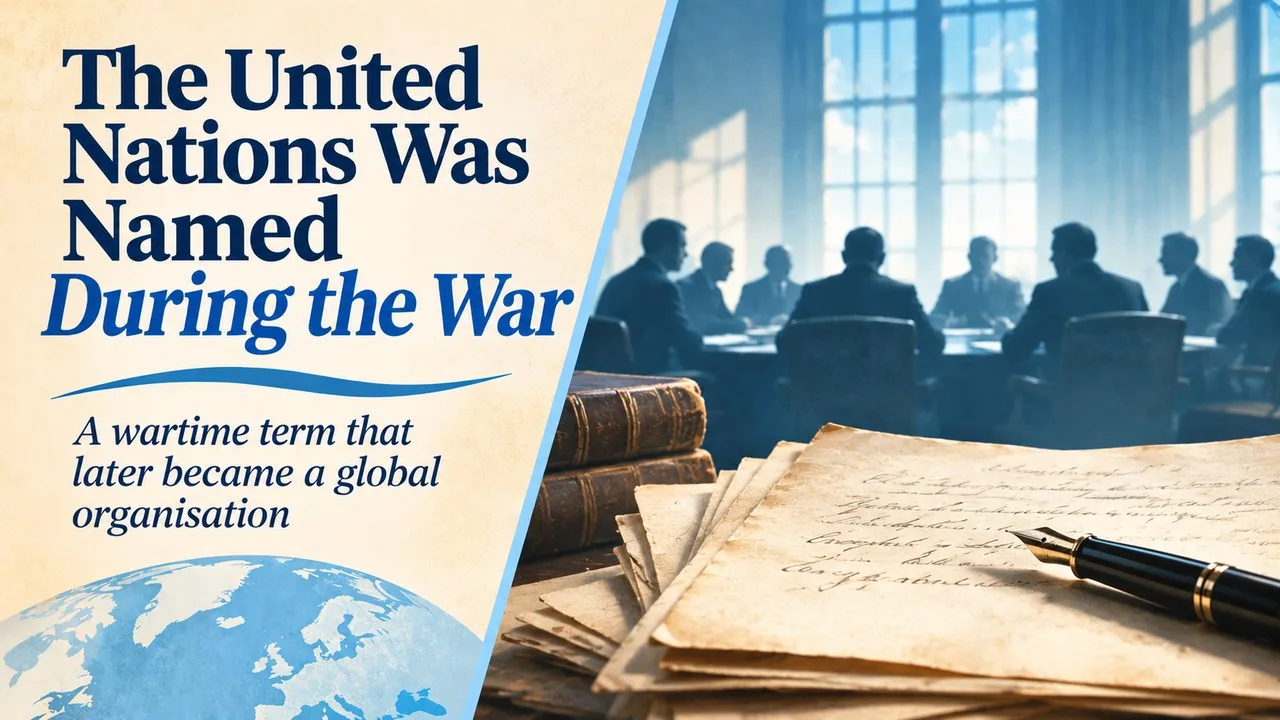
The United Nations was named during the war: the term first described the Allies in the Declaration by United Nations, signed in Washington on 1 January 1942.[1][2]
This Finepedia guide, updated in November 2026, explains where the name came from, who signed the 1942 declaration, how the wartime alliance turned into plans for a permanent organisation, and how the UN Charter was finally agreed in 1945. It is number 7 in Top 20 World War II Facts: Little-Known Details.
Key Facts
| Attribute | Detail |
|---|---|
| First official use of the name | Declaration by United Nations, 1 January 1942 |
| Who coined it | US President Franklin D. Roosevelt |
| Place of signing | Washington, DC, during the Arcadia Conference |
| Leading signatories | United States, United Kingdom, USSR and China |
| Original signatories | 26 governments |
| Total adherents by the end of the war | 47 |
| Core pledges | Use full resources against the Axis; no separate peace |
| Founding conference | San Francisco, April to June 1945 |
| Charter signed | 26 June 1945 |
| Organisation came into being | 24 October 1945 |
Sources: United Nations, US Office of the Historian and the Avalon Project.[1][2][3][4]
A Name for an Alliance
Today "United Nations" means an organisation based in New York. In 1942 it meant something different: the coalition of countries at war with Germany, Italy and Japan. According to the UN's own history pages, the 1942 declaration was the first official document to use the term.[1]
The alliance needed a name because it had changed so quickly. When Germany and Italy declared war on America on 11 December 1941, days after Pearl Harbor, Washington found itself in a truly global conflict.[5] Churchill crossed the Atlantic in December 1941 and spent Christmas at the White House, where the two leaders worked out a joint strategy at what became known as the Arcadia Conference.[6][7]
How Roosevelt Chose the Name
Early drafts of the declaration referred to "Associated Powers", the label the United States had used for itself in World War I, when it fought alongside the Allies without formally joining them.[7][5] Roosevelt wanted something better, and he proposed "United Nations" instead.[1][7]
Churchill recorded in his memoirs that the President substituted the new title for "Associated Powers", and that he thought it "a great improvement".[8] He showed Roosevelt a stanza from Lord Byron's poem Childe Harold's Pilgrimage about the Battle of Waterloo, in which "the sword United Nations drew".[8][7] In a cable to London on 3 January 1942, Churchill explained that the new name avoided both "Alliance", which caused constitutional difficulties for Roosevelt, and the flat-sounding "Associated Powers".[8]
The International Churchill Society also lists the choice of name among the decisions the two leaders reached during their Christmas talks of 1941.[6]
The Declaration of 1 January 1942
The text itself is short. Its signatories endorsed the Atlantic Charter and stated that only complete victory could protect freedom, independence and religious liberty, as well as human rights and justice.[3][7] It then set out two pledges.
The Two Pledges
First, every government promised to throw all its military and economic strength against whichever Axis partners it was fighting.[3][2] Second, each undertook to work with its fellow signatories and never to conclude a separate ceasefire or peace.[3][2] The final clause allowed other nations that were helping in the struggle against what the text called "Hitlerism" to join later.[3]
A Careful Form of Words
The wording was chosen with care. The USSR was not at war with Japan in 1942, and the State Department considered giving Moscow a separate text before deciding that one shared document would carry more weight.[6] The solution was to tie each government's pledge only to the Axis partners it was actually fighting, so the Soviet signature did not commit it to a Pacific war.[3][6]
Related: The UN Charter Was Signed Before Japan's Surrender
The pledge against a separate peace was the heart of the agreement. It echoed a similar promise the Allies had made to one another against the Central Powers in World War I, and it was meant to stop any member from striking its own deal with the enemy. By one account, none of the major powers broke this promise before the war ended.[6][4]
Who Signed First
Accounts differ on the exact sequence. The UN and the US Office of the Historian both describe 26 nations signing on 1 January 1942.[1][2] More detailed accounts say the four leading powers signed on 1 January in the White House, where Roosevelt and Churchill signed together with Maxim Litvinov for the USSR and T. V. Soong for China, and the other 22 governments added their signatures the next day.[5][7]
The 26 original signatories included the four major Allies, Britain's four Dominions, India, eight governments in exile from occupied Europe, and nine countries from Central America and the Caribbean.[1][7]
From Atlantic Charter to Wartime Alliance
The ideas behind the declaration came from the Atlantic Charter. Roosevelt and Churchill met aboard ships in Placentia Bay, Newfoundland, on 9 and 10 August 1941, and released their joint statement on 14 August.[9][1] It set out eight common principles, including no territorial gains for the two powers, freedom of the seas and the right of every people to decide how it is governed.[9]
An earlier step had come in London. On 12 June 1941, Britain, the Dominions and the governments in exile signed a declaration at St James's Palace calling for the willing cooperation of free peoples in war and peace.[1] The 1942 declaration turned these statements of intent into a binding wartime commitment.
Comparison: Wartime Alliance and Postwar Organisation
| Feature | United Nations (1942) | United Nations Organization (1945) |
|---|---|---|
| Nature | Wartime alliance | Permanent international organisation |
| Founding text | Declaration by United Nations | Charter of the United Nations |
| Main purpose | Defeat the Axis powers | Maintain international peace and security |
| Initial members | 26 signatory governments | 51 original member states |
| Membership rule | Help in the war against the Axis | Accept the Charter's obligations |
| Key date | 1 January 1942 | 24 October 1945 |
Growing Membership
The declaration stayed open, and further countries signed as the war went on. The UN lists 21 later adherents, in order of signature, beginning with Mexico and the Philippines and ending with Saudi Arabia, Syria and Lebanon in 1945, bringing the total to 47.[1][7] France signed as one of these later adherents.[1]
France, represented by General de Gaulle's provisional government, joined at the end of December 1944.[6][4] The largest group, eleven states including Turkey, Egypt and Saudi Arabia, signed in February and early March 1945, and by 1 March the total stood at 47.[6][4] Argentina was the only Latin American state missing, and Germany's former partners that switched sides late in the war were not admitted.[6]
Related: The Axis and Allies Were Coalitions That Changed Over Time
Signing mattered. The UN notes that invitations to the San Francisco Conference went only to states that had subscribed to the declaration and were at war with both Germany and Japan by March 1945.[1]
Planning a Permanent Organisation
The alliance became the seed of a permanent body through a series of wartime conferences.
Moscow and Tehran, 1943
When foreign ministers met in Moscow in October 1943, the United States, Britain, the USSR and China called for a general international organisation open to all peace-loving states, large and small.[1][2] The UN calls this the first official document to name such a peacekeeping body explicitly.[1] At Tehran in late 1943, Roosevelt sketched a plan in which four great powers would police the peace, an idea later known as the "four policemen".[2]
Dumbarton Oaks and Yalta
From August to October 1944, delegates from the four powers gathered at Dumbarton Oaks, a historic house in Washington, to draft proposals for the new organisation, including a General Assembly and a Security Council.[1][2] The UN gives the dates as 21 August until 7 October 1944, with the Soviet and Chinese phases held separately, while the Office of the Historian summarises them as taking place in August and September.[1][2]
One gap remained: how the Security Council would vote. Roosevelt, Churchill and Stalin settled the veto question at Yalta in February 1945 and agreed to summon a conference at San Francisco.[1][2]
Even before the Charter existed, the name was already on wartime agencies, among them the relief body known as UNRRA, set up in 1943.[2]
Timeline
| Date | Event |
|---|---|
| 12 June 1941 | Declaration of St James's Palace in London[1] |
| 14 August 1941 | Atlantic Charter released[9][1] |
| December 1941 | Arcadia Conference in Washington; name chosen[6][7] |
| 1 January 1942 | Declaration by United Nations signed[1][2] |
| October 1943 | Moscow Conference calls for a general international organisation[1][2] |
| August to October 1944 | Dumbarton Oaks talks[1][2] |
| February 1945 | Yalta Conference settles Security Council voting[1][2] |
| 25 April 1945 | San Francisco Conference opens[4][1] |
| 26 June 1945 | UN Charter signed by 50 nations[4][1] |
| 24 October 1945 | The Charter enters into force[4][1] |
From Alliance to Charter
Roosevelt never saw the outcome. His death on 12 April 1945 came less than two weeks before the San Francisco Conference opened, and his successor, Harry Truman, chose to keep to the planned schedule.[1]
Related: The Atomic Bombings Occurred in August 1945
The San Francisco Conference brought together delegates of 50 nations and ran until 26 June 1945. Working from the Dumbarton Oaks proposals and the Yalta agreement, they adopted the Charter unanimously on 25 June and signed it the following day.[4][2] Poland, absent from the conference, added its signature afterwards and counts among the 51 original members.[1][4] The Charter took effect on 24 October 1945, after ratification by China, France, the USSR, the United Kingdom and the United States and by most of the other signatories.[4][1]
Key Figures
- 26: governments listed by the UN as original signatories of the 1942 declaration.[1][2]
- 47: total governments that eventually adhered to it.[1][7]
- 2: core pledges, full use of resources and no separate peace.[3][2]
- 50: nations represented at the San Francisco Conference.[4][2]
- 51: original member states of the United Nations, including Poland.[1][4]
- Nearly 4 years: time between the declaration and the Charter coming into force.[1][4]
Common Misconceptions
A common misconception is that the United Nations was invented after the war to replace the League of Nations. The name was in official use from January 1942, as the title of a wartime alliance.[1][7]
Another is that the name was Churchill's idea. He welcomed it and supplied the Byron quotation, but the UN and other accounts credit Roosevelt with coining it.[1][8]
A third is that the UN began on the day the Charter was signed. Signature came on 26 June 1945, but the organisation formally came into existence only when the Charter entered into force on 24 October.[4][1]
Legacy
The wartime name gave the new organisation instant legitimacy. Its founding members were, almost by definition, the countries that had stood together against the Axis, and the Security Council's permanent members reflected the leading wartime powers.[2][4]
24 October is still celebrated each year as United Nations Day, marking the Charter's entry into force.[4][1]
Frequently Asked Questions
When was the name United Nations first used officially?
Its first official use came in the Allied declaration signed on 1 January 1942, which bound the Allied governments together against the Axis powers.[1][2]
Related: The Eastern Front Was the Largest Theatre of the War
Who came up with the name United Nations?
President Franklin D. Roosevelt proposed it in December 1941 as a replacement for "Associated Powers". Churchill accepted it and pointed to a line from Byron that used the phrase.[1][8][7]
How many countries signed the Declaration by United Nations?
The UN lists 26 original signatories and 21 later adherents, for a total of 47 governments by the end of the war.[1][7]
What did the signatories promise?
They pledged to use their full military and economic resources against the Axis powers they were fighting, to work together, and to reject any separate ceasefire or peace.[3][2]
When did the United Nations organisation come into existence?
The Charter was signed in June 1945 and took effect on 24 October 1945, the date now marked as United Nations Day.[4][1]
Conclusion
The United Nations began as a name for a wartime coalition. Roosevelt chose it in December 1941, 26 governments adopted it in January 1942, and over the next three years conferences in Moscow, Tehran, Dumbarton Oaks and Yalta turned that alliance into the blueprint for a permanent organisation.
When the Charter entered into force in October 1945, the new body kept the name its founders had fought under.
See all 20 in Top 20 World War II Facts: Little-Known Details
See also
- Top 20 World War II Facts: Little-Known Details
- Top 10 Overlooked Events of World War II
- Top 10 Forged Documents That Saved Lives in World War II
- ^ [1] "Preparatory Years: UN Charter History". United Nations. United Nations: Preparatory Years
- ^ [2] "The Formation of the United Nations, 1945". Office of the Historian, US Department of State. Office of the Historian
- ^ [3] "Declaration by the United Nations, January 1, 1942". The Avalon Project, Yale Law School. Avalon Project
- ^ [4] "The San Francisco Conference". United Nations. United Nations: San Francisco Conference
- ^ [5] "The Declaration by United Nations (1 January 1942)". The Second War. The Second War
- ^ [6] "Churchill and Roosevelt: The Struggle over D-Day Alternatives". International Churchill Society. International Churchill Society
- ^ [7] "Declaration by United Nations". Wikipedia. Wikipedia: Declaration by United Nations
- ^ [8] "United Nations". Wordorigins.org. Wordorigins.org
- ^ [9] "The Atlantic Conference & Charter, 1941". Office of the Historian, US Department of State. Office of the Historian
























Discussion
Log in with