






 By
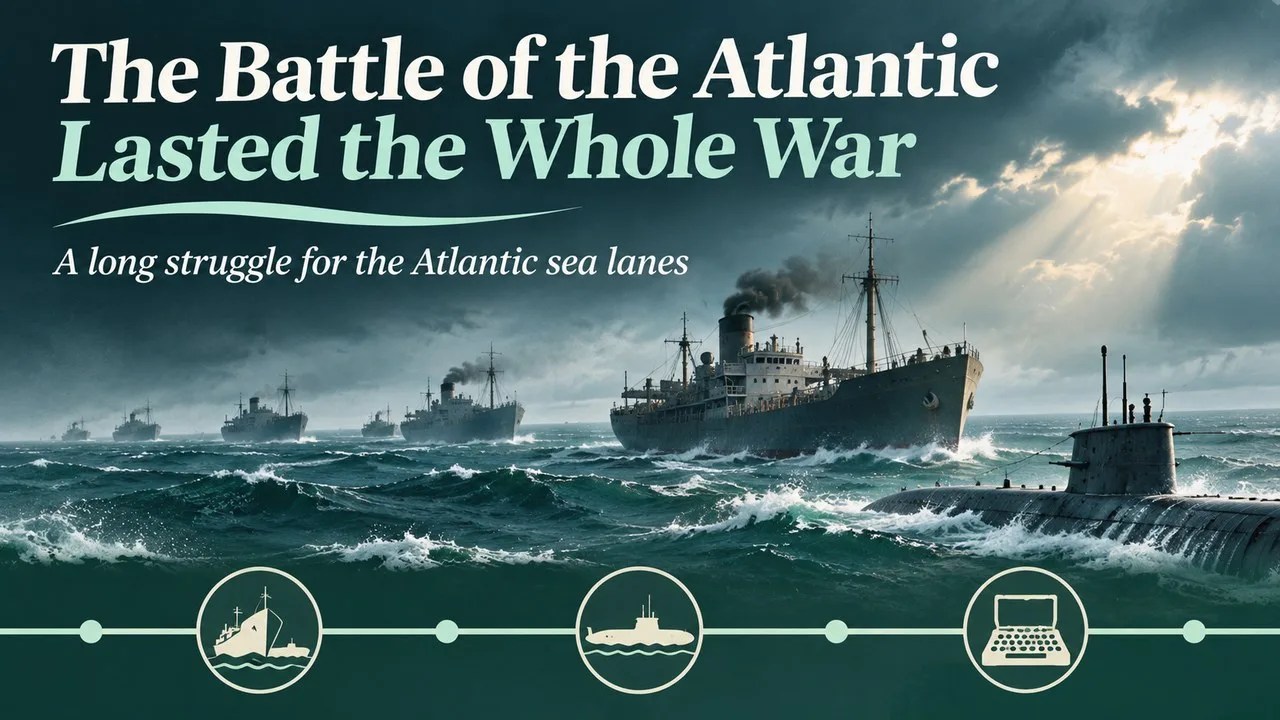
The Battle of the Atlantic lasted the whole war: the struggle for the sea lanes to Britain ran from 3 September 1939 until Germany's surrender in May 1945.[1][2]
This Finepedia guide, updated in November 2026, explains why the Atlantic mattered so much, how the campaign swung between U-boat success and Allied control, which technologies and tactics decided it, and what it cost both sides. It is number 8 in Top 20 World War II Facts: Little-Known Details.
Key Facts
| Attribute | Detail |
|---|---|
| Duration | 3 September 1939 to 8 May 1945 |
| Main contestants | German U-boats, surface raiders and aircraft against Allied navies, air forces and merchant fleets |
| First loss | Passenger liner SS Athenia, sunk by U-30 on 3 September 1939 |
| Worst month for Allied shipping | June 1942 |
| Turning point | May 1943 ("Black May") |
| Key Allied tools | Convoys, escort groups, long-range aircraft, radar, sonar and codebreaking |
| Canadian contribution | More than 25,000 escorted merchant voyages |
| U-boat crew deaths | Roughly two in three of those who served |
| Status | The longest continuous campaign of World War II |
Sources: Imperial War Museums, GOV.UK, Veterans Affairs Canada and National Museums Liverpool.[1][3][4][2]
The Longest Campaign
Most World War II campaigns had a clear start and finish within the war. The Atlantic was different. GOV.UK describes it as the one battle that ran from the opening day of the war to its final day, and the Imperial War Museums (IWM), National Museums Liverpool and Canada's Department of National Defence all describe it as the longest campaign of the conflict.[3][1][4][5]
Veterans Affairs Canada dates it from 3 September 1939 to 8 May 1945, and the Canadian government counts 2,075 days of fighting.[2][5] It began within hours of Britain's declaration of war, when the U-boat U-30 torpedoed the passenger liner SS Athenia.[5][4]
Why the Atlantic Mattered
Britain was an island power that depended on imports. Food, fuel, raw materials and weapons all had to come by sea, and almost all of it crossed the Atlantic.[1][3] Germany's naval leaders understood that cutting this lifeline could starve Britain out of the war.
IWM notes that Karl Dönitz, who led the U-boat arm, argued for building submarines rather than a large surface fleet, and regarded every enemy merchant ship as a fair target.[1] Later the same route carried American troops and supplies to Britain, and convoys also sailed to Soviet ports.[6][1] Winning the Atlantic therefore became a precondition for invading Europe.
Churchill later admitted that nothing in the war frightened him as much as the "U-boat peril".[3][4]
Convoys and Wolf Packs
The Allies answered the threat with convoys: merchant ships sailing together under naval escort. Veterans Affairs Canada records that the first convoy left Halifax for Britain on 16 September 1939, guarded by British cruisers and Canadian destroyers, while IWM dates the first Atlantic convoy to 2 September.[2][1]
Convoys made ships harder to find, but Germany adapted. From September 1940, groups of U-boats began attacking convoys together at night, the tactic known as the wolf pack.[2][6] The fall of France in 1940 gave Germany Atlantic bases on the French coast, so its submarines could reach further and stay longer at sea. U-boat crews called the following months the "happy time".[1][2]
Related: Midway Turned the Tide in the Pacific
The Air Gap
Aircraft were the U-boats' most dangerous enemy, but early on they could not fly far enough to patrol the middle of the ocean. This unpatrolled zone, called the mid-Atlantic gap or "Black Pit", became a hunting ground where U-boats operated freely.[1][2][4] Closing it took several years.
More Than Submarines
The U-boats dominate the story, but Germany used other weapons too. Large warships such as the "pocket battleship" Admiral Graf Spee had put to sea before war was declared and began attacking British and French merchant ships at once.[6] In October 1939 a U-boat got inside the Royal Navy's main anchorage at Scapa Flow and torpedoed the battleship HMS Royal Oak as she lay at anchor.[4][6]
The most famous surface action came in May 1941, when the Royal Navy hunted down and sank the battleship Bismarck. IWM notes that the loss was a heavy blow to German morale and confirmed Hitler's reluctance to risk his big ships against the Royal Navy in open battle.[1][6] Long-range German aircraft also scouted for convoys from bases in occupied Europe and guided submarines towards them.[4]
Command from Liverpool
The Atlantic war was directed from an underground headquarters. Early in 1941 the Admiralty transferred Western Approaches Command to Liverpool from Plymouth, and it operated from a bomb-proof basement beneath Derby House.[6][4] National Museums Liverpool notes that much of the campaign against the U-boats was planned in those rooms.[4]
Liverpool's docks also served as a base for escort groups. The best known was led by Captain Frederic John "Johnny" Walker, a tactical innovator whose escorts, supported in December 1941 by HMS Audacity, one of the earliest escort carriers, fought a five-day battle around convoy HG 76.[6][4]
Turning Points, 1941 to 1943
Crisis of 1941
By spring 1941 Britain faced an Atlantic crisis. IWM says that if losses had continued at the rate of March and April, Britain stood to lose millions of tons of shipping by the end of the year, far more than it could build.[1] Churchill publicly named the struggle "the Battle of the Atlantic" and set up a War Cabinet committee to deal with it.[1][6]
Related: Pearl Harbor Did Not Happen in a Vacuum
Breaking the Codes
On 9 May 1941, sailors from HMS Bulldog boarded the U-boat U-110 and seized Enigma material. GOV.UK records that the Navy allowed the Germans to assume the boat had gone down with its codes, so the captured keys could be exploited for weeks.[6][3][4] In late 1942, men from HMS Petard recovered further codebooks from the sinking U-559. Two of them, Lieutenant Tony Fasson and Able Seaman Colin Grazier, drowned, but the material helped Bletchley Park break the naval key known as Triton.[3][6]
America Joins the Fight
Once America was in the war, from December 1941, Dönitz sent U-boats across to the American coast. IWM describes January to August 1942 as a "Second Happy Time" for the Germans, with heavy losses off the US East Coast and in the Caribbean.[1][6] June 1942 was the worst single month of the campaign, with about 830,000 tons of Allied shipping lost.[1][4]
Black May
Then the balance shifted. Allied technology, intelligence and air power came together in spring 1943. In May that year, convoy escorts and aircraft sank so many U-boats that Dönitz withdrew them from the North Atlantic.[1][4][2] The U-boats returned later, but never regained their earlier advantage.
The Tools of Victory
| Tool | What it did | Impact |
|---|---|---|
| Convoys | Grouped merchant ships under escort | Fewer targets, protection from attack[1][2] |
| Asdic (sonar) | Located submerged submarines by sound | Removed the U-boats' surprise[1] |
| Radar and long-range aircraft | Found U-boats on the surface | Closed the mid-Atlantic gap by 1943[1][5] |
| Escort carriers | Brought aircraft along with convoys | Covered areas land planes could not reach[4][6] |
| Hedgehog and Squid | Fired anti-submarine bombs ahead of the ship | More reliable kills[1][6] |
| Codebreaking | Revealed U-boat positions | Convoys rerouted away from wolf packs[4][3] |
IWM sees the outcome as a technological race, in which better escort ships, detection equipment, patrol aircraft such as the Liberator, and new anti-submarine mortars like Hedgehog and Squid had beaten the U-boats by the summer of 1943.[1] Access to bases in the Azores later that year extended air cover further.[1][6]
Canada's Role
Canada carried a large share of the burden. Veterans Affairs Canada says more than 25,000 merchant voyages from North America to Britain sailed under Canadian escort, delivering about 165 million tonnes of cargo, and that Canadian ships and aircraft sank or helped sink some 50 U-boats.[2][5]
The Royal Canadian Navy grew dramatically. Both Canadian sources agree that it ended the war with 373 fighting ships, but they describe its starting point differently: the Department of National Defence says six destroyers, while Veterans Affairs Canada says 13 vessels, both with about 3,500 personnel.[5][2] Commodore Leonard Murray took charge of the Newfoundland Escort Force in 1941 and later commanded Allied forces in the north-west Atlantic.[2][5]
Related: Stalingrad Was a Major Turning Point
The Human Cost
Losses were heavy on both sides, and sources count them in different ways.
| Measure | Figure | Source |
|---|---|---|
| British and Allied merchant ships sunk (UK count) | Over 2,200 | GOV.UK[3] |
| Merchant vessels lost (wider count) | About 3,500 | Wikipedia[6] |
| Allied and neutral shipping destroyed | 12.8 million tons | National Museums Liverpool[4] |
| Merchant seamen killed | Over 30,000 | GOV.UK[3] |
| Allied seamen killed (naval and merchant) | About 72,200 to 80,000 | Wikipedia, National Museums Liverpool[6][4] |
| U-boats lost | 510 in the Atlantic; 783 in total | GOV.UK, Wikipedia[3][6] |
German submariners suffered one of the highest death rates of any service in the war. GOV.UK puts the toll at more than 18,000 dead out of roughly 27,000 Atlantic U-boat crewmen; National Museums Liverpool estimates about 28,000 dead from 41,000; and IWM says three in every five German submariners were killed.[3][4][1] Allied sailors and merchant seamen also died from exposure, storms and accidents as well as enemy action.[2]
Timeline
| Date | Event |
|---|---|
| 3 September 1939 | SS Athenia sunk; the campaign begins[5][4] |
| 16 September 1939 | First convoy sails from Halifax[2][5] |
| September 1940 | U-boats begin wolf-pack attacks[2][6] |
| 9 May 1941 | HMS Bulldog captures Enigma material from U-110[6][4] |
| January to August 1942 | U-boat offensive off the American coast[1][6] |
| June 1942 | Worst month for Allied shipping losses[1][4] |
| May 1943 | "Black May"; U-boats withdrawn from the North Atlantic[1][4] |
| 8 May 1945 | Germany surrenders and the campaign ends[2][5] |
Key Figures
- 2,075: days the campaign lasted, by the Canadian government's count.[5][2]
- 830,000 tons: Allied shipping lost in June 1942, the worst month.[1][4]
- About 25,000: merchant voyages escorted by Canadian forces.[2][5]
- 165 million tonnes: cargo delivered under Canadian escort.[2][5]
- 373: fighting ships in the Royal Canadian Navy at the end of the war.[5][2]
- About 2 in 3: share of U-boat crewmen who died, by GOV.UK's estimate.[3][6]
Common Misconceptions
One misconception is that the battle was won in May 1943 and then ended. The U-boats lost their advantage that month, but they kept operating, Germany developed new boats such as the Type XXI, and the campaign continued until May 1945.[1][2]
Another is that codebreaking alone defeated the U-boats. Intelligence was vital, but historians and museums stress the combination of convoys, escorts, aircraft, radar and new weapons.[1][6]
A third is that the battle was a purely British and American affair. Canada provided a large share of the escorts, and merchant seamen from many nations sailed in the convoys.[2][5]
Frequently Asked Questions
Why is it called the longest campaign of World War II?
It started on the day Britain entered the war, when SS Athenia was torpedoed on 3 September 1939, and continued without a break until Germany surrendered in May 1945.[3][2]
What was the mid-Atlantic gap?
It was the mid-ocean area that shore-based aircraft could not reach, where U-boats could attack convoys with little risk. Long-range aircraft and escort carriers closed it in 1943.[4][1]
Related: Germany's Invasion of Poland Began the War in Europe
What was Black May?
Black May was May 1943, when Allied escorts and aircraft sank so many U-boats that Dönitz withdrew them from the North Atlantic, a decisive turning point.[1][4]
How many ships were lost in the Battle of the Atlantic?
Counts vary. GOV.UK counts more than 2,200 merchant ships of Britain and its allies sunk, while other estimates put total merchant losses at about 3,500 vessels.[3][6]
What did Canada contribute?
Canadian forces escorted more than 25,000 merchant voyages, helped sink about 50 U-boats and built the Royal Canadian Navy into a fleet of 373 fighting ships.[2][5]
Conclusion
The Atlantic struggle was not one clash but a six-year contest over the routes that kept Britain fighting. It opened with the loss of SS Athenia on the war's first day, reached its crisis in 1941 and 1942, turned in May 1943, and ended only with Germany's surrender.
Without victory at sea, the build-up for the invasion of Europe would not have been possible, which is why the campaign that lasted the whole war also shaped how it ended.
See all 20 in Top 20 World War II Facts: Little-Known Details
See also
- Top 20 World War II Facts: Little-Known Details
- Top 10 Inventions That Changed Warfare: Chariots to Drones
- Top 10 Real Intelligence Operations That Sound Like Fiction
- Top 10 Overlooked Events of World War II
- ^ [1] "Battle of the Atlantic". Imperial War Museums. IWM: Battle of the Atlantic
- ^ [2] "Battle of the Atlantic". Veterans Affairs Canada. Veterans Affairs Canada
- ^ [3] "First day to last: The Navy and the Battle of the Atlantic". GOV.UK. GOV.UK
- ^ [4] "Battle of the Atlantic" (Information sheet 4). National Museums Liverpool, Maritime Museum Archives Centre. National Museums Liverpool
- ^ [5] "Royal Canadian Navy commemorates 81st Anniversary of the Battle of the Atlantic". National Defence, Government of Canada. Government of Canada
- ^ [6] "Battle of the Atlantic". Wikipedia. Wikipedia: Battle of the Atlantic























Discussion
Log in with