






 By
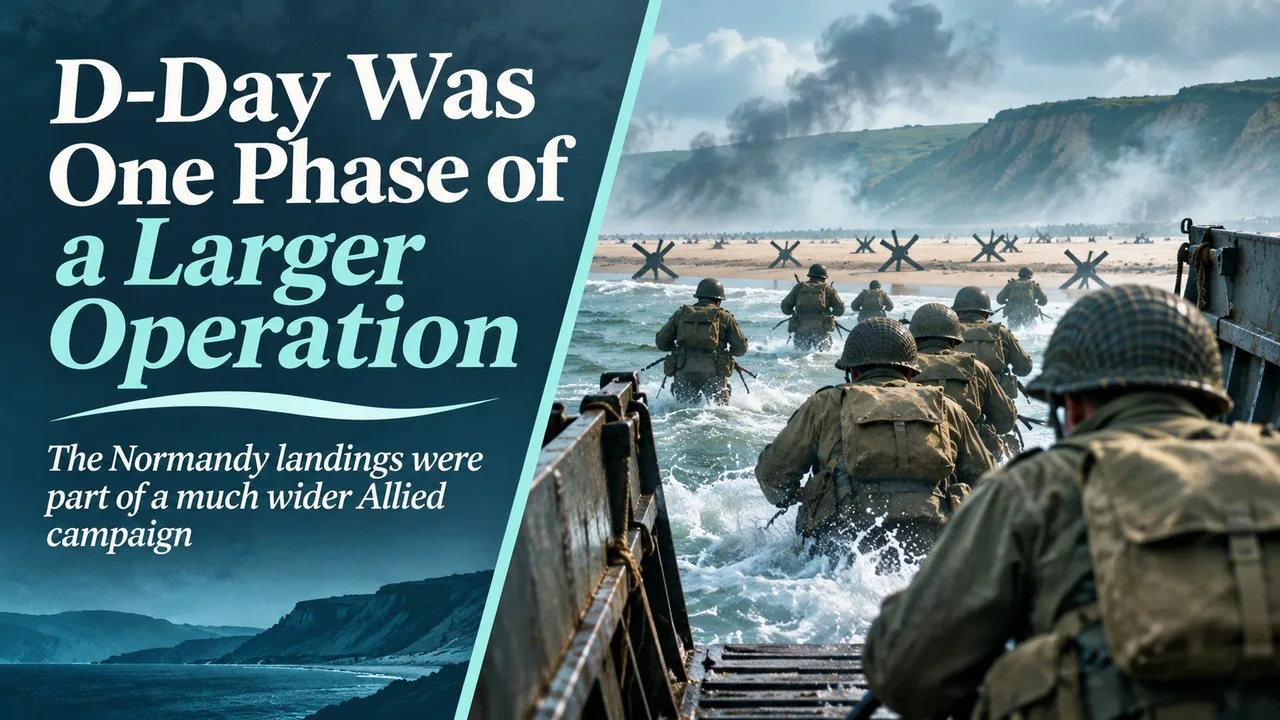
D-Day was one phase of a larger operation: the Normandy landings of 6 June 1944 opened Operation Overlord, the Allied drive to free north-western Europe.[1][2]
This Finepedia guide, updated in November 2026, explains how the landings fitted into the wider Overlord campaign, how they were planned and disguised, what happened on the day itself, and why the fighting in Normandy lasted until late August. It is number 6 in Top 20 World War II Facts: Little-Known Details.
Key Facts
| Attribute | Detail |
|---|---|
| Date of the landings | 6 June 1944 |
| Wider operation | Operation Overlord, the invasion of north-west Europe |
| Naval part | Operation Neptune, the cross-Channel assault |
| Supreme commander | General Dwight D. Eisenhower (United States) |
| Land forces commander | General Bernard Montgomery (21st Army Group) |
| Assault beaches | Utah, Omaha (US); Gold, Sword (British); Juno (Canadian) |
| Vessels involved | Nearly 7,000 warships, landing craft and support ships |
| Troops ashore by nightfall | About 156,000 (by sea and air) |
| Allied casualties on 6 June | At least 10,000 killed, wounded or missing |
| End of Overlord | Late August 1944, as German forces fell back across the Seine |
Sources: Imperial War Museums, the Eisenhower Presidential Library and Wikipedia.[1][2][3][4]
What the Name D-Day Means
The "D" in D-Day simply stands for "day". Planners applied it to the opening day of any major operation, so the war had many D-Days.[1] The label stuck to 6 June 1944 because of the scale of what began on that morning.
The Imperial War Museums (IWM) and the Eisenhower Presidential Library both rank the Normandy landings as the biggest seaborne invasion ever attempted.[1][2] Yet the day was only the opening move. The campaign it began would take almost three months to win in Normandy alone.
Overlord, Neptune and D-Day
Three names are often mixed up. Overlord covered the entire Allied invasion of France and the Low Countries. Neptune was its naval component: the crossing of the Channel, the bombardment of the coast and the landing of troops and supplies. D-Day was the first day on which both came together.[1][5]
A Second Front
The western Allies had treated the defeat of Germany as their main war aim since December 1941.[1] A landing in France would open a second front, ease the pressure on Soviet forces in the east and give the Allies their first real foothold in northern Europe since the Dunkirk evacuation of 1940.[1][6]
The Decision
At the Trident Conference, held in Washington during May 1943, Allied leaders committed to crossing the Channel within roughly a year.[4][2] Lieutenant-General Frederick Morgan and a joint British, American and Canadian staff produced the first full plan in July 1943.[1][4] Detailed preparation began only after the Tehran Conference late that year, and Eisenhower's command team was set up in December 1943.[1][6]
Planning on an Enormous Scale
The build-up in Britain was vast. By 1944 more than 2 million troops from over a dozen countries were waiting in southern England, and IWM estimates that some 9 million tons of material were shipped to Britain from North America in the first six months of that year.[1][6] Wikipedia records about 1.5 million American troops in the United Kingdom by May 1944, while IWM gives over 1.4 million arriving during 1943 and 1944.[4][1]
Normandy was chosen partly because the Germans expected an attack at the Pas-de-Calais, the shortest crossing from England, and had fortified that coast most heavily.[4] Planners knew they could not seize a large port in the first days. Their answer was to bring the harbours with them: two prefabricated Mulberry harbours, towed across the Channel and working within about ten days of the landings.[5][4]
Related: Germany's Invasion of Poland Began the War in Europe
Timing depended on the moon and the tide. The airborne units wanted moonlight, while the naval forces wanted the beach obstacles to be visible as the tide came in, so just a handful of dates each month were suitable.[5][4] Eisenhower first chose 5 June. Gales and rough water forced a 24-hour delay, and a forecast of a brief improvement from the meteorologist Group Captain James Stagg persuaded him to go on 6 June.[5][4]
Deceiving the Enemy
Overlord depended on surprise, and the Allies built an elaborate deception plan around it. The overall strategy, Operation Bodyguard, included Operation Fortitude. Fortitude North used fake radio traffic to suggest an attack on Norway. Fortitude South tried to persuade German commanders that the main landing would come at the Pas-de-Calais in July.[4]
To support that story, the Allies invented the First US Army Group, supposedly based in Kent and Sussex under General George S. Patton, complete with dummy equipment and fake signals.[4] German agents in Britain had in fact all been captured, and some were feeding false reports back as double agents. The best known, the Spanish agent Juan Pujol García, codenamed "Garbo", sent hundreds of messages that pointed to Calais.[4]
According to IWM, German commanders still believed in July 1944 that a bigger Allied landing was yet to come somewhere else. The threat of that second invasion kept German reserves away from Normandy.[1]
The Day Itself
The assault began shortly after midnight. Paratroopers and glider troops came down inland to protect the flanks of the landing area and seize key bridges, while bombers and warships pounded the coastal defences.[1][6] HMS Belfast opened fire at 5:27 in the morning in support of the British and Canadian beaches.[5][6]
Infantry began landing at 6:30 on the American beaches, Utah and Omaha, about an hour before the British and Canadian landings further east.[3][6] Strong winds pushed the tide in faster than expected, so engineers struggled to clear the explosive obstacles, and damaged boats and vehicles piled up at the water's edge.[5]
Omaha and the Other Beaches
Losses were unequal. A study by the French Ministry of Culture estimates loss rates of 1.4 per cent at Utah, 1.7 per cent at Gold, 3.35 per cent at Juno and 2.2 per cent at Sword, but about 7 per cent at Omaha.[7] IWM says the American assault there nearly failed, both because the preliminary bombardment left strong points intact and because the defenders included battle-hardened troops.[1]
Related: The War Ended on Different Dates in Europe and Asia
By nightfall the Allies had a foothold along the coast, though many first-day objectives, including the city of Caen, had not been taken.[3][5]
The Forces Involved
| Element | Figure | Notes |
|---|---|---|
| Ships and landing craft | About 7,000 | IWM and the Eisenhower Library agree[1][2] |
| Naval personnel | About 195,000 to 200,000 | Drawn from eight Allied nations[2][5] |
| Troops landed by sea | About 132,000 to 133,000 | IWM, the Eisenhower Library and French sources[1][2][7] |
| Airborne troops | 18,000 to 24,000 | Sources disagree on the total[1][3][7] |
| Total ashore by midnight | About 156,000 | IWM and French Ministry of Culture[5][7] |
| Allied casualties | At least 10,000 | About 4,414 confirmed dead[3][7] |
The airborne total varies most. IWM counts over 18,000 paratroopers, the French Ministry of Culture says 23,000 came by air, and Wikipedia puts the airborne force at 24,000.[1][7][3] The difference partly reflects whether glider-borne soldiers are included.
After the Beaches: the Battle of Normandy
Establishing the bridgehead was only the first step. IWM argues that the fame of D-Day tends to hide the importance of the wider Normandy campaign.[1] For weeks, the Allies fought their way through the bocage, a landscape of sunken lanes and thick hedgerows that favoured the defenders.[1]
According to the French Ministry of Culture, it took eight weeks of heavy combat before the Americans broke the German line near Saint-Lô in late July.[7] In August a German counter-attack failed, and much of the German Seventh Army was trapped in the Falaise pocket.[4] A second Allied invasion came ashore in the south of France on 15 August, about ten weeks after D-Day.[1][4]
Overlord is usually dated from 6 June to 30 August 1944, when German forces withdrew across the Seine.[4] By late August, over 2 million Allied soldiers had reached France and German forces were falling back.[5][6]
Timeline
| Date | Event |
|---|---|
| May 1943 | Trident Conference agrees a cross-Channel invasion[4][2] |
| July 1943 | Morgan's planning staff submits the first Overlord plan[1][4] |
| December 1943 | Eisenhower's command team formed[1][6] |
| 4 June 1944 | Bad weather postpones the landings by a day[5][4] |
| 6 June 1944 | Airborne and seaborne landings in Normandy (D-Day)[1][2] |
| Late July 1944 | American breakthrough west of Saint-Lô[7][4] |
| 15 August 1944 | Allied landings in southern France[1][4] |
| 30 August 1944 | German forces withdraw across the Seine; Overlord ends[4][6] |
Why the Wider Campaign Mattered
The landings relied on Allied successes on other fronts. IWM points out that the strategic bombing campaign weakened German industry, that winning the Atlantic convoy war by 1943 let men and supplies reach Britain, and that the Italian campaign drew German troops away.[1][6]
Related: Stalingrad Was a Major Turning Point
The Soviet summer offensive, Operation Bagration, began shortly after the landings and destroyed German Army Group Centre, tying down forces that might otherwise have gone west.[1] Overlord itself did not end the war in Europe, but IWM sees it as the start of the path to Allied victory in the west.[1][6]
Key Figures
- 24 hours: the delay forced by bad weather, moving the landings from 5 to 6 June.[5][4]
- 5: the number of assault beaches, from Utah in the west to Sword in the east.[1][2]
- About 7,000: vessels that took part in Operation Neptune.[1][2]
- About 156,000: Allied troops ashore by the end of 6 June.[5][7]
- About 7 per cent: the estimated loss rate at Omaha, the highest of the five beaches.[7][1]
- About 12 weeks: the length of the Overlord campaign, from 6 June to 30 August 1944.[4][6]
Common Misconceptions
One misconception is that D-Day was the whole Normandy invasion. The landings lasted one day; Overlord lasted almost three months, and the hardest fighting came after the beaches were taken.[1][4]
Another is that the "D" stands for a special word such as "deliverance". IWM explains that it simply means "day", a term used for the start of any operation.[1]
A third is that the landings were an American, British and Canadian affair alone. IWM notes that soldiers, sailors and airmen from Australia, Belgium, Czechoslovakia, France, Greece, the Netherlands, New Zealand, Norway, Poland and Rhodesia also took part.[1][6]
Legacy
Eisenhower prepared two messages. One, his Order of the Day, was issued to the troops on 6 June. The other, a short note accepting responsibility in case the landings failed, was never needed; the Eisenhower Library holds it, which Eisenhower wrongly dated "July 5" when he meant 5 June.[2]
The landings also shaped how later amphibious operations were judged. IWM notes that the planners had drawn lessons from earlier failures at Dieppe and Anzio, and the Normandy campaign became the benchmark for combined sea, air and land operations.[1] Wrecks from the landings in the Bay of the Seine are still studied by French maritime archaeologists.[5]
Frequently Asked Questions
What is the difference between D-Day and Operation Overlord?
D-Day was 6 June 1944, the day of the Normandy landings. Operation Overlord was the full campaign to free north-west Europe, usually dated from 6 June to 30 August 1944.[1][4]
Related: Pearl Harbor Did Not Happen in a Vacuum
Why did D-Day take place on 6 June?
The planners needed the right moon and tide. Eisenhower first chose 5 June, but storms forced a delay, and a forecast of a short break in the weather led him to launch the invasion a day later.[5][4]
How many troops landed on D-Day?
By midnight roughly 156,000 Allied troops had landed, roughly 132,000 to 133,000 by sea and the rest by air. Sources differ on the airborne figure.[5][7][1]
What was Operation Fortitude?
It was the deception plan that persuaded German commanders the main invasion would land at the Pas-de-Calais, using a fictional army group, false radio traffic and double agents.[4][1]
How long did the Battle of Normandy last?
The fighting in Normandy lasted until late August 1944, when German forces retreated across the Seine. The breakthrough west of Saint-Lô came only at the end of July.[7][4]
Conclusion
D-Day is remembered as a single day, but it was the first step of Operation Overlord. Years of planning, a huge deception effort and a naval operation on an unprecedented scale made the landings possible, and almost three months of hard fighting followed before the Allies broke out of Normandy.
Seeing the landings as one phase of a larger operation explains both their importance and their limits: 6 June gave the Allies a foothold, and the campaign that followed turned it into victory in the west.
See all 20 in Top 20 World War II Facts: Little-Known Details
See also
- Top 20 World War II Facts: Little-Known Details
- Top 10 Overlooked Events of World War II
- Top 10 Real Intelligence Operations That Sound Like Fiction
- ^ [1] "10 Facts About D-Day You Need To Know". Imperial War Museums. IWM: 10 facts about D-Day
- ^ [2] "World War II: D-Day, The Invasion of Normandy". Dwight D. Eisenhower Presidential Library. Eisenhower Library
- ^ [3] "Normandy landings". Wikipedia. Wikipedia: Normandy landings
- ^ [4] "Operation Overlord". Wikipedia. Wikipedia: Operation Overlord
- ^ [5] "D-Day at sea: Operation Neptune". Imperial War Museums. IWM: Operation Neptune
- ^ [6] "D-Day Explained". Imperial War Museums. IWM: D-Day explained
- ^ [7] "Assessment of the landings". Maritime archaeology of the Normandy landings, French Ministry of Culture. French Ministry of Culture



























Discussion
Log in with