






 By
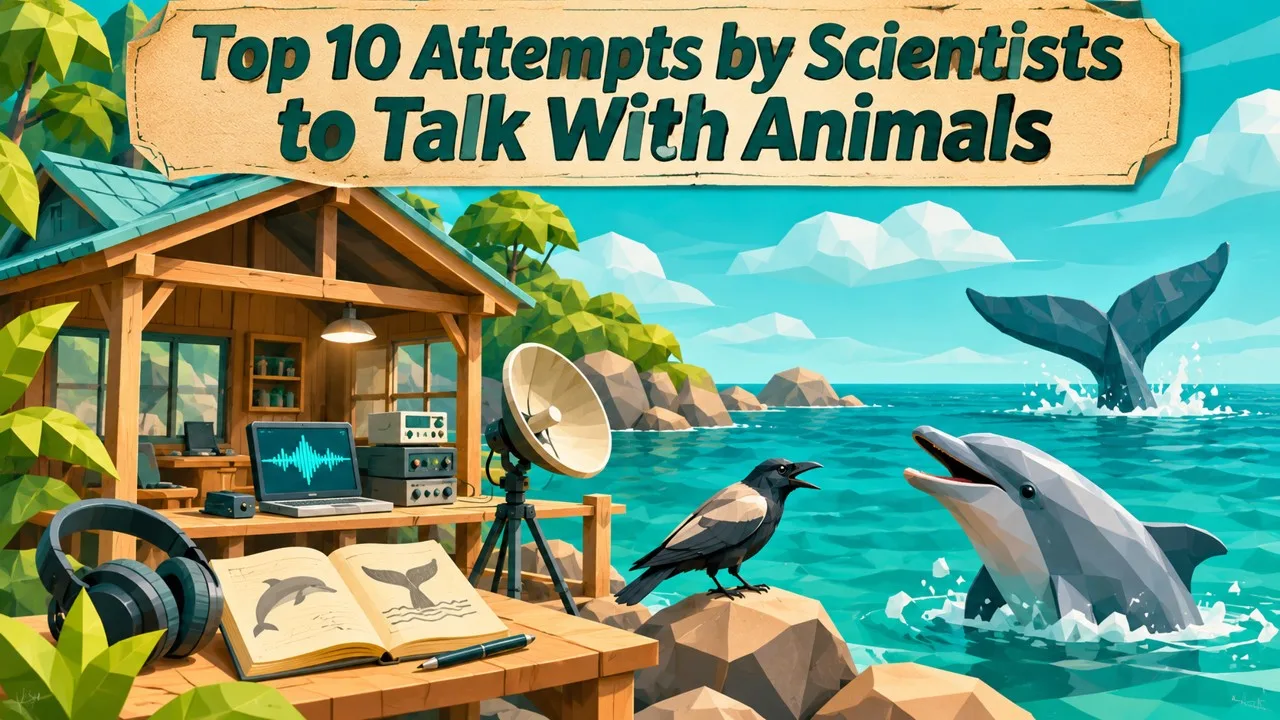
Scientists have taught apes sign language, quizzed a parrot on colors and shapes and used AI on whale clicks in the long effort to talk with animals. The dream of talking with animals is ancient, appearing in myths, fables and children's stories. In the twentieth century, scientists began to test it seriously. They tried teaching animals human sign language, symbols and spoken words, and they studied the natural signals animals use with each other.
The results have been fascinating and controversial. Some animals learned hundreds of words or symbols and used them in meaningful ways. Yet most researchers agree that no animal has shown the full grammar and open-ended creativity of human language. Debates about how to interpret the results continue today.
The ten projects below are Washoe the chimpanzee, Project Nim, Koko the gorilla, Kanzi the bonobo, Alex the parrot, the dolphin house experiment, Louis Herman's dolphin language studies, Chaser the border collie, research on prairie dog alarm calls and the use of artificial intelligence to study sperm whale communication. Each one tells us something about animal minds, and about the limits of our own assumptions.
Key Facts
| # | Project | Who and when | What it showed |
|---|---|---|---|
| 1 | Washoe | Allen and Beatrix Gardner, from 1966 | A chimpanzee learned many signs from American Sign Language |
| 2 | Project Nim | Herbert Terrace, 1973 to 1977 | Concluded that the chimpanzee did not use grammar |
| 3 | Koko | Francine Patterson, from 1972 | Learned a large vocabulary of modified signs |
| 4 | Kanzi | Sue Savage-Rumbaugh, from the 1980s | A bonobo learned symbols and understood spoken sentences |
| 5 | Alex the parrot | Irene Pepperberg, 1977 to 2007 | A grey parrot labeled objects, colors and quantities |
| 6 | The dolphin house experiment | John C. Lilly's laboratory, 1965 | An attempt to teach a dolphin English |
| 7 | Artificial language studies | Louis Herman, from the 1970s | Dolphins responded correctly to novel instructions |
| 8 | Chaser | John Pilley, from 2004 | A border collie learned the names of over 1,000 objects |
| 9 | Prairie dog alarm calls | Con Slobodchikoff, from the 1980s | Calls appeared to describe predators' size and color |
| 10 | Project CETI | Founded 2020 | Uses artificial intelligence to study sperm whale codas |
1. The First Signing Chimpanzee
In 1966, the psychologists Allen and Beatrix Gardner at the University of Nevada began raising a young chimpanzee named Washoe in a home-like environment and teaching her signs from American Sign Language. Earlier attempts to teach chimpanzees to speak had failed, partly because their vocal tracts cannot produce human speech sounds [1].
Washoe learned around 130 to 350 signs, according to different estimates, and could combine them in short sequences. Researchers reported that she sometimes created new combinations, such as signing water and bird when she saw a swan, though critics argued this might not be a true new compound [1].
Washoe later lived with other chimpanzees at Central Washington University, where researchers reported that a young chimpanzee named Loulis learned some signs from her. The project showed that apes could learn and use symbols, while opening a long debate about whether this amounted to language.
2. A Skeptical Result
Project Nim was designed to test whether a chimpanzee could produce sentences. The psychologist Herbert Terrace at Columbia University raised a chimpanzee named Nim Chimpsky, a playful reference to the linguist Noam Chomsky, and taught him sign language [2].
Nim learned more than 100 signs. However, when Terrace and his colleagues analyzed videotapes of Nim's signing, they concluded that he was often imitating his teachers and that his longer sequences did not follow grammatical rules. His sentences did not grow more complex in the way children's do [2].
The project's conclusions were influential and cast doubt on claims made for other signing apes. Supporters of ape language research argued that Nim's unstable upbringing, with many changing caregivers, affected the results. Project Nim became the subject of a 2011 documentary and remains an important skeptical reference point.
Related: Top 10 Most Intelligent Animals
3. A Gorilla Who Signed
Koko was a western lowland gorilla who was taught a modified form of sign language by the psychologist Francine Patterson, beginning in 1972. Koko lived for many years with Patterson's Gorilla Foundation in California and became world famous [3].
Patterson reported that Koko learned more than 1,000 signs and understood about 2,000 spoken English words. Koko appeared in magazines and documentaries, and stories about her pet kitten were widely shared. She died in 2018 [3].
Many scientists criticized the research for relying on interpretation by Koko's caregivers rather than controlled testing, and few of the findings were published in peer-reviewed journals. Koko's story showed the strong public desire to communicate with animals, and the importance of careful methods in interpreting what animals do.
4. Symbols on a Keyboard
Kanzi is a bonobo who learned to communicate using lexigrams, abstract symbols on a keyboard, each representing a word. Remarkably, he learned many symbols by watching his adoptive mother being taught, rather than through direct training [4].
Researchers led by Sue Savage-Rumbaugh reported that Kanzi learned hundreds of lexigrams and could respond correctly to many unfamiliar spoken English sentences. In tests, his comprehension was compared with that of a young human child, with broadly similar results on some measures [4].
Kanzi's achievements are often seen as some of the strongest evidence for language-related abilities in apes, especially comprehension. Critics still argue that his output lacks the complexity of human language. Kanzi became one of the most studied apes in the world, and he died in 2025.
5. A Parrot Who Knew Colors
Alex was an African grey parrot studied by the scientist Irene Pepperberg for about 30 years. Parrots can imitate human speech, but Pepperberg wanted to test whether Alex could use words with meaning [5].
Related: Top 10 Unexpected Abilities Found in Animals
Alex learned to name about 50 objects and to identify colors, shapes, materials and quantities up to about six. He could answer questions such as what color, or which object is bigger, and he appeared to understand a concept similar to zero. Pepperberg used a training method in which two humans modeled the interaction [5].
Alex died in 2007. His abilities changed scientific views of bird intelligence, which had often been underestimated because of the small size of bird brains. Pepperberg's work showed that parrots can learn abstract concepts, not just mimic sounds, though whether Alex used language in the human sense remains debated.
6. A House Shared With a Dolphin
In the 1960s, the neuroscientist John C. Lilly believed dolphins might be able to learn human language. At his laboratory in the United States Virgin Islands, funded in part by government grants, a researcher named Margaret Howe Lovatt lived for weeks in a partly flooded house with a young dolphin named Peter [6].
The goal was to teach Peter to imitate English words through constant contact. Lovatt recorded daily lessons, and Peter reportedly made sounds that resembled some words. However, the project did not produce meaningful spoken communication [6].
The experiment ended after funding was cut, and later accounts focused on unusual and controversial aspects of the project, along with Lilly's later use of drugs in research. The experiment is now generally seen as poorly designed, but it was an early, ambitious attempt to bridge the gap between humans and dolphins.
7. Dolphins That Understood Word Order
At a laboratory in Hawaii, the psychologist Louis Herman and his team taught bottlenose dolphins artificial languages, one based on hand gestures and another on computer-generated sounds. The two most famous dolphins in the research were named Akeakamai and Phoenix [7].
Instead of asking the dolphins to produce language, the researchers tested comprehension. The dolphins learned words for objects and actions and could respond correctly to new combinations of instructions. Importantly, they understood that word order changed meaning, such as the difference between taking a ball to a hoop and taking a hoop to a ball [7].
Related: Top 10 Animals That Make Music in the Wild
The research provided evidence that dolphins can process a simple form of syntax. It also showed that comprehension can be easier to test reliably than production. Herman's work remains one of the most cited studies of dolphin cognition.
8. A Dog That Knew a Thousand Words
Chaser was a border collie trained by the retired psychology professor John Pilley in South Carolina. Over several years, Pilley taught Chaser the names of more than 1,000 toys, each with a unique name [8].
In controlled tests, Chaser could retrieve a named toy from a large collection. She also appeared to learn the names of new objects by exclusion, choosing an unfamiliar toy when given an unfamiliar name. Pilley published his results in a scientific journal in 2011 [8].
Chaser also learned to respond to combinations of commands and object names. Her abilities suggested that dogs, with long histories of living with humans, may be especially good at understanding human words. Chaser died in 2019, and research on dog word learning has continued since.
9. Prairie Dogs With Descriptive Calls
Instead of teaching animals human language, some scientists study the natural communication of animals. The biologist Con Slobodchikoff spent decades studying the alarm calls of Gunnison's prairie dogs in the American Southwest [9].
His research suggested that prairie dogs produce different calls for different predators, such as hawks, coyotes, dogs and humans. Further experiments indicated that the calls might contain information about the size, shape and even the color of the clothing worn by a human approaching the colony [9].
Related: Top 10 Animals That Can Live Without Food for Months
Some scientists are cautious about describing the calls as a language. But the research shows that animal signals can carry detailed information. It encouraged a shift in focus, from asking whether animals can learn our language to understanding the communication systems they already use.
10. Listening to Whales With Machines
Project CETI, the Cetacean Translation Initiative, is a research effort launched in 2020 to study the communication of sperm whales off the island of Dominica in the Caribbean. Sperm whales communicate using patterns of clicks called codas [10].
The project uses underwater microphones, tags attached to whales and machine learning to analyze large amounts of recorded sound. In 2024, researchers reported that sperm whale codas vary in rhythm and tempo in ways that suggest a more complex system than previously known [10].
The project's goal is to understand whale communication, not necessarily to talk to whales. Other groups are using similar methods to study birds, bats and other animals. Artificial intelligence may help reveal patterns in animal sounds that humans would struggle to detect, though interpreting their meaning remains a major challenge.
Conclusion
The ten projects above show both the promise and the difficulty of communicating with animals. Apes, parrots, dolphins and dogs have learned words, symbols and simple rules, and wild animals such as prairie dogs and whales use sophisticated signals of their own.
At the same time, none of these animals has shown the full flexibility of human language, and researchers continue to debate how to interpret their abilities. The search has taught scientists to respect animal minds more than ever, and to study their communication on its own terms.
- ^ [1] Accounts of Washoe and the Gardner project. Wikipedia: Washoe Wikipedia: great ape language
- ^ [2] Accounts of Project Nim and its conclusions. Wikipedia: Nim Chimpsky Wikipedia: Project Nim
- ^ [3] Accounts of Koko and the debate over her signing. Wikipedia: Koko Wikipedia: great ape language
- ^ [4] Accounts of Kanzi and lexigram research. Wikipedia: Kanzi Wikipedia: Sue Savage-Rumbaugh
- ^ [5] Accounts of Alex and Pepperberg's research. Wikipedia: Alex (parrot) Wikipedia: Irene Pepperberg
- ^ [6] Accounts of Lilly's dolphin research and the 1965 experiment. Wikipedia: John C. Lilly Wikipedia: dolphin
- ^ [7] Accounts of Herman's dolphin language studies. Wikipedia: Louis Herman Wikipedia: cetacean intelligence
- ^ [8] Accounts of Chaser and Pilley's research. Wikipedia: Chaser (dog) Wikipedia: Border Collie
- ^ [9] Accounts of prairie dog alarm call research. Wikipedia: prairie dog Wikipedia: Gunnison's prairie dog
- ^ [10] Accounts of Project CETI and sperm whale codas. Wikipedia: Project CETI Wikipedia: sperm whale



















Discussion
Log in with