





 By
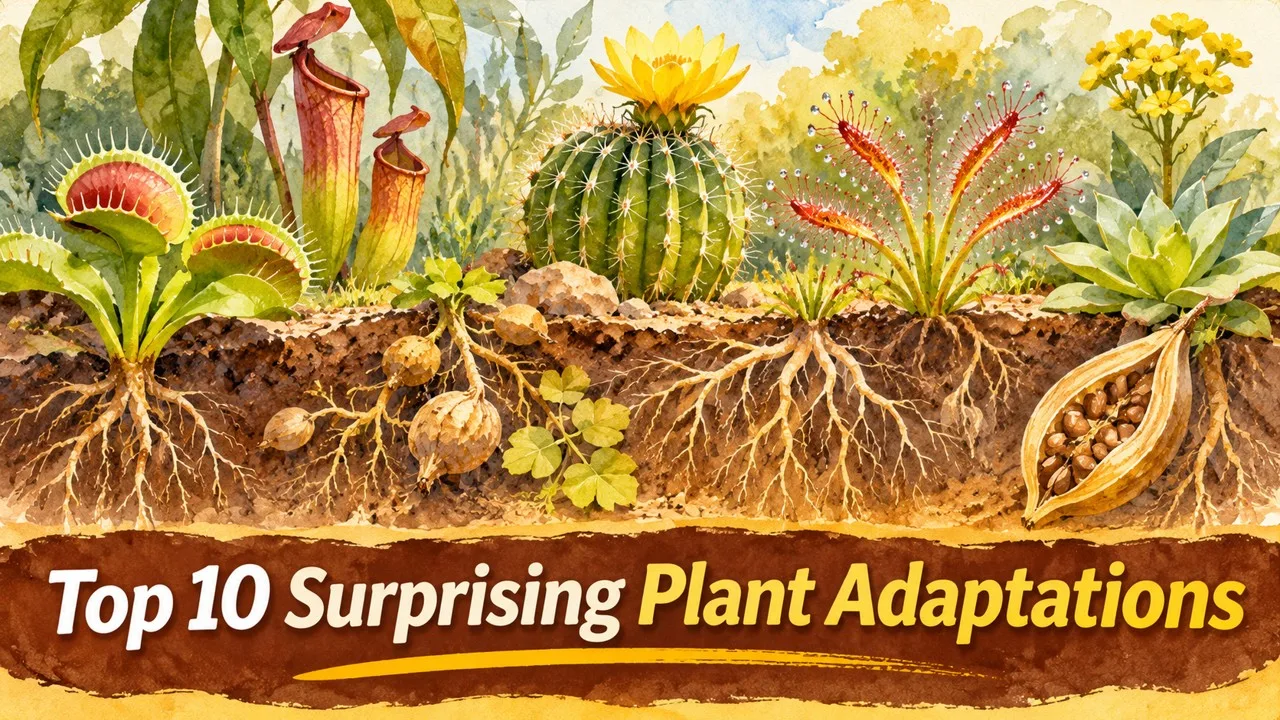
Plants that count, sniff out victims, serve as toilets for shrews and signal to bats: ten surprising adaptations that show plants are far from passive. Plants are often thought of as passive organisms. Unlike animals, they cannot run from danger, chase prey or search for mates.
Yet plants have evolved an astonishing range of strategies for surviving in difficult environments. They have found ways to obtain nutrients, attract pollinators, defend themselves and spread their seeds.
Some plants trap and digest animals. Others trick insects, recruit bodyguards or exploit their neighbours. Some can survive extreme drought or even rely on fire to reproduce.
Scientists continue to discover new and surprising plant behaviours. Some of these discoveries have challenged long-held assumptions about what plants can sense and do.
Many of these adaptations involve close relationships with animals, from insects and ants to bats and small mammals. These relationships have evolved over millions of years.
The plants in this list come from many parts of the world, including tropical rainforests, deserts, wetlands and fire-prone forests.
Some of the more surprising findings about plant behaviour, such as whether plants can learn, are still debated among scientists. Where this is the case, it is noted.
Each entry names the plant, its adaptation and where it grows, followed by an explanation of how the adaptation works.
The entries are not ranked.
Together, they show that plants are far more dynamic and inventive than they might appear.
Plants sense the world in ways that differ from animals but are often remarkably sophisticated. They detect light with several kinds of receptor proteins, allowing them to tell the difference between direct sunlight and the shade of competing plants. They respond to gravity, touch, temperature and chemicals in the air and soil. Roots can grow towards water and nutrients, and some plants release chemical signals when attacked by insects, which may attract predators of those insects or warn neighbouring plants.
Key Facts
| # | Plant | Adaptation | Where it grows |
|---|---|---|---|
| 1 | The Venus flytrap | Snapping traps triggered by touch | The Carolinas, United States |
| 2 | Nepenthes lowii | Collecting droppings for nutrients | Borneo |
| 3 | Marcgravia evenia | Echo-reflecting leaves | Cuba |
| 4 | Dodder | Locating hosts by scent | Many parts of the world |
| 5 | Bee orchids | Sexual deception | Europe and the Mediterranean |
| 6 | Rafflesia arnoldii | A parasitic giant | Sumatra and Borneo |
| 7 | Welwitschia mirabilis | Surviving in the desert | Namibia and Angola |
| 8 | Serotinous pines and banksias | Fire-triggered seed release | North America and Australia |
| 9 | Mimosa pudica | Folding leaves when touched | Tropical Americas, now widespread |
| 10 | The bullhorn acacia | Partnership with ants | Central America and Mexico |
1. A Plant That Counts
The Venus flytrap is a carnivorous plant that catches insects and spiders in hinged leaves lined with bristles. In the wild, it grows only in a small region of wetlands in North and South Carolina in the United States [1].
Each trap has sensitive trigger hairs. Touching a single hair once does not usually close the trap. A second touch within a short time is needed, which helps the plant avoid wasting energy on raindrops or debris [1].
Related: Top 10 Carnivorous Plants and How They Catch Their Prey
Research has shown that the plant effectively counts touches. After the trap closes, further stimulation by struggling prey triggers the production of digestive enzymes. The plant then absorbs nutrients from its prey, helping it survive in nutrient-poor soils.
2. A Toilet for Tree Shrews
Pitcher plants catch insects in deep, fluid-filled traps formed from modified leaves. But one species from the mountains of Borneo, Nepenthes lowii, has developed an unusual alternative [2].
Its pitchers produce a sweet secretion on the underside of the lid. Tree shrews visit the pitchers to feed on it, and while doing so, they often leave droppings in the pitcher [2].
Researchers have found that the plant obtains much of its nitrogen from these droppings. The shape of the pitcher appears to fit the body of a tree shrew, positioning the animal in just the right place. This relationship has been described as a toilet for tree shrews.
3. A Dish That Signals to Bats
Many plants rely on bats for pollination. Bats find flowers using echolocation, emitting high-pitched calls and listening to the echoes [3].
The Cuban vine Marcgravia evenia has a dish-shaped leaf above its flowers. In 2011, researchers reported that this leaf reflects strong echoes back towards bats from many directions, acting like an acoustic beacon [3].
In experiments, bats found the flowers much faster when the dish-shaped leaf was present. The discovery showed that plants can evolve features that communicate with animals through sound as well as through colour and scent.
4. A Parasite That Smells Its Host
Dodder is a parasitic plant with thin, often yellow or orange stems and very little chlorophyll. It cannot produce enough food on its own, so it must attach to another plant and draw nutrients from it [4].
When a dodder seedling sprouts, it has only a short time to find a host. In 2006, researchers showed that dodder seedlings grow towards volatile chemicals released by host plants, effectively sniffing them out [4].
The seedlings even showed preferences, growing towards tomato plants rather than wheat when given a choice. Once it finds a host, dodder coils around it and inserts structures that tap into the host's tissues.
Related: Top 25 Interesting Facts About the Universe
5. Flowers That Impersonate Insects
Orchids of the genus Ophrys, which include the bee orchids, have flowers that resemble female insects. Their shape, colour, texture and even scent mimic those of female bees or wasps [5].
Male insects are attracted to the flowers and try to mate with them. In doing so, they pick up pollen, which they carry to the next flower they visit. This strategy, known as pseudocopulation, allows the orchid to be pollinated without offering nectar [5].
Each species of Ophrys often mimics a particular insect species. Scientists have found that the flowers' scent can closely imitate the chemical signals produced by female insects.
6. The Largest Flower With No Leaves
Rafflesia arnoldii produces the largest single flower in the world, which can measure around one metre across. It grows in the rainforests of Sumatra and Borneo [6].
The plant has no leaves, stems or roots of its own. It lives as a parasite inside the vines of a particular group of plants, drawing all its nutrients from them. For most of its life, it is hidden inside its host, appearing only when it flowers [6].
The flower gives off a smell like rotting flesh, which attracts flies that carry its pollen. Rafflesia flowers are rare and short-lived, lasting only a few days.
7. Two Leaves for a Thousand Years
Welwitschia mirabilis grows in the Namib Desert of Namibia and southern Angola, one of the driest places on Earth. It is unlike any other living plant [7].
The plant produces only two leaves in its entire lifetime. These leaves grow continuously from the base and become split and tattered over time, giving the plant a sprawling appearance [7].
Some individual Welwitschia plants are estimated to be well over a thousand years old. The plant may obtain some moisture from fog that rolls in from the Atlantic Ocean, and research has revealed genetic adaptations that help it survive extreme heat and drought.
8. Seeds Released by Fire
Some plants depend on fire to reproduce. Certain pines, such as the lodgepole pine, and some Australian banksias, produce cones or seed pods that remain sealed for years, a trait known as serotiny [8].
Related: Top 25 Interesting Facts About the Solar System
The cones of some serotinous pines are sealed with resin that melts only at high temperatures. After a fire, the cones open and release their seeds onto ground that has been cleared of competing plants and enriched by ash [8].
This strategy allows the plants to regenerate quickly after wildfires. It shows how some ecosystems are not only adapted to fire but depend on it.
9. The Plant That May Remember
Mimosa pudica, sometimes called the sensitive plant, folds its leaves rapidly when touched or shaken. The movement is caused by changes in water pressure in specialised cells at the base of the leaves [9].
The folding may help the plant deter insects or reduce damage. In 2014, researchers reported that Mimosa plants that were repeatedly dropped in a harmless way stopped folding their leaves, and appeared to retain this response for weeks [9].
The researchers interpreted this as a form of learning and memory. Their interpretation has attracted interest and debate, as some scientists question whether such responses should be described using the same terms as animal learning.
10. A Tree With Its Own Army
The bullhorn acacia has large, hollow thorns that look like the horns of a bull. Colonies of ants live inside these thorns [10].
The tree provides the ants with shelter, nectar and small food bodies rich in nutrients. In return, the ants aggressively defend the tree, attacking insects, other animals and even plants that grow too close [10].
This relationship is a classic example of mutualism, in which both partners benefit. Studies have shown that acacias without their ants suffer much more damage and grow less well.
Conclusion
These adaptations show that plants are far from passive. They sense their environment, respond to touch and chemicals and form complex relationships with animals.
Related: Top 10 Mythical Creatures in World Mythology - That Inspired Myths Across Civilizations (unchanged)
Many of these adaptations help plants survive in difficult conditions, from nutrient-poor soils and deserts to fire-prone forests.
Some adaptations, such as the dish-shaped leaves of Marcgravia and the shrew-friendly pitchers of Nepenthes lowii, were discovered only in recent decades.
Debates about plant behaviour, such as whether plants can learn, continue among scientists and are leading to new research.
Many of the plants in this list are rare or threatened by habitat loss, collection and climate change. Conservation efforts aim to protect them.
Botanical gardens play an important role in studying and preserving unusual plants, and many display species described here.
For anyone who enjoys nature, these plants are a reminder that some of the most remarkable living things may be growing quietly nearby.
Charles Darwin was fascinated by plant behaviour. He wrote books on carnivorous plants, climbing plants, orchid pollination and the movements of plants, and he called the Venus flytrap one of the most wonderful plants in the world. Many of the questions he raised are still being investigated by botanists using modern tools such as genetics and high-speed imaging.
Studying plant adaptations can also inspire human technology. Engineers have looked to plants for ideas, from self-cleaning surfaces modelled on lotus leaves to fasteners inspired by burrs that cling to fur and clothing.
Even common garden plants and weeds have adaptations worth noticing, from the hooked seeds of cleavers to the deep roots of dandelions, which help them thrive in lawns, fields and cracks in the pavement.
- ^ [1] Accounts of the Venus flytrap. Wikipedia: Venus flytrap Wikipedia: Carnivorous plant
- ^ [2] Accounts of Nepenthes lowii. Wikipedia: Nepenthes lowii Wikipedia: Treeshrew
- ^ [3] Accounts of Marcgravia. Wikipedia: Marcgravia Wikipedia: Animal echolocation
- ^ [4] Accounts of dodder. Wikipedia: Cuscuta Wikipedia: Parasitic plant
- ^ [5] Accounts of bee orchids. Wikipedia: Ophrys Wikipedia: Pseudocopulation
- ^ [6] Accounts of Rafflesia. Wikipedia: Rafflesia arnoldii Wikipedia: Rafflesia
- ^ [7] Accounts of Welwitschia. Wikipedia: Welwitschia Wikipedia: Namib
- ^ [8] Accounts of serotiny. Wikipedia: Serotiny Wikipedia: Pinus contorta
- ^ [9] Accounts of Mimosa pudica. Wikipedia: Mimosa pudica Wikipedia: Plant perception (physiology)
- ^ [10] Accounts of the bullhorn acacia. Wikipedia: Vachellia cornigera Wikipedia: Myrmecophyte





















Discussion
Log in with