






 By
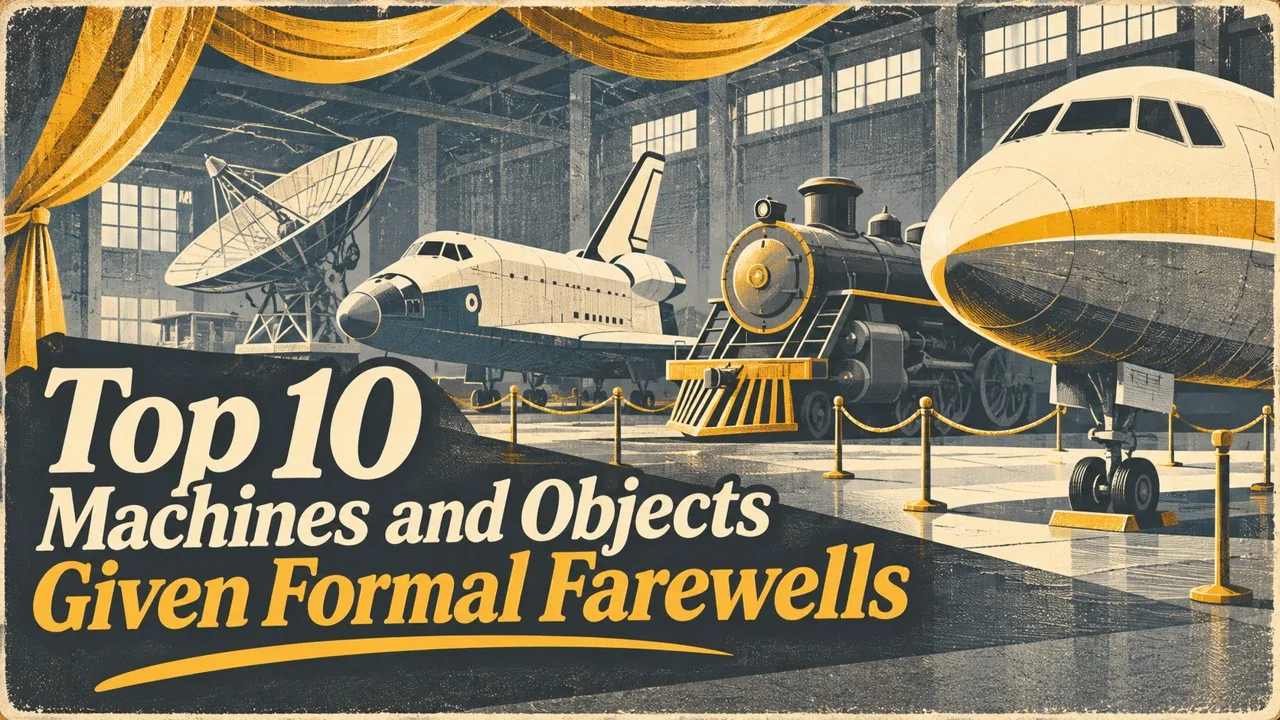
A last steam train, a temple funeral for robot dogs, a goodnight to a space telescope and the final telegram: ten machines and objects given formal farewells. People often form strong attachments to the machines and objects in their lives. Cars, trains, tools and even spacecraft can become symbols of an era, a community or a shared achievement.
When these machines reach the end of their working lives, people sometimes mark the moment with ceremonies. Farewells can range from final journeys and celebrations to religious rites and solemn commands sent across space.
Some of these farewells reflect cultural traditions that treat objects with respect. In Japan, for example, certain religious rituals honour items that have served people well.
Others reflect public affection for machines that captured the imagination. Space missions, in particular, have drawn emotional responses from people who followed their adventures.
Farewells also mark technological change. The end of a machine or service often signals the arrival of something new, and ceremonies help people come to terms with the passing of familiar things.
The farewells in this list come from Britain, Japan, Mexico, India and the United States, as well as from missions in space.
Some details of these farewells have been embellished in popular retellings. Where this is the case, it is noted.
Each entry names the machine or object, where the farewell took place and the year, followed by an account of how it was marked.
The entries are arranged in chronological order, beginning with a traditional ritual that has been practised for centuries.
Together, they show the surprising ways in which people say goodbye to the things that have shaped their lives.
Psychologists have studied why people grow attached to objects and machines. Familiar things can become linked to memories, identities and relationships, and people often describe them with human qualities, a tendency called anthropomorphism. A car may be given a name, a robot may be treated like a pet and a spacecraft may be described as brave or tired. These feelings help explain why the end of a machine's working life can feel like a genuine loss, and why people seek ways to mark it with dignity.
Key Facts
| # | Machine or object | Where | Year |
|---|---|---|---|
| 1 | Broken sewing needles | Japan | Practised for centuries |
| 2 | The Fifteen Guinea Special | England | 1968 |
| 3 | The last original Volkswagen Beetle | Puebla, Mexico | 2003 |
| 4 | Space Shuttle Atlantis on mission STS-135 | Kennedy Space Center, Florida, United States | 2011 |
| 5 | The end of the telegram service | India | 2013 |
| 6 | Sony Aibo robot dogs | Isumi, Japan | 2015 onwards |
| 7 | The Cassini spacecraft | Saturn | 2017 |
| 8 | The Kepler space telescope | Space | 2018 |
| 9 | The Opportunity rover | Mars | 2019 |
| 10 | The final Boeing 747 | Everett, Washington, United States | 2023 |
1. A Memorial Service for Needles
In Japan, a traditional ceremony called Hari-Kuyo, or the festival of broken needles, honours sewing needles that have been bent or broken in use. It is held each year at Buddhist temples and Shinto shrines, usually in February or December [1].
Related: Top 10 Engineering Disasters That Changed the Rules
During the ceremony, people bring their old needles and push them into a soft block of tofu or konnyaku, a jelly-like food. The soft material is seen as offering the needles a gentle resting place after their hard work [1].
The ritual has been practised for centuries, particularly by seamstresses, tailors and others who work with needles. It reflects a broader Japanese tradition of showing gratitude and respect to objects that have served people well.
2. The Last Steam Train
By the 1960s, British Railways was replacing steam locomotives with diesel and electric trains. The last regular steam-hauled passenger services ended in early August 1968 [2].
On 11 August 1968, British Railways ran a final steam-hauled special train from Liverpool to Carlisle and back. Tickets cost fifteen guineas, a high price at the time, and the train became known as the Fifteen Guinea Special. Crowds of enthusiasts lined the route to watch [2].
The following day, a ban on steam locomotives on the main network came into effect. The event marked the end of an era, although steam enthusiasts later preserved many locomotives and restored them for heritage railways and special excursions.
3. The End of an Icon
The Volkswagen Beetle was one of the best-selling cars in history, with more than 21 million produced over several decades. Production in Germany ended in the 1970s, but the car continued to be made in Mexico [3].
In July 2003, the last original Beetle rolled off the production line at the Volkswagen factory in Puebla. The final cars were part of a special edition, and the occasion was marked with a ceremony, reportedly including music from a mariachi band [3].
The very last car was sent to a Volkswagen museum in Germany. A later, modernised version of the Beetle was also discontinued in 2019, with its final car produced at the same Mexican factory.
4. The Final Landing of the Shuttle
The Space Shuttle programme ran for three decades, launching satellites, building the International Space Station and carrying hundreds of astronauts into orbit [4].
On 21 July 2011, the shuttle Atlantis landed at the Kennedy Space Center in Florida at the end of mission STS-135, the final flight of the programme. Crowds gathered to watch, and many NASA workers attended the landing [4].
Related: Top 10 Longest Railway Lines in the World
In the following year, the remaining shuttles were flown on the backs of modified jumbo jets to museums. These ferry flights over cities drew large crowds who came to say goodbye.
5. The Last Telegram
India's telegram service had a long history, beginning in the mid-nineteenth century. For generations, telegrams carried news of births, deaths, jobs and other important events [5].
By the twenty-first century, mobile phones and the internet had made telegrams almost obsolete. The state-owned telecommunications company announced that the service would end in July 2013 [5].
On the final day, crowds gathered at telegraph offices to send last telegrams to friends and family as keepsakes. The occasion was widely reported as the end of an era in Indian communication.
6. Funerals for Robot Dogs
Sony's Aibo robot dogs were introduced in 1999 and became popular pets for many owners. After Sony stopped making the original models and later ended official repair services, owners faced the prospect of their robots breaking down permanently [6].
Beginning in 2015, a Buddhist temple in Isumi, Japan, began holding memorial services for broken Aibo robots, in cooperation with a repair company. Priests chanted sutras for rows of robot dogs before they were taken apart [6].
Parts from the robots were used to repair other Aibos, allowing them to continue working. The ceremonies attracted international attention and reflected the emotional bonds that people can form with machines.
7. A Plunge Into Saturn
The Cassini spacecraft, a joint mission of NASA, the European Space Agency and the Italian Space Agency, arrived at Saturn in 2004. It studied the planet, its rings and its moons for more than a decade [7].
As Cassini ran low on fuel, mission controllers planned a dramatic finale. The spacecraft made a series of dives between Saturn and its rings, collecting new data [7].
On 15 September 2017, Cassini plunged into Saturn's atmosphere, sending back data until the end. The plunge was designed to prevent the spacecraft from contaminating moons that might have conditions suitable for life. Mission staff gathered to mark the moment.
Related: Top 10 Personifications of Death in Myth and Folklore
8. Goodnight to a Planet Hunter
NASA's Kepler space telescope was launched in 2009 to search for planets orbiting other stars. It discovered thousands of planets, transforming our understanding of how common planets are in the galaxy [8].
In October 2018, NASA announced that Kepler had run out of fuel and would be retired. On 15 November 2018, controllers sent the final commands to the telescope, shutting down its communications [8].
The date was chosen to mark the anniversary of the death of Johannes Kepler, the seventeenth-century astronomer after whom the telescope was named. The final commands were described by NASA as saying goodnight to the spacecraft.
9. A Final Song for a Rover
NASA's Opportunity rover landed on Mars in January 2004 for a mission planned to last about 90 Martian days. Instead, it kept working for nearly 15 years, travelling more than 45 kilometres across the Martian surface [9].
In 2018, a planet-wide dust storm cut off Opportunity's power, and contact was lost. NASA sent hundreds of commands over several months, hoping to wake it up [9].
In February 2019, NASA declared the mission over. The last song played to the rover was I'll Be Seeing You. A widely shared phrase, my battery is low and it's getting dark, was a journalist's poetic summary of its final data rather than the rover's actual words.
10. The Last Jumbo Jet
The Boeing 747, nicknamed the jumbo jet, first flew in 1969 and transformed international air travel. Its distinctive hump made it one of the most recognisable aircraft in the world [10].
After more than five decades of production, Boeing built the last 747, a cargo version delivered to the airline Atlas Air. On 31 January 2023, a ceremony was held at Boeing's factory in Everett, Washington, attended by employees, customers and guests [10].
The final aircraft marked the end of production of one of the most famous airliners ever built. Many 747s continue to fly, particularly as cargo aircraft, but no new ones will be made.
Related: Top 10 Places Where Folklore Is Still Part of Daily Life
Conclusion
These farewells show how deeply people can become attached to machines and objects. Ceremonies help people mark the end of an era and celebrate what has been achieved.
Some farewells, such as Hari-Kuyo and the Aibo funerals, reflect cultural traditions of gratitude and respect for objects.
Others, such as the farewells to spacecraft, reflect public fascination with exploration and the people who made it possible.
Farewells also mark the passage of technology, from steam trains and telegrams to jumbo jets.
Museums often preserve the machines honoured in these ceremonies, allowing future generations to see them and learn their stories.
As technology continues to change rapidly, new farewells are likely to be held for the machines of today.
For anyone who has felt sad to part with a favourite object, these stories show that such feelings are widely shared.
Engineers and scientists who work on long missions often speak of their machines with deep affection. After years of solving problems, sending commands and analysing data, the end of a mission can feel like saying goodbye to a colleague, and many teams hold gatherings, share memories and keep mementoes of the machines they looked after.
In some cases, the farewell becomes part of a machine's legacy. Recordings, photographs and stories of these final moments are often remembered as vividly as the machines' years of service.
- ^ [1] Accounts of Hari-Kuyo. Wikipedia: Hari-Kuyo Wikipedia: Konjac
- ^ [2] Accounts of the Fifteen Guinea Special. Wikipedia: Fifteen Guinea Special Wikipedia: British Rail
- ^ [3] Accounts of the Volkswagen Beetle. Wikipedia: Volkswagen Beetle Wikipedia: Volkswagen Beetle in Mexico
- ^ [4] Accounts of STS-135. Wikipedia: STS-135 Wikipedia: Space Shuttle Atlantis
- ^ [5] Accounts of the end of telegrams in India. Wikipedia: Telegraphy Wikipedia: Bharat Sanchar Nigam Limited
- ^ [6] Accounts of Aibo funerals. Wikipedia: AIBO Wikipedia: Isumi, Chiba
- ^ [7] Accounts of Cassini's finale. Wikipedia: Cassini Grand Finale Wikipedia: Cassini-Huygens
- ^ [8] Accounts of Kepler's retirement. Wikipedia: Kepler space telescope Wikipedia: Johannes Kepler
- ^ [9] Accounts of Opportunity. Wikipedia: Opportunity (rover) Wikipedia: Mars Exploration Rover
- ^ [10] Accounts of the last 747. Wikipedia: Boeing 747 Wikipedia: Atlas Air






















Discussion
Log in with