





 By
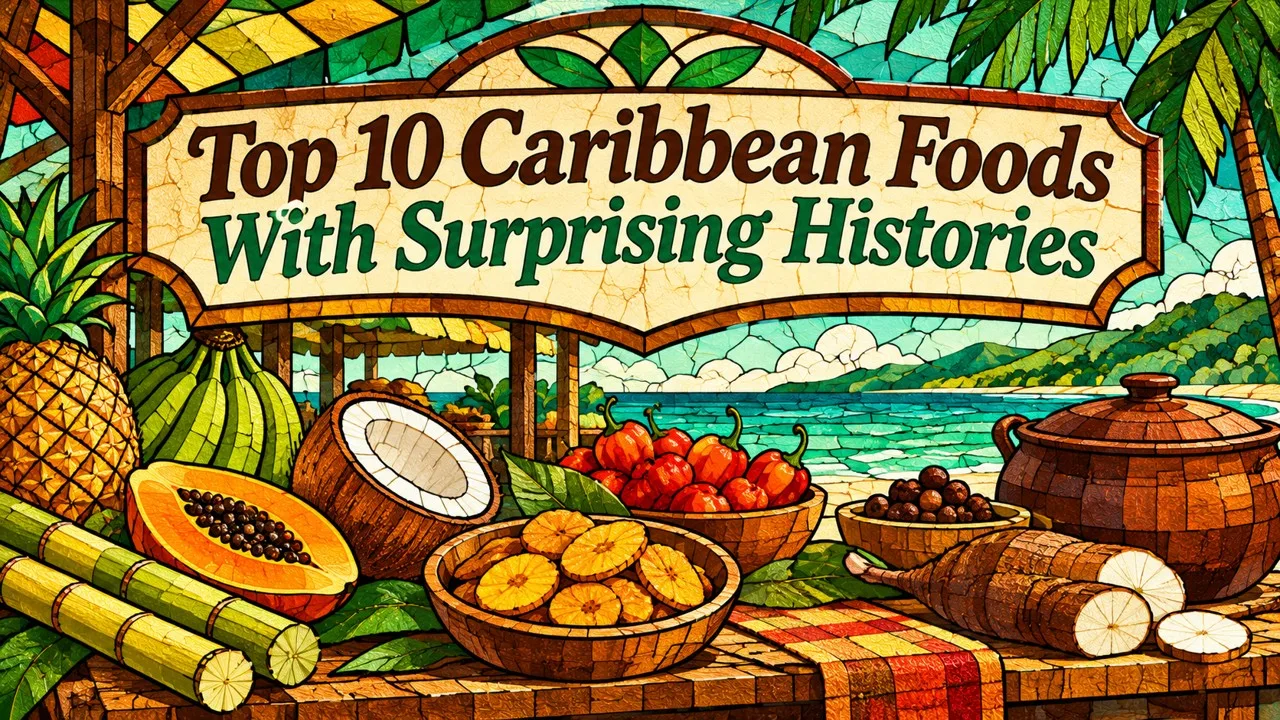
A fruit carried by the Bounty's captain, a word borrowed from the Taino and a drink with rival inventors: ten Caribbean foods with surprising histories. Caribbean food is famous for its bold flavours, vibrant colours and creative combinations. Dishes from the islands and the surrounding coasts are now enjoyed around the world.
Behind these dishes lie complex and often painful histories. The Caribbean was home to Indigenous peoples such as the Taino and the Kalinago before European colonisation transformed the region.
Colonisation brought European settlers and the transatlantic slave trade, which forcibly transported millions of Africans to the Caribbean to work on plantations. After slavery ended, indentured labourers arrived from India, China and elsewhere.
Each of these groups contributed ingredients, techniques and traditions. Caribbean cuisine is the result of centuries of mixing, adaptation and survival under often harsh conditions.
Many familiar foods and drinks have surprising stories. Some ingredients were brought across oceans for economic reasons, while others were invented by people making the most of limited resources.
The foods in this list come from Jamaica, Barbados, Trinidad and Tobago, Guyana, Puerto Rico and the wider region. Some are national dishes, while others are everyday favourites or famous drinks.
Food histories are often based on tradition and oral accounts, and the origins of some dishes are disputed. Where this is the case, it is noted.
Each entry names the food or drink, the island or country most associated with it and its roots, followed by an account of its history.
The entries are not ranked.
Together, they show how Caribbean food reflects the region's history of colonisation, slavery, migration and creativity.
Key Facts
| # | Food or drink | Island or country | Roots |
|---|---|---|---|
| 1 | Barbecue | The wider Caribbean | Taino cooking frameworks |
| 2 | Rum | Barbados and the wider Caribbean | Sugar plantations |
| 3 | Breadfruit | Jamaica, Saint Vincent and the wider Caribbean | The voyages of William Bligh |
| 4 | Ackee and saltfish | Jamaica | West Africa and the Atlantic trade |
| 5 | Jerk | Jamaica | The Maroons and Indigenous techniques |
| 6 | Pepperpot | Guyana | Indigenous Amerindian traditions |
| 7 | Doubles | Trinidad and Tobago | Indian indentured labour |
| 8 | Cou-cou and flying fish | Barbados | West African cooking traditions |
| 9 | Mofongo | Puerto Rico | West African fufu |
| 10 | The pina colada | Puerto Rico | Twentieth-century bartending |
1. A Word From the Taino
The word barbecue has its roots in the Caribbean. Spanish explorers in the sixteenth century recorded a word, barbacoa, used by the Taino and other Indigenous peoples for a raised wooden framework. Such frameworks could be used for cooking or drying food over a fire, and sometimes for sleeping [1].
The Spanish adopted the word, and it spread to other European languages. Over time, its meaning shifted to refer to the method of cooking meat slowly over a fire and to the social gatherings associated with it [1].
Today, barbecue traditions around the world, from the southern United States to Australia, owe at least part of their name to the Indigenous peoples of the Caribbean. Many of those peoples suffered devastating losses after European contact, but their language left a lasting mark.
Related: Top 10 Most Popular Food Rivalries in the World
2. A Drink Born From Sugar
Rum is made from sugarcane products, usually molasses, a by-product of sugar production. In the seventeenth century, plantation workers in the Caribbean, particularly in Barbados, began distilling molasses into a strong spirit, which was sometimes known by nicknames such as kill-devil [2].
Rum became an important part of the Atlantic economy, which was closely linked to the trade in enslaved Africans. Sugar, molasses and rum were shipped across the Atlantic as part of a network of trade that relied on enslaved labour [2].
The British Royal Navy issued a daily ration of rum to sailors for centuries. The tradition ended on 31 July 1970, a date remembered by sailors as Black Tot Day. Caribbean rums remain famous worldwide.
3. The Fruit Behind a Famous Mutiny
In the late eighteenth century, British plantation owners wanted a cheap, nutritious food to feed enslaved people in the Caribbean. The naturalist Joseph Banks promoted breadfruit, a starchy fruit from the Pacific islands [3].
In 1787, William Bligh sailed on HMS Bounty to collect breadfruit plants from Tahiti. In 1789, part of his crew mutinied, and the plants were thrown overboard. Bligh later commanded a second expedition, which successfully delivered breadfruit to Saint Vincent and Jamaica in 1793 [3].
At first, the fruit was reportedly unpopular, but over time it became a staple in many Caribbean islands. Today, roasted or fried breadfruit is a popular food, and breadfruit appears in dishes such as oil down, the national dish of Grenada.
4. A National Dish With a Poisonous Fruit
Ackee and saltfish is the national dish of Jamaica. Ackee is a fruit originally from West Africa, which arrived in Jamaica in the eighteenth century, possibly on a slave ship. Its scientific name, Blighia sapida, honours William Bligh, who took specimens to Britain [4].
Ackee must be prepared carefully. The unripe fruit contains a toxin that can cause serious illness, sometimes called Jamaican vomiting sickness. Only the flesh of fruits that have opened naturally on the tree is safe to eat [4].
Saltfish, or salted cod, was imported from North Atlantic fisheries such as those of Newfoundland as cheap, long-lasting food for enslaved people. The combination of an African fruit and North Atlantic fish reflects the trade networks of the colonial era.
5. Cooking in the Mountains
Jerk is a style of cooking in which meat, often chicken or pork, is marinated in a spicy mixture and slowly cooked over a fire. Key ingredients include Scotch bonnet peppers and pimento, also known as allspice [5].
Related: Top 10 Common Misconceptions in Food History
The technique is closely associated with the Jamaican Maroons, communities of Africans who escaped slavery and established independent settlements in the island's mountains. They are believed to have adapted cooking methods from the Indigenous Taino, slowly cooking meat over pimento wood [5].
The origin of the word jerk is uncertain, but it is often linked to a Spanish word for dried meat, which itself came from a South American Indigenous language. Jerk is now one of Jamaica's best-known contributions to world cuisine.
6. A Stew Preserved by Cassava
Pepperpot is a rich meat stew that is considered the national dish of Guyana. It is often eaten on Christmas morning [6].
The dish's key ingredient is cassareep, a thick, dark sauce made from the juice of the cassava root. Indigenous peoples of the region developed the technique of processing cassava juice, which is poisonous when raw, into a safe and flavourful sauce [6].
Cassareep has preservative qualities. Traditionally, pepperpot could be kept and reheated over several days, with more meat added over time. The dish reflects the lasting influence of Indigenous food traditions in Guyana.
7. Street Food From Indentured Labourers
After slavery was abolished in the British Caribbean, plantation owners recruited labourers from India under indenture contracts. The first ship carrying Indian labourers to Trinidad arrived in 1845, and many more followed [7].
The Indian community brought spices, curries and breads that transformed Trinidadian cuisine. Doubles, a popular street food, consists of two pieces of fried flatbread called bara filled with curried chickpeas and topped with sauces [7].
According to commonly told accounts, doubles was developed in the 1930s by a family of street vendors in Trinidad. Whatever its exact origins, it has become one of the most beloved foods in Trinidad and Tobago, typically eaten for breakfast.
8. A National Dish With African Roots
Cou-cou and flying fish is the national dish of Barbados. Cou-cou is made from cornmeal and okra, cooked and stirred until it becomes smooth and firm. It is served with flying fish, usually steamed in a spicy sauce [8].
Related: Top 10 Historical Food Fads That Left a Mark
Cou-cou is similar to dishes made in West Africa, such as fufu, which are made from starchy ingredients and eaten with stews. Enslaved Africans adapted their traditions to the ingredients available in the Caribbean [8].
The flying fish has become a symbol of Barbados, appearing on coins and in national imagery. Barbados is sometimes called the land of the flying fish, although changes in fish populations have affected supplies in recent years.
9. Mashed Plantains With African Roots
Mofongo is a Puerto Rican dish made from fried green plantains mashed with garlic, olive oil and pork cracklings. It is often shaped into a mound and served with broth, meat or seafood [9].
The dish is widely believed to have roots in West African fufu, brought to the Caribbean by enslaved Africans. Over time, it incorporated Spanish and Indigenous influences [9].
Mofongo is now one of the most famous dishes of Puerto Rico. Variations exist in other parts of the Caribbean, such as mangu in the Dominican Republic, which is made with boiled plantains.
10. A Cocktail With Rival Inventors
The pina colada, a blend of rum, coconut cream and pineapple juice, is one of the world's best-known tropical cocktails. Its origins are claimed by several people in Puerto Rico [10].
The Caribe Hilton hotel in San Juan has said that its bartender Ramon Marrero created the drink in 1954. Another bartender, Ramon Portas Mingot, is said to have created it at a restaurant in Old San Juan in 1963. Some legends even attribute an earlier version to a nineteenth-century pirate [10].
The drink became possible in its modern form after the development of a commercial cream of coconut in Puerto Rico in the mid-twentieth century. In 1978, Puerto Rico declared the pina colada its official national drink.
Conclusion
These foods and drinks show how Caribbean cuisine was shaped by many peoples and histories. Indigenous, African, European and Asian traditions all contributed.
Related: Top 10 Foods That Went From Scraps to Delicacies
Many dishes have roots in the painful history of slavery and colonisation. Enslaved and indentured people created rich culinary traditions despite harsh conditions and limited resources.
Some ingredients, such as breadfruit and ackee, were deliberately transported across oceans by colonial powers. Others reflect the trade networks that linked the Caribbean to the wider world.
Today, Caribbean food is celebrated around the world, carried by migrants to cities in North America, Europe and beyond.
Food historians continue to study the origins of Caribbean dishes, drawing on archives, oral histories and culinary traditions.
Many Caribbean communities take great pride in their national dishes, which serve as symbols of identity and heritage.
For food lovers, exploring Caribbean cuisine is a delicious way to learn about the region's history and the resilience of its peoples.
Markets, roadside stalls and family kitchens remain the heart of Caribbean food culture. Recipes are often passed down by word of mouth, and each island, village and household may have its own version of a classic dish, adjusted to local ingredients and personal taste.
Festivals such as Carnival in Trinidad and Crop Over in Barbados also showcase traditional foods, connecting modern celebrations with the history of the islands.
- ^ [1] Accounts of barbecue. Wikipedia: Barbecue Wikipedia: Taino
- ^ [2] Accounts of rum. Wikipedia: Rum Wikipedia: Black Tot Day
- ^ [3] Accounts of breadfruit. Wikipedia: Breadfruit Wikipedia: Mutiny on the Bounty
- ^ [4] Accounts of ackee and saltfish. Wikipedia: Ackee and saltfish Wikipedia: Blighia sapida
- ^ [5] Accounts of jerk. Wikipedia: Jamaican jerk spice Wikipedia: Jamaican Maroons
- ^ [6] Accounts of pepperpot. Wikipedia: Pepperpot Wikipedia: Cassareep
- ^ [7] Accounts of doubles. Wikipedia: Doubles (food) Wikipedia: Indo-Trinidadians and Tobagonians
- ^ [8] Accounts of cou-cou. Wikipedia: Cou-cou Wikipedia: Barbados
- ^ [9] Accounts of mofongo. Wikipedia: Mofongo Wikipedia: Fufu
- ^ [10] Accounts of the pina colada. Wikipedia: Pina colada Wikipedia: Caribe Hilton Hotel


















Discussion
Log in with