




 By
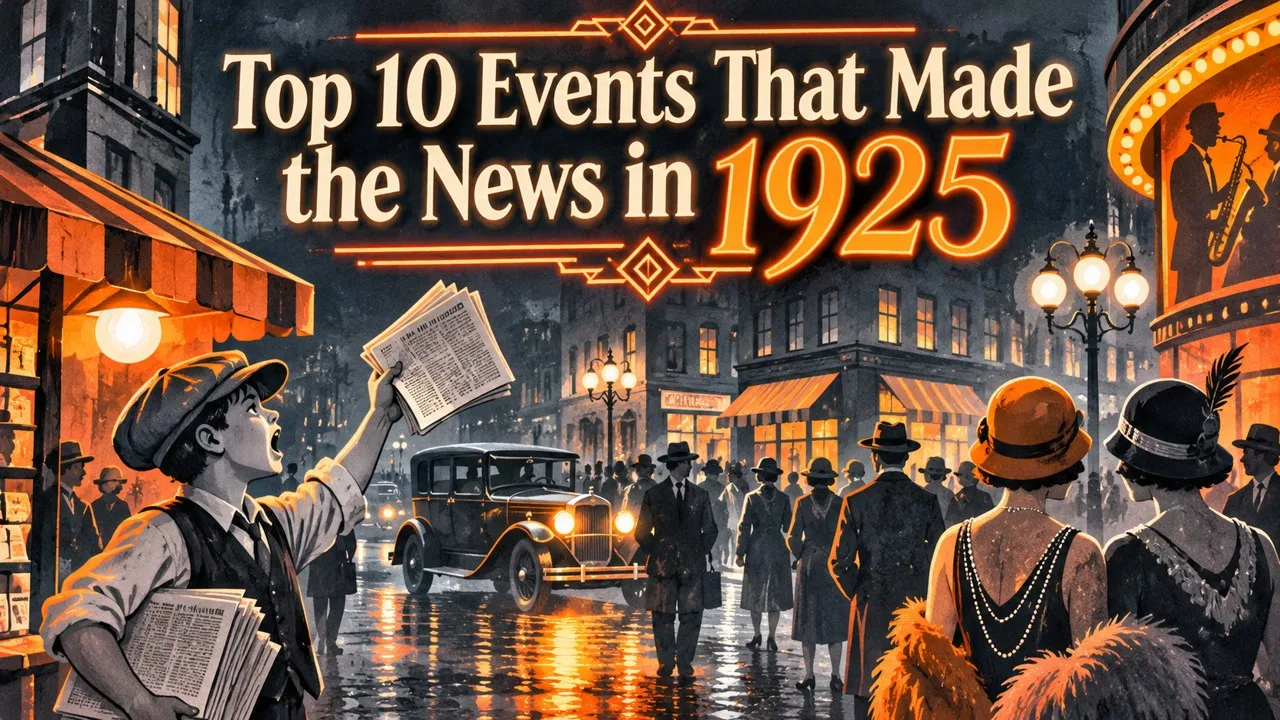
A dog-sled relay against disease, a trial over evolution, a deadly tornado and a novel that later became a classic: ten events that made the news in 1925. In 1925, the world was in the middle of the Roaring Twenties. In many countries, economies were growing, cities were expanding and new technologies such as radio and cinema were changing everyday life.
Newspapers and radio brought dramatic stories to huge audiences. Rescues, trials and disasters could capture national and even international attention for weeks.
The events of 1925 included tales of heroism and tragedy. A relay of dog sled teams raced to deliver medicine, while a man trapped in a cave became the focus of a media frenzy.
It was also a year of cultural milestones. A novel that would become one of the most famous in American literature was published, an exhibition in Paris gave its name to an artistic style and a radio show began that is still running.
Political and scientific debates made headlines too. A courtroom battle over the teaching of evolution and a set of treaties aimed at securing peace in Europe drew worldwide attention.
The events in this list come from the United States, Europe and Egypt. They range from politics and science to literature, music and natural disasters.
Some figures associated with these events, such as casualty counts and distances, vary between sources. They are presented here as approximate.
Each entry names the event, where it happened and when in 1925, followed by an account of what happened and why it mattered.
The entries are arranged in chronological order.
Together, they offer a snapshot of a world a century ago, full of energy, change and tension.
Radio was still a young medium in 1925, but it was spreading rapidly. In the United States, hundreds of stations were broadcasting, and millions of families gathered around receivers to hear music, sports, news and comedy. Newspapers competed fiercely for readers with dramatic headlines, special editions and photographs sent by wire. This combination of mass media helped turn local events into national stories, and it created new kinds of celebrities, from heroic sled dogs to courtroom lawyers.
Key Facts
| # | Event | Place | Date in 1925 |
|---|---|---|---|
| 1 | Nellie Tayloe Ross takes office | Wyoming, United States | 5 January |
| 2 | The serum run to Nome | Alaska, United States | January and February |
| 3 | The Floyd Collins rescue attempt | Kentucky, United States | January and February |
| 4 | The Tri-State Tornado | Missouri, Illinois and Indiana, United States | 18 March |
| 5 | The Great Gatsby is published | United States | 10 April |
| 6 | The International Exhibition of Modern Decorative and Industrial Arts | Paris, France | April to October |
| 7 | The Scopes Trial | Dayton, Tennessee, United States | July |
| 8 | The Locarno Treaties | Locarno, Switzerland | October to December |
| 9 | Examination of Tutankhamun's mummy | Egypt | October and November |
| 10 | The first broadcast of the Grand Ole Opry | Nashville, Tennessee, United States | 28 November |
1. The First Woman Governor
In 1924, the governor of Wyoming, William Ross, died in office. His widow, Nellie Tayloe Ross, was nominated to replace him and won a special election [1].
On 5 January 1925, she was sworn in as governor of Wyoming, becoming the first woman to serve as governor of an American state. Weeks later, Miriam Ferguson became governor of Texas [1].
Related: Top 10 Forgotten American Disasters
Ross later became the first woman to direct the United States Mint, a post she held for twenty years. Her election came only a few years after the Nineteenth Amendment guaranteed women the right to vote across the country.
2. A Race to Save a Town
In January 1925, an outbreak of diphtheria threatened the town of Nome in Alaska. The town's supply of antitoxin serum was insufficient, and winter weather made it impossible to fly in more [2].
Officials organised a relay of dog sled teams to carry serum across hundreds of kilometres of frozen wilderness. About twenty mushers and well over a hundred dogs took part, completing the journey in less than a week despite blizzards and extreme cold [2].
The musher Gunnar Kaasen and his lead dog Balto completed the final leg and became famous. Leonhard Seppala and his lead dog Togo covered the longest and most dangerous part of the route. A statue of Balto was unveiled in New York's Central Park later that year.
3. Trapped Underground
In late January 1925, the cave explorer Floyd Collins became trapped in a narrow passage in Sand Cave, Kentucky, while searching for a new cave to attract tourists. A rock pinned his foot, leaving him unable to move [3].
Rescue efforts became a national sensation. Newspapers and radio reported on the attempts daily, and thousands of people flocked to the site. A young reporter, William Burke Miller, crawled into the cave to interview Collins and later won a Pulitzer Prize for his reporting [3].
Rescuers were unable to free Collins, and he died in the cave in February. His story became one of the biggest news events of the 1920s and inspired later films and songs.
4. The Deadliest Tornado in American History
On 18 March 1925, a powerful tornado tore through southeastern Missouri, southern Illinois and southwestern Indiana. It travelled a very long distance across the three states, destroying towns along its path [4].
The tornado killed about 695 people, making it the deadliest tornado in United States history. Thousands of people were injured, and many communities were devastated [4].
At the time, tornado forecasting and warning systems did not exist. Later research has continued to study the event, including whether it was a single tornado or a series of tornadoes.
Related: Top 10 Famous Historical Events That Did Not Happen
5. A Novel That Struggled at First
On 10 April 1925, F. Scott Fitzgerald published The Great Gatsby, a novel set among wealthy people on Long Island during the Jazz Age. It tells the story of the mysterious millionaire Jay Gatsby and his longing for Daisy Buchanan [5].
The novel received mixed reviews and sold modestly during Fitzgerald's lifetime. He died in 1940 believing that he had been a failure [5].
After his death, interest in the novel grew, helped by its distribution to American soldiers during the Second World War. It is now regarded as one of the greatest American novels and is widely read in schools.
6. The Exhibition That Named a Style
In 1925, Paris hosted a major international exhibition devoted to modern decorative arts and design. Pavilions displayed furniture, glass, jewellery, textiles and architecture in bold new styles [6].
The exhibition showcased a sleek, geometric and luxurious style that had been developing in France and elsewhere. It influenced design around the world in the following years [6].
Decades later, the style became known as Art Deco, a name derived from the exhibition's French title. Art Deco influenced everything from skyscrapers to cinemas, ocean liners and household objects.
7. Evolution on Trial
In 1925, Tennessee passed a law banning the teaching of human evolution in public schools. John Scopes, a high school teacher in Dayton, agreed to be prosecuted to test the law [7].
The trial in July 1925 attracted national attention. The prosecution was assisted by William Jennings Bryan, a famous politician, while the defence was led by the lawyer Clarence Darrow. In a dramatic moment, Darrow questioned Bryan about the Bible [7].
Scopes was found guilty and fined 100 dollars, but the verdict was later overturned on a technicality. The trial became a symbol of conflicts between science and religion and was later dramatised in the play and film Inherit the Wind.
Related: Top 10 Things People Blamed for Natural Disasters
8. Treaties for Peace in Europe
In October 1925, representatives of several European countries met in the Swiss town of Locarno. They negotiated a series of agreements aimed at securing peace after the First World War [8].
The main treaty guaranteed the borders between Germany and its western neighbours, France and Belgium. The agreements were formally signed in London in December 1925, and they paved the way for Germany to join the League of Nations in 1926 [8].
The treaties created a spirit of optimism about peace in Europe. However, they did not settle Germany's eastern borders, and the hopes they raised were later shattered by the rise of Nazi Germany.
9. The Face of a Pharaoh
In 1922, the British archaeologist Howard Carter discovered the tomb of the Egyptian pharaoh Tutankhamun in the Valley of the Kings. The discovery caused a worldwide sensation [9].
In late 1925, Carter and his team opened the innermost coffin and examined the pharaoh's mummy. They revealed the famous gold funerary mask that covered the mummy's head and shoulders [9].
The examination was carried out with the methods of the time, which damaged the mummy. The golden mask became one of the most famous artefacts in the world and is now displayed in Egypt.
10. A Radio Show That Is Still Running
On 28 November 1925, the radio station WSM in Nashville broadcast a programme of country music featuring a fiddler named Uncle Jimmy Thompson. The programme, initially called the WSM Barn Dance, became a weekly show [10].
In 1927, the show was renamed the Grand Ole Opry. It became one of the most important venues for country music, helping to launch the careers of many stars [10].
The Grand Ole Opry is still broadcast today and is often described as the longest-running radio broadcast in American history. It celebrated its centenary in 2025.
Related: Top 10 Historical Mysteries That Have Been Solved
Conclusion
The events of 1925 reflect a world in transition. New media such as radio and mass-circulation newspapers turned rescues, trials and disasters into national dramas.
Cultural milestones from 1925, such as The Great Gatsby and Art Deco, continue to shape literature and design today.
The Scopes Trial and the Locarno Treaties reflected debates about science, religion, war and peace that remained important throughout the twentieth century.
Tragedies such as the Tri-State Tornado and the death of Floyd Collins highlighted the dangers people faced and the limits of rescue and warning systems at the time.
The serum run to Nome showed how courage and cooperation could overcome extreme conditions, and its story is still told today.
Many of the people involved in these events became famous, while others are remembered mainly by historians.
Looking back a century later, 1925 offers a fascinating view of a world that was rapidly becoming modern.
Other notable events of 1925 also deserve mention. Charlie Chaplin released The Gold Rush, the Soviet director Sergei Eisenstein completed Battleship Potemkin, and the Chrysler Corporation was founded in the United States. Each of these would leave a lasting mark on film or industry, showing how much creative and commercial energy the year contained.
Several of these stories, including the serum run and the Scopes Trial, were retold in later films, books and plays, keeping them alive in popular memory.
- ^ [1] Accounts of Nellie Tayloe Ross. Wikipedia: Nellie Tayloe Ross Wikipedia: Governor of Wyoming
- ^ [2] Accounts of the serum run. Wikipedia: 1925 serum run to Nome Wikipedia: Balto
- ^ [3] Accounts of Floyd Collins. Wikipedia: Floyd Collins Wikipedia: William Burke Miller
- ^ [4] Accounts of the Tri-State Tornado. Wikipedia: 1925 Tri-State tornado Wikipedia: Tornado
- ^ [5] Accounts of The Great Gatsby. Wikipedia: The Great Gatsby Wikipedia: F. Scott Fitzgerald
- ^ [6] Accounts of the Paris exhibition. Wikipedia: International Exhibition of Modern Decorative and Industrial Arts Wikipedia: Art Deco
- ^ [7] Accounts of the Scopes Trial. Wikipedia: Scopes trial Wikipedia: Clarence Darrow
- ^ [8] Accounts of the Locarno Treaties. Wikipedia: Locarno Treaties Wikipedia: League of Nations
- ^ [9] Accounts of Tutankhamun. Wikipedia: Tutankhamun Wikipedia: Mask of Tutankhamun
- ^ [10] Accounts of the Grand Ole Opry. Wikipedia: Grand Ole Opry Wikipedia: WSM (AM)




















Discussion
Log in with