





Top 10 Turning Points That Defined Eras of American History
 By Dhiraj Sharma · Published
Share Post
Loading…
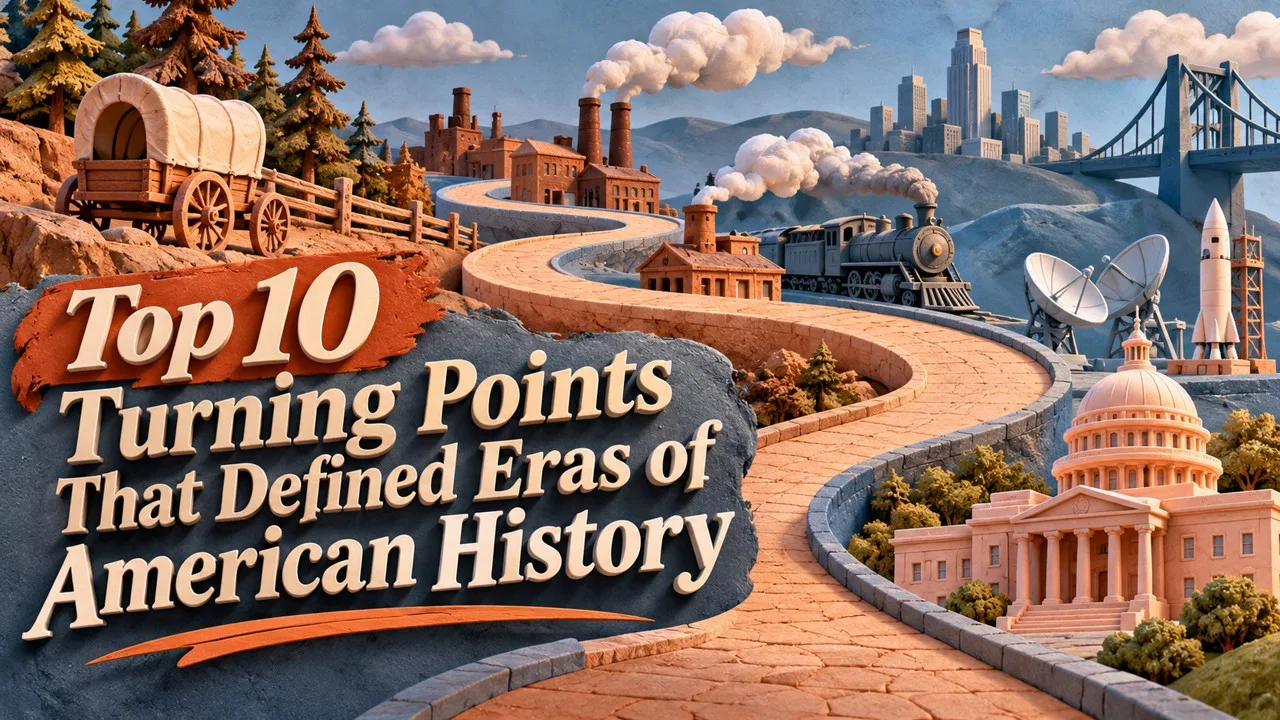
From a fragile settlement at Jamestown to the Constitution, a golden spike, a market crash and the 2001 attacks: ten turning points that defined American eras. American history is often divided into eras, each with its own character, challenges and achievements. Historians speak of the colonial era, the early republic, the age of expansion, the Civil War and Reconstruction, the Gilded Age, the Great Depression and many others.
Eras rarely begin or end on a single day. Yet certain events stand out as turning points that changed the direction of the country and marked the start of something new.
Some turning points were political, such as the adoption of the Constitution or the passage of landmark laws. Others were economic or technological, such as the opening of a canal or the completion of a railroad.
Some were moments of crisis, from economic collapse to terrorist attacks, that forced Americans to rethink their institutions and priorities.
Many of these turning points had very different meanings for different groups of people. Expansion that brought opportunity to some brought displacement and suffering to others, particularly Native American nations and enslaved people.
The turning points in this list span almost four centuries, from the founding of Jamestown in 1607 to the attacks of 11 September 2001.
Historians debate which events were most important, and many other turning points could have been included. This list is one selection among many possible choices.
Each entry names the turning point, the year it occurred and the era it helped open, followed by an account of what happened and why it mattered.
The entries are arranged in chronological order.
Together, they offer a broad overview of how the United States has been shaped by decisive moments.
Turning points are often clearer in hindsight than they were at the time. People living through the founding of Jamestown or the passage of the GI Bill could not know how important those events would become. Historians identify turning points by looking at long-term consequences, comparing conditions before and after an event and studying how people at the time understood what was happening. Their conclusions change as new evidence emerges and as each generation asks new questions about the past.
Key Facts
| # | Turning point | Year | Era it opened |
|---|---|---|---|
| 1 | The founding of Jamestown | 1607 | The colonial era |
| 2 | The Constitution | 1787 to 1789 | The early republic |
| 3 | The Louisiana Purchase | 1803 | The age of westward expansion |
| 4 | The Erie Canal | 1825 | The market revolution |
| 5 | The Thirteenth Amendment | 1865 | Reconstruction |
| 6 | The first transcontinental railroad | 1869 | The Gilded Age and industrial growth |
| 7 | The stock market crash | 1929 | The Great Depression |
| 8 | The GI Bill | 1944 | The post-war boom |
| 9 | The Civil Rights Act | 1964 | The civil rights era |
| 10 | The attacks of 11 September 2001 | 2001 | The post-9/11 era |
1. A Fragile Foothold
In May 1607, English colonists sponsored by the Virginia Company founded a settlement at Jamestown in Virginia. It became the first permanent English settlement in North America [1].
The early years were desperately hard. Disease, hunger and conflict with the Powhatan people killed many settlers, especially during the winter of 1609 to 1610, known as the Starving Time. The colony survived, and tobacco cultivation later made it profitable [1].
Related: Top 10 Accidents That Changed the Course of History
In 1619, Virginia's General Assembly met for the first time, an early form of representative government in English America. The same year, the first recorded enslaved Africans arrived in the colony. Both developments shaped the centuries that followed.
2. A New Framework of Government
After independence, the United States was governed under the Articles of Confederation, which created a weak central government. Many leaders believed a stronger framework was needed [2].
In 1787, delegates met in Philadelphia and drafted the Constitution, which established a federal government with three branches and a system of checks and balances. It was ratified by the required number of states in 1788 and took effect in 1789 [2].
The Bill of Rights, the first ten amendments, was added in 1791. The Constitution is often described as the oldest written national constitution still in use, though it has been amended many times, including to end slavery and extend voting rights.
3. Doubling the Nation
In 1803, the United States purchased the vast Louisiana Territory from France for about 15 million dollars. The purchase roughly doubled the size of the country [3].
President Thomas Jefferson sent Meriwether Lewis and William Clark on an expedition to explore the new territory and the lands beyond it. Their journey, from 1804 to 1806, reached the Pacific Ocean [3].
The purchase opened the way for westward expansion, which brought enormous growth to the United States. It also led to the displacement of Native American nations, whose lands were taken over the following decades, and intensified debates about whether slavery would spread into new territories.
4. A Waterway That Built a City
In 1825, the Erie Canal opened in New York State, connecting the Hudson River with Lake Erie. The canal stretched about 580 kilometres and was an extraordinary engineering achievement for its time [4].
The canal dramatically reduced the cost of transporting goods between the Midwest and the East Coast. Farm products flowed east, while manufactured goods and settlers moved west [4].
New York City became the leading port and commercial centre of the United States. The canal's success inspired a wave of canal and railroad building and helped transform the American economy into a national market.
Related: Top 10 Remarkable Coincidences From History
5. The End of Slavery
The Civil War, fought from 1861 to 1865, was the deadliest war in American history. In 1863, President Abraham Lincoln issued the Emancipation Proclamation, declaring enslaved people in Confederate-held areas to be free [5].
In December 1865, the Thirteenth Amendment to the Constitution was ratified, abolishing slavery throughout the United States. It was followed by the Fourteenth Amendment, which guaranteed citizenship and equal protection, and the Fifteenth Amendment, which prohibited denying the vote on the basis of race [5].
The period of Reconstruction that followed saw major efforts to rebuild the South and secure rights for formerly enslaved people. Many of these gains were later reversed, and the struggle for equal rights continued for another century.
6. The Golden Spike
On 10 May 1869, the tracks of the Central Pacific and Union Pacific railroads met at Promontory Summit in Utah. A ceremonial golden spike marked the completion of the first transcontinental railroad [6].
The railroad was built by thousands of workers, including large numbers of Chinese immigrants on the Central Pacific and Irish immigrants and Civil War veterans on the Union Pacific. Many workers died in dangerous conditions [6].
The railroad cut travel time across the country from months to about a week. It accelerated settlement of the West, the growth of national markets and the rise of large corporations, while bringing devastating changes to Native American nations and the buffalo herds on which many depended.
7. The Crash
In October 1929, the New York stock market crashed, with dramatic falls on days that became known as Black Thursday and Black Tuesday. The crash wiped out vast amounts of wealth [7].
The crash was followed by the Great Depression, the worst economic downturn in American history. Banks failed, businesses closed and unemployment rose to around a quarter of the workforce by 1933 [7].
The crisis led to major changes in the role of government. Under President Franklin D. Roosevelt, the New Deal introduced programmes such as Social Security and new regulation of banks and financial markets, many of which still exist.
Related: Top 10 Surprising Facts About Benjamin Franklin
8. Opportunity for Returning Veterans
In June 1944, President Franklin D. Roosevelt signed the Servicemen's Readjustment Act, known as the GI Bill. It provided benefits to veterans of the Second World War, including support for education, training and home loans [8].
Millions of veterans used the GI Bill to attend college or receive training, and many bought homes with government-backed loans. The law helped expand the middle class and fuel the growth of suburbs [8].
However, the benefits were not equally available to everyone. Many Black veterans faced discrimination from banks, colleges and local administrators, limiting their access to the opportunities that the law provided.
9. Ending Legal Segregation
In 1954, the Supreme Court ruled in Brown v. Board of Education that racial segregation in public schools was unconstitutional. The decision was followed by years of activism, protests and resistance [9].
In July 1964, President Lyndon B. Johnson signed the Civil Rights Act, which outlawed discrimination based on race, colour, religion, sex or national origin in employment and public accommodations. It was followed in 1965 by the Voting Rights Act, which protected the right to vote [9].
These laws were the result of years of struggle by the civil rights movement. They transformed American society, although debates about civil rights and equality continue today.
10. A Day That Changed Security
On 11 September 2001, terrorists hijacked four passenger airliners. Two were flown into the World Trade Center in New York, one into the Pentagon near Washington, and one crashed in a field in Pennsylvania after passengers fought back. Nearly 3,000 people were killed [10].
The attacks led to wars in Afghanistan and Iraq, the creation of the Department of Homeland Security and major changes to security in airports and other public places [10].
The attacks also sparked debates about civil liberties, surveillance and the use of military force that continue to shape American politics. Many historians see them as the start of a new era in American history.
Related: History of Bombay: From Seven Islands to Mumbai
Conclusion
These turning points show how the United States has been shaped by decisive moments in politics, economics, technology and society.
Many of these events had very different consequences for different groups. Expansion and economic growth brought opportunity for some and loss for others.
Several turning points involved the expansion of rights, from the end of slavery to the civil rights laws of the 1960s. Others involved crises that tested American institutions.
Historians continue to debate the significance of these events and how they connect to one another.
Many other events could have been included, such as the Declaration of Independence, the entry into the world wars or the Moon landing.
Understanding these turning points can help explain how the United States became the country it is today.
For anyone interested in history, these moments offer a framework for exploring the many stories that make up the American past.
Many of these turning points are commemorated today in museums, national parks and historic sites, from the reconstructed settlement at Jamestown to the Golden Spike National Historical Park in Utah and the National September 11 Memorial and Museum in New York. Visiting such places can bring these moments vividly to life.
- ^ [1] Accounts of Jamestown. Wikipedia: Jamestown, Virginia Wikipedia: Starving Time
- ^ [2] Accounts of the Constitution. Wikipedia: Constitution of the United States Wikipedia: United States Bill of Rights
- ^ [3] Accounts of the Louisiana Purchase. Wikipedia: Louisiana Purchase Wikipedia: Lewis and Clark Expedition
- ^ [4] Accounts of the Erie Canal. Wikipedia: Erie Canal Wikipedia: Market Revolution
- ^ [5] Accounts of the Thirteenth Amendment. Wikipedia: Thirteenth Amendment Wikipedia: Reconstruction era
- ^ [6] Accounts of the transcontinental railroad. Wikipedia: First transcontinental railroad Wikipedia: Golden spike
- ^ [7] Accounts of the 1929 crash. Wikipedia: Wall Street crash of 1929 Wikipedia: Great Depression in the United States
- ^ [8] Accounts of the GI Bill. Wikipedia: G.I. Bill Wikipedia: Suburbanization
- ^ [9] Accounts of the Civil Rights Act. Wikipedia: Civil Rights Act of 1964 Wikipedia: Brown v. Board of Education
- ^ [10] Accounts of 11 September 2001. Wikipedia: September 11 attacks Wikipedia: United States Department of Homeland Security























Discussion
Log in with