




 By
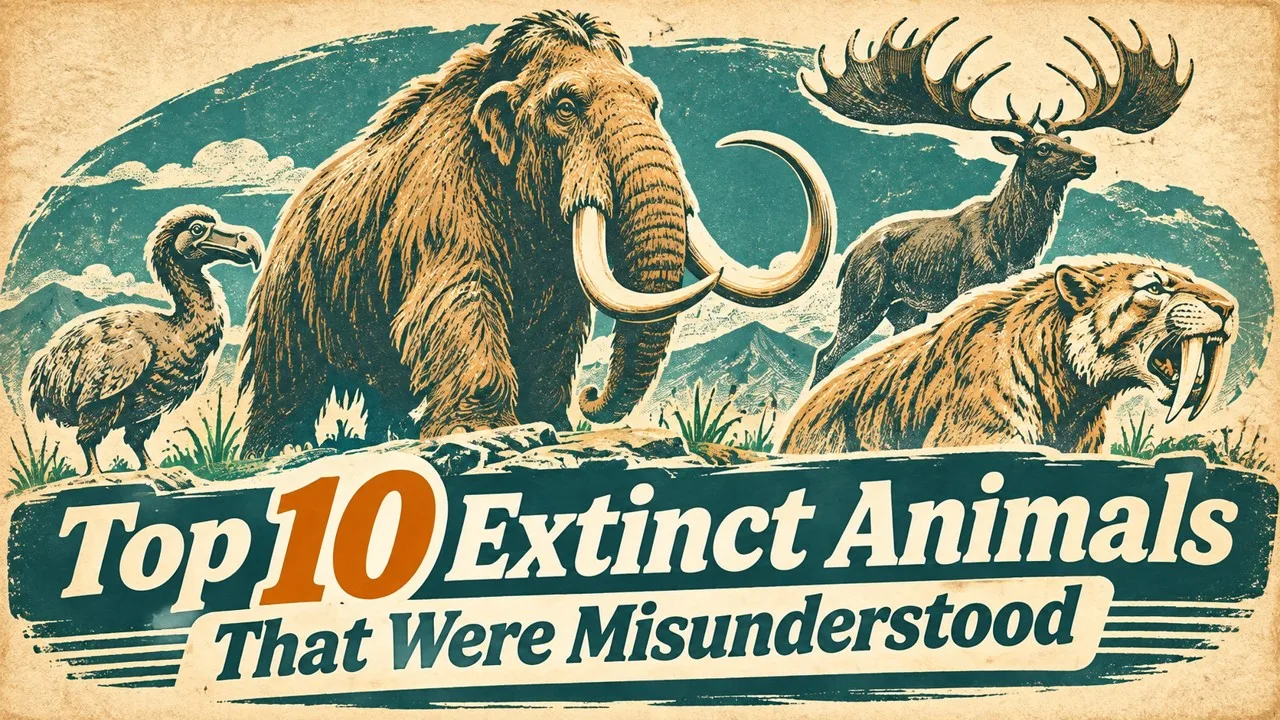
Cave lions sometimes mixed with modern lions, and a Jurassic fish shows bony fishes could grow huge; the dodo was a pigeon, and a film is not a nest record. Extinct animals accumulate folklore as quickly as they accumulate fossils: a bear becomes a monster, a pigeon becomes a fool, a tyrannosaur becomes a movie parent, a shark becomes a shape that later papers have to slim down [4][5][7][9]. The ten cases below are revisions of that kind, drawn from bones, genes, coprolites and endocasts, and kept distinct from an earlier list of dinosaur misconceptions where the two would otherwise repeat a posture debate [3][4]. This article will not stage a film chase, will not treat a 2026 nest study as a finished family portrait, and will not turn scavenging into a gore scene [1][3][5]. Sizes, identities and diets are qualified where the evidence is still moving [4][8][9].
A new paper can change a silhouette. The useful habit is to say so, and to leave the old silhouette in the history of the argument.
Key Facts
These are documented reinterpretations of extinct, or recently extinct, animals.
Ten Revisions at a Glance
| Rank | Claim | Careful version |
|---|---|---|
| 1 | Ground-squirrel diets | Ancient Yukon nest material contains environmental DNA from many plants and large mammals; that does not, by itself, prove that squirrels ate all of those animals |
| 2 | Cave lions and modern lions | Genetic evidence indicates limited interbreeding when ranges overlapped in cold periods |
| 3 | Tyrannosaur hatchlings | Recent work on very small fossils suggests precocial young and fairly large clutches; that is not a film scene, and it does not prove that adults never attended a nest |
| 4 | Nanotyrannus | A small tyrannosaur taxon, long argued to be a juvenile T. rex, has been supported again in recent work; the debate is reopened, not necessarily closed forever |
| 5 | Leedsichthys | A Jurassic bony fish reached a very large size, which undercuts a neat rule that bony fishes cannot become giants; published length estimates have varied |
| 6 | California grizzly | A 2023 study of museum specimens found typical grizzly sizes, not the monstrous weights of some old stories; the population was still hunted to local extinction |
| 7 | The dodo | Endocast work treats the bird as a pigeon with a brain in the normal columbid range, not as a proverb for stupidity |
| 8 | Denisovan limbs | A 2026 protein study assigned dredged Taiwanese limb bones to Denisovans; the sample is small, and "some were tall" remains a cautious reading |
| 9 | Megalodon shape | A 2025 restudy of a Belgian vertebral column favors a longer, leaner reconstruction than some earlier images; the animal was still an enormous shark |
| 10 | Myotragus | An extinct Balearic goat shows bone growth lines more often associated with reptiles, evidence of flexible, slow growth on a poor island, not a living "cold-blooded mammal" |
1. A Nest, and a Cautious Menu
Arctic ground squirrels today will take meat, including carrion, when they emerge from hibernation and need a dense meal, which already complicates a strictly vegetarian cartoon of the group [1]. In 2026, researchers reported environmental DNA from ancient squirrel nest material in the Yukon, some of it hundreds of thousands of years old, with traces of many plants and of large mammals, including mammoth, bison and big cats [1]. The unexpected fact is the archive, a midden that holds a landscape. The careful fact is the limit of the method. DNA in a nest can arrive on food, on a carcass, on plant material, or as background from the surroundings, and the paper itself does not require that the squirrels ate every animal on the list. This article will not invent a hunt, and it will not stage a feeding.
A nest can be a library. The library should be read as a set of possible contacts, not as a finished cookbook.
2. Two Lions, Occasionally in Contact
The cave lion, Panthera spelaea, was a large Pleistocene cat of northern Eurasia and northwestern North America, and it disappeared around the end of the last Ice Age [2]. Genetic work has indicated that it sometimes interbred with the lineage of modern lions when cold climates pushed ranges together, and that such contact declined when the ice retreated [2]. The unexpected fact is the leaky boundary, not a single mixed population living as a safari species. The careful fact is "occasionally" and "in cold periods," which is what the genetic pattern can support. This article will not restage a fight, and it will not treat a hybrid signal as a new zoo animal.
Two closely related cats can meet at the edge of a shifting habitat. The meeting is a genetic footnote, and the footnote is enough.
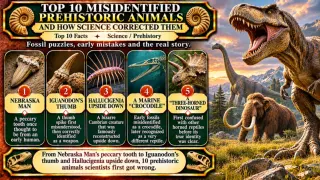
Related: Top 10 Misidentified Prehistoric Animals and How Science Corrected Them
3. Hatchlings, without a Movie
Popular images of tyrannosaur family life have been shaped by fiction, including scenes that this article will not retell [3]. Recent work on very small fossils, identified as tyrannosaur hatchlings, describes animals perhaps under a meter long and already showing tooth wear consistent with feeding, a pattern often called precocial [3]. Estimates of fairly large clutches have been used to suggest less intensive care per offspring than in many living birds, though more than in many reptiles; that is a comparison, not a proof that adults never attended young [3]. The unexpected fact is the size of the hatchling, which is easy to over-draw. The careful fact is the fossil, and the refusal to let a film stand in for a nest record. This entry is also kept clear of an earlier misconceptions list that already treated posture, feathers and speed.
A hatchling can be small and still be a tyrannosaur. The family life around it remains, in large part, an inference.
4. A Small Tyrannosaur, Argued Again
A small tyrannosaur skull found in Montana in 1942 later became the basis for Nanotyrannus lancensis, a name that many specialists spent years treating as a juvenile Tyrannosaurus rex [4]. The resemblance is real, and the synonymy became the majority view, but the debate never fully vanished. More recent work, including studies reported in the mid-2020s, has again argued that at least some of the small specimens represent a distinct taxon [4]. The unexpected fact is the return of a name that textbooks had begun to retire. The careful fact is the status of the argument. This article will say that the case for Nanotyrannus has been strengthened, not that every last worker now agrees, and not that the question can never reopen once more.
A genus can be declared a teenager and later asked to sit up again. The asking is the scientific fact worth listing.
5. A Bony Fish That Grew Very Large
Living bony fishes, numerous as they are, rarely approach the mass of the largest sharks; a giant sunfish of a few tonnes is already exceptional among measured living bony species [5]. That pattern has sometimes been turned into a physiological rule, as if bone, metabolism and oxygen together forbade true giants. Leedsichthys problematicus, a Jurassic filter feeder, is the usual counterexample: published length estimates have varied, and some careful accounts put it in a range of many meters, large enough to break any neat modern size cap [5]. The unexpected fact is the existence of the giant, not a single frozen number. This article will not pretend that every early estimate was precise. The careful fact is that a bony fish, in the Jurassic, reached a size that living relatives do not.
Related: Top 10 Animals Once Thought Extinct That Turned Up Alive
A rule about living animals can fail in a quarry. The quarry, in this case, holds a bony fish that had already tested the limit.
6. A Reputation, and a Museum Drawer
The California grizzly, a population of the North American brown bear, was gone as a wild animal by the mid-1920s, after hunting, trapping and poisoning, and it left behind stories of enormous, cattle-destroying beasts [6]. Research published in 2023 on museum skulls, bones and fur found body sizes in the ordinary grizzly range and a diet that does not match the most extreme old newspaper version [6]. The unexpected fact is the gap between the scrapbook and the drawer. The careful fact is double: the folklore overshot the animal, and the animal was still exterminated. This article will not become a trophy list, and it will not deny the real conflict that settlers created. The bones are the correction; the extinction is the other fact that remains.
A legendary weight can shrink in a caliper. The shrinkage does not bring the population back.
7. A Pigeon, not a Punchline
The dodo, Raphus cucullatus, was a large, flightless pigeon of Mauritius, extinct in the seventeenth century, and later used as a byword for stupidity [7]. Recent endocast work, including a 2026 study of skulls, has compared the reconstructed brain with those of living pigeons and found no good evidence that the dodo was an unusually unintelligent bird; some details, such as an emphasis on smell over vision, have been offered as clues to twilight or nocturnal habits, which remain an interpretation [7]. The unexpected fact is the ordinary pigeon-ness of the brain. The careful fact is that a brain shape does not restore a lost behavior in full, and that "not stupid" is not the same as a list of tricks. This article will not turn the bird into a clown or into a genius.
An island pigeon can be extinct and still have been competent at being a pigeon. The competence is the correction the proverb needed.
Related: Top 10 Most Bizarre Dinosaurs
8. A Few Bones, Assigned with Proteins
Denisovans were first identified in 2010 from DNA in a Siberian cave, and most of the early record was teeth and fragments, which left body size poorly known [8]. A 2026 analysis of proteins in limb bones dredged from the Penghu Channel off Taiwan assigned those bones to Denisovans, a result that, if it holds, adds stature and robustness to a small sample [8]. The unexpected fact is the method: proteins from a commercial dredge, read as a cousin of Neanderthals and of us. The careful fact is the sample size. "Some Denisovans may have been tall" is a cautious sentence, not a new average for a whole species. This article will not invent a population of giants.
A shin bone can move a picture. It should not be asked to stand for every Denisovan who ever lived.
9. Longer, Leaner, Still Enormous
Otodus megalodon, the huge shark of roughly 23 million to 3.6 million years ago, is known mostly from teeth and from scattered vertebrae, which is why reconstructions of its body have always been inferences [9]. A 2025 restudy of a partial Belgian vertebral column, compared with many living and extinct sharks, favored a longer and leaner animal than some earlier, stockier images had implied [9]. The unexpected fact is a change of silhouette, not a sudden shrinking of the famous teeth. The careful fact is uncertainty: one column, however carefully treated, is not a complete body, and length estimates remain ranges. This article will not borrow a film shark, and it will not stage a feeding.
A giant can be redrawn and still be a giant. The redrawing is the scientific news; the giant is the part that did not need a rumor.
Related: Top 10 Ancient Earth Events That Sound Like Science Fiction
10. An Island Goat, Growing by Fits
Myotragus balearicus, a small extinct goat of Mallorca and Menorca, lived for millions of years on resource-poor islands and disappeared several thousand years ago, around the time people arrived [10]. Bone histology published in 2009 showed lamellar-zonal tissue and lines of arrested growth of a kind more often discussed in reptiles, evidence that the animal could slow or pause growth when food was scarce [10]. The unexpected fact is the flexibility, not a claim that a mammal became a lizard. No living mammal is a reptile in its physiology, and this article will not say otherwise. The careful fact is a reduced, island energy budget written into the bone.
A goat can adapt to a poor island by growing slowly. The slowness is a life-history fact, and it does not require a cartoon about cold blood.
Conclusion
The ten revisions above are a cautious squirrel menu, a limited lion hybrid zone, a hatchling that is not a film prop, a small tyrannosaur name argued again, a Jurassic bony giant, a California bear cut down to measured size, a dodo restored to pigeon-hood, a few Denisovan limb bones, a slimmer megalodon, and an island goat with flexible growth. Several of the papers are recent, and several of the conclusions are still ranges.
An extinct animal is allowed to change in the literature after it has vanished from the world. The decent way to list those changes is to keep the fossil, name the uncertainty, and leave the movie, the proverb and the trophy in the margins.
- ^ [1] Research on environmental DNA from ancient Arctic ground-squirrel nest material in the Yukon, including the limits of using that DNA as a diet list. Britannica: ground squirrel Britannica: environmental DNA
- ^ [2] Genetic and paleontological accounts of the cave lion and of limited interbreeding with the modern lion lineage. Britannica: cave lion Britannica: lion
- ^ [3] Recent studies of very small tyrannosaur fossils interpreted as hatchlings, discussed without film scenes and without a finished claim about parental care. Britannica: Tyrannosaurus
- ^ [4] The taxonomic history of Nanotyrannus and of recent work reopening the case that some small specimens are not juvenile T. rex. Britannica: Tyrannosaurus
- ^ [5] Accounts of Leedsichthys and of debates about maximum size in bony fishes, with published length estimates treated as a range. Britannica: bony fish Britannica: Leedsichthys
- ^ [6] A 2023 study of California grizzly museum specimens, and histories of the population's extermination in the early twentieth century, without trophy or gore detail. Britannica: grizzly bear
- ^ [7] Endocast studies of the dodo and comparisons with living pigeons, treating "stupidity" as an unsupported proverb. Britannica: dodo Britannica: pigeon
- ^ [8] The 2010 identification of Denisovans and a 2026 protein analysis assigning Penghu Channel limb bones to that group, with body-size inferences left cautious. Britannica: Denisova remains
- ^ [9] A 2025 restudy of a Belgian megalodon vertebral column and of longer, leaner body reconstructions, without a film animal. Britannica: megalodon
- ^ [10] Bone-histology research on Myotragus balearicus and on flexible, slow growth in an extinct Balearic goat. Britannica: goat Britannica: Balearic Islands





















Discussion
Log in with