






 By
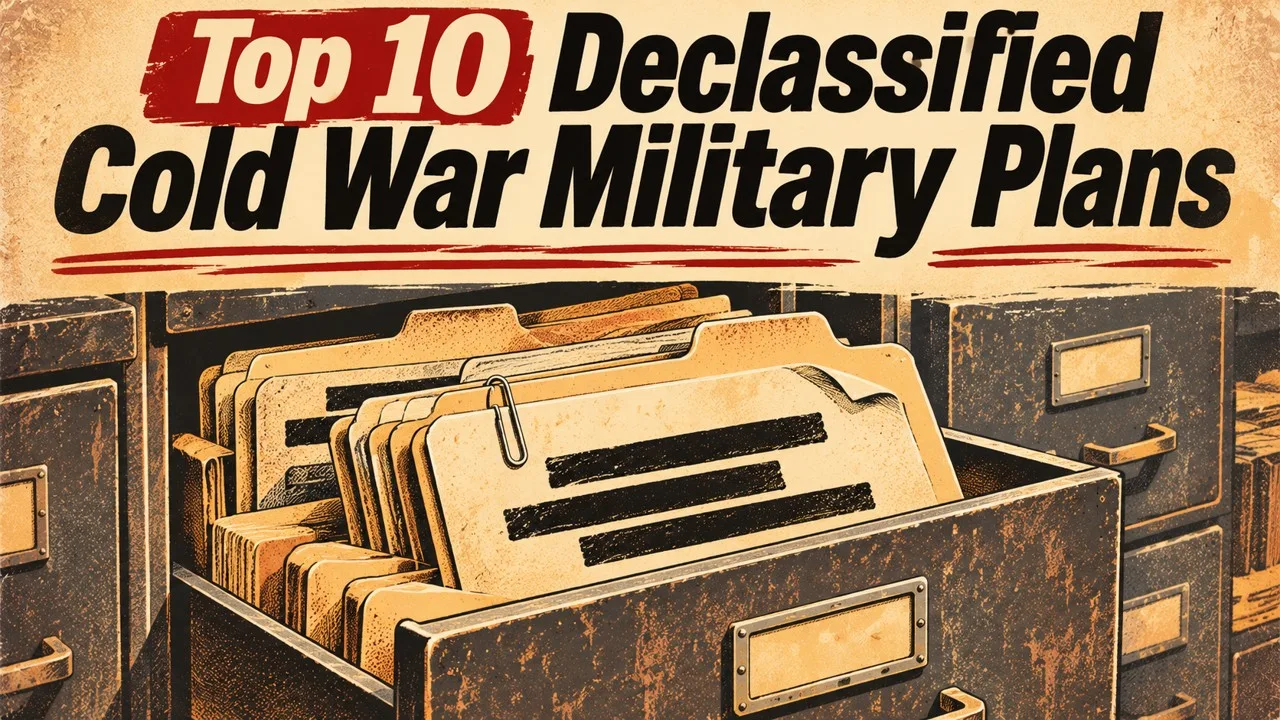
Declassified files show Cold War planners considered a blast on the Moon, missiles under Greenland's ice and a harbor dug by bombs, most never carried out. During the Cold War, military planners in the United States, Britain and elsewhere produced thousands of studies, contingency plans and proposals. Many were routine. Some, released decades later through declassification, archives or freedom of information requests, reveal ideas that sound like science fiction or political thrillers.
The ten plans below are Operation Unthinkable, Operation Dropshot, Project A119, Project Chariot, Project Horizon, Project Pluto, Project Iceworm, Blue Peacock, Operation Northwoods and the stay-behind networks often called Gladio. Most were never carried out. This article describes what they proposed, how they became public and what they show about the period, without endorsing any of them.
Key Facts
| # | Plan | Who and when | What happened to it |
|---|---|---|---|
| 1 | Operation Unthinkable | Britain, 1945 | Rejected as unworkable; released in 1998 |
| 2 | Operation Dropshot | United States, 1949 | A contingency plan, declassified in the late 1970s |
| 3 | Project A119 | United States Air Force, 1958 to 1959 | Studied and shelved; revealed in 2000 |
| 4 | Project Chariot | United States, 1958 to 1962 | Opposed by local communities and scientists; cancelled |
| 5 | Project Horizon | U.S. Army, 1959 | A feasibility study; never funded |
| 6 | Project Pluto | United States, 1957 to 1964 | Engine tests succeeded; the project was cancelled |
| 7 | Project Iceworm | United States, Greenland, 1960s | Abandoned; revealed by Danish research in the 1990s |
| 8 | Blue Peacock | Britain, 1950s | Two prototypes built; cancelled; documents released in 2004 |
| 9 | Operation Northwoods | U.S. Joint Chiefs of Staff, 1962 | Rejected by the Kennedy administration; released in 1997 |
| 10 | Stay-behind networks, known as Gladio | Western Europe, from the 1950s | Revealed by the Italian government in 1990 |
1. A Plan for War on an Ally
In the spring of 1945, as the Second World War in Europe was ending, Winston Churchill asked British military planners to consider a possible attack on the Soviet Union, then an ally, to impose a fair deal for Poland. The resulting plan was code-named Operation Unthinkable [1].
The Chiefs of Staff concluded that such an attack would be extremely risky. Soviet forces in Europe were much larger, and a war could last a long time. A second version of the plan considered how to defend Britain if the Soviet Union advanced. The plans were filed away [1].
The documents were declassified and released to the British National Archives in 1998. They show how quickly wartime alliances were giving way to mistrust, even before the war in Asia had ended. They also show that military staffs were asked to plan for scenarios their own leaders regarded as remote.
2. A War Plan for 1957
Operation Dropshot was a U.S. contingency plan, drawn up in 1949, for a possible war with the Soviet Union around 1957. It assumed a Soviet attack on Western Europe and other areas and outlined how the United States and its allies would respond [2].
The plan included the use of large numbers of nuclear and conventional bombs against Soviet targets, as well as ground and naval campaigns. Like other war plans of the period, it was a contingency document, not a decision to go to war [2].
Dropshot was declassified in the late 1970s and published in book form. Historians use it to understand early Cold War strategy, when the United States had a growing nuclear arsenal but the Soviet Union had only recently tested its first atomic bomb. It reflects the planning assumptions of a dangerous period.
3. A Nuclear Flash on the Moon
After the Soviet Union launched Sputnik in 1957, the United States looked for ways to show its own capabilities. One study, Project A119, considered detonating a nuclear device on the Moon, where the flash might be visible from Earth [3].
Related: Top 10 Inventions That Changed Warfare: Chariots to Drones
The study was carried out at the Armour Research Foundation in Chicago. The young Carl Sagan worked on calculations related to the possible dust cloud. The project was abandoned, partly because of concerns about public reaction and the risk of contaminating the Moon for future scientific study [3].
The project became public in 2000, when the physicist Leonard Reiffel, who had led it, spoke about it. Reports were later found in archives. Project A119 is often cited as an example of how the space race and the arms race were tangled together in the late 1950s.
4. A Harbor Dug by Bombs
Project Chariot was part of Project Plowshare, a U.S. program that studied peaceful uses of nuclear explosions. The plan proposed using several nuclear devices to excavate a harbor at Cape Thompson in northwest Alaska [4].
Iñupiat communities in the area, including the village of Point Hope, objected strongly, and some scientists studying the region raised concerns about radioactive contamination of the food chain. Their opposition, and the questionable value of a harbor in a place with a short shipping season, led to the cancellation of the project in 1962 [4].
Later investigations revealed that radioactive material had been brought to the site for experiments and buried there, which led to a cleanup in the 1990s. Project Chariot is often seen as an early example of environmental activism influencing nuclear policy and of Indigenous communities resisting government plans.
5. An Army Outpost on the Moon
In 1959, the U.S. Army produced a study called Project Horizon, which proposed building a military outpost on the Moon. The study argued that a lunar base would have strategic value and could be established by the mid-1960s [5].
The plan envisioned many rocket launches to carry materials and personnel. It reflected the Army's interest in space before NASA took over most civilian space work. The proposal was never adopted, and responsibility for lunar exploration went to NASA [5].
Related: Top 10 Battles the British Empire Lost
Project Horizon documents were later declassified and are now available to researchers. They show how military planners thought about space in the years before Apollo. Treaties later restricted military uses of the Moon, notably the Outer Space Treaty of 1967, which bans military bases and weapons tests on celestial bodies.
6. A Flying Nuclear Reactor
Project Pluto was a U.S. program to develop a nuclear-powered ramjet engine for a cruise missile known as SLAM, for Supersonic Low Altitude Missile. The idea was a missile that could fly at low altitude for very long distances, powered by an unshielded nuclear reactor [6].
Engineers at Lawrence Radiation Laboratory built and tested reactors, called Tory II-A and Tory II-C, in Nevada in the early 1960s. The tests showed that the engine could work. However, the missile would have spread radiation along its flight path, and its noise and shock waves would have caused damage below [6].
The program was cancelled in 1964, partly because intercontinental ballistic missiles had become a more practical option. Project Pluto is often cited as an extreme example of Cold War engineering. Its details have been published in historical studies since the end of the Cold War.
7. Missiles Under the Ice
Camp Century was a U.S. Army research base built in 1959 inside the Greenland ice sheet. Publicly, it was presented as a scientific station, and it did produce important ice core research. Secretly, it was linked to Project Iceworm, a plan to deploy hundreds of nuclear missiles in tunnels under the ice [7].
Engineers found that the moving ice sheet deformed the tunnels faster than expected, making the plan impractical. Camp Century was abandoned in 1967. The Danish government, which had authority over Greenland, was not fully informed about the missile plans [7].
Related: Top 20 World War II Facts: Little-Known Details and Essential History
Iceworm became public in the 1990s, when Danish researchers studied the history of U.S. activities in Greenland. Today, scientists are concerned that waste left at Camp Century, including chemical and radioactive material, could be exposed as the ice changes. The project is an example of a secret plan defeated by the environment itself.
8. A Nuclear Mine That Needed Warmth
Blue Peacock was a British project in the 1950s to develop nuclear landmines that could be buried in West Germany to slow a Soviet invasion. Each device was large, weighing several tons, and was designed to be detonated remotely or by a timer [8].
One problem was that buried electronics might fail in cold winters. Documents released in 2004 showed that engineers had considered several ways to keep the devices warm, including a proposal to seal live chickens inside with food, so that their body heat would keep the components working. The proposal was not carried out [8].
The project was cancelled in 1958, partly because of the political problems of placing nuclear mines in an allied country. The chicken detail made headlines when the documents were released by the National Archives, and some people at first suspected an April Fool joke because of the date.
9. A Proposal That Was Rejected
In March 1962, the U.S. Joint Chiefs of Staff proposed a series of possible actions, under the name Operation Northwoods, to create a pretext for military intervention in Cuba. The proposals included staged incidents that could be blamed on the Cuban government [9].
The plan was presented to Secretary of Defense Robert McNamara and was rejected by the Kennedy administration. It was never put into action. Its existence became public in 1997, when documents were released by the Assassination Records Review Board [9].
Related: Women Served in Armed Forces and Wartime Industries
The document is now widely cited because it shows that senior military officials put forward proposals involving deception of the public. Historians stress that it was a proposal that was refused, not an operation carried out. It remains an important source for understanding tensions between civilian leaders and the military during the period.
10. Secret Networks Behind the Lines
After the Second World War, NATO countries and their intelligence services set up secret stay-behind networks, intended to organize resistance, sabotage and intelligence gathering if the Soviet Union occupied Western Europe. In Italy, the network was called Gladio [10].
In 1990, Italian Prime Minister Giulio Andreotti publicly acknowledged the existence of Gladio. Investigations followed in several countries, including Belgium and Switzerland, and the European Parliament passed a resolution calling for inquiries [10].
Some investigations explored alleged links between members of stay-behind networks and political violence in Italy during the 1970s and 1980s. Those allegations remain contested and have been examined by various inquiries. The networks were dismantled in the early 1990s. Their revelation showed how much of Cold War preparation had been kept secret from the public in democratic countries.
Conclusion
The ten plans above show the range of Cold War thinking, from contingency war plans to engineering projects that pushed technology to its limits. Most were never carried out. Some were stopped by practical problems, such as the moving ice under Camp Century. Others were stopped by political leaders, local communities or scientists.
Declassification has made it possible to study these plans in detail, but it has also produced sensational headlines. The careful lesson is that planning for something is not the same as doing it. These documents are records of fears and possibilities, and of the checks that kept many of them on paper.
- ^ [1] Accounts of Operation Unthinkable and its release to the National Archives. Wikipedia: Operation Unthinkable Wikipedia: The National Archives (UK)
- ^ [2] Accounts of the 1949 Dropshot contingency plan. Wikipedia: Operation Dropshot Wikipedia: RDS-1
- ^ [3] Accounts of Project A119 and Leonard Reiffel's disclosure. Wikipedia: Project A119 Wikipedia: Carl Sagan
- ^ [4] Accounts of Project Chariot and the Point Hope community. Wikipedia: Project Chariot Wikipedia: Project Plowshare
- ^ [5] Accounts of Project Horizon and the Outer Space Treaty. Wikipedia: Project Horizon Wikipedia: Outer Space Treaty
- ^ [6] Accounts of Project Pluto and the Tory reactors. Wikipedia: Project Pluto Wikipedia: Supersonic Low Altitude Missile
- ^ [7] Accounts of Camp Century and Project Iceworm. Wikipedia: Project Iceworm Wikipedia: Camp Century
- ^ [8] Accounts of Blue Peacock and the 2004 release. Wikipedia: Blue Peacock Wikipedia: nuclear land mine
- ^ [9] Accounts of Operation Northwoods and its 1997 release. Wikipedia: Operation Northwoods Wikipedia: Assassination Records Review Board
- ^ [10] Accounts of NATO stay-behind networks and Italy's Gladio. Wikipedia: Operation Gladio Wikipedia: stay-behind





















Discussion
Log in with