






Women Served in Armed Forces and Wartime Industries
 By Dhiraj Sharma · Published
Share Post
Loading…
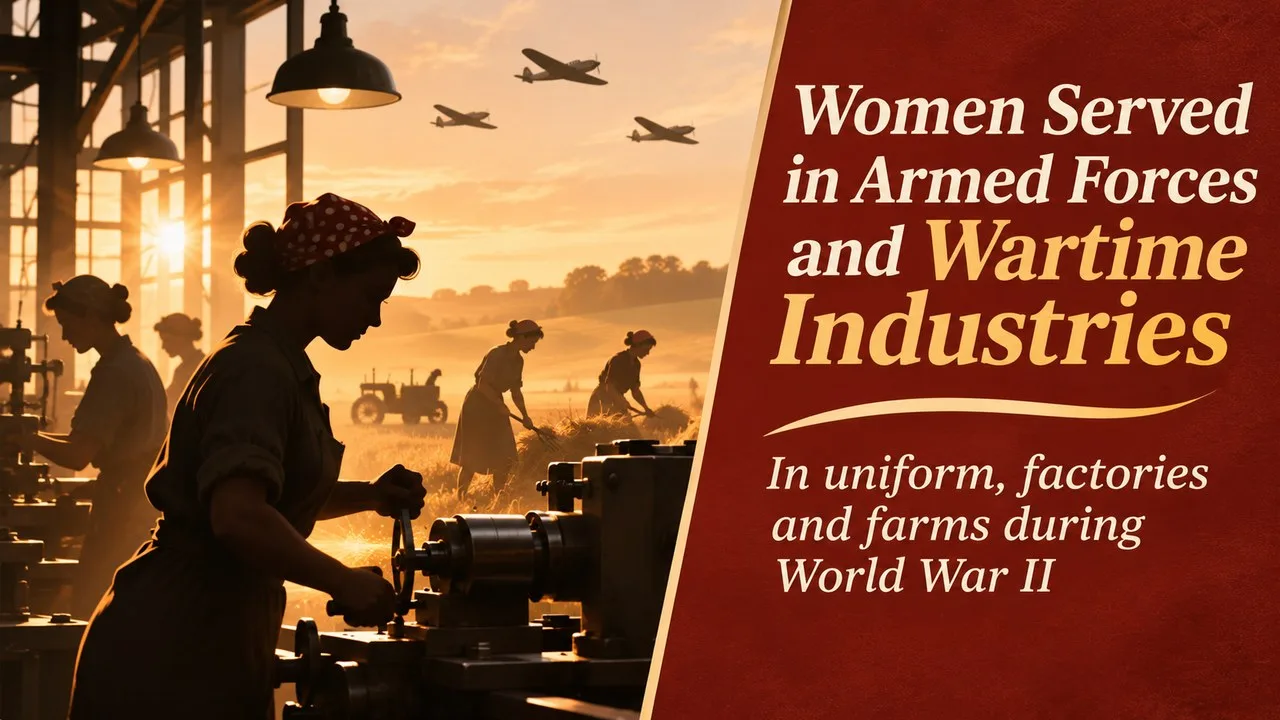
Women served in armed forces and wartime industries on an unprecedented scale in World War II, taking military, factory and farm jobs from 1939 to 1945.[1][2]
This Finepedia guide, updated in November 2026, looks at how Britain, the United States and the USSR mobilised women, the jobs they did in uniform and on the home front, the risks they faced and what changed once the war ended. It is number 4 in Top 20 World War II Facts: Little-Known Details.
Key Facts
| Attribute | Detail |
|---|---|
| Period | 1939 to 1945 |
| British call-up of women | From December 1941 under the National Service Act |
| Britain: women in war work (1944) | Over 7 million |
| Britain: largest women's service | Auxiliary Territorial Service (ATS), over 250,000 served |
| United States: women in uniform | More than 350,000 |
| United States: largest women's branch | Women's Army Corps, about 150,000 |
| United States: employed women | 12.09 million (December 1941) to 16.48 million (March 1944) |
| USSR: women in the Red Army | About 800,000 saw service |
| Famous all-female unit | 588th Night Bomber Regiment, the "Night Witches" |
| Symbol of industrial work | "Rosie the Riveter" in the United States |
| Key postwar law (US) | Women's Armed Services Integration Act, 1948 |
Sources: Imperial War Museums, US National Park Service, US Department of Labor and History Today.[1][2][3][4][5]
Background: Why Women Were Needed
Total war demanded total mobilisation. Millions of men were called into the armed forces, yet factories had to produce more weapons than ever, farms had to grow more food and offices had to run larger bureaucracies. Women were the largest untapped pool of labour.
The scale varied by country. The Imperial War Museums judges that no other combatant mobilised its civilians as effectively as Britain, and that one in three civilians, among them over 7 million women, was engaged in war work by 1944.[2] In the USSR, women already formed 41 per cent of the workforce at the start of 1940, before the German invasion, according to the historian John Erickson.[5]
Britain: Compulsory Service and the Women's Services
Registration and Call-Up
From early 1941, British women aged 18 to 60 had to register for war work.[2] In December 1941 the National Service Act allowed the government to call up women for war work or the forces.[1][6] The first to be called up were single women between 20 and 30, who were given a choice between the auxiliary services and industry.[2][7]
There were exemptions. Pregnant women and those with children under 14 were exempt from compulsory war work, although they could volunteer, and married women at home were usually directed into local jobs.[2]
The Three Women's Services
Britain's women's services grew from almost nothing before the war into large organisations. Their main figures are compared below.
| Service | Founded or reformed | Peak or total strength | Typical roles |
|---|---|---|---|
| Auxiliary Territorial Service (ATS) | 1938 | 210,308 at peak; over 250,000 served in all | Clerks, drivers, mechanics, anti-aircraft and searchlight crews |
| Women's Auxiliary Air Force (WAAF) | June 1939 | About 182,000 to 183,000 by 1943 | Radar plotting, weather reports, aircraft maintenance, barrage balloons |
| Women's Royal Naval Service (WRNS) | April 1939 | About 74,000 | Signals, radar, boat crews in harbours, codebreaking machines |
Sources: IWM, BBC and Historic England.[1][6][7]
The ATS was the largest. At first its members worked as cooks, clerks and storekeepers, but eventually more than a hundred roles were open, including service with anti-aircraft batteries.[1][6] Its members gained full military status in April 1941, although they were still paid only about two-thirds as much as men of equal rank.[6]
On the Gun Sites
Mixed anti-aircraft batteries became one of the most striking changes. Women located enemy aircraft and directed the guns, but officially they did not fire at the enemy during raids, a task kept for men.[7] Historic England notes that one searchlight regiment, the 93rd, was made up entirely of women.[7] The BBC records that 335 members of the ATS were killed during the war.[6]
Related: Midway Turned the Tide in the Pacific
Other Services
Many women also served outside the main three. The IWM lists the First Aid Nursing Yeomanry, Women's Voluntary Service, the National Fire Service, Civil Defence, the Air Transport Auxiliary and military nursing.[1] The Women's Land Army replaced male farm workers as Britain tried to grow more of its own food.[1]
United States: New Branches and Rosie the Riveter
Women in Uniform
Over 350,000 American women served in the armed forces during the war, a figure confirmed by the National Park Service and the National WWII Museum.[3][8] Congress set up three new bodies in 1942: the Women's Army Auxiliary Corps (WAAC, later converted into the WAC), the Navy's WAVES and a women's reserve for the Marine Corps, while the Coast Guard formed the SPARS.[3]
The WAC was the largest branch, with about 150,000 members.[3] More than 100,000 women served in the WAVES, which was set up as part of the Naval Reserve by a law President Roosevelt signed on 30 July 1942.[9][10] The Women Airforce Service Pilots (WASP), a civilian group, flew military aircraft from 1943.[3]
Jobs and Risks
American servicewomen did more than 200 different jobs, from clerks and mechanics to air traffic controllers, weather forecasters and translators.[3] WAVES worked at 900 shore locations, about 23,000 of them in naval aviation, and some served as codebreakers in Washington.[9]
The work was not free of danger. The National Park Service records that 432 servicewomen died and 88 were taken prisoner.[3]
The Industrial Workforce
On the home front, the change was even larger. A US Department of Labor survey counted 12.09 million employed women in December 1941 and 16.48 million in March 1944, an increase of 36 per cent, including 6.65 million new entrants to the labour force.[4] The Federal Highway Administration gives a rise from about 12 million women workers in 1940 to roughly 18 million in 1945, a 50 per cent increase.[11]
Related: Stalingrad Was a Major Turning Point
Women's share of jobs in durable goods manufacturing, such as aircraft, ships and weapons, rose from 8 per cent in 1940 to 25 per cent by 1945, according to the same agency.[11] The image of "Rosie the Riveter" came to stand for this workforce, and the National Park Service now runs a historical park in Richmond, California, dedicated to it.[12][11]
USSR: Women at the Front
Scale of Service
The USSR went further than any other major power in sending women into combat. Some 800,000 Soviet women served at the front with the Red Army, according to both History Today and Wikipedia.[5][13] The majority worked in medical units, but women also served as pilots, navigators, snipers, gunners, tank crew and sappers.[5][13]
Erickson notes that women medics serving with rifle battalions took heavier losses than anyone except the combat troops.[5] Women also played a prominent role in partisan units behind German lines.[5]
The Night Witches
The best-known Soviet women's unit was the 588th Night Bomber Regiment, later the 46th Taman Guards Night Bomber Aviation Regiment.[14][13] Its crews flew Polikarpov Po-2 biplanes made of wood and canvas, attacking at night with engines throttled back, and the Germans nicknamed them the "Night Witches".[14]
The National WWII Museum says the regiment flew over 24,000 missions; Wikipedia gives almost 24,000.[14][13] Twenty-four of its members received the USSR's highest honour for bravery, more than any other Soviet women's unit.[14]
Snipers
The USSR also trained women as snipers. Wikipedia cites 2,484 women snipers in Soviet service between 1941 and 1945, while History Today stresses that exact figures for women at the front are hard to establish.[13][5]
Comparisons
| Country | Women in uniform | Compulsory call-up? | Combat roles |
|---|---|---|---|
| United Kingdom | Hundreds of thousands in the ATS, WAAF and WRNS | Yes, from December 1941 | Anti-aircraft duties, but not firing at the enemy |
| United States | More than 350,000 | No, all volunteers | Non-combat; nurses served near front lines |
| USSR | About 800,000 | Volunteers and mobilised specialists | Yes, including pilots, snipers and tank crew |
Sources: IWM, Historic England, National Park Service and History Today.[1][7][3][5]
Related: Pearl Harbor Did Not Happen in a Vacuum
The comparison shows three different models. Britain used compulsion but kept women formally out of combat, the United States relied on volunteers in support roles, and the USSR placed large numbers of women directly at the front.
Timeline
| Date | Event |
|---|---|
| September 1938 | ATS formed in Britain[6][1] |
| April 1939 | WRNS reformed[1][7] |
| June 1939 | WAAF founded[1][7] |
| April 1941 | ATS members given full military status[6] |
| Early 1941 | British women aged 18 to 60 must register for war work[2] |
| October 1941 | Soviet Aviation Group 122 formed under Marina Raskova[14] |
| December 1941 | National Service Act allows women to be called up in Britain[1][6] |
| 1942 | US creates the WAAC, WAVES and Marine Corps Women's Reserve[3][9] |
| February 1943 | 588th regiment redesignated a Guards unit[14][13] |
| March 1944 | US survey counts 16.48 million employed women[4] |
| 1948 | US Women's Armed Services Integration Act[3][9] |
Key Figures
- Over 7 million: British women in war work by 1944.[2]
- 210,308: peak strength of the ATS.[6]
- More than 350,000: American women in uniform.[3][8]
- 16.48 million: employed American women in March 1944.[4]
- 25 per cent: women's share of US durable goods jobs by 1945.[11]
- About 800,000: Soviet women who saw service with the Red Army.[5][13]
- Over 24,000: missions flown by the Night Witches.[14][13]
- 432: American servicewomen who died in the war.[3]
Common Misconceptions
One misconception is that women only did office work. In Britain they repaired aircraft, crewed searchlights and helped direct anti-aircraft guns, and in the USSR they flew bombers and served as snipers.[1][7][14] Another is that women first entered paid work during the war. Many already had jobs: the Department of Labor found that most women employed in 1944 had been in the labour force before Pearl Harbor.[4]
A third misconception is that every country treated women the same way. Britain called them up by law, the United States did not, and the USSR alone used them widely in combat.[1][3][5]
After the War
Demobilisation was swift. In the United States most servicewomen were discharged, some specialised units were disbanded, and many industrial workers lost their jobs as men returned.[3][9] In the USSR, the National WWII Museum notes that most women aviators were not allowed to continue serving, and their wartime achievements were later obscured.[14]
Yet some changes lasted. In 1948 the US Women's Armed Services Integration Act gave women a permanent place in the regular armed forces for the first time.[3][9]
Frequently Asked Questions
How many women served in the armed forces in World War II?
Totals are approximate. Over 350,000 American women served in uniform, about 800,000 Soviet women saw service with the Red Army, and hundreds of thousands joined Britain's ATS, WAAF and WRNS, with over 250,000 serving in the ATS alone.[3][5][1]
Related: Germany's Invasion of Poland Began the War in Europe
Were women called up compulsorily in World War II?
Britain called up women from December 1941 under the National Service Act. The first to be called up were single women between 20 and 30, who could choose the auxiliary services or industry. Women in the US forces all volunteered.[1][2][3]
Did women fight in combat in World War II?
Soviet women did, as pilots, snipers, gunners and tank crew. British women served in anti-aircraft batteries but officially did not fire at the enemy, and American servicewomen held non-combat roles, though some nurses served near the front.[5][7][8]
Who was Rosie the Riveter?
Rosie the Riveter was a wartime image representing American women in war industries, rather than a single real person. The National Park Service commemorates this workforce at the Rosie the Riveter WWII Home Front National Historical Park in Richmond, California.[12][11]
Who were the Night Witches?
They were the women of the Soviet 588th Night Bomber Regiment, later the 46th Taman Guards regiment. Flying wood-and-canvas Po-2 biplanes at night, they carried out over 24,000 missions, and 24 members received the USSR's highest award for bravery.[14][13]
Conclusion
World War II pulled women into military service and war production in every major combatant country, though in very different ways. Britain called them up by law, the United States recruited volunteers and expanded its industrial workforce by millions, and the USSR sent hundreds of thousands to the front line.
Many of the gains were rolled back after 1945, but the war showed what women could do in almost every role, and it left lasting changes such as permanent places for women in the American armed forces.
See all 20 in Top 20 World War II Facts: Little-Known Details
See also
- Top 20 World War II Facts: Little-Known Details
- Top 10 Overlooked Events of World War II
- Top 10 Forged Documents That Saved Lives in World War II
- ^ [1] "The Vital Role Of Women In World War Two". Imperial War Museums. IWM: Women's roles in WW2
- ^ [2] "The Workers That Kept Britain Going During World War 2". Imperial War Museums. IWM: The workers that kept Britain going
- ^ [3] "Women in the Military During World War II". US National Park Service. NPS: Women in the Military During WWII
- ^ [4] "Changes in Women's Employment During the War", Special Bulletin No. 20 (1944). US Department of Labor, Women's Bureau, via FRASER (Federal Reserve Bank of St. Louis). US Department of Labor 1944 bulletin
- ^ [5] "Night-Witches, Snipers and Laundresses" (John Erickson). History Today. History Today
- ^ [6] "Auxiliary Territorial Service (ATS)". BBC, WW2 People's War. BBC: WW2 People's War fact file
- ^ [7] "Women in the Workforce During the Second World War: Taking on Men's Roles". Historic England. Historic England blog
- ^ [8] "History At a Glance: Women in World War II". The National WWII Museum. National WWII Museum: Women in WWII
- ^ [9] "The Women's Reserve (WAVES)". Naval History and Heritage Command. NHHC: The Women's Reserve (WAVES)
- ^ [10] "The WAVES of the US Navy". The National WWII Museum. National WWII Museum: The WAVES of the US Navy
- ^ [11] "Women in Transportation: Rosie the Riveter". US Federal Highway Administration. FHWA: Rosie the Riveter
- ^ [12] "History and Culture". Rosie the Riveter WWII Home Front National Historical Park, US National Park Service. NPS: Rosie the Riveter park
- ^ [13] "Soviet women in World War II". Wikipedia. Wikipedia: Soviet women in WWII
- ^ [14] "Night Witches: The Soviet Women Pilots Who Terrified Nazi Soldiers". The National WWII Museum. National WWII Museum: Night Witches


























Discussion
Log in with