






 By
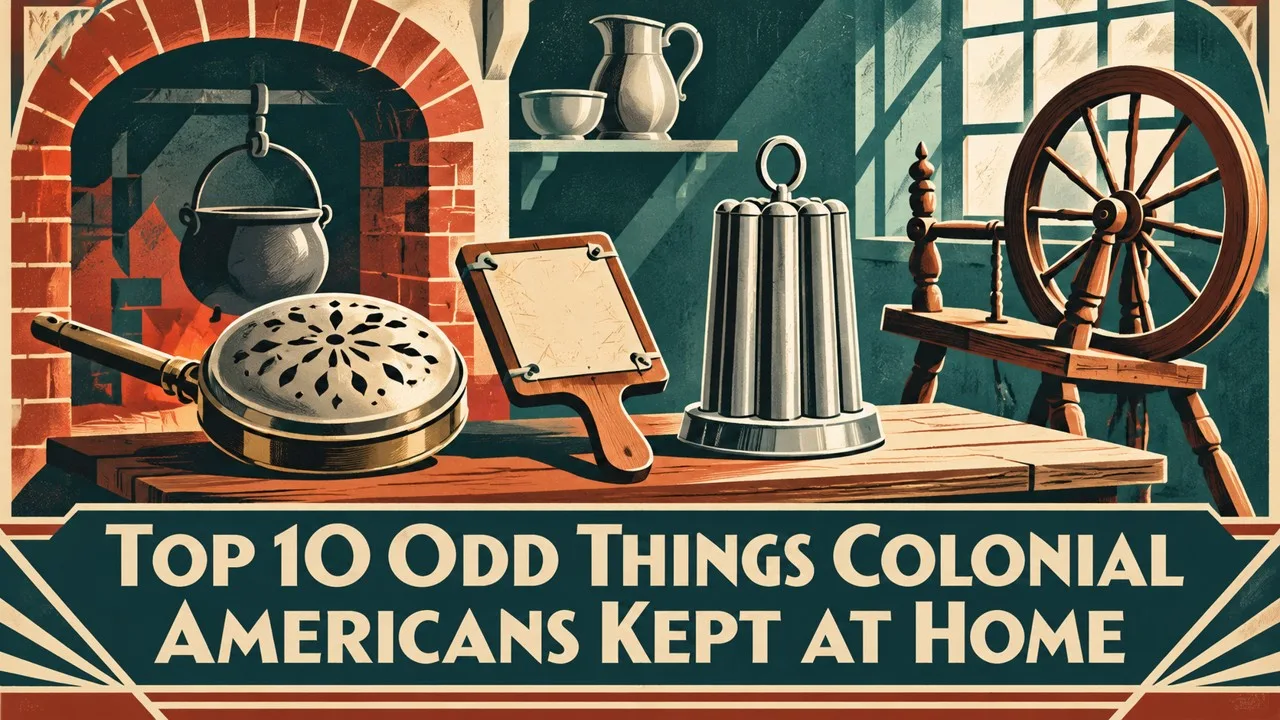
Leather fire buckets, locked tea boxes, sugar cones, bundling boards and alphabet paddles: ten odd household items found in colonial American homes. A typical home in seventeenth- or eighteenth-century colonial America would look both familiar and strange to a modern visitor. There were beds, tables and chairs, but no electricity, running water or matches, and many everyday tasks required specialized tools.
Families made or repaired much of what they used. Expensive goods such as tea and sugar were carefully guarded, while fire was both essential for cooking and heating and a constant danger.
Some household objects reflected local laws and customs. Others were imported from Britain and adapted to life in the colonies. Many survive today in museums and historic houses, where they offer a glimpse of daily routines.
The ten objects below were common in many colonial homes, especially in New England and the Middle Colonies, though what a family owned depended greatly on its wealth.
Key Facts
| # | Object | Purpose | Where it was kept |
|---|---|---|---|
| 1 | Leather fire buckets | Fighting fires as a community | By the front door |
| 2 | Warming pan | Heating cold beds | Near the hearth |
| 3 | Sugar loaf and nippers | Sweetening food and drink | Kitchen or pantry |
| 4 | Tea caddy | Protecting a costly luxury | Parlor |
| 5 | Tinderbox | Starting fires without matches | Beside the fireplace |
| 6 | Rushlights and betty lamps | Lighting at night | Hung by the hearth or table |
| 7 | Hornbook | Teaching children to read | Schoolroom or home |
| 8 | Chamber pots and close stools | Relieving oneself at night | Bedroom |
| 9 | Bundling boards | Supervised courtship | Family bedroom |
| 10 | Trenchers | Eating meals | Dining table |
1. Buckets Ready for Fire
In colonial towns, where wooden buildings stood close together, fire was a serious threat. Laws in places such as Boston required householders to keep leather fire buckets ready for emergencies [1].
The buckets were often painted with the owner's name or initials so that they could be returned after a fire. When an alarm sounded, residents formed lines to pass water from wells or rivers to the flames [1].
In 1736, Benjamin Franklin helped found the Union Fire Company in Philadelphia, a volunteer group whose members pledged to bring buckets and bags to fires. Painted fire buckets are now prized by collectors. Fire bags were sturdy linen sacks used to carry valuables out of burning buildings, and members of fire societies kept them alongside their buckets. Fire insurance companies later appeared, and one Philadelphia insurer founded by Franklin and others in 1752 marked insured houses with a plaque showing four clasped hands.
2. A Pan Full of Coals
Bedrooms in colonial homes were often unheated and bitterly cold in winter. To warm their beds, people used a warming pan, a covered metal pan on a long wooden handle [2].
The pan was filled with hot coals or embers from the fireplace and moved back and forth between the sheets before bedtime. Care was needed to avoid scorching the bedding or starting a fire [2].
Warming pans were made of brass or copper, and decorated lids show that they were also objects of pride. Many surviving examples have pierced or engraved lids that let air reach the coals. Later, some people used hot water bottles or heated stones instead. A popular story concerns the eccentric Massachusetts merchant Timothy Dexter, who claimed in his own writings to have shipped thousands of warming pans to the Caribbean, where they were supposedly sold as ladles for the molasses industry. Whether the tale is true or exaggerated, it shows how common the pans were.
Related: History of Bombay: From Seven Islands to Mumbai
3. Sugar in a Cone
Refined sugar was sold in hard, cone-shaped loaves, often wrapped in blue paper. A loaf could weigh several pounds and last a household for months [3].
To use it, people broke off pieces with sugar nippers, a tool resembling large pincers, and sometimes ground them into smaller grains. Sugar was expensive and often locked away [3].
Much of the sugar came from Caribbean plantations, where enslaved Africans worked under brutal conditions. The sugar trade was closely linked to the slave trade and the economy of the colonies. Sugar loaves were made by pouring boiled sugar into clay or metal molds and letting syrup drain out of a hole in the tip. Brown sugar and molasses were cheaper and more widely used for everyday cooking, and molasses was distilled into rum in New England.
4. Tea Under Lock and Key
In the eighteenth century, tea was an expensive imported luxury. Wealthier households stored it in a tea caddy, a decorative box often fitted with a lock [4].
The key was usually kept by the lady of the house, who prepared tea for guests. Some caddies had separate compartments for different types of tea and a bowl for mixing them [4].
Tea was at the center of colonial protests against British taxes. In 1773, colonists in Boston dumped chests of tea into the harbor in the event later called the Boston Tea Party. The word caddy probably comes from kati, a Malay unit of weight used in the tea trade. During the boycotts that preceded the American Revolution, some patriotic households switched to herbal drinks, sometimes called liberty tea, made from plants such as raspberry leaves.
5. Making Fire by Hand
Before friction matches became widely available in the nineteenth century, people started fires with a tinderbox. It contained a piece of steel, a sharp stone such as flint, and tinder, often charred cloth [5].
Striking the steel against the flint produced sparks that landed on the tinder and created a glowing ember. This could then be used to light a candle or kindling [5].
Related: Top 10 Pilgrim and Mayflower Myths: What History Really Shows
Lighting a fire this way could take several minutes, especially in damp weather. Many households tried to keep their hearth fires burning overnight to avoid having to start from scratch. Children were sometimes sent to a neighbor's house to borrow burning coals when a fire went out. The first friction matches were invented in England in 1826 by the chemist John Walker, and safer matches spread through the nineteenth century.
6. Light From Rushes and Fat
Candles made of beeswax were costly, and even tallow candles, made from animal fat, were not cheap. Many families relied on simpler forms of lighting [6].
Rushlights were made by peeling rushes and dipping their pith in fat, then burning them in iron holders that clipped them at an angle. Betty lamps were shallow iron lamps that burned fat or oil with a wick [6].
These lights gave off a dim glow and often smoked. People tended to organize their activities around daylight and the light of the fireplace. Many families made their own candles from tallow in the autumn, after animals were slaughtered, while those near the coast sometimes made candles from the waxy berries of the bayberry shrub, which gave off a pleasant scent. Whale oil and spermaceti candles became popular among wealthier households in the eighteenth century.
7. Learning the Alphabet on a Paddle
Children in colonial America often learned to read using a hornbook, a wooden paddle with a sheet of paper attached to one side. The paper usually showed the alphabet, syllables and the Lord's Prayer [7].
The paper was protected by a thin, transparent layer of animal horn, which kept it clean and allowed it to be used for years. Children could hold the paddle by its handle [7].
Hornbooks were gradually replaced by printed primers, such as the New England Primer, which combined reading lessons with religious instruction. Because they were so heavily used, few original hornbooks survive, which makes them rare and valuable today. Children also practiced writing with quill pens, and girls often stitched samplers displaying the alphabet, numbers and verses, which demonstrated their needlework skills. Literacy rates in New England were relatively high for the time, partly because of the Puritan emphasis on reading the Bible.
Related: Top 10 Surprising Facts About Paul Revere
8. Toilets Under the Bed
Most colonial homes had no indoor plumbing. During the day, people used outhouses, but at night they relied on chamber pots kept under the bed [8].
Wealthier families might have a close stool, a box or chair with a lid that concealed a chamber pot. The contents were emptied outside, sometimes into the street or a privy pit. In crowded towns, the disposal of waste became a growing public health problem, and some colonial towns passed rules about where it could be dumped [8].
Archaeologists have found that old privy pits are rich sources of information, often containing broken dishes, bottles and other discarded objects. Some chamber pots were decorated, and later ceramic examples were sold with matching washbasins and pitchers. Public baths were rare, and most people washed with a basin of water rather than bathing fully.
9. Boards for Courting Couples
In parts of New England and Pennsylvania, some families practiced bundling, a courtship custom in which a young couple shared a bed while fully clothed. In some cases, a wooden board was placed between them [9].
The custom may have arisen partly because houses were cold and travel between farms was difficult, so a visiting suitor might stay overnight. Parents expected the couple to talk rather than become intimate [9].
Some ministers criticized bundling, and it declined in the late eighteenth century. Historians debate how widespread bundling boards actually were. Bundling was also practiced in parts of Wales, Scotland, the Netherlands and Scandinavia. Writers in the nineteenth century sometimes treated the custom as a joke, and some surviving bundling boards in museums may be later reproductions.
10. Wooden Plates for Sharing
Many colonial families ate from trenchers, flat or hollowed wooden plates. In poorer households, two people sometimes shared a single trencher [10].
Related: Top 10 Most Bizarre Phobias: Strange Fears That Exist
Wealthier families used pewter plates, which were more durable but contained lead. Ceramic and porcelain dishes became more common later in the eighteenth century [10].
The word trencherman, meaning a hearty eater, comes from these plates. Some museums display trenchers worn smooth by years of use. Spoons and knives were the main eating utensils for most of the colonial period, while forks became common only in the eighteenth century, first among wealthier families. Many households also used a single large cup or tankard that was passed around the table.
Conclusion
These objects show how colonial Americans managed daily life without many of the conveniences people take for granted today. Fire, light, food and education all required careful planning and work.
Many of these items reflected both necessity and status. A family's wealth could be seen in its tea caddy, warming pan or pewter dishes.
Historic houses and museums preserve many of these objects, helping visitors imagine life in colonial times.
Looking at ordinary household items can reveal much about the economy, culture and values of the past.
- ^ [1] Accounts of fire buckets. Wikipedia: Fire bucket Wikipedia: Union Fire Company
- ^ [2] Accounts of warming pans. Wikipedia: Bed warmer Wikipedia: Colonial history of the United States
- ^ [3] Accounts of sugar loaves. Wikipedia: Sugarloaf Wikipedia: Sugar nips
- ^ [4] Accounts of tea caddies. Wikipedia: Tea caddy Wikipedia: Boston Tea Party
- ^ [5] Accounts of tinderboxes. Wikipedia: Tinderbox Wikipedia: fire striker
- ^ [6] Accounts of rushlights. Wikipedia: Rushlight Wikipedia: Betty lamp
- ^ [7] Accounts of hornbooks. Wikipedia: Hornbook Wikipedia: The New England Primer
- ^ [8] Accounts of chamber pots. Wikipedia: Chamber pot Wikipedia: Close stool
- ^ [9] Accounts of bundling. Wikipedia: Bundling (tradition) Wikipedia: courtship
- ^ [10] Accounts of trenchers. Wikipedia: Trencher (tableware) Wikipedia: pewter




















Discussion
Log in with