



 By
From a suffrage parade and Gandhi's Salt March to a lunch counter sit-in, a two-million-person human chain and Tank Man: ten protests that changed history. Protests have long been one of the most powerful tools available to people without formal political power. Through marches, strikes, boycotts and sit-ins, ordinary citizens have challenged laws, governments and social customs.
Not every protest succeeds, and some have been met with violence. But some have changed public opinion, inspired movements in other countries or forced governments to negotiate. Their images, slogans and tactics are still studied and copied.
Many influential protests relied on nonviolent methods, which could draw public sympathy and make repression costly for authorities. Others began spontaneously, in response to a particular event.
The ten protests below, from the early twentieth century to 1989, are widely regarded by historians as turning points in the struggles they were part of.
Key Facts
| # | Protest | Place and date | What followed |
|---|---|---|---|
| 1 | Woman Suffrage Procession | Washington, DC, March 1913 | Renewed momentum for women's suffrage |
| 2 | Salt March | India, March and April 1930 | A mass campaign of civil disobedience |
| 3 | Greensboro sit-ins | North Carolina, February 1960 | A wave of sit-ins across the South |
| 4 | Stonewall riots | New York City, June 1969 | The rise of the gay liberation movement |
| 5 | First Earth Day | United States, April 1970 | New environmental laws |
| 6 | Soweto uprising | South Africa, June 1976 | Global attention on apartheid |
| 7 | Gdansk shipyard strike | Poland, August 1980 | The birth of Solidarity |
| 8 | People Power Revolution | Philippines, February 1986 | The fall of a dictator |
| 9 | Baltic Way | Estonia, Latvia and Lithuania, August 1989 | Independence for the Baltic states |
| 10 | Tiananmen Square protests | Beijing, April to June 1989 | A crackdown and lasting censorship |
1. Marching for the Vote
On March 3, 1913, the day before Woodrow Wilson's inauguration as president, thousands of women marched along Pennsylvania Avenue in Washington, DC, demanding the right to vote. The procession was organized by Alice Paul and Lucy Burns [1].
Crowds of onlookers, many of them men in town for the inauguration, blocked and harassed the marchers, and around a hundred people were taken to the hospital. The lack of police protection caused a public outcry and congressional hearings [1].
The march revived the national campaign for women's suffrage. The Nineteenth Amendment, guaranteeing women the right to vote, was ratified in 1920. The procession was led by the lawyer Inez Milholland, dressed in white and riding a white horse. The journalist and activist Ida B. Wells, told that Black women should march at the back, instead joined the Illinois delegation along the route.
2. Walking to the Sea
In 1930, Mohandas Gandhi led a march from his ashram near Ahmedabad to the coastal village of Dandi, about 385 kilometers away, to protest the British tax on salt. He set out on March 12 with fewer than eighty followers, and thousands joined along the way [2].
On April 6, Gandhi picked up a handful of salt from the shore, breaking the law that gave the British government a monopoly on salt production. Across India, people began making and selling salt illegally [2].
Tens of thousands of people were arrested, including Gandhi. The march drew worldwide attention to the Indian independence movement and showed the power of nonviolent resistance. The American journalist Webb Miller reported on later protests at the Dharasana salt works, where police beat unarmed marchers, and his account was published widely abroad. Time magazine named Gandhi its Man of the Year for 1930.
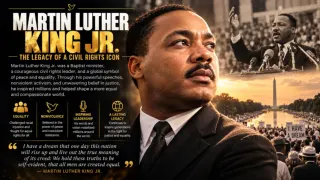
Related: Martin Luther King Jr.: The Legacy of a Civil Rights Icon
3. Sitting Down to Stand Up
On February 1, 1960, four Black college students sat down at a whites-only lunch counter in a Woolworth store in Greensboro, North Carolina, and asked to be served. When they were refused, they stayed until the store closed [3].
They returned the next day with more students, and the protest grew. Within weeks, sit-ins had spread to dozens of cities across the South [3].
The Greensboro Woolworth lunch counter was desegregated in July 1960. The sit-ins helped inspire the formation of the Student Nonviolent Coordinating Committee, an important civil rights organization. The four students, Ezell Blair Jr., Franklin McCain, Joseph McNeil and David Richmond, attended North Carolina Agricultural and Technical College. Part of the original lunch counter is now displayed at the Smithsonian's National Museum of American History in Washington.
4. A Night That Sparked a Movement
In the early hours of June 28, 1969, police raided the Stonewall Inn, a gay bar in New York City's Greenwich Village. Patrons and local residents resisted, leading to several nights of protests and clashes with police [4].
At the time, gay people faced widespread discrimination and harassment, and police raids on gay bars were common. The Stonewall uprising became a rallying point for activists [4].
On the first anniversary, marches were held in New York and other cities, the beginning of what became annual Pride celebrations. In 2016, the site was designated the Stonewall National Monument. It was the first national monument in the United States dedicated to LGBTQ history. Activists associated with the uprising, including Marsha P. Johnson and Sylvia Rivera, later became well-known figures in the movement.
5. A Day for the Planet
On April 22, 1970, an estimated 20 million Americans took part in the first Earth Day, with rallies, teach-ins and clean-up events across the country. The event was proposed by Senator Gaylord Nelson and organized by a team led by the activist Denis Hayes [5].
The demonstrations reflected growing concern about pollution, oil spills and pesticides. Politicians from both major parties supported the event [5].
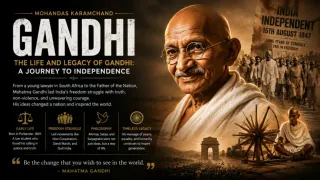
Related: The Life and Legacy of Mahatma Gandhi: A Journey to India Independence
Later that year, the United States created the Environmental Protection Agency, and Congress passed major environmental laws in the following years. Earth Day became a global event in 1990. Around 10 percent of the US population at the time is estimated to have taken part, including students at thousands of schools and universities. The Clean Air Act was significantly expanded in 1970, and the Clean Water Act and Endangered Species Act followed in 1972 and 1973.
6. Students Against Apartheid Education
On June 16, 1976, thousands of Black students in Soweto, near Johannesburg, protested a government policy requiring Afrikaans to be used as a language of instruction in their schools [6].
Police opened fire on the students. A photograph by Sam Nzima of the dying twelve-year-old Hector Pieterson being carried by another student became one of the defining images of apartheid. The official death toll was 176, though estimates are much higher [6].
The uprising spread to other parts of the country and increased international pressure on the apartheid government. June 16 is now a national holiday in South Africa, known as Youth Day. The Hector Pieterson Museum now stands in Soweto near the place where he was shot. The student who carried him, Mbuyisa Makhubo, later left South Africa, and his fate remains unknown.
7. A Shipyard Strike That Shook a Bloc
In August 1980, workers at the Lenin Shipyard in Gdansk, Poland, went on strike after the dismissal of Anna Walentynowicz, a crane operator and activist. The electrician Lech Walesa became the strike's leader [7].
The strike spread to other workplaces, and the communist government was forced to negotiate. On August 31, it signed an agreement allowing the creation of independent trade unions [7].
The resulting union, Solidarity, quickly gained around ten million members. Although the government imposed martial law in 1981, Solidarity survived underground and played a central role in Poland's transition to democracy in 1989. Walesa received the Nobel Peace Prize in 1983 and was elected president of Poland in 1990. The shipyard's gate, decorated with flowers and religious images during the strike, became a symbol of the movement and is now part of the European Solidarity Centre.
Related: Top 10 Nonviolent Acts of Resistance Against the Nazis
8. People Power in Manila
In February 1986, after a disputed presidential election, hundreds of thousands and eventually millions of Filipinos gathered along a major highway in Manila, known as EDSA, to support military officers who had broken with President Ferdinand Marcos [8].
The protesters, encouraged by the Catholic Cardinal Jaime Sin, blocked tanks and soldiers with their bodies, offering them flowers and food. The protests remained largely peaceful [8].
After four days, Marcos left the country, and Corazon Aquino became president. The revolution inspired nonviolent movements in other countries. The highway, Epifanio de los Santos Avenue, gave its name to the revolution, which is also called the EDSA Revolution. Marcos and his family were flown to Hawaii by the United States, and a monument known as the EDSA Shrine was later built at the site.
9. A Human Chain Across Three Countries
On August 23, 1989, around two million people joined hands to form a human chain about 675 kilometers long, stretching across Estonia, Latvia and Lithuania. The date marked the fiftieth anniversary of the pact between Nazi Germany and the Soviet Union that led to the Soviet occupation of the Baltic states [9].
The demonstration drew international attention to the Baltic peoples' demands for independence from the Soviet Union [9].
Within two years, all three countries had regained their independence. Documents related to the Baltic Way were added to UNESCO's Memory of the World Register in 2009. In many places, the chain was continuous, with people traveling from cities and villages to fill gaps along the route. Cars carrying radios helped coordinate the event, and at the agreed moment participants joined hands for fifteen minutes.
10. The Square and the Tanks
In April 1989, students gathered in Tiananmen Square in Beijing after the death of Hu Yaobang, a former Communist Party leader seen as a reformer. The protests grew to include workers and spread to other cities, with demands for political reform and an end to corruption [10].
Related: History of Bombay: From Seven Islands to Mumbai
On the night of June 3 to 4, the government sent troops and tanks to clear the square and surrounding streets. The death toll remains unknown, with estimates ranging from hundreds to several thousand [10].
A photograph of an unidentified man standing in front of a column of tanks, known as Tank Man, became one of the most famous images of the twentieth century. Discussion of the events remains heavily censored in China. Before the crackdown, students had held a hunger strike and erected a statue they called the Goddess of Democracy in the square. Vigils to commemorate the events were held in Hong Kong for three decades until they were banned in 2020.
Conclusion
These protests show how ordinary people have challenged governments and social systems. Some succeeded in bringing rapid change, while others were suppressed but left lasting legacies.
Many relied on nonviolent tactics, such as marches, boycotts and sit-ins, which drew public support and media attention.
The courage of protesters, often facing arrest, violence or death, has inspired later movements around the world.
Their stories remain important reminders of the power of collective action and the price that has sometimes been paid for it.
- ^ [1] Accounts of the suffrage procession. Wikipedia: Woman Suffrage Procession Wikipedia: Alice Paul
- ^ [2] Accounts of the Salt March. Wikipedia: Salt March Wikipedia: Mahatma Gandhi
- ^ [3] Accounts of the Greensboro sit-ins. Wikipedia: Greensboro sit-ins Wikipedia: SNCC
- ^ [4] Accounts of Stonewall. Wikipedia: Stonewall riots Wikipedia: Stonewall National Monument
- ^ [5] Accounts of Earth Day. Wikipedia: Earth Day Wikipedia: Gaylord Nelson
- ^ [6] Accounts of the Soweto uprising. Wikipedia: Soweto uprising Wikipedia: Hector Pieterson
- ^ [7] Accounts of the Gdansk strike. Wikipedia: Gdansk Agreement Wikipedia: Solidarity
- ^ [8] Accounts of People Power. Wikipedia: People Power Revolution Wikipedia: Corazon Aquino
- ^ [9] Accounts of the Baltic Way. Wikipedia: Baltic Way Wikipedia: Molotov-Ribbentrop Pact
- ^ [10] Accounts of Tiananmen. Wikipedia: 1989 Tiananmen Square protests Wikipedia: Tank Man





















Discussion
Log in with