





Top 10 Environmental Headlines That Need a Calmer Number
 By Dhiraj Sharma · Published
Share Post
Loading…

Some environmental headlines use a sharp number or a nickname that runs ahead of the measurement; the underlying risks, in the cases below, are still real.
A calmer number is not a dismissal. The ten cases below are popular environmental claims that have been sharpened, dated, or nicknamed past what a report, a time series, or a definition will support. Thwaites Glacier is still a serious sea-level concern if it is not a "doomsday" on a poster. A policy window is not a countdown to extinction. A bleached reef can be badly hurt and still not be "dead." This article is not a brief for inaction, and it is not a tour of every frightening headline. It is a set of corrections that leave the risk in view.
The inspiration list mixed some claims that age quickly. The items here stay with environmental and climate headlines that can be checked against measurements and reports.
Key Facts
| Headline or nickname | What needs calming | What remains real | |
|---|---|---|---|
| 1 | "Doomsday Glacier" for Thwaites | The nickname is journalistic; collapse timing is uncertain | A large, vulnerable Antarctic glacier and a genuine sea-level risk |
| 2 | "Twelve years left" after the 2018 1.5 degree report | The report described pathways, not a date on which the world ends | A narrow window for a 1.5 degree path, which later reports have continued to treat as tight |
| 3 | "The Great Barrier Reef is dead" | The reef is not a single corpse; cover has fallen and, in some intervals, partially rebounded | Repeated mass bleaching and a long-term stress that is not imaginary |
| 4 | "Bees are about to vanish" | Honeybees and wild bees are different stories; a single extinction date does not hold | Serious colony losses in some years, and declines in many wild bees |
| 5 | "The Amazon is the lungs of the Earth" | The forest is not the planet's main net oxygen source | A vast carbon, rainfall, and biodiversity system under real deforestation pressure |
| 6 | "The Arctic will be ice-free by year X" | "Ice-free" is usually a summer threshold, and specific years have slipped | A clear long-term decline in summer sea ice |
| 7 | "Seventy-five percent of all insects are gone" | A key study measured flying-insect biomass in German reserves, not a global census | Documented declines in many places, which are already enough to worry about |
| 8 | "The ozone hole will never recover" | The Montreal Protocol set a recovery in motion | The Antarctic hole is shrinking on a decades-long path and is not finished |
| 9 | "A new ice age is coming," from 1970s magazines | That was not a scientific consensus | It does not cancel the measured warming of recent decades |
| 10 | "Every disaster is climate" or "no disaster is climate" | Attribution is event-specific and stronger for some hazards than others | Heat, in particular, has a clear, repeatedly quantified human influence |
1. A Glacier That Does Not Need a Movie Title
Thwaites Glacier, in West Antarctica, is one of the most closely watched ice streams on Earth because of its size, its bed, and the way it helps hold back a larger basin [1]. Popular coverage often calls it the Doomsday Glacier. The nickname is not a scientific name, and it compresses a difficult, year-by-year research problem into a single ending. Researchers have documented retreat, thinning, and processes at the ice-ocean boundary that could, in some models, lead to much faster loss. They have not agreed on a calendar date for a collapse [1].
The unexpected fact is that dropping the nickname does not make the glacier safe. A slower or less certain timetable is still a sea-level risk, and it is one reason governments fund the fieldwork [1]. This article will not pick a dramatic year, and it will not pretend that uncertainty is the same as comfort. The careful fact is a real, closely measured glacier, a genuine contribution to future sea level if loss accelerates, and a headline word, "doomsday," that outruns the papers.
A glacier can be badly named and still be in trouble. The calmer sentence is the one that keeps both halves.
2. A Policy Window, Not a Countdown Clock
In 2018 the Intergovernmental Panel on Climate Change issued a special report on warming of 1.5 degrees Celsius [2]. One widely quoted pathway described rapid cuts in global carbon dioxide emissions by 2030, on the order of a 45 percent reduction from 2010 levels, as part of a route that would keep 1.5 degrees within reach. Headlines often shortened that to "twelve years to save the world," or to a date at which civilization would end. The report did not say that [2].
The unexpected fact is how much of the sharpness was editorial. A pathway is a description of what would have to happen for a goal; it is not a fuse [2]. Later assessments have continued to treat the 1.5 degree goal as extremely demanding, and the remaining carbon budget as small, which is not a reason to mock the urgency. This article will not replace a bad countdown with a claim that time does not matter. The careful fact is a documented policy window, a real budget of remaining emissions, and a slogan that turned a pathway into an apocalypse date.
Twelve years was never a prophecy. It was a misread of a hard, and still hard, mitigation path.
Related: Top 10 Most Bizarre Phobias: Strange Fears That Exist
3. A Reef That Has Been Hurt, Not Buried
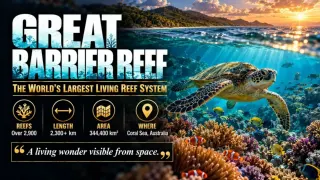
The Great Barrier Reef has suffered repeated mass coral-bleaching events in the past decade, including major years in 2016, 2017, 2020, 2022, and later heat, and large stretches have seen sharp falls in living hard-coral cover [3]. Headlines that declared the reef dead, or already a skeleton, ran ahead of the monitoring. Australia's long-term reef program has also recorded intervals in which cover partially rebounded in some regions between bleaching years, even as the cumulative heat stress has grown [3].
The unexpected fact is that a living reef and a badly damaged reef can be the same place in different years, and even in different sectors in the same year [3]. This article will not use a rebound as a claim that bleaching does not matter. Recovery between hits can be real and still leave the system worse off than it was. The careful fact is a documented pattern of severe bleaching, a monitoring record that is more detailed than a funeral headline, and a reef that remains a conservation emergency without being a single corpse.
A calmer map is a map with regions, years, and cover. It is not a map that paints the whole Coral Sea black and walks away.
4. Bees, Colonies, and a Slogan That Oversimplifies
Managed honeybee colonies in several countries have seen heavy winter and annual losses in some years, and beekeepers have had to replace colonies at a cost [4]. Many wild bees, which are a different story from a kept hive, face habitat loss, pesticides, disease, and climate stress, and some species have declined sharply. Headlines that treat "bees" as a single animal about to vanish on a given date mix those stories and then add a deadline the data do not support [4].
The unexpected fact is that a honeybee operation can report a terrible loss year and still not be the same fact as the extinction of wild pollinators [4]. This article will not dismiss colony loss or wild-bee decline. Both are real enough to occupy researchers and regulators. The careful fact is a mixed, often worrying set of trends, a distinction between managed and wild bees, and a popular "bee-pocalypse" frame that is sharper than a single global census. A calmer number is usually a percentage loss in a season or a species trend, not a date on which bees disappear.
A hive can be in trouble without being the last hive. The decent headline keeps the trouble and drops the movie ending.
5. A Forest That Is More Than a Lung Metaphor
The Amazon rainforest is often called the lungs of the Earth, a phrase that suggests the forest supplies a large share of the planet's oxygen [5]. In a simple budget, a mature forest produces oxygen by photosynthesis and consumes a large amount of it in respiration, so the net gift of oxygen to the global atmosphere is much smaller than the slogan implies. The ocean and other plants also matter in the oxygen story. None of that makes the Amazon optional [5].
Related: Top 10 Oldest Buildings in the World
The unexpected fact is that the better reasons to care are already sufficient: carbon storage, regional rainfall, evapotranspiration, and an enormous living diversity, all of them harmed by clearing and degradation [5]. This article will not use a corrected oxygen metaphor as a reason to relax about deforestation. The careful fact is a slogan that overstates net oxygen, and a forest whose carbon and climate roles are as serious as the metaphor tried, clumsily, to say. A calmer sentence is longer, and it is still an alarm.
A lung is a metaphor. The Amazon is a system, and the system is under pressure that does not depend on the metaphor being exact.
6. An Ice-Free Date That Depends on the Definition
Arctic sea ice has declined markedly in the satellite record that begins in 1979, especially at the September minimum [6]. Headlines sometimes announce that the Arctic will be ice-free by a particular year. In research, "ice-free" often means a summer extent below about one million square kilometers, not a polar ocean with no ice in every season, and not a date that every model is required to hit [6]. Specific popular dates have already passed without a first ice-free summer, which is a reason to be careful with the calendar, not a reason to deny the trend.
The unexpected fact is that a missed year can be misused as if the ice were stable. It is not [6]. This article will not invent a new first-year, and it will not treat definitional caution as a rebuttal of the decline. The careful fact is a well-measured loss of summer sea ice, a technical meaning of "ice-free," and a set of headlines that made a threshold look like a single, failed prophecy. The ice that remains in winter does not cancel the summer trend.
A date is a sharp object. A time series is a better one, and the time series still points to a shrinking summer ice cover.
7. A Famous Percentage, and a Smaller Map
A widely cited 2017 study found a decline of about 75 percent in flying-insect biomass over twenty-seven years in a set of German nature reserves [7]. The paper became a global headline, often shortened to "three-quarters of all insects are gone." That shortening left out the place, the method, and the fact that a biomass sample in reserves is not a census of every insect on Earth [7]. Other work has found declines, mixed trends, or data gaps, depending on the region and the group. The pattern is worrying in many landscapes, and it is not a single planetary percentage.
The unexpected fact is that shrinking the claim to its real map does not make the German result small. A large drop inside protected areas is already a serious finding [7]. This article will not use the missing global census as a reason to ignore insects. The careful fact is a documented, influential regional study, a popular number that traveled farther than the sampling design, and a research field that is still filling in other continents. A calmer headline names the study, the place, and the uncertainty, and then leaves the concern in place.
Related: 10 Sikh Gurus: The Pillars of Sikhism Who Shaped Faith, Equality, Courage, and Humanity
Seventy-five percent is a real figure from a real paper. It is not, by itself, a complete inventory of the world's insects.
8. A Hole That Is Recovering on a Slow Clock
The Antarctic ozone hole, discovered in the 1980s and caused largely by manufactured ozone-depleting chemicals, became a symbol of a sky that might not mend [8]. The Montreal Protocol, and later amendments, cut those chemicals. Assessments now describe a recovery path: Antarctic ozone is expected to return toward earlier conditions around the middle of this century, with the exact year depending on the metric and on remaining emissions, including some unexpected later sources [8]. Spring depletion still happens. The problem is not over.
The unexpected fact is that a success can be real and still be unfinished. A headline that the hole will never recover was too dark; a headline that the hole is gone is too bright [8]. This article will not treat the ozone story as proof that every environmental problem will be solved the same way, and it will not deny the original harm. The careful fact is a measured recovery under a binding treaty, a remaining seasonal hole, and a timescale of decades. A calmer number here is a mid-century range, not a never, and not a already.
A treaty can bend a curve. The curve is still on the page, which is the point of having measured it.
9. A 1970s Magazine Scare, and What the Record Did Next
In the 1970s, some popular magazines ran stories about a coming ice age, often built on a stretch of mid-century cooling in parts of the Northern Hemisphere and on research into orbital cycles and aerosols [9]. Those stories were not a settled scientific consensus that the world was about to freeze. Many researchers were already writing about carbon dioxide and warming, and later reviews have been careful to separate the magazine cover from the journal literature [9].
The unexpected fact, on a list of headlines that need calming, is that this one has been reused as a reason to dismiss today's warming. That is the wrong lesson [9]. A media overreach fifty years ago does not cancel a planetary temperature record, a shrinking of many ice masses, or the physical effect of greenhouse gases. This article will not pretend that every 1970s scientist "knew" an ice age was coming, and it will not pretend that the opposite error, an underplayed warming, is therefore harmless. The careful fact is a popular trope that outran the consensus, and a later climate record that went, clearly, the other way.
Related: Top 10 Tallest Buildings in the World
A calmed headline from 1975 is not a calmed thermometer now. The thermometer is the measurement that matters.
10. Attribution Is a Study, Not a Chant
When a flood, a fire, or a hurricane arrives, two slogans appear almost on cue: that the event is "the climate," or that no single event can ever be. Attribution science, as summarized in the major IPCC assessments, sits between those chants [10]. For many heat extremes, studies have repeatedly found a strong human influence on the likelihood or intensity of the event. For some storms, rainfall totals, or fire-weather episodes, the finding is more modest, mixed, or still being worked out, and it depends on the place and the question [10].
The unexpected fact is that this middle position is not a dodge. It is how a physical science talks when it has methods and error bars [10]. This article will not claim that every disaster has a single climate percentage, and it will not claim that the lack of a percentage is the same as a lack of risk. Heat, sea-level rise, and a greater intensity of some heavy-rain events are among the more robust conclusions. The careful fact is a growing, event-specific literature, a clear result for heat, and a pair of slogans that are both too neat for the reports.
A calmer number, when one exists, comes from an attribution study. When one does not, the honest sentence is that the risk can still be real, and the event is not automatically a proof.
Conclusion
The ten headlines above are a doomsday nickname for Thwaites, a twelve-year countdown that was a misread pathway, a funeral notice for a reef that is damaged and not uniformly dead, a bee extinction date that mixes two stories, a lung metaphor for the Amazon, an ice-free Arctic year that depends on a definition, a 75 percent insect claim taken off its map, an ozone hole that is recovering slowly, a 1970s ice-age scare that was not a consensus, and a pair of disaster slogans that attribution science refuses to chant. In each case a sharper phrase ran ahead of the measurement.
A calmer number is a kind of respect for the risk. It is not a way of saying that the risk was a hoax, and this list should not be read as one.
- ^ [1] Scientific and official overviews of Thwaites Glacier as a large, vulnerable West Antarctic ice stream, with popular "doomsday" language treated as a nickname rather than a timetable. Britannica: Thwaites Glacier British Antarctic Survey: International Thwaites Glacier Collaboration
- ^ [2] The IPCC Special Report on Global Warming of 1.5°C, including widely quoted 2030 emission-pathway figures, distinct from popular "twelve years left" countdown language. IPCC: Special Report on 1.5°C Britannica: IPCC
- ^ [3] Long-term monitoring and assessments of the Great Barrier Reef, including repeated mass bleaching and regional changes in hard-coral cover rather than a single "dead reef" finding. Australian Institute of Marine Science: reef monitoring Britannica: Great Barrier Reef
- ^ [4] Agricultural and conservation accounts that distinguish managed honeybee colony losses from wild-bee declines, without a single global extinction date. Britannica: honeybee FAO: pollination
- ^ [5] Ecological discussions of Amazon carbon, rainfall, and biodiversity roles, and of why a "lungs of the Earth" oxygen slogan overstates the forest's net oxygen contribution. Britannica: Amazon Rainforest Britannica: photosynthesis
- ^ [6] Satellite-era records of Arctic sea-ice decline and technical discussions of a summer "ice-free" threshold, as distinct from a single failed calendar prophecy. National Snow and Ice Data Center: Arctic sea ice news Britannica: sea ice
- ^ [7] The 2017 German reserve flying-insect biomass study and later discussions of insect declines that do not treat one percentage as a global census. Hallmann et al., PLOS ONE, 2017 Britannica: insect
- ^ [8] Scientific assessments of Antarctic ozone depletion and of recovery expected under the Montreal Protocol on a decades-long path, not as a finished or hopeless case. UNEP: ozone Secretariat Britannica: ozone depletion
- ^ [9] Historical discussions of 1970s popular "coming ice age" stories, distinguished from the scientific literature of the time and from the later instrumental warming record. Britannica: climate change IPCC
- ^ [10] IPCC and related overviews of extreme-event attribution, including robust findings for many heat extremes and more event-specific results for some storms, rains, and fires. IPCC AR6 Working Group I Britannica: global warming



















Discussion
Log in with