






Top 10 Times Animals Led People to Archaeological Discoveries
 By Dhiraj Sharma · Published
Share Post
Loading…
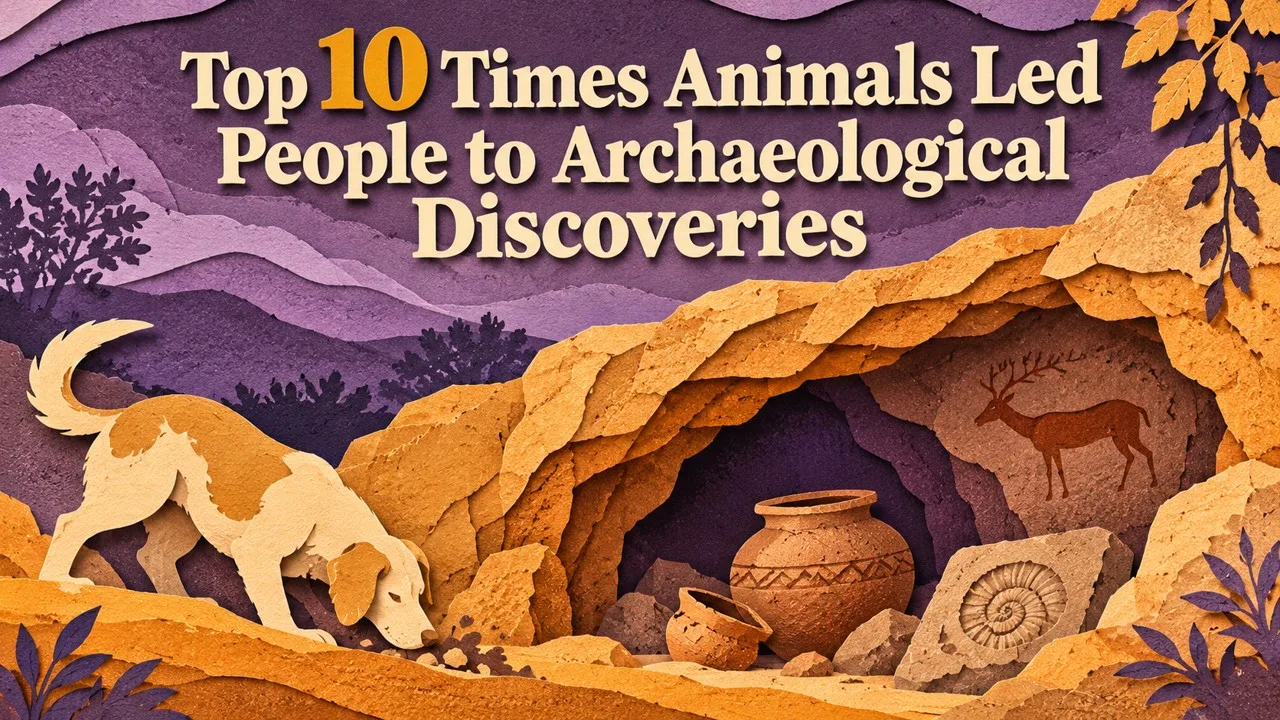
Dogs, goats, a donkey, rabbits and badgers have all helped reveal archaeological sites, and some animals preserve or bury the past in quieter ways. Most archaeological discoveries come from careful survey, construction work or farming. A surprising number, though, began with an animal: a dog that fell into a hole, a goat that wandered into a cave, a donkey that stumbled. In recent years, burrowing animals have also become a known source of finds, and archaeologists sometimes study what they turn up.
The ten cases below are the dog at Altamira, the dog at Lascaux, the goat at Qumran, the donkey at Bahariya, the rabbits of Skokholm, a badger in Asturias, a badger in northern Germany, trained detection dogs, Darwin's earthworms and packrat middens. Several of the older stories have been retold many times, and where details are uncertain or disputed, that is said plainly.
Key Facts
| # | Animal | Discovery | What it revealed |
|---|---|---|---|
| 1 | Dog | Altamira Cave, Spain, 1868 | Prehistoric cave paintings |
| 2 | Dog | Lascaux, France, 1940 | Some of the most famous cave paintings in the world |
| 3 | Goat | Qumran caves, West Bank, 1946 and 1947 | The Dead Sea Scrolls |
| 4 | Donkey | Bahariya Oasis, Egypt, 1996 | A large Greco-Roman cemetery with gilded mummies |
| 5 | Rabbits | Skokholm, Wales, 2022 | Mesolithic stone tools and Bronze Age pottery |
| 6 | Badger | La Cuesta cave, Asturias, Spain | More than two hundred Roman coins |
| 7 | Badger | Stolpe, northern Germany, 2012 | Graves from the medieval period |
| 8 | Detection dogs | Drvišica, Croatia, and other sites | Ancient burials located by scent |
| 9 | Earthworms | Charles Darwin's studies, published 1881 | How objects sink into the soil |
| 10 | Packrats | Deserts of western North America | Plant remains preserved for tens of thousands of years |
1. A Hunting Dog Among the Rocks
According to the usual account, in 1868 a local hunter named Modesto Cubillas was looking for his dog, which had become trapped among rocks near Santillana del Mar in Cantabria, northern Spain. While freeing it, he found the entrance to a cave [1].
The cave became known as Altamira. Years later, the amateur archaeologist Marcelino Sanz de Sautuola explored it, and in 1879 his young daughter María noticed painted bison on the ceiling. Sautuola published the paintings, but many experts dismissed them as forgeries because they seemed too sophisticated for prehistoric people [1].
Acceptance came only in the early twentieth century, after similar art was found in French caves. Altamira is now recognized as one of the most important sites of Paleolithic art, with paintings dated to tens of thousands of years ago. The dog's role is a small part of the story, but it is often cited as the beginning of the cave's modern history.
2. A Dog Named Robot
In September 1940, near Montignac in the Dordogne region of France, eighteen-year-old Marcel Ravidat and three friends explored a hole in the ground. The usual story says that Ravidat's dog, named Robot, had fallen into or found the hole [2].
The boys found a cave decorated with hundreds of paintings and engravings of animals, including horses, deer and aurochs, now dated to around 17,000 years ago. Ravidat later gave varying accounts, and some historians think the dog's role may have been exaggerated. The discovery itself, however, is well documented [2].
Lascaux opened to the public in 1948, but the breath and lights of visitors damaged the paintings, and the cave was closed in 1963. Replicas have since been built for visitors. Whatever Robot actually did, the story of a dog leading teenagers to a prehistoric gallery has become part of the site's identity.
3. A Stone Thrown After a Goat
The best-known account of the discovery of the Dead Sea Scrolls says that a young Bedouin shepherd, Muhammed edh-Dhib, was searching for a lost goat in the cliffs near Qumran, close to the Dead Sea, in late 1946 or early 1947. He threw a stone into a cave and heard pottery break [3].
Related: Top 10 Ancient Sites That Keep Yielding New Finds
Inside, he and his companions found jars containing ancient scrolls. The first scrolls passed through antiquities dealers and were eventually bought by scholars and institutions. Further searches between 1947 and 1956 found thousands of fragments in eleven caves [3].
The scrolls include the oldest known manuscripts of books of the Hebrew Bible, along with other religious and community texts, dated from about the third century BC to the first century AD. Details of the original discovery story vary between accounts, but a missing animal and a curious shepherd remain at its center.
4. A Donkey's Leg in a Hole
In 1996, a donkey belonging to a guard at the Bahariya Oasis in Egypt's Western Desert reportedly stumbled when its leg sank into a hole. The hole led to a tomb, and Egyptian archaeologists soon realized that it was part of a large cemetery [4].
Excavations led by Zahi Hawass, beginning in 1999, uncovered many mummies from the Greco-Roman period, some with gilded masks and decorated coverings. The site became known as the Valley of the Golden Mummies. Estimates suggest that the cemetery may contain many thousands of burials [4].
The find attracted international attention and highlighted the importance of the oases in Roman Egypt. It also showed how much remains undiscovered in Egypt even after centuries of archaeology. The donkey story is frequently retold, and while its details depend on the accounts of those involved, it is the standard description of how the site came to light.
5. Rabbits Digging on an Island
Skokholm is a small island off the coast of Pembrokeshire in Wales, known for its seabirds and managed as a nature reserve. In 2022, wardens on the island noticed objects that rabbits had dug up from their burrows [5].
Archaeologists identified a Mesolithic stone tool, a beveled pebble thought to be several thousand years old, and fragments of Early Bronze Age pottery, possibly from a cremation urn. Because the island is a protected bird reserve, excavation is restricted, so the rabbits' digging gave a rare view of what lies beneath [5].
Related: Top 10 Overlooked Ancient Mysteries
The finds suggested that people used the island long ago, in periods for which little evidence had been found there. Burrowing animals can damage archaeological layers by mixing them, so archaeologists treat such finds with care. Even so, rabbits and other burrowers can reveal sites in places where people cannot easily dig.
6. A Badger and a Roman Coin Hoard
In a cave known as La Cuesta, in the Asturias region of northern Spain, a badger digging a burrow brought Roman coins to the surface. A local resident noticed them and alerted archaeologists, and a study of the find was published in 2024 [6].
Archaeologists recovered more than 200 coins, most of them dated to the late Roman period, in the third to fifth centuries AD. Some came from distant mints, including in the eastern Mediterranean. The researchers suggested that the coins may have been hidden in the cave during a period of instability [6].
The find is one of several in which badgers have disturbed archaeological deposits. Badger setts can be extensive, and badgers can move large amounts of earth. In this case, the animal's digging led to a planned archaeological investigation, and the coins are now studied as evidence of money circulation in late Roman northern Spain.
7. A Badger and Medieval Graves
In 2012, news reports described how a badger digging a sett near the village of Stolpe an der Peene, in northeastern Germany, had brought human bones and artifacts to the surface. A local man noticed the finds and reported them [7].
Archaeologists investigated and identified graves dating to the medieval period, including burials with grave goods such as a sword and other metal objects. The graves were associated with the period of Slavic settlement in the region in the twelfth century, according to reports [7].
Related: Cleopatra's Tomb: History, Theories and the Search at Taposiris Magna
This example, like the Spanish coins, shows how badgers, with their large underground systems, can reveal buried material. The find is mostly known from press reports rather than a major publication, so details should be treated with some caution. It is often cited alongside other cases in which animals have prompted archaeological investigations.
8. Dogs Trained to Find Old Graves
Some dogs are trained to detect the scent of human remains, mainly for police and disaster work. Researchers have tested whether such dogs could also find ancient burials, which might help archaeologists locate graves without digging [8].
In a study published in 2019, dogs trained to detect human remains were used at an Iron Age necropolis at Drvišica in Croatia. The dogs indicated locations that excavation later showed to contain graves, some of them about 2,700 years old. Similar trials have been carried out at other sites [8].
The results suggest that scent can persist for a long time in some conditions, but the method is still experimental. Dogs can give false alerts, and soil, climate and burial type all affect what they can detect. Archaeologists see detection dogs as a possible complement to other survey methods rather than a replacement for them.
9. Worms That Bury the Past
In his last book, published in 1881, Charles Darwin studied earthworms and the way they turn over soil. He showed that worms constantly bring fine soil to the surface in their casts, so that objects lying on the ground are slowly buried [9].
Darwin examined archaeological sites, including Roman ruins at Silchester and Wroxeter and fallen stones at Stonehenge, to measure how quickly objects sank. He concluded that worms played a large role in burying ancient remains and in forming the topsoil [9].
Related: Top 20 Archaeological Hoaxes That Fooled the Public
Modern archaeologists recognize that earthworms and other soil animals can move small objects between layers, which affects how sites are dated and interpreted. Darwin's worm book was a best seller in its time. It shows that animals do not only reveal the past. They also help bury it, slowly and quietly, over centuries.
10. Rodents That Keep Records
Packrats, also called woodrats, collect plant material, bones and other objects near their dens. In dry caves and rock shelters, these piles can become cemented by crystallized urine and preserved for very long periods. Scientists call them packrat middens [10].
Researchers have studied middens to reconstruct past vegetation and climate in the deserts of the American Southwest. Some middens are tens of thousands of years old, and radiocarbon dating of their contents shows how plant communities shifted as climates changed after the last ice age [10].
Middens can also contain material relevant to human history, such as remains of plants used by people. They are not archaeological sites in the usual sense, but they are an important archive of the environment people lived in. In this case, the animals are not discoverers but accidental archivists, preserving a record that scientists can read.
Conclusion
The ten cases above show the different ways animals connect with archaeology. Some, like the dogs at Altamira and Lascaux, the goat at Qumran and the donkey at Bahariya, are part of discovery stories that have been retold so often that their details have softened. Others, like the rabbits of Skokholm and the badgers of Spain and Germany, are recent and well recorded.
Animals also shape the record itself. Earthworms bury objects, and packrats preserve environmental evidence. Archaeologists now pay attention to burrows and soil life, because the animals living on a site can both reveal and disturb what lies beneath it.
- ^ [1] Accounts of the discovery of Altamira and Sautuola's publication. Wikipedia: Altamira Cave Wikipedia: Marcelino Sanz de Sautuola
- ^ [2] Accounts of the 1940 discovery of Lascaux and its later closure. Wikipedia: Lascaux Wikipedia: cave painting
- ^ [3] Accounts of the discovery of the Dead Sea Scrolls at Qumran. Wikipedia: Dead Sea Scrolls Wikipedia: Qumran Caves
- ^ [4] Accounts of the Bahariya cemetery and its discovery. Wikipedia: Valley of the Golden Mummies Wikipedia: Bahariya Oasis
- ^ [5] Background on Skokholm island and the 2022 finds. Wikipedia: Skokholm Wikipedia: Mesolithic
- ^ [6] Background on the Asturias find and on badger setts. Wikipedia: European badger Wikipedia: hoard
- ^ [7] Background on badger burrowing and medieval Slavic settlement in northeastern Germany. Wikipedia: badger Wikipedia: Polabian Slavs
- ^ [8] Background on human-remains detection dogs and their archaeological use. Wikipedia: detection dog Wikipedia: cadaver dog
- ^ [9] Darwin's 1881 study of earthworms and buried objects. Wikipedia: Darwin's worm book Wikipedia: earthworm
- ^ [10] Research on packrat middens as environmental archives. Wikipedia: packrat midden Wikipedia: Neotoma






















Discussion
Log in with