





Top 10 Facts About Volcanoes That Are Easy to Get Wrong
 By Dhiraj Sharma · Published
Share Post
Loading…
Kimberlite can carry diamonds, and a Tanzanian volcano erupts a rare dark lava; a Hawaiian mountain is taller from its base than Everest is above the sea. Volcanoes attract headlines that slightly miss the mechanism: a blue glow that is not lava, a "taller than Everest" claim that depends on where you start the tape, a diamond that did not fly out of an ordinary stratovolcano [2][3][9]. The ten notes below are corrections and distinctions of that kind [5][8][10]. They are not a disaster gallery, and they will not restage a famous blast already treated as a sound in another list [5]. A slope used for boarding is mentioned as a tourism fact, not as an invitation [1]. This article will not offer a route, a flag, or a close-up of harm [4][7].
A volcano can be described as a system. The interesting fact is often a measurement, a chemistry, or a place, not a superlative left unqualified.
Key Facts
These are documented volcanic facts, with the easy errors marked.
Ten Facts at a Glance
| Rank | Claim | Careful version |
|---|---|---|
| 1 | Boarding on Cerro Negro | A Nicaraguan cinder cone has a legal tourism industry of sliding on ash; this is a fact about the slope, not a dare |
| 2 | Diamonds and volcanoes | Diamonds can ride to the surface in kimberlite or lamproite pipes, a rare and specific kind of eruption, not a typical stratovolcano product |
| 3 | Mauna Kea and Everest | Mauna Kea is taller than Everest if height is taken from the seafloor or from the mountain's base; Everest remains the highest summit above sea level |
| 4 | A Mars analog in Hawaii | HI-SEAS has run isolation studies on the slopes of Mauna Loa; the site is a habitat experiment, not a camp on an active vent |
| 5 | A lava lake in Antarctica | Mount Erebus has hosted a long-lived lava lake, a fact about a persistent vent in a cold climate |
| 6 | Paektu, or Changbaishan | A major tenth-century eruption is documented on the China–Korea border; sulfur mass estimates vary and are not repeated here as a single official number |
| 7 | Unzen, 1792 and after | A 1792 collapse and tsunami made Unzen one of Japan's deadliest volcanic disasters; later eruptions also killed; a seventeenth-century persecution associated with the mountain's springs is noted without graphic detail |
| 8 | Sharks at Kavachi | Surveys have documented sharks in the crater of a Solomon Islands submarine volcano during quieter periods |
| 9 | Blue fire at Kawah Ijen | The famous blue glow is burning sulfur gas, not blue lava |
| 10 | Blackish lava at Ol Doinyo Lengai | The Tanzanian volcano erupts natrocarbonatite lava, cooler and chemically unusual, which can look dark or silvery |
1. An Ash Slope, Described, not Recommended
Cerro Negro, a young cinder cone in western Nicaragua, last erupted in 1999 and has, in the quieter years since, become a site for "volcano boarding," in which visitors slide down a loose black slope on a board [1]. The unexpected fact is only that a recent cone can have a tourism economy built on its grain size and its angle. This article will not describe a run, a rental, or a safety method, and it will not treat the industry as an invitation [1]. The careful fact is geomorphic: a scoria slope is steep and loose, which is why both erosion and a sport appeared there. The sport is a fact about the present; the cone is the geology.
A hillside can be commodified without a list becoming an advertisement. The list stops at the existence of the trade.
2. A Pipe, not a Typical Eruption
Diamonds form deep in the mantle, under high pressure, and a few of them have reached the surface as passengers in kimberlite or lamproite, unusual, often ancient, pipe-like eruptions, not as cargo in an ordinary andesitic stratovolcano [2]. The unexpected fact is the specificity. "Some volcanoes erupt diamonds" is a headline that hides a rare rock type and a deep origin [2]. This article will not become a prospecting note, and it will not claim that a tourist volcano is a mine. The careful fact is the transport: a rapid, particular magma can carry a xenocryst upward, and most volcanoes never do.
A gem can have a volcanic ride and still not be a typical volcanic product. The ride is the geological story; the headline is not.
3. A Height That Depends on the Zero
Mauna Kea, on the island of Hawaii, has a summit well below Everest's elevation above sea level, and it is still, if you measure from the seafloor or from a reasonably chosen base of the volcanic edifice, a taller mountain than Everest [3]. Everest remains the highest point on Earth's surface above sea level, which is the measurement most people mean by "tallest" [3]. The unexpected fact is the units, not a secret peak. A newspaper contrast between the two mountains is usually a contrast between two definitions. This article will not invent a single official winner of "tallest." The careful fact is both numbers, each with its zero marked.
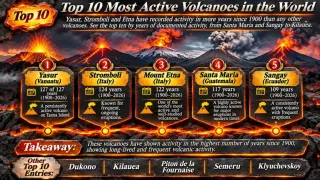
Related: Top 10 Most Active Volcanoes in the World
A mountain can be taller and shorter at once, if the tape starts in two places. The honest sentence always says where it starts.
4. A Habitat Study, on a Volcanic Slope
The Hawaii Space Exploration Analog and Simulation, known as HI-SEAS, has run multi-month isolation studies in a habitat on the slopes of Mauna Loa, using the lava landscape as a rough stand-in for work on Mars or the Moon [4]. The unexpected fact is administrative more than volcanic. An active massif can host a research camp that is interested in dust, isolation and logistics, not in standing on a vent [4]. This article will not treat the analog as a rehearsal of colonization, and it will not imply that the crew lives in a lava lake. The careful fact is the program, and the difference between a slope and a crater.
A volcano can be a backdrop for a habitat test. The test is a human-factors study, not a proof that Mars is already a neighbor.
5. A Persistent Lake, in a Cold Country
Mount Erebus, on Ross Island in Antarctica, has been known for a long-lived lava lake in its summit crater, a rare persistent body of molten rock in one of the coldest regions on the planet [5]. The unexpected fact is coexistence, not paradox. A lava lake is a plumbing fact; Antarctica is a climate fact; they can occupy the same mountain [5]. This article will not restage a famous tropical or Indonesian eruption as the hook, and it will not turn the crater into a spectacle of harm. The careful fact is the documented lake, and the volcano that holds it.
A cold continent can still have a hot throat. The throat is the interesting measurement, not a riddle about ice and fire as opposites.
Related: Top 10 Most Stunning Volcanoes in the World
6. A Border Mountain, and a Tenth-Century Eruption
The mountain known as Paektu in Korean and Changbaishan in Chinese sits on the border of China and the Korean peninsula, and it produced a major eruption in 946, often called the Millennium Eruption, among the largest of the last two thousand years [6]. Popular accounts sometimes attach a single sulfur-mass number to that event; published estimates vary with the method, and this article will not freeze one figure as official [6]. The unexpected fact is the reach of the deposits, which have been traced well beyond the summit, not a political caption. This article will not use flags, and it will not treat the mountain as a national emblem. The careful fact is the tenth-century eruption, and the need to keep its sulfur budget qualified.
A large historic eruption can be named from more than one side of a border. The geology does not require a flag in the sentence.
7. A Deadly Collapse, and a Later History
Mount Unzen, on Kyushu, is tied in Japanese disaster history especially to 1792, when a collapse and a tsunami from the Shimabara side killed a very large number of people, one of the country's worst volcanic disasters [7]. The mountain later erupted in the 1990s, again with fatalities, including among researchers, which is why "most deadly" is a title this article will not award as a unique, final ranking [7]. In the seventeenth century, the area's hot springs were also bound up with the persecution of Christians, a historical fact that can be stated without a description of the harm [7]. This article will not become a casualty table or a torture scene. The careful facts are the 1792 disaster, the later eruptions, and the existence of that persecution in the record.
A volcano can have more than one public memory. The memories can be named, and still be told without a graphic scene.
Related: Top 10 Most Famous Mountains in Chile
8. A Submarine Crater, and a Survey
Kavachi, a submarine volcano in the Solomon Islands, is one of many underwater vents in the ocean, and it has, in quieter intervals, been surveyed in ways that documented sharks inside the crater [8]. The unexpected fact is occupancy, not a myth of fireproof animals. A crater can be hostile in eruption and still, between pulses, be a volume of seawater that large fishes enter [8]. This article will not stage a hunt or a burn, and it will not inflate a survey into a permanent aquarium. The careful fact is the observation, and the condition that it was made in a less active period.
An underwater volcano is mostly a seamount with a habit. The habit can include visitors that a land crater would not suggest.
9. A Blue Glow That Is Not Lava
Kawah Ijen, in Indonesia, is often said, in captions, to have blue lava. The electric-blue glow that photographers follow at night is the combustion of hot sulfuric gases leaking from the volcano, not a blue silicate melt [9]. The lava itself is not the blue object in the picture. The unexpected fact is the chemistry of the flame, which can run along the ground and look, in a long exposure, like a flowing light [9]. This article will not ignore the sulfur miners' labor, and it will not turn that labor into a spectacle. The careful fact is the distinction: burning gas, not blue lava.
A famous color can be real and still be misnamed. The name to keep is sulfur, burning as it leaves the rock.
Related: Top 10 Most Bizarre Phobias: Strange Fears That Exist
10. A Rare Lava, Darker and Cooler
Ol Doinyo Lengai, in northern Tanzania, is the only volcano on Earth known to erupt natrocarbonatite lava in historic time, a carbonate-rich melt that is much cooler than ordinary basalt and can appear black, brown or silvery as it flows and then alters [10]. The unexpected fact is the chemistry, not a gothic color for its own sake. Most lavas are silicate; this one is not, and that is why it looks and behaves unlike a textbook flow [10]. This article will not treat the mountain only as a curiosity of appearance. The careful fact is the carbonatite, and the uniqueness, so far, of that eruptive style among active volcanoes.
A blackish lava can be a different liquid, not a dyed one. The liquid is the reason the photograph surprises people.
Conclusion
The ten facts above are an ash-slope tourism trade described without a dare, a diamond that travels in a rare pipe, a Hawaiian height that depends on the zero, a Mars-analog habitat on a flank, an Antarctic lava lake, a tenth-century border eruption with a qualified sulfur budget, a Kyushu disaster history told without gore, sharks documented in a quieter submarine crater, a blue glow that is burning sulfur, and a Tanzanian carbonatite that is allowed to look dark. None of them needs an overstated superlative in order to be worth listing.
A volcano is a measurement, a rock type and a date. The decent way to list it is to keep those three in view, leave the route book closed, and correct the caption when the caption has the chemistry wrong.
- ^ [1] Geographical accounts of Cerro Negro, Nicaragua, and of later tourism on its scoria slopes, described as a fact, not as an invitation. Britannica: Nicaragua Britannica: cinder cone
- ^ [2] Reviews of kimberlite and lamproite as rare hosts that can carry diamonds from the mantle, distinct from ordinary stratovolcano eruptions. Britannica: kimberlite Britannica: diamond
- ^ [3] Comparisons of Mauna Kea's base-to-summit or seafloor-to-summit height with Everest's elevation above sea level. Britannica: Mauna Kea Britannica: Mount Everest
- ^ [4] Descriptions of the HI-SEAS isolation studies on the slopes of Mauna Loa as a planetary-analog habitat program. Britannica: Mauna Loa Britannica: space exploration
- ^ [5] Accounts of Mount Erebus and of its long-lived summit lava lake. Britannica: Mount Erebus
- ^ [6] Geological and historical accounts of the 946 eruption of Paektu, or Changbaishan, with sulfur-mass estimates left qualified. Britannica: Mount Paektu
- ^ [7] Histories of Unzen, including the 1792 collapse and tsunami, later twentieth-century eruptions, and a seventeenth-century persecution associated with the area, without graphic detail. Britannica: Unzen-dake Britannica: Shimabara Rebellion
- ^ [8] Reports of surveys at Kavachi, a submarine volcano in the Solomon Islands, including observations of sharks in quieter periods. Britannica: submarine volcano Britannica: Solomon Islands
- ^ [9] Accounts of Kawah Ijen and of the blue glow as the combustion of sulfuric gases, not as blue lava. Britannica: Ijen
- ^ [10] Descriptions of Ol Doinyo Lengai and of natrocarbonatite lava as a rare, cooler, carbonate-rich melt. Britannica: Ol Doinyo Lengai Britannica: carbonatite



















Discussion
Log in with