




 By
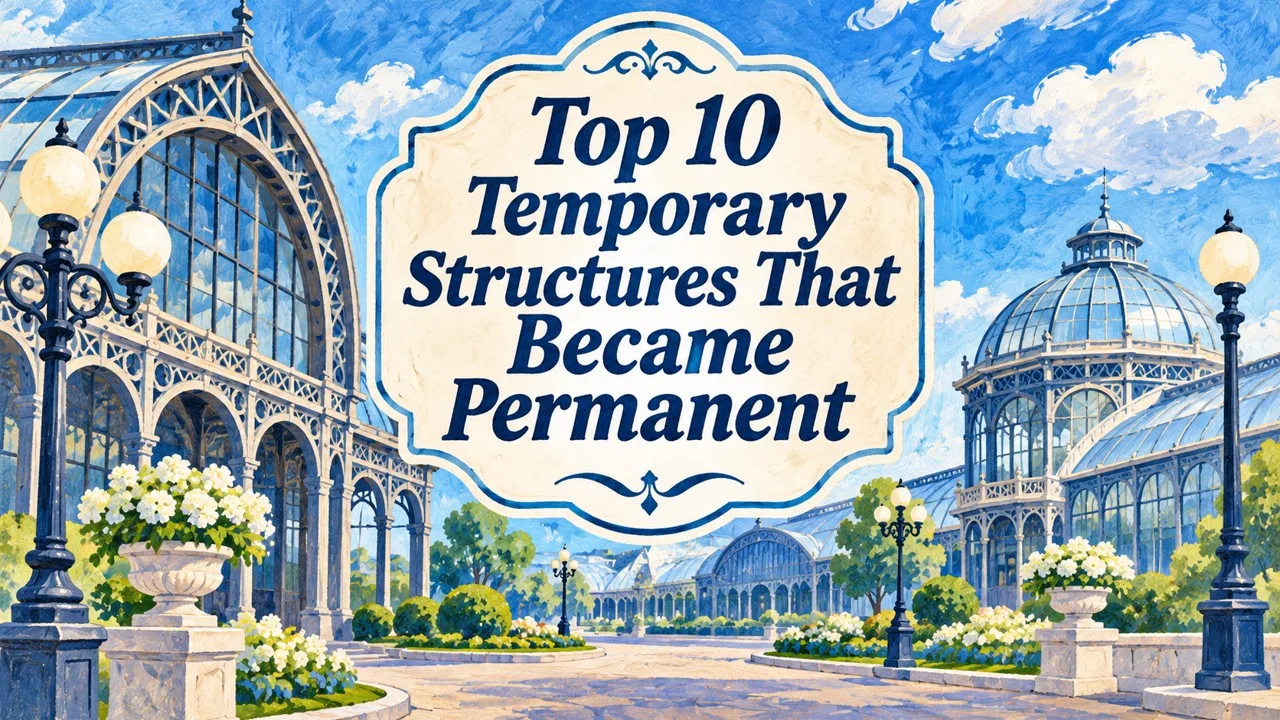
Some buildings meant to last months or years became beloved landmarks, from a tower built for a world's fair to a giant wheel and an advertising sign. There is an old saying that nothing is as permanent as a temporary solution. Many structures around the world were built to last for a few months or a few years, only to remain standing for decades or even more than a century.
Some were built for world's fairs and exhibitions, designed to impress visitors and then be taken down when the event ended. Others were emergency shelters, put up quickly after wars or disasters. A few were simply advertisements that outlived the businesses they promoted.
What saved them varied. Sometimes the public grew so attached to a structure that removing it became unthinkable. Sometimes it found a new practical use, and sometimes nobody ever got around to replacing it.
The ten structures below were all intended to be temporary. Today, many of them are protected landmarks, tourist attractions or symbols of their cities.
Their stories show how places can grow attached to structures that were never meant to stay, and how the meaning of a building can change over time.
They also raise questions about planning. If temporary structures can last so long, perhaps they deserve as much care in their design as permanent ones.
A number of these structures were controversial when first built, criticized as ugly, cheap or out of place. Time has a way of changing opinions, and several of them are now among the most photographed sights in the world.
World's fairs produced many of the examples on this list. From the nineteenth century onward, these huge exhibitions gave architects and engineers the chance to experiment with new materials and bold designs, knowing the buildings would not need to last. Most pavilions were demolished soon after the fairs closed, but a lucky few were kept, sometimes by accident and sometimes after determined campaigns by local residents.
Key Facts
| # | Structure | Where | Original lifespan |
|---|---|---|---|
| 1 | Eiffel Tower | Paris, France | Built for the 1889 Exposition Universelle |
| 2 | Atomium | Brussels, Belgium | Built for Expo 58 |
| 3 | London Eye | London, United Kingdom | Opened in 2000 |
| 4 | Palace of Fine Arts | San Francisco, United States | Built for the 1915 exposition |
| 5 | Hollywood Sign | Los Angeles, United States | Erected in 1923 |
| 6 | Post-war prefabs | United Kingdom | Built from 1944 onward |
| 7 | Montreal Biosphere | Montreal, Canada | Built for Expo 67 |
| 8 | Tower of the Sun | Osaka, Japan | Built for Expo '70 |
| 9 | Peace lines | Belfast and other towns, Northern Ireland | From 1969 |
| 10 | Cardboard Cathedral | Christchurch, New Zealand | Opened in 2013 |
1. The Tower That Was Meant to Come Down
The Eiffel Tower was built as the entrance arch for the 1889 Exposition Universelle in Paris, held to mark the centenary of the French Revolution. Gustave Eiffel's company was given a permit for the tower to stand for twenty years, after which it could be dismantled [1].
Many artists and writers protested against the tower when it was being built, calling it ugly and useless. Eiffel worked to prove its value by encouraging scientific experiments, including in meteorology and radio communication [1].
The tower's usefulness as a radio transmission site helped save it, and its permit was extended. It became the symbol of Paris and one of the most visited monuments in the world, far outlasting the exhibition that created it.
Related: Top 10 Architectural Wonders of the Modern World
2. A Giant Molecule of Iron
The Atomium was built for the 1958 Brussels World's Fair, known as Expo 58. It represents a unit cell of an iron crystal, magnified billions of times, with nine large spheres connected by tubes [2].
The structure was designed to stand only for the duration of the fair, which lasted around six months. It was meant to celebrate scientific progress and the peaceful use of atomic energy [2].
Instead, the Atomium remained and became a symbol of Brussels. After years of wear, it was extensively renovated in the 2000s, with its spheres covered in new stainless steel panels. It now houses exhibitions and a restaurant with views over the city.
3. A Wheel for the Millennium
The London Eye was built to celebrate the new millennium and opened to the public in early 2000. At the time, it was the tallest Ferris wheel in the world, and it was granted planning permission for only five years [3].
The wheel proved hugely popular, carrying millions of visitors each year and offering views across London. It quickly became a familiar part of the skyline beside the River Thames [3].
In the early 2000s, local authorities granted it permanent permission to remain. Today, the London Eye is one of the most popular paid tourist attractions in the United Kingdom, and its temporary origins are largely forgotten.
4. A Plaster Palace Rebuilt in Concrete
The Palace of Fine Arts was built for the Panama-Pacific International Exposition of 1915, which celebrated the opening of the Panama Canal and San Francisco's recovery from the 1906 earthquake. It was designed by the architect Bernard Maybeck to resemble a romantic classical ruin [4].
Like most buildings at the fair, it was made of a temporary material called staff, a mixture of plaster and fiber. When the exposition ended, most of the buildings were demolished, but residents campaigned to save the palace [4].
Over the decades, it slowly crumbled. In the 1960s, the palace was rebuilt in more durable materials, preserving its appearance. It remains one of San Francisco's most photographed landmarks.
Related: Top 10 Iconic Parliament Buildings of the World
5. An Advertisement That Became an Icon
The Hollywood Sign was put up in 1923 to advertise a real estate development called Hollywoodland. It originally spelled out the full name of the development in large white letters and was illuminated with thousands of light bulbs [5].
The sign was expected to stand for only a year and a half or so. Instead, it remained on the hillside for decades, slowly deteriorating. In 1949, the last four letters were removed, leaving the word Hollywood to represent the district and the film industry [5].
By the 1970s, the sign was in very poor condition. Donors helped fund a full replacement in 1978. Today, it is one of the most famous signs in the world and a protected landmark.
6. Homes for Ten Years That Lasted Sixty
After the Second World War, Britain faced a severe housing shortage caused by bombing and years without new building. The government launched a program to build prefabricated houses, made in factories and assembled quickly on site [6].
More than one hundred and fifty thousand prefabs were built, and they were designed to last around ten years. Many families loved them for their modern kitchens, indoor bathrooms and gardens, which were luxuries for many at the time [6].
Some prefabs remained in use for decades. The Excalibur Estate in south London was one of the largest surviving groups, and several of its homes were given listed status to recognize their historical importance.
7. A Dome That Outlived Its Skin
The Montreal Biosphere was built as the United States pavilion for Expo 67, the world's fair held in Montreal. It was designed by the architect and inventor Buckminster Fuller as a giant geodesic dome covered with acrylic panels [7].
After the fair, the structure remained as part of a continuing exhibition. In 1976, a fire destroyed the acrylic skin, leaving only the steel framework, and the site was closed for years [7].
Related: Top 10 Most Famous Monuments in Europe
The dome was later reopened as a museum focused on the environment. The bare frame, still standing on an island in the St. Lawrence River, has become one of the city's most recognizable sights.
8. A Tower With Faces
The Tower of the Sun was created by the artist Taro Okamoto for Expo '70 in Osaka, the first world's fair held in Asia. The tall, white structure has faces representing the past, present and future, and it rose through the roof of a large festival pavilion [8].
After the fair, most of the buildings were removed, but the tower remained in what became the Expo '70 Commemorative Park. For many years, its interior was closed to the public [8].
The interior was restored and reopened to visitors in 2018, allowing people to see the giant artwork inside, known as the Tree of Life. The tower has become a much-loved symbol of Osaka.
9. Barriers Built as a Short-Term Measure
During the Troubles in Northern Ireland, barriers known as peace lines were built to separate neighborhoods and reduce violence. The first were put up in 1969 and were meant to be temporary [9].
Over the following decades, more barriers were built, extended and made taller. Some residents came to see them as a source of security, while others saw them as a symbol of division [9].
Many peace lines still stand today, long after the peace agreement of 1998. Plans have been made to remove them, but progress has been slow, since removal depends on the agreement of local communities.
10. A Church Made of Cardboard
After the earthquake of 2011 badly damaged Christchurch's historic cathedral, the city needed a place of worship. The Japanese architect Shigeru Ban designed a transitional cathedral using large cardboard tubes, along with timber, steel and a polycarbonate roof [10].
Related: Top 10 Construction Projects That Took Centuries
The building opened in 2013 and was intended to serve while the original cathedral was repaired. Ban, known for his disaster relief architecture, has used paper and cardboard tubes in many projects [10].
Although described as transitional, the building has been designed to last for decades. It is used for services, concerts and events, and it has become a symbol of the city's recovery.
Conclusion
These structures show that the line between temporary and permanent is often blurred. Buildings meant to last only months or years have become symbols of cities and even countries.
Their survival often depended on public affection, new uses or simple inertia. Once people grow used to a structure, removing it can feel like losing part of their identity.
The stories also show how attitudes change. Structures once criticized as ugly or cheap are now admired and protected.
For architects and planners, these examples are a reminder that every structure might last longer than expected, so even temporary buildings deserve thoughtful design.
They are also a reminder that cities are never finished. What one generation puts up for a moment, the next may decide to keep forever.
Preserving temporary structures can be difficult and expensive. Materials chosen for a short life, such as plaster, acrylic or cardboard, may need constant repair or complete replacement. Several of the buildings on this list have been rebuilt or reinforced, raising interesting questions about whether a structure remains the same once most of its original parts have been changed.
- ^ [1] Accounts of the Eiffel Tower. Wikipedia: Eiffel Tower Wikipedia: Exposition Universelle (1889)
- ^ [2] Accounts of the Atomium. Wikipedia: Atomium Wikipedia: Expo 58
- ^ [3] Accounts of the London Eye. Wikipedia: London Eye Wikipedia: Ferris wheel
- ^ [4] Accounts of the Palace of Fine Arts. Wikipedia: Palace of Fine Arts Wikipedia: Panama-Pacific International Exposition
- ^ [5] Accounts of the Hollywood Sign. Wikipedia: Hollywood Sign Wikipedia: Hollywood
- ^ [6] Accounts of British prefabs. Wikipedia: Prefabs in the United Kingdom Wikipedia: Excalibur Estate
- ^ [7] Accounts of the Montreal Biosphere. Wikipedia: Montreal Biosphere Wikipedia: Expo 67
- ^ [8] Accounts of the Tower of the Sun. Wikipedia: Tower of the Sun Wikipedia: Expo '70
- ^ [9] Accounts of the peace lines. Wikipedia: Peace lines Wikipedia: The Troubles
- ^ [10] Accounts of the Cardboard Cathedral. Wikipedia: Cardboard Cathedral Wikipedia: Shigeru Ban



















Discussion
Log in with