



 By
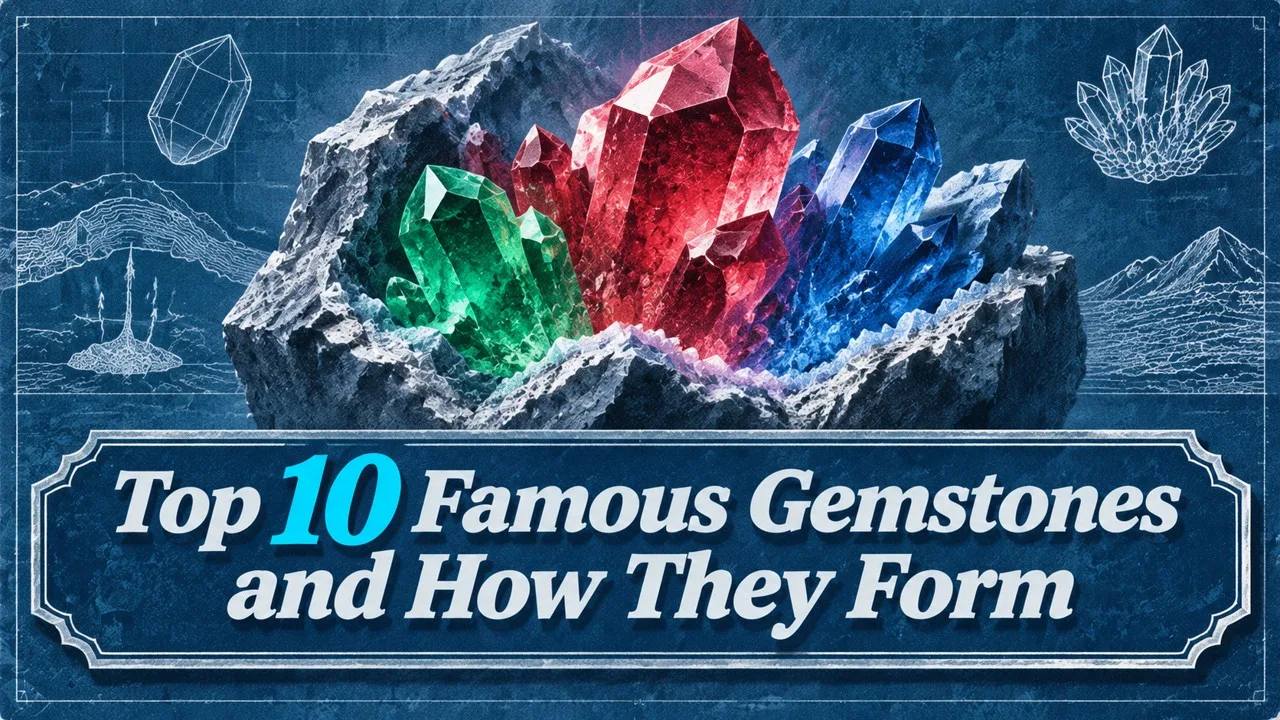
From rubies and emeralds grown in ancient rocks to opals, pearls and tanzanite, discover ten famous gemstones and the natural processes that create them. Gemstones have been treasured for thousands of years for their colour, sparkle and rarity. Yet each one is the product of natural processes, from the slow crystallisation of minerals deep underground to the work of living animals in the sea.
Some gems form in molten rock, some in hot fluids moving through cracks, some in rocks transformed by heat and pressure, and some near the surface where water slowly deposits minerals. This list explains how ten famous gems form and why they look the way they do. Diamonds are covered in a separate Finepedia list.
Key Facts
The ten gemstones below include crystals, rocks and organic gems, each with its own story of formation.
Famous Gemstones at a Glance
| # | Gemstone | Mineral or material | Colour cause or feature | How it forms |
|---|---|---|---|---|
| 1 | Ruby | Corundum | Red from chromium | Grows in marble and other rocks transformed by heat |
| 2 | Sapphire | Corundum | Blue from iron and titanium | Forms in metamorphic and volcanic rocks |
| 3 | Emerald | Beryl | Green from chromium or vanadium | Grows in hot fluids in rock cracks |
| 4 | Opal | Hydrated silica | Play of colour from tiny spheres | Forms from silica-rich water in cavities |
| 5 | Jade | Jadeite or nephrite | Toughness from interlocking fibres | Forms under high pressure in rocks |
| 6 | Pearl | Nacre made by molluscs | Lustre from thin layers | Formed inside living oysters and mussels |
| 7 | Lapis Lazuli | Rock rich in lazurite | Deep blue from lazurite | Formed when limestone meets hot fluids |
| 8 | Tanzanite | Zoisite | Blue-violet from vanadium | Formed by intense heat in rocks in one place on Earth |
| 9 | Turquoise | Copper aluminium phosphate | Blue-green from copper | Formed near the surface in dry regions |
| 10 | Peridot | Olivine | Green from iron | Formed deep in the Earth's mantle |
1. Ruby
Ruby is the red variety of the mineral corundum, an aluminium oxide that is very hard, rating 9 on the Mohs scale. [1]
Its red colour comes from tiny amounts of chromium in the crystal. Chromium also makes rubies glow red under ultraviolet light. [1]
Many of the finest rubies form in marble, a rock created when limestone is heated and squeezed deep in the Earth during mountain building.
The most famous source is the Mogok valley in Myanmar, known for deep red stones described as pigeon's blood.
In ancient Sanskrit, the ruby was called ratnaraj, the king of gems, and it was highly prized by Indian rulers.
Rubies are also found in Sri Lanka, Thailand, Mozambique and parts of India.
Key Figures
- Mineral: corundum
- Hardness: 9 on the Mohs scale
- Colour cause: chromium
- Famous source: Mogok, Myanmar
Why It Made the List
The ruby shows how a trace element can turn a colourless mineral into a treasure. It has long been called the king of gems.
2. Sapphire
Sapphire is corundum of any colour other than red. The classic blue colour comes from small amounts of iron and titanium. [2]
Sapphires can also be pink, yellow, green, purple or colourless. [2]
They form in metamorphic rocks and in some volcanic rocks. Erosion often releases them into river gravels, where they are mined.
Some of the most famous sapphires came from Kashmir, India. They were found in the remote Paddar valley of the Kashmir Himalaya in the early 1880s, reportedly after a landslide, and their velvety blue colour remains legendary.
Sri Lanka has been a major source for more than two thousand years.
Synthetic sapphire, made in laboratories, is used for scratch-resistant watch glass and in electronics.
Some sapphires show a six-rayed star when cut into a dome, caused by needle-like inclusions.
Key Figures
- Mineral: corundum
- Colour cause: iron and titanium
- Legendary source: Kashmir
- Modern use: synthetic sapphire glass
Why It Made the List
Sapphire is one of the most loved gems. Kashmir sapphires are among the rarest stones in the world.
3. Emerald
Emerald is the green variety of the mineral beryl. Its colour comes from traces of chromium or vanadium. [3]
Related: Top 10 Minerals of the Mohs Hardness Scale
Emeralds form when hot, mineral-rich fluids flow through cracks in rocks, depositing crystals as they cool. [3]
Most emeralds contain tiny inclusions of other minerals or fluids. Jewellers call these the jardin, French for garden.
Colombia, especially the Muzo region, produces some of the finest emeralds in the world.
The Mughal emperors of India loved emeralds and had many carved with inscriptions and floral designs.
Ancient Egypt also had emerald mines, sometimes linked by tradition to Cleopatra.
Emerald is slightly softer and more brittle than ruby or sapphire, so many stones are treated with oils or resins to hide small cracks. Its rich green has made it the birthstone for May in many traditions.
Key Figures
- Mineral: beryl
- Colour cause: chromium or vanadium
- Famous source: Muzo, Colombia
- Typical feature: inclusions
Why It Made the List
Emerald is the most famous green gem. Its inclusions tell the story of how it formed.
4. Opal
Opal is not a crystal but a form of silica containing water. Precious opal shows flashes of rainbow colour, called play of colour. [4]
These colours come from tiny spheres of silica, packed in neat rows, which bend and split light like a prism. [4]
Opal forms when water rich in dissolved silica seeps into cracks and holes in rock. As the water slowly evaporates, it leaves silica behind.
Australia produces the vast majority of the world's precious opal. Lightning Ridge is famous for rare black opals.
In the opal mining town of Coober Pedy, many people live underground to escape the desert heat.
Opals can crack if they dry out or are exposed to sudden temperature changes.
Key Figures
- Material: hydrated silica
- Colour cause: diffraction by tiny spheres
- Main producer: Australia
- Famous fields: Lightning Ridge and Coober Pedy
Why It Made the List
Opal creates colour from structure rather than chemistry. It is one of the most unusual gems.
5. Jade
Jade is a name for two different minerals, jadeite and nephrite. A French scientist showed in 1863 that they were distinct. [5]
Related: Top 10 Most Famous Diamonds in History
Both are made of tightly interlocking mineral fibres, which make jade extremely tough and resistant to breaking. [5]
Jadeite forms under high pressure and relatively low temperature, often where ocean plates sink beneath continents. Myanmar is the main source of fine jadeite.
In China, nephrite jade has been carved for thousands of years and was valued above gold.
The Maori of New Zealand also carve nephrite, which they call pounamu.
Jade comes in many colours, including green, white, lavender and black.
It has been used for tools, weapons and ritual objects since the Stone Age.
Jade is the name often used for both minerals in trade.
Key Figures
- Minerals: jadeite and nephrite
- Key property: toughness
- Main jadeite source: Myanmar
- Cultural importance: China and New Zealand
Why It Made the List
Jade combines beauty with toughness. It has a deep cultural importance in many parts of the world.
6. Pearl
Pearls are unique among gems because they are made by living animals. They form inside oysters and mussels. [6]
When an irritant gets inside the shell, the mollusc coats it with layers of nacre, also called mother of pearl. Over years, these layers build up into a pearl. [6]
The thin, overlapping layers of nacre give pearls their soft lustre.
Natural pearls are very rare. In 1893, the Japanese businessman Mikimoto Kokichi produced cultured pearls by placing a bead inside oysters.
India has a long history of pearl fishing in the Gulf of Mannar. Thoothukudi in Tamil Nadu was known as the Pearl City.
Today most pearls on the market are cultured, while natural pearls fetch very high prices.
Key Figures
- Made by: oysters and mussels
- Material: nacre
- Cultured pearls: from 1893
- Indian pearl fisheries: Gulf of Mannar
Why It Made the List
Pearls are the only gems made by animals. Their history connects India's coast to the wider world.
7. Lapis Lazuli
Lapis lazuli is a deep blue rock, not a single mineral. Its colour comes from a mineral called lazurite, often mixed with sparkling flecks of pyrite. [7]
It forms when limestone is changed by heat and fluids in the Earth's crust. [7]
The Sar-e-Sang mines in Afghanistan have produced lapis for more than 6,000 years, and lapis from there reached ancient Egypt, Mesopotamia and the Indus Valley.
Ground lapis was used to make the pigment ultramarine, which was more expensive than gold in Renaissance Europe and used for the robes of important figures in paintings.
Related: Top 10 Most Bizarre Phobias: Strange Fears That Exist
Lapis lazuli was used in jewellery, seals and inlays in many ancient civilisations.
Its name comes from Latin and Persian words meaning stone of the blue sky.
Fine lapis is a rich even blue, and too much white calcite lowers its value.
Key Figures
- Type: rock
- Colour cause: lazurite
- Famous source: Sar-e-Sang, Afghanistan
- Pigment: ultramarine
Why It Made the List
Lapis lazuli is one of the oldest traded gems. It gave artists their most precious blue.
8. Tanzanite
Tanzanite is a blue-violet variety of the mineral zoisite. It was discovered in 1967 in the Merelani Hills of northern Tanzania. [8]
It is found commercially in only one small area in the world, near Mount Kilimanjaro, making it rarer than many better-known gems. [8]
Tanzanite formed about 585 million years ago, when heat and pressure during mountain building transformed the rocks.
The stone shows different colours when viewed from different directions, a property called pleochroism.
Most tanzanite is gently heated to bring out its best blue-violet colour.
The gem was named and promoted by the jeweller Tiffany and Co. in 1968.
Small-scale miners and larger companies work the deposit, and Tanzania built a wall around the mining area in 2018 to control smuggling.
It is a birthstone for December.
Key Figures
- Mineral: zoisite
- Discovered: 1967
- Source: Merelani Hills, Tanzania
- Special property: pleochroism
Why It Made the List
Tanzanite is a modern gem from a single source. Its limited supply adds to its appeal.
9. Turquoise
Turquoise is an opaque blue to green mineral made of copper, aluminium and phosphorus. [9]
It forms near the surface in dry regions, when rainwater trickles through rocks rich in copper and slowly deposits the mineral. [9]
Iran has mined turquoise near Nishapur for around two thousand years, and Persian turquoise is famous for its sky-blue colour.
The ancient Egyptians mined turquoise in the Sinai Peninsula and used it in jewellery.
Turquoise is also central to the jewellery traditions of Native American peoples in the southwestern United States.
Related: Top 10 Oldest Buildings in the World
Its name comes from French words meaning Turkish stone, because it reached Europe through Turkish trade routes.
It is relatively soft and porous, so it can change colour with exposure to oils and sunlight.
Key Figures
- Composition: copper aluminium phosphate
- Colour cause: copper
- Famous source: Nishapur, Iran
- Name meaning: Turkish stone
Why It Made the List
Turquoise is one of the oldest gems known. It has been valued across many cultures.
10. Peridot
Peridot is the gem form of olivine, a mineral common in the Earth's mantle. Its green colour comes from iron. [10]
It forms deep below the crust and is carried to the surface by volcanic eruptions. [10]
Peridot is one of the few gems that comes in only one colour, ranging from yellowish to olive green.
The ancient Egyptians mined peridot on the island of Zabargad in the Red Sea.
Peridot has even been found in meteorites called pallasites, making it one of the few gems known from outer space.
Today, Arizona in the United States, Pakistan and Myanmar are important sources.
Hawaiian beaches sometimes glitter with tiny green olivine grains.
Because it forms under extreme conditions, peridot crystals large enough to cut are uncommon. It is the traditional birthstone for August.
Key Figures
- Mineral: olivine
- Colour cause: iron
- Origin: the Earth's mantle
- Space connection: pallasite meteorites
Why It Made the List
Peridot comes from deep inside the Earth and from space. It is a gem with a remarkable origin.
Conclusion
Gemstones form in many ways, from molten rock and hot fluids to the patient work of oysters. Understanding their origins makes them even more fascinating.
Many gems have been mined for thousands of years, linking ancient civilisations through trade. Today responsible mining and laboratory-grown stones are changing the gem world.
- ^ [1] "Ruby". Wikipedia. Wikipedia: Ruby Wikipedia: Mogok
- ^ [2] "Sapphire". Wikipedia. Wikipedia: Sapphire Wikipedia: Paddar
- ^ [3] "Emerald". Wikipedia. Wikipedia: Emerald Wikipedia: Beryl
- ^ [4] "Opal". Wikipedia. Wikipedia: Opal Wikipedia: Coober Pedy
- ^ [5] "Jade". Wikipedia. Wikipedia: Jade Wikipedia: Jadeite Wikipedia: Nephrite
- ^ [6] "Pearl". Wikipedia. Wikipedia: Pearl Wikipedia: Gulf of Mannar Wikipedia: Mikimoto Kokichi
- ^ [7] "Lapis Lazuli". Wikipedia. Wikipedia: Lapis lazuli Wikipedia: Ultramarine
- ^ [8] "Tanzanite". Wikipedia. Wikipedia: Tanzanite Wikipedia: Zoisite
- ^ [9] "Turquoise". Wikipedia. Wikipedia: Turquoise Wikipedia: Nishapur
- ^ [10] "Peridot". Wikipedia. Wikipedia: Peridot Wikipedia: Pallasite Wikipedia: Zabargad Island




















Discussion
Log in with