




 By
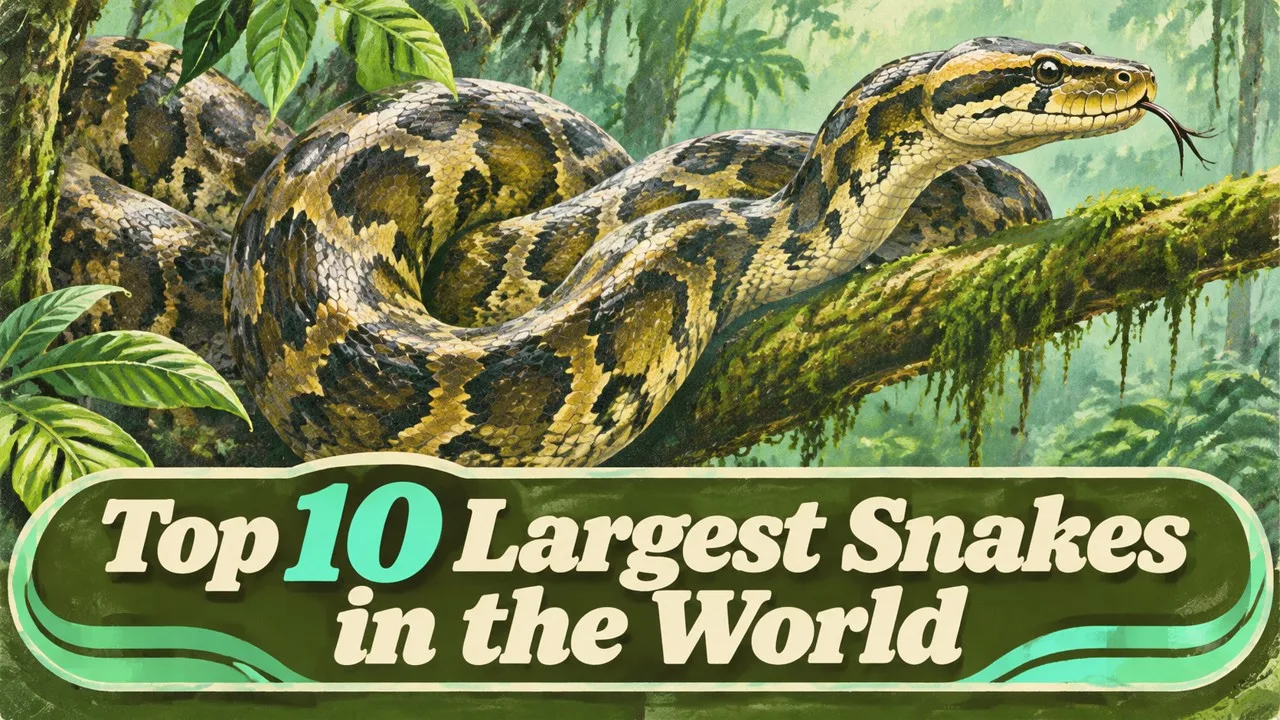
From the reticulated python and green anaconda to Vasuki indicus, a giant fossil snake from Gujarat, these are ten of the largest snakes that ever lived. Snakes come in every size, from thread snakes thinner than a pencil lead to giants longer than a bus. The biggest living snakes are constrictors, which kill by squeezing rather than with venom, and most of them live in warm tropical regions near water.
Measuring large snakes is difficult, and stories of monster serpents are often exaggerated. This list uses reliable scientific estimates and includes two extinct giants known from fossils, one of them discovered in Gujarat, India. It also includes the world's longest venomous snake.
Key Facts
The ten snakes below include two fossil giants and eight living species, with lengths given as typical maximums supported by scientific records.
The Largest Snakes in the World at a Glance
| # | Snake | Length | Range | Living or extinct |
|---|---|---|---|---|
| 1 | Titanoboa | About 13 metres, estimated | Ancient Colombia | Extinct, about 60 million years ago |
| 2 | Vasuki indicus | About 11 to 15 metres, estimated | Ancient India | Extinct, about 47 million years ago |
| 3 | Reticulated Python | Over 6 metres | South and Southeast Asia | Living, the longest snake |
| 4 | Green Anaconda | Over 5 metres | South America | Living, the heaviest snake |
| 5 | Burmese Python | Up to about 5.7 metres | Southeast Asia | Living, invasive in Florida |
| 6 | African Rock Python | Up to about 6 metres | Sub-Saharan Africa | Living, Africa's largest snake |
| 7 | Indian Python | Usually about 3 metres, sometimes more | Indian subcontinent | Living, protected in India |
| 8 | Australian Scrub Python | Up to about 5 metres | Northern Australia | Living, Australia's largest snake |
| 9 | King Cobra | Up to about 5.85 metres | South and Southeast Asia | Living, the longest venomous snake |
| 10 | Boa Constrictor | Up to about 4 metres | Central and South America | Living, a famous constrictor |
1. Titanoboa
Titanoboa was a gigantic snake that lived in what is now Colombia during the Paleocene epoch, roughly 60 million years ago, a few million years after the dinosaurs died out. [1]
Its fossils were found in the Cerrejon coal mine in northern Colombia. Scientists named and described it in 2009. [1]
Based on the size of its backbones, Titanoboa is estimated to have reached about 12.8 metres in length and to have weighed more than a tonne.
It was related to modern boas and anacondas and probably lived in rivers and swamps, eating large fish and crocodile relatives.
Because snakes are cold-blooded, such a huge size suggests that the tropics were much warmer then than they are today.
A life-sized model of Titanoboa has been displayed in museums, giving visitors a sense of its enormous size.
Key Figures
- Length: about 12.8 m, estimated
- Weight: over a tonne, estimated
- Age: about 60 million years
- Found: Cerrejon coal mine, Colombia
Why It Made the List
Titanoboa was long considered the largest snake ever found. It offers clues to the ancient climate.
2. Vasuki indicus
In 2024, scientists from IIT Roorkee described Vasuki indicus, a giant fossil snake found in a lignite mine in the Kutch district of Gujarat. [2]
It lived about 47 million years ago, during the Eocene epoch, when India was still drifting towards Asia. [2]
Known from a series of large vertebrae, it is estimated to have been between about 11 and 15 metres long, possibly rivalling or even exceeding Titanoboa.
The snake was named after Vasuki, the serpent king of Hindu mythology often shown coiled around the neck of Lord Shiva.
Vasuki belonged to an extinct family of snakes called madtsoiids. Scientists think it was a slow-moving ambush predator, like modern pythons.
The discovery made international news and highlighted India's rich fossil record.
Related: Top 10 Most Venomous Snakes in the World
Key Figures
- Described: 2024
- Found: Kutch, Gujarat
- Length: about 11 to 15 m, estimated
- Named after: Vasuki of Hindu mythology
Why It Made the List
Vasuki indicus may be one of the longest snakes that ever lived. It put Indian palaeontology in the global spotlight.
3. Reticulated Python
The reticulated python is the longest living snake in the world. Large individuals can exceed 6 metres, and a few reliable records are longer still. [3]
It is named for its net-like, or reticulated, pattern of dark and light markings. [3]
The species is found from Southeast Asia to the Nicobar Islands of India. It is an excellent swimmer and has reached many small islands by sea.
Like other pythons, it is not venomous. It ambushes prey and kills by constriction, swallowing animals as large as pigs and deer.
It is hunted in large numbers for its skin, which is used in the leather industry.
In captivity, reticulated pythons need large enclosures and expert care, and the longest captive specimens have been measured at more than 7 metres.
Key Figures
- Length: over 6 m
- Range: South and Southeast Asia
- Indian range: Nicobar Islands
- Pattern: net-like
Why It Made the List
The reticulated python is the longest snake alive today. Its swimming skills have spread it across many islands.
4. Green Anaconda
The green anaconda of South America is the heaviest snake in the world. Large females can weigh close to 100 kilograms or more, and some exceed 5 metres in length. [4]
Females are much larger than males, a pattern common among big constrictors. [4]
Anacondas live in swamps, marshes and slow rivers in the Amazon and Orinoco basins. They spend much of their time in water, which supports their heavy bodies.
Their eyes and nostrils sit on top of the head, letting them watch and breathe while almost completely submerged.
They prey on fish, birds, capybaras and caimans.
In 2024, scientists proposed that the northern population is a separate species, the northern green anaconda, showing that even giant animals can hold surprises.
Key Figures
- Length: over 5 m
- Weight: around 100 kg or more for large females
- Habitat: Amazon and Orinoco wetlands
- Prey: includes capybaras and caimans
Why It Made the List
The green anaconda is the heaviest snake on Earth. It is perfectly adapted to life in water.
Related: Top 10 Largest Species in Their Animal Groups
5. Burmese Python
The Burmese python is one of the largest snakes in the world, with big individuals reaching more than 5 metres. [5]
It is native to Southeast Asia, including parts of northeastern India, and is listed as Vulnerable in the wild. [5]
Until 2009 it was considered a subspecies of the Indian python.
Released or escaped pet pythons have created a large invasive population in the Everglades of Florida, in the United States.
There, the pythons have caused dramatic declines in native mammals. Officials run hunting programmes and competitions to remove them.
Its calm temperament made it popular in the pet trade, which is how it reached Florida.
Females lay large clutches of eggs and coil around them, shivering their muscles to keep the eggs warm.
Key Figures
- Length: up to about 5.7 m
- Native range: Southeast Asia
- Status: Vulnerable in its native range
- Invasive in: the Florida Everglades
Why It Made the List
The Burmese python is both a threatened species and a damaging invader. It shows the risks of the exotic pet trade.
6. African Rock Python
The Central African rock python is the largest snake in Africa, with some individuals approaching or exceeding 6 metres. [6]
It lives across much of sub-Saharan Africa, in habitats from forests to grasslands, usually near water. [6]
A smaller relative, the southern African rock python, lives further south.
Rock pythons are known for having a more aggressive temperament than many other large pythons.
They eat antelopes, monkeys and even crocodiles, and females coil around their eggs to protect them until they hatch.
During the dry season, the snake may become dormant, resting in a burrow until the rains return.
Like other pythons, it has heat-sensing pits along its lips that help it detect warm-blooded prey in the dark. Attacks on people are very rare.
Key Figures
- Length: up to about 6 m
- Range: sub-Saharan Africa
- Temperament: often aggressive
- Parental care: females guard eggs
Why It Made the List
The African rock python is the continent's giant snake. Its care for its eggs is unusual among snakes.
Related: Top 25 Interesting Facts About the Universe
7. Indian Python
The Indian python, also called the Indian rock python, is native to the Indian subcontinent and parts of Southeast Asia. [7]
It usually reaches about 3 metres, although larger individuals have been recorded. It is lighter in colour than its close relative, the Burmese python. [7]
It lives in many habitats, including grasslands, swamps, rocky foothills and forests, often near water.
The species is protected under India's Wildlife Protection Act, because it has been hunted for its skin and affected by habitat loss.
Pythons are often seen in national parks such as Keoladeo in Rajasthan, where they bask near their burrows in winter.
In Indian folklore, pythons are sometimes respected as guardians of forests and water.
Key Figures
- Length: usually about 3 m
- Range: Indian subcontinent and Southeast Asia
- Protection: Wildlife Protection Act
- Good place to see one: Keoladeo National Park
Why It Made the List
The Indian python is India's own giant snake. It is a protected part of the country's wildlife heritage.
8. Australian Scrub Python
The Australian scrub python is the longest snake in Australia. Large individuals can exceed 5 metres, although most are smaller. [8]
It lives in the rainforests and scrublands of northeastern Queensland, and closely related scrub pythons live in New Guinea. [8]
It is a slender python with a beautiful iridescent sheen, which is why its relatives are sometimes called amethystine pythons.
Scrub pythons hunt birds, bats and small mammals, including wallabies.
They often climb trees, waiting on branches to ambush prey.
Although they are large, they are rarely seen, because they are active mainly at night and blend into dense forest.
Its scientific name honours the Australian naturalist James Roy Kinghorn.
It is not dangerous to people.
Key Figures
- Length: up to about 5 m
- Range: northeastern Queensland
- Prey: birds, bats and wallabies
- Activity: mainly nocturnal
Why It Made the List
The scrub python is Australia's giant snake. It shows that big snakes also thrive outside Asia, Africa and South America.
9. King Cobra
The king cobra is the longest venomous snake in the world, with a record length of about 5.85 metres. [9]
Related: Top 25 Interesting Facts About the Solar System
It is found from India through Southeast Asia to southern China. In India, it lives in the Western Ghats, the northeast and the forests of the Himalayan foothills. [9]
Its scientific name, Ophiophagus, means snake-eater, because it feeds mainly on other snakes.
When threatened, it can raise the front third of its body off the ground and spread its hood, making a deep growling hiss.
The king cobra is the only snake known to build a nest of leaves for its eggs, which the female guards.
Studies published in recent years suggest the king cobra is actually a group of several closely related species.
Key Figures
- Record length: about 5.85 m
- Diet: mainly other snakes
- Nest: built from leaves
- Indian range: Western Ghats and northeast
Why It Made the List
The king cobra is the giant of venomous snakes. Its nest-building is unique among snakes.
10. Boa Constrictor
The boa constrictor is one of the best-known large snakes. Most adults are 2 to 3 metres long, while large females can reach about 4 metres. [10]
It lives in Central and South America, from tropical rainforests to dry scrublands. [10]
Like other boas, it gives birth to live young instead of laying eggs.
Its patterned skin provides excellent camouflage among leaves and branches.
The boa constrictor is unusual in that its scientific name and common name are the same.
It is one of the most popular large snakes kept in zoos and by reptile enthusiasts, because of its manageable size and calm nature.
Boas can go weeks without eating after a large meal.
Wild populations are generally stable.
Key Figures
- Length: up to about 4 m
- Range: Central and South America
- Reproduction: live birth
- Scientific name: Boa constrictor
Why It Made the List
The boa constrictor is the classic big snake. It is familiar to millions from zoos and nature films.
Conclusion
The largest snakes, living and extinct, are among the most impressive reptiles ever to exist. They range from tropical rainforests to swamps and ancient fossil beds.
Many of today's giant snakes face threats from habitat loss and the skin trade. Protecting them helps preserve some of the most remarkable animals on Earth.
- ^ [1] "Titanoboa". Wikipedia. Wikipedia: Titanoboa Wikipedia: Paleocene
- ^ [2] "Vasuki indicus". Wikipedia. Wikipedia: Vasuki indicus Wikipedia: Madtsoiidae
- ^ [3] "Reticulated Python". Wikipedia. Wikipedia: Reticulated python Wikipedia: Constriction
- ^ [4] "Green Anaconda". Wikipedia. Wikipedia: Green anaconda Wikipedia: Eunectes akayima
- ^ [5] "Burmese Python". Wikipedia. Wikipedia: Burmese python Wikipedia: Burmese pythons in Florida
- ^ [6] "African Rock Python". Wikipedia. Wikipedia: Central African rock python Wikipedia: Southern African rock python
- ^ [7] "Indian Python". Wikipedia. Wikipedia: Indian python Wikipedia: Keoladeo National Park
- ^ [8] "Australian Scrub Python". Wikipedia. Wikipedia: Simalia kinghorni Wikipedia: Simalia amethistina
- ^ [9] "King Cobra". Wikipedia. Wikipedia: King cobra Wikipedia: Western Ghats
- ^ [10] "Boa Constrictor". Wikipedia. Wikipedia: Boa constrictor Wikipedia: Boidae




















Discussion
Log in with