





 By
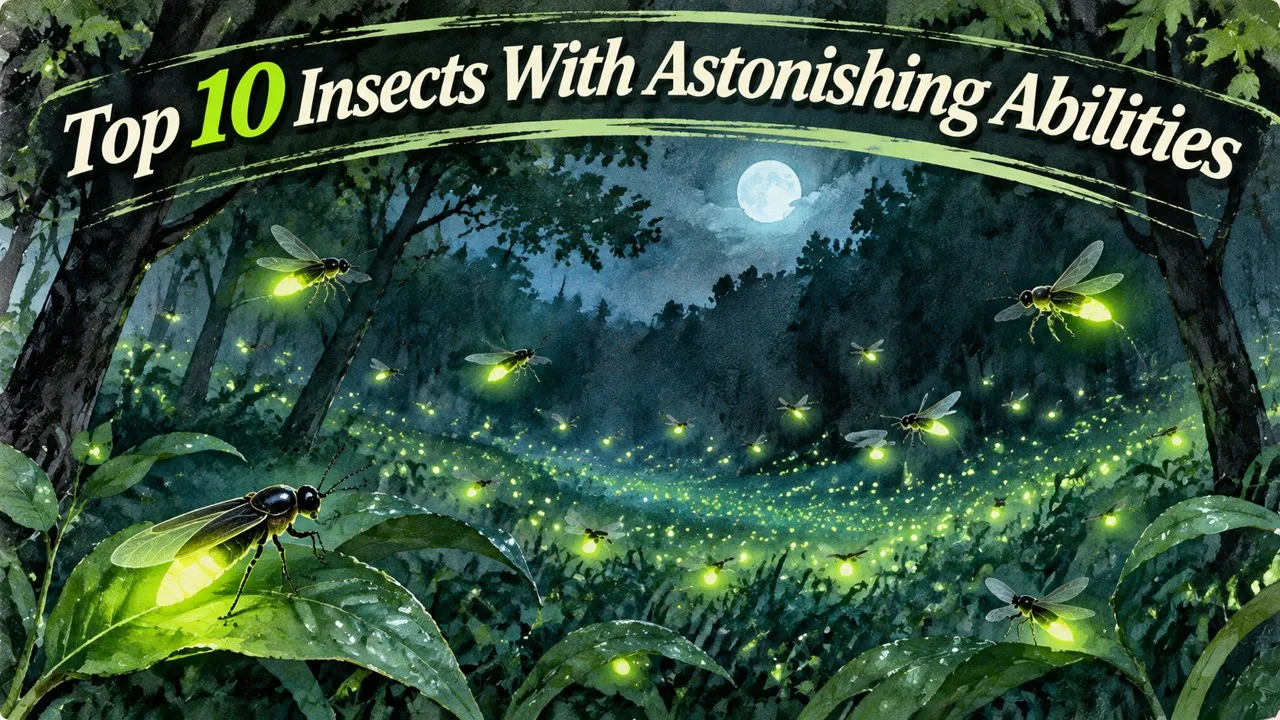
From dung beetles that steer by the Milky Way to dragonflies that cross the Indian Ocean, these ten insects with astonishing abilities reveal nature's genius. Insects make up the majority of known animal species, and they have been evolving for more than 400 million years. In that time, they have developed abilities that often surpass anything humans can build.
Some insects navigate by the stars, others farm, build air-conditioned towers or spray boiling chemicals. This list introduces ten insects whose abilities astonish scientists, including a dragonfly whose migration links India and Africa.
Key Facts
The ten insects below show remarkable skills in navigation, communication, farming, defence, flight and building.
Insects With Astonishing Abilities at a Glance
| # | Insect | Ability | Where found | Why it is astonishing |
|---|---|---|---|---|
| 1 | Dung Beetle | Navigates by the Milky Way | Worldwide | Uses starlight to steer |
| 2 | Honeybee | Communicates with a dance | Worldwide | Tells others where food is |
| 3 | Leafcutter Ant | Farms fungus | Central and South America | Agriculture before humans |
| 4 | Bombardier Beetle | Sprays boiling chemicals | Worldwide | A natural chemical weapon |
| 5 | Desert Locust | Transforms into swarms | Africa, the Middle East and South Asia | Changes its behaviour and appearance |
| 6 | Froghopper | Super jumper | Worldwide | The best jumper for its size |
| 7 | Firefly | Makes its own light | Worldwide | Cold light and synchronised displays |
| 8 | Termite | Builds air-conditioned towers | Africa, Asia and Australia | Master architects |
| 9 | Dragonfly | Expert hunter and long-distance migrant | Worldwide | Precision flight and epic journeys |
| 10 | Water Strider | Walks on water | Worldwide | Uses surface tension |
1. Dung Beetle
Dung beetles feed on animal droppings, and many species roll the dung into balls to carry away from competitors. [1]
To escape quickly, they need to roll their balls in a straight line. In 2013, scientists in South Africa showed that some dung beetles use the band of light from the Milky Way to keep their course on dark nights. [1]
It was the first animal shown to navigate using the Milky Way. In experiments in a planetarium, the beetles lost their way when the stars were hidden.
Some dung beetles are also extraordinarily strong. One species, Onthophagus taurus, can pull more than a thousand times its own body weight.
Dung beetles play a vital role in nature by recycling waste and spreading seeds.
The ancient Egyptians revered the scarab beetle as a symbol of the sun god Khepri, who was imagined rolling the sun across the sky.
Key Figures
- Ability: navigation by the Milky Way
- Discovery: published in 2013
- Strength: over 1,000 times body weight in one species
- Ecological role: recycling dung
Why It Made the List
The dung beetle is a star navigator and a strongman. It shows that small brains can achieve remarkable feats.
2. Honeybee
Honeybees live in colonies of tens of thousands, and they share information about food in an extraordinary way. [2]
When a forager finds a good source of nectar, she returns to the hive and performs a waggle dance on the honeycomb. [2]
The direction of the dance shows the direction of the food relative to the sun, and the length of the waggle shows how far away it is.
The Austrian scientist Karl von Frisch decoded the dance and shared the 1973 Nobel Prize in Physiology or Medicine for his work on animal behaviour.
Bees also have excellent vision, can see ultraviolet light and can learn to recognise complex patterns.
Honeybees pollinate many of the world's crops, making them vital for food production, including in India.
Related: Top 25 Interesting Facts About the Universe
Key Figures
- Ability: the waggle dance
- Decoded by: Karl von Frisch
- Nobel Prize: 1973
- Role: pollinating crops
Why It Made the List
The honeybee has a true symbolic language. Its pollination work supports much of our food supply.
3. Leafcutter Ant
Leafcutter ants are often seen carrying pieces of leaves many times their own weight in long processions through the forest. [3]
Surprisingly, they do not eat the leaves. Instead, they chew them into a paste and use it to grow a special fungus, which feeds the colony. [3]
Ants have been farming fungus for millions of years, long before humans began agriculture.
A large colony can contain millions of ants, divided into workers of different sizes, each with a specialised job.
Some ants even carry antibiotic-producing bacteria on their bodies, which help protect their fungus gardens from disease.
Their underground nests can be huge, with hundreds of chambers.
Their trails are kept clear of debris by worker ants, like tiny road crews. In parts of the Americas, leafcutter ants are among the most important plant-eaters in the forest.
Key Figures
- Ability: farming fungus
- Range: the Americas
- Colony size: millions
- Helpers: antibiotic-producing bacteria
Why It Made the List
Leafcutter ants are true farmers. Their societies are among the most complex in the animal kingdom.
4. Bombardier Beetle
The bombardier beetle defends itself with a chemical explosion. [4]
It stores two chemicals, hydroquinone and hydrogen peroxide, in a reservoir in its abdomen. When threatened, it squeezes them into a separate chamber containing enzymes. [4]
The reaction heats the mixture to near the boiling point of water and produces gas that blasts a hot, irritating spray out of the beetle's rear with a popping sound.
Some species can aim the spray in different directions, even over their backs.
The spray is released in rapid pulses, which protects the beetle from being harmed by its own heat.
Engineers have studied the beetle's spray system for ideas about fuel injection and fire extinguishers.
Its pulses come so quickly that they sound like a single pop.
Key Figures
- Ability: hot chemical spray
- Chemicals: hydroquinone and hydrogen peroxide
- Temperature: near boiling
- Species: more than 500
Why It Made the List
The bombardier beetle carries its own chemical cannon. It is a remarkable example of natural engineering.
5. Desert Locust
The desert locust is a grasshopper that usually lives alone. But when populations become crowded after good rains, it undergoes a dramatic change. [5]
Crowding causes locusts to change colour, behaviour and body shape. They become gregarious, gathering into bands and then huge flying swarms. [5]
Related: Top 25 Interesting Facts About the Solar System
A single swarm can contain billions of locusts and cover hundreds of square kilometres. Swarms can travel well over 100 kilometres in a day.
According to the United Nations Food and Agriculture Organization, even a small swarm can eat as much food in a day as thousands of people.
In 2019 and 2020, India faced its worst locust invasion in decades, with swarms damaging crops in Rajasthan, Gujarat and other states.
Scientists track locust populations with satellites and field surveys to give early warnings.
Key Figures
- Ability: changing from solitary to swarming form
- Swarm size: billions of insects
- Indian outbreak: 2019 to 2020
- Monitored by: the FAO
Why It Made the List
The desert locust's transformation is one of the most dramatic in nature. It remains a serious threat to farming.
6. Froghopper
Froghoppers are small insects that feed on plant sap. They get their name from their frog-like faces and their remarkable leaps. [6]
Research published in 2003 found that a common froghopper can jump up to about 70 centimetres, more than a hundred times its own body length. [6]
The jump involves acceleration hundreds of times the force of gravity, far more than humans could survive.
Froghoppers store energy in their legs like a catapult, then release it all at once.
Their young, called spittlebugs, hide inside frothy foam they make on plant stems, often called cuckoo spit.
The foam protects them from predators and keeps them from drying out.
There are thousands of species around the world, and some feed on crops such as sugarcane.
Key Figures
- Ability: jumping
- Jump: up to about 70 cm
- Method: catapult-like legs
- Young: spittlebugs in foam
Why It Made the List
The froghopper is one of nature's champion jumpers. It outperforms even the flea for its size.
7. Firefly
Fireflies are beetles that make light through a chemical reaction in their abdomens, a process called bioluminescence. [7]
Related: Top 10 Longest Rail Tunnels in the World
The reaction uses a chemical called luciferin and an enzyme called luciferase. It produces light with very little wasted heat, which is why it is called cold light. [7]
Each species has its own flashing pattern, which males and females use to find each other.
In some places, thousands of fireflies flash in unison. Synchronised displays occur in parts of Southeast Asia and the Great Smoky Mountains of the United States.
In India, the forests of the Western Ghats in Maharashtra light up with fireflies just before the monsoon, attracting visitors to villages such as Purushwadi.
Firefly numbers are falling in many places because of light pollution, pesticides and habitat loss.
Key Figures
- Ability: bioluminescence
- Chemicals: luciferin and luciferase
- Displays: synchronised flashing
- Indian hotspot: Western Ghats of Maharashtra
Why It Made the List
Fireflies create one of nature's most magical sights. Their light is a marvel of chemistry.
8. Termite
Some termites, such as those of the genus Macrotermes in Africa, build huge mounds that can rise several metres tall. [8]
These mounds contain networks of tunnels that help regulate temperature and air flow, keeping the colony and its fungus gardens comfortable. [8]
The design inspired the Eastgate Centre in Harare, Zimbabwe, an office building that uses natural ventilation to save energy.
Termite colonies are ruled by a queen and king. The queen can lay thousands of eggs a day and may live for decades.
Termites break down dead wood and plant material, enriching the soil.
Large termite mounds are also common in India, where they are sometimes associated with snakes and worshipped in rural shrines.
Workers constantly repair and adjust the mound.
Key Figures
- Ability: building ventilated mounds
- Mound height: several metres
- Inspired: the Eastgate Centre, Harare
- Queen's egg output: thousands a day
Why It Made the List
Termites are master builders. Their mounds have inspired human architecture.
9. Dragonfly
Dragonflies are among the most successful hunters in the animal kingdom. Studies suggest some species catch prey in the vast majority of their attempts. [9]
They can fly forwards, backwards and sideways, and hover in place, using four independently controlled wings. [9]
Their huge compound eyes contain thousands of lenses and give them a nearly all-round view.
Related: Top 25 Weird Facts About Left-Handed People
One species, the globe skimmer, makes one of the longest migrations of any insect. Scientists believe it crosses the Indian Ocean between India and East Africa.
The full journey of about 18,000 kilometres takes several generations, with individuals flying more than 6,000 kilometres.
Dragonflies have existed for more than 300 million years, and some of their ancient relatives had wingspans of around 70 centimetres.
Key Figures
- Ability: precision hunting and migration
- Eyes: thousands of lenses
- Migration: about 18,000 km over several generations
- Indian link: globe skimmers cross the Indian Ocean
Why It Made the List
The dragonfly is an aerial master and an ocean-crossing traveller. It links India and Africa through migration.
10. Water Strider
Water striders are insects that glide across the surface of ponds, streams and even the ocean. [10]
They can do this because of surface tension, the thin skin-like layer at the surface of water. [10]
Their legs are covered in thousands of tiny hairs that trap air and repel water, so they do not sink.
Water striders detect ripples on the surface to find insects that have fallen into the water.
One group, called Halobates, lives on the open ocean, among the very few insects that live at sea.
Engineers have studied water striders to design tiny robots that can move on water.
Males and females communicate by sending patterns of ripples across the water.
They are found on every continent except Antarctica.
Key Figures
- Ability: walking on water
- Secret: water-repellent hairs
- Hunting: sensing ripples
- Ocean species: Halobates
Why It Made the List
The water strider turns physics into a way of life. It is one of the few insects to live on the open ocean.
Conclusion
Insects show astonishing abilities in navigation, communication, defence and engineering. Many of these skills are now inspiring new technologies.
Insects are also essential for pollination, recycling and food webs. Protecting them protects the natural systems on which people depend.
- ^ [1] "Dung Beetle". Wikipedia. Wikipedia: Dung beetle Wikipedia: Onthophagus taurus
- ^ [2] "Honeybee". Wikipedia. Wikipedia: Waggle dance Wikipedia: Karl von Frisch
- ^ [3] "Leafcutter Ant". Wikipedia. Wikipedia: Leafcutter ant Wikipedia: Ant-fungus mutualism
- ^ [4] "Bombardier Beetle". Wikipedia. Wikipedia: Bombardier beetle Wikipedia: Hydrogen peroxide
- ^ [5] "Desert Locust". Wikipedia. Wikipedia: Desert locust Wikipedia: 2019–2021 locust infestation
- ^ [6] "Froghopper". Wikipedia. Wikipedia: Froghopper Wikipedia: Spittlebug
- ^ [7] "Firefly". Wikipedia. Wikipedia: Firefly Wikipedia: Bioluminescence
- ^ [8] "Termite". Wikipedia. Wikipedia: Termite Wikipedia: Mound-building termites Wikipedia: Eastgate Centre, Harare
- ^ [9] "Dragonfly". Wikipedia. Wikipedia: Dragonfly Wikipedia: Pantala flavescens
- ^ [10] "Water Strider". Wikipedia. Wikipedia: Gerridae Wikipedia: Halobates






















Discussion
Log in with