






 By
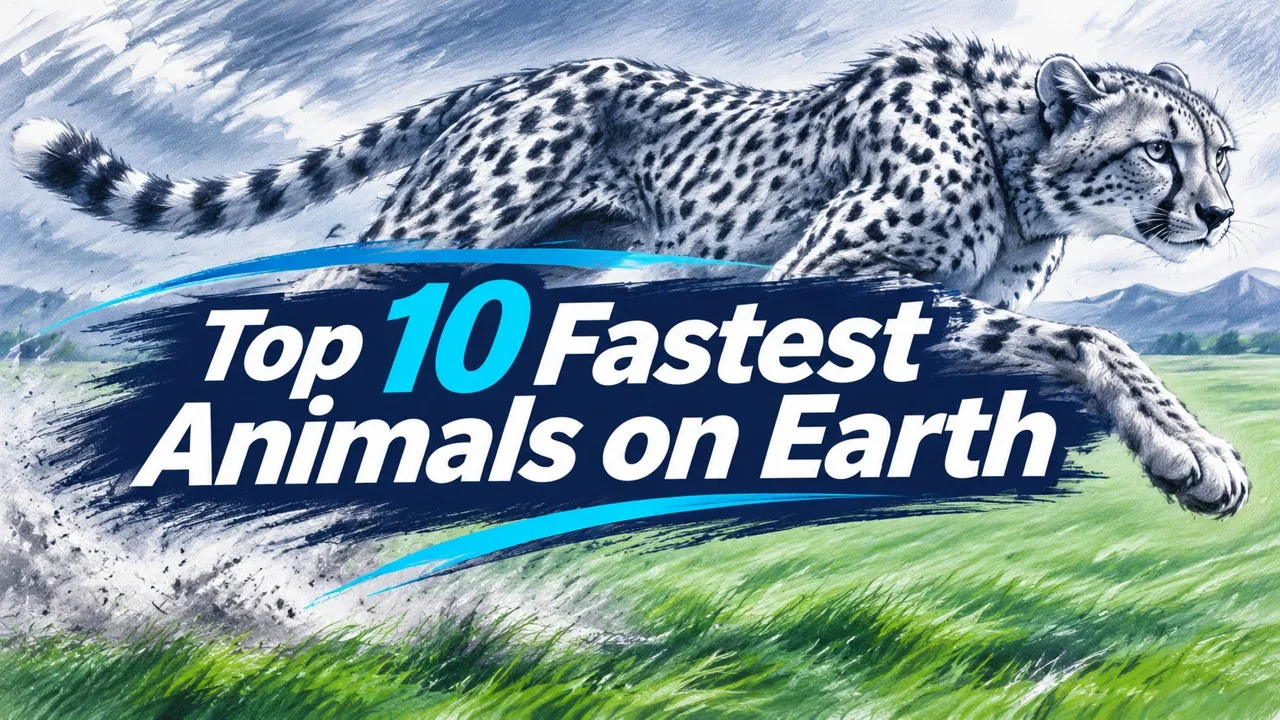
From the diving peregrine falcon and the cheetah to India's blackbuck and a lightning-fast beetle, meet ten of the fastest animals on Earth and how they do it. Speed is one of the great survival tools in nature. Predators use it to catch prey, while prey animals use it to escape. Over millions of years, evolution has produced animals that sprint, dive, swim and fly at astonishing speeds.
Measuring animal speed is surprisingly difficult, and many popular figures are exaggerated. This list uses well-supported estimates and explains where records are uncertain. It covers air, land and water, as well as two small creatures that are fast in their own extraordinary ways.
Key Facts
The ten animals below include birds, mammals, fish and invertebrates, and each holds a speed record of some kind.
The Fastest Animals on Earth at a Glance
| # | Animal | Top speed | Habitat | Type of speed |
|---|---|---|---|---|
| 1 | Peregrine Falcon | Over 300 km/h in a dive | Worldwide | Fastest diving bird |
| 2 | Brazilian Free-tailed Bat | Up to 160 km/h | The Americas | Fastest level flight |
| 3 | Cheetah | About 93 to 104 km/h | Africa and Iran | Fastest land animal |
| 4 | Pronghorn | About 88 km/h | North America | Fastest long-distance runner |
| 5 | Blackbuck | About 80 km/h | India and Nepal | One of the fastest antelopes |
| 6 | Ostrich | About 70 km/h | Africa | Fastest bird on land |
| 7 | Shortfin Mako Shark | About 74 km/h in bursts | Oceans worldwide | Fastest shark |
| 8 | Sailfish | Burst speeds now debated | Tropical and warm oceans | The fish once called the fastest |
| 9 | Tiger Beetle | About 9 km/h, 125 body lengths a second | Worldwide | Fastest relative to size |
| 10 | Mantis Shrimp | Strikes at about 23 metres a second | Tropical seas | Fastest punch |
1. Peregrine Falcon
The peregrine falcon is usually called the fastest animal on Earth. It hunts other birds by climbing high and then diving, or stooping, at tremendous speed. [1]
Speeds above 300 kilometres per hour are often quoted, and one trained falcon was recorded at about 389 kilometres per hour in a dive. Radar measurements of wild birds have recorded lower figures, so the true maximum is still debated. [1]
Its body is built for diving. It folds its wings tight, and small bony structures in its nostrils are thought to help it breathe at high speed.
The peregrine lives on every continent except Antarctica, including India, and it is one of the most widespread birds in the world.
In the 20th century, the pesticide DDT caused its numbers to collapse. After DDT was banned in many countries, populations recovered.
Today peregrines even nest on tall city buildings, hunting pigeons among the skyscrapers.
Key Figures
- Top speed: over 300 km/h in a dive, by many estimates
- Habitat: worldwide
- Hunting method: the stoop
- Recovery: after DDT bans
Why It Made the List
The peregrine is the fastest creature in a dive. Its comeback is a conservation success story.
2. Brazilian Free-tailed Bat
The Brazilian free-tailed bat, also called the Mexican free-tailed bat, is a small bat found across the Americas. [2]
In a study published in 2016, researchers tracked bats with tiny tags from a light aircraft and recorded ground speeds of up to 160 kilometres per hour. [2]
If confirmed, this makes it the fastest animal in horizontal flight, faster than any bird flying level. Some scientists note that tailwinds may have helped.
The bats have long, narrow wings, like those of fast birds, which suit rapid flight in open air.
They live in huge colonies. Bracken Cave in Texas holds millions of them, and their evening emergence is a famous sight.
They eat enormous numbers of insects, including crop pests, making them valuable to farmers.
Related: Top 10 Slowest Animals on Earth
Key Figures
- Top speed: up to 160 km/h recorded
- Habitat: North, Central and South America
- Record type: level flight
- Colonies: millions in some caves
Why It Made the List
This small bat may be the fastest flier in level flight. It shows that birds do not hold every speed record in the air.
3. Cheetah
The cheetah is the fastest land animal. It can reach about 93 to 104 kilometres per hour in short sprints while chasing prey. [3]
Its body is designed for speed: a light frame, long legs, a flexible spine that stretches and bends like a spring, and a long tail that acts as a rudder in sharp turns. [3]
Cheetahs can accelerate very quickly, but they tire fast. Most chases last less than a minute.
Unlike other big cats, cheetahs have claws that do not fully retract, giving them extra grip, like running spikes.
Cheetahs once lived across India, but they became extinct there in the 20th century. Since 2022, cheetahs from Namibia and South Africa have been brought to Kuno National Park in Madhya Pradesh in an effort to restore them.
Wild cheetahs are now found mainly in Africa, with a tiny population surviving in Iran.
Key Figures
- Top speed: about 93 to 104 km/h
- Range: Africa and Iran
- Chase length: usually under a minute
- Indian reintroduction: Kuno National Park, from 2022
Why It Made the List
The cheetah is the fastest runner on land. Its return to India makes it especially interesting to Indian readers.
4. Pronghorn
The pronghorn is a hoofed mammal of the North American grasslands. Although it looks like an antelope, it belongs to its own family. [4]
It can reach about 88 kilometres per hour, making it the fastest land mammal in the Americas. [4]
What makes it truly remarkable is endurance. A pronghorn can run at about 56 kilometres per hour for several kilometres, something a cheetah could never do.
It has a large heart and lungs, and a big windpipe, which help it take in plenty of oxygen while running.
Its speed is far greater than any living predator in its habitat needs. Some scientists think it evolved to escape fast predators that are now extinct, such as the American cheetah.
Pronghorns also have very large eyes and can spot movement from kilometres away.
Key Figures
- Top speed: about 88 km/h
- Endurance: about 56 km/h for several km
- Habitat: North American grasslands
- Family: the only living pronghorn species
Why It Made the List
The pronghorn combines speed with stamina better than almost any other animal. It may be outrunning ghosts of the Ice Age.
Related: Top 10 Unexpected Abilities Found in Animals
5. Blackbuck
The blackbuck is an elegant antelope native to India and Nepal. Males have dark coats and long, spiral horns, while females are lighter brown. [5]
It can run at about 80 kilometres per hour, making it one of the fastest land animals in Asia. [5]
Blackbuck live in open grasslands and lightly wooded areas. When alarmed, they make high leaps into the air before sprinting away.
In the past, Indian rulers used trained cheetahs to hunt blackbuck, a sign of how fast both animals were.
The blackbuck is protected in India. The Bishnoi community of Rajasthan is famous for protecting blackbuck and other wildlife near their villages.
It is the state animal of several Indian states, including Andhra Pradesh, Haryana and Punjab.
Key Figures
- Top speed: about 80 km/h
- Native range: India and Nepal
- Protected by: law and the Bishnoi community
- State animal: Andhra Pradesh, Haryana, Punjab
Why It Made the List
The blackbuck is India's own speed star. It shows how local traditions can help protect wildlife.
6. Ostrich
The ostrich is the largest living bird and cannot fly. Instead, it is a superb runner. [6]
It can sprint at more than 70 kilometres per hour and run for long periods at about 55 kilometres per hour, making it the fastest animal on two legs. [6]
Its long, powerful legs can cover 3 to 5 metres in a single stride.
Each foot has only two toes, one of them large and tipped with a strong claw, which helps with grip and speed.
An ostrich kick is powerful enough to injure or kill a lion, giving the bird a strong defence when it cannot run.
Ostriches lay the largest eggs of any living bird, each weighing more than a kilogram.
Key Figures
- Top speed: over 70 km/h
- Cruising speed: about 55 km/h
- Stride: 3 to 5 metres
- Toes: two per foot
Why It Made the List
The ostrich is the fastest two-legged runner alive. It proves that a bird does not need to fly to be fast.
7. Shortfin Mako Shark
The shortfin mako is the fastest known shark. It can reach about 74 kilometres per hour in short bursts. [7]
Related: Top 10 Animals That Can Live Without Food for Months
It has a sleek, torpedo-shaped body and a crescent-shaped tail that drives it powerfully through the water. [7]
Makos can keep their muscles warmer than the surrounding water, which gives them extra power and speed.
They are known for spectacular leaps out of the water, sometimes several metres high.
Makos hunt fast fish such as tuna and swordfish.
Sadly, the shortfin mako is now listed as Endangered, mainly because of overfishing. International trade in the species is now controlled.
Female makos can grow larger than males, and the species is found in the Indian Ocean as well as the Atlantic and Pacific.
Key Figures
- Top speed: about 74 km/h in bursts
- Habitat: tropical and temperate oceans
- Special feature: warm muscles
- Status: Endangered
Why It Made the List
The mako is the speed champion among sharks. Its decline is a warning about overfishing.
8. Sailfish
The sailfish, named for its huge sail-like fin, has long been called the fastest fish in the sea. Older books claimed speeds of more than 100 kilometres per hour. [8]
Research published in 2015 and 2016 suggests those figures were greatly exaggerated. Studies of sailfish muscles and real hunts found much lower burst speeds. [8]
Even so, sailfish are fast and agile hunters. They raise their sail to herd schools of small fish and then slash at them with their long bills.
They can change the colour of their bodies rapidly, perhaps to signal to each other during group hunts.
Sailfish are found in warm waters around the world, including the Indian Ocean.
Their story is a useful reminder that famous animal speed records should be checked carefully.
Key Figures
- Old claimed speed: over 100 km/h
- New research: 2015 and 2016 studies
- Hunting tool: a long bill
- Feature: a huge dorsal sail
Why It Made the List
The sailfish shows how science corrects popular myths. It remains one of the ocean's most impressive hunters.
9. Tiger Beetle
Tiger beetles are small predatory insects known for their speed. The fastest known species, found in Australia, can run at about 9 kilometres per hour. [9]
That may not sound fast, but it equals about 125 body lengths per second. A human running at the same relative speed would travel at hundreds of kilometres per hour. [9]
Related: Top 10 Extraordinary Lizards of the World
Tiger beetles run so fast that their eyes cannot keep up. They often stop briefly to find their prey again, then dash off once more.
Scientists studying them found that they hold their antennae out in front of them like feelers, to avoid obstacles during these blind sprints.
Many tiger beetles have shiny metallic colours, and they are common on beaches, riverbanks and open ground.
India and nearby regions have some of the richest variety of tiger beetle species in the world.
Key Figures
- Top speed: about 9 km/h
- Relative speed: about 125 body lengths per second
- Odd fact: they run too fast to see
- Diversity: richest in the Indo-Malayan region
Why It Made the List
The tiger beetle is one of the fastest runners for its size. Its blind sprints are a wonder of insect biology.
10. Mantis Shrimp
The mantis shrimp is not a true shrimp but a fierce marine crustacean. It holds a very different speed record: the fastest punch in the animal kingdom. [10]
Some species have club-like limbs that they swing at about 23 metres per second, roughly 80 kilometres per hour, with enormous acceleration. [10]
The strike is so fast that it creates bubbles in the water that collapse with a burst of heat, light and sound, adding a second impact.
Mantis shrimp use their punches to smash open snails and crabs. Large ones can even crack aquarium glass.
They also have some of the most complex eyes known, with many more types of colour receptors than humans.
Engineers study their tough clubs to design stronger materials.
Key Figures
- Strike speed: about 23 m/s
- Habitat: shallow tropical and subtropical seas
- Prey: snails and crabs
- Eyes: many types of colour receptors
Why It Made the List
The mantis shrimp has the fastest punch in nature. It shows that speed can be measured in more than one way.
Conclusion
Speed has evolved again and again, in falcons and bats, cats and antelopes, sharks and beetles. Each animal's speed is shaped by its way of life, whether hunting or escaping.
Many speed records remain uncertain, and new measurements continue to change the rankings. But all of these animals show how far evolution can push the limits of movement.
- ^ [1] "Peregrine Falcon". Wikipedia. Wikipedia: Peregrine falcon Wikipedia: Bird flight
- ^ [2] "Brazilian Free-tailed Bat". Wikipedia. Wikipedia: Mexican free-tailed bat Wikipedia: Bracken Cave
- ^ [3] "Cheetah". Wikipedia. Wikipedia: Cheetah Wikipedia: Cheetah reintroduction in India
- ^ [4] "Pronghorn". Wikipedia. Wikipedia: Pronghorn Wikipedia: Miracinonyx
- ^ [5] "Blackbuck". Wikipedia. Wikipedia: Blackbuck Wikipedia: Bishnoi
- ^ [6] "Ostrich". Wikipedia. Wikipedia: Common ostrich Wikipedia: Ratite
- ^ [7] "Shortfin Mako Shark". Wikipedia. Wikipedia: Shortfin mako shark Wikipedia: Overfishing
- ^ [8] "Sailfish". Wikipedia. Wikipedia: Sailfish Wikipedia: Billfish
- ^ [9] "Tiger Beetle". Wikipedia. Wikipedia: Tiger beetle Wikipedia: Rivacindela hudsoni
- ^ [10] "Mantis Shrimp". Wikipedia. Wikipedia: Mantis shrimp Wikipedia: Cavitation






















Discussion
Log in with