





 By
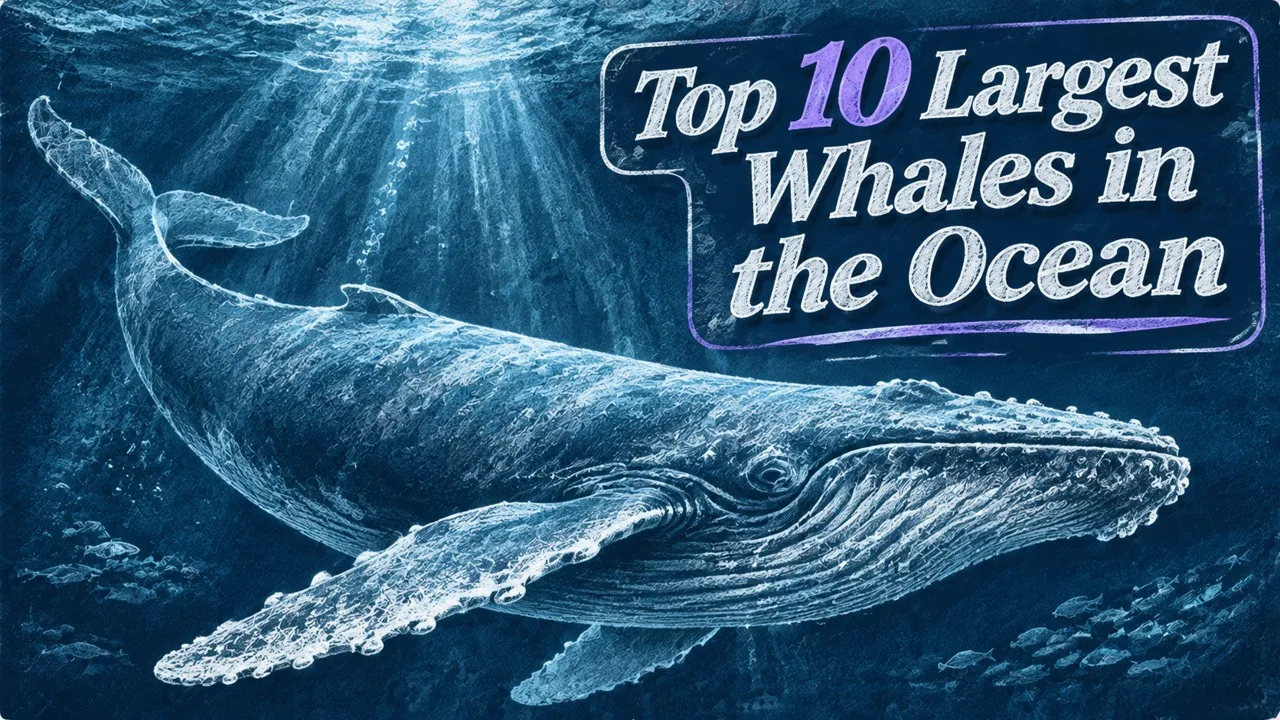
From the blue whale, the largest animal known, to the fin, sperm and humpback whales, these ten largest whales in the ocean show the giants of marine life. Whales are mammals that returned to the sea around 50 million years ago, and some of them have grown to sizes unmatched by any other animals. The water supports their weight, allowing them to become far larger than anything that lives on land.
Whales fall into two main groups. Baleen whales filter small animals such as krill from the water using plates of baleen, while toothed whales hunt fish and squid. This list ranks the ten largest whale species by typical maximum length, including several that can be seen in the Indian Ocean.
Key Facts
The ten whales below range from the blue whale, up to about 30 metres long, to Baird's beaked whale, the largest of the beaked whales.
The Largest Whales at a Glance
| # | Whale | Maximum length | Type | Known for |
|---|---|---|---|---|
| 1 | Blue Whale | About 30 metres | Baleen whale | The largest animal known |
| 2 | Fin Whale | About 26 to 27 metres | Baleen whale | The greyhound of the sea |
| 3 | Sperm Whale | Up to about 20 metres for males | Toothed whale | The largest toothed predator |
| 4 | Sei Whale | Up to about 19.5 metres | Baleen whale | One of the fastest whales |
| 5 | North Pacific Right Whale | About 18 metres | Baleen whale | One of the rarest whales |
| 6 | Southern Right Whale | About 17 to 18 metres | Baleen whale | A giant making a comeback |
| 7 | Humpback Whale | About 14 to 17 metres | Baleen whale | Long flippers and acrobatic leaps |
| 8 | Bryde's Whale | About 15 to 16 metres | Baleen whale | A whale of warm waters |
| 9 | Gray Whale | About 15 metres | Baleen whale | An epic migration |
| 10 | Baird's Beaked Whale | About 12 to 13 metres | Toothed whale | The largest beaked whale |
1. Blue Whale
The blue whale is the largest animal known to have ever lived. It can reach about 30 metres in length and weigh up to around 190 to 200 tonnes. [1]
Despite its size, it feeds almost entirely on krill, tiny shrimp-like animals. In a day of heavy feeding, a large blue whale can swallow many tonnes of them. [1]
It feeds by lunging into swarms of krill, gulping huge amounts of water and pushing it out through its baleen plates.
Its calls are among the loudest of any animal and can travel hundreds of kilometres underwater.
Blue whales were hunted to near extinction in the 20th century. They have been protected since the 1960s, and some populations are slowly recovering.
A subspecies of blue whale lives in the northern Indian Ocean, and the waters off Sri Lanka are one of the best places in the world to see them.
Key Figures
- Length: about 30 m
- Weight: up to about 190 to 200 tonnes
- Diet: krill
- Indian Ocean: resident subspecies
Why It Made the List
The blue whale is the biggest animal in Earth's history, as far as we know. Its recovery is a slow conservation story.
2. Fin Whale
The fin whale is the second-longest animal on Earth, with the largest individuals reported at about 26 to 27 metres. [2]
It has a long, slender body and is one of the fastest large whales, earning it the nickname greyhound of the sea. [2]
The fin whale has an unusual feature: its head is coloured asymmetrically. The right side of the lower jaw is white, while the left is dark.
Scientists think this may help it herd fish while circling them.
Fin whales are found in all major oceans. They were heavily hunted in the 20th century and are still listed as Vulnerable.
Their low-pitched calls are so deep that humans cannot hear them without special equipment.
It can live for 80 to 90 years.
Key Figures
- Length: about 26 to 27 m
- Nickname: greyhound of the sea
- Feature: asymmetrical jaw colour
- Status: Vulnerable
Why It Made the List
The fin whale is a sleek, fast giant. Its asymmetrical colouring is unique among whales.
Related: Top 10 Best Whale Watching Destinations in the World
3. Sperm Whale
The sperm whale is the largest toothed whale and the largest toothed predator on Earth. Males can reach around 16 to 20 metres, while females are much smaller. [3]
Its huge, square head contains the largest brain of any animal and a waxy substance called spermaceti, which was once prized for candles and lamps. [3]
Sperm whales dive to depths of more than 1,000 metres, sometimes over 2,000 metres, to hunt squid, including giant squid.
They use powerful clicks to find prey by echolocation. These clicks are among the loudest sounds made by any animal.
Females and young live in close family groups and help care for each other's calves.
The sperm whale inspired Herman Melville's novel Moby-Dick, published in 1851.
Key Figures
- Length: about 16 to 20 m for males
- Brain: the largest of any animal
- Diving depth: over 1,000 m
- Literary fame: Moby-Dick
Why It Made the List
The sperm whale is the giant of the deep. Its brain and diving skills make it one of the most remarkable animals.
4. Sei Whale
The sei whale is the third-largest rorqual, after the blue and fin whales. It can grow to about 19.5 metres and weigh up to about 28 tonnes. [4]
It is among the fastest of all whales, reaching around 50 kilometres per hour over short distances. [4]
Its name comes from the Norwegian word for pollock, a fish that often appeared off Norway at the same time as the whales.
Sei whales prefer deep offshore waters and avoid polar and tropical seas, so they are rarely seen.
They feed by skimming the surface for small crustaceans, rather than lunging like blue whales.
The species was heavily hunted and is listed as Endangered.
Its population is slowly recovering.
Key Figures
- Length: up to about 19.5 m
- Speed: about 50 km/h in bursts
- Name origin: Norwegian for pollock
- Status: Endangered
Why It Made the List
The sei whale is a fast and elusive giant. It remains one of the least studied large whales.
5. North Pacific Right Whale
The North Pacific right whale is a very large, thickset whale that can reach about 18 metres in length. [5]
Right whales got their name because whalers considered them the right whale to hunt. They swim slowly near the coast and float when killed. [5]
Related: Top 10 Largest Animals of Their Kind
As a result, they were hunted almost to extinction. Before commercial whaling, the North Pacific may have had more than 20,000 of them.
Today the eastern population may have no more than 40 animals, making it one of the rarest whales in the world.
Right whales have no dorsal fin and have rough white patches of skin on their heads called callosities, which help scientists identify individuals.
They feed by skimming through dense patches of tiny plankton with their mouths open.
Key Figures
- Length: about 18 m
- Name origin: the right whale to hunt
- Eastern population: perhaps 40 or fewer
- Feature: callosities on the head
Why It Made the List
The North Pacific right whale is a giant on the edge of extinction. It shows the lasting damage of commercial whaling.
6. Southern Right Whale
The southern right whale lives in the Southern Hemisphere and can reach about 17 to 18 metres in length. [6]
Like its northern relatives, it has no dorsal fin, a long arching mouth and white callosities on its head. [6]
Southern right whales were hunted for centuries and nearly wiped out. Since gaining protection, their numbers have grown to many thousands.
In winter they travel to warmer coastal waters to give birth. They often come very close to shore.
Places such as Hermanus in South Africa and Peninsula Valdes in Argentina are famous for watching them from land.
In summer they return to the cold waters of the Southern Ocean to feed.
Calves stay close to their mothers for about a year.
Key Figures
- Length: about 17 to 18 m
- Range: the Southern Hemisphere
- Estimated population: around 13,600 in 2009
- Watching sites: Hermanus and Peninsula Valdes
Why It Made the List
The southern right whale is a conservation success story. It can often be seen from the shore.
7. Humpback Whale
The humpback whale grows to about 14 to 17 metres and weighs up to around 40 tonnes. [7]
Its flippers are the longest of any whale, up to about a third of its body length. Their bumpy edges help the whale turn sharply. [7]
Humpbacks often leap out of the water, a behaviour called breaching, which makes them a favourite of whale watchers.
Related: Top 10 Remarkable Jellyfish of the World
Groups of humpbacks hunt by blowing rings of bubbles around fish, trapping them before lunging upwards with open mouths.
The black and white patterns on the underside of their tail flukes are unique, so scientists can identify individuals from photographs.
Humpbacks make some of the longest migrations of any mammal, travelling thousands of kilometres between feeding and breeding grounds.
Key Figures
- Length: about 14 to 17 m
- Flippers: up to a third of body length
- Hunting method: bubble nets
- Identification: tail patterns
Why It Made the List
The humpback is the most acrobatic of the great whales. Its recovery has delighted whale watchers worldwide.
8. Bryde's Whale
Bryde's whales are medium-to-large rorquals that live in warm tropical and temperate waters around the world, including the seas around India. [8]
Large individuals can reach about 15 to 16 metres in length. [8]
Unlike many whales, they do not make long seasonal migrations, and some populations stay in the same region all year.
Bryde's whales have three ridges running along the top of their heads, which helps distinguish them from similar species.
Their classification is complex, and scientists still debate how many species the Bryde's whale group contains.
They feed on schooling fish such as sardines and anchovies, as well as krill.
In 2021, a small population in the Gulf of Mexico was described as a separate species, Rice's whale, one of the most endangered whales on Earth.
Key Figures
- Length: about 15 to 16 m
- Range: warm tropical and temperate waters
- Feature: three ridges on the head
- Migration: little or none
Why It Made the List
Bryde's whales are the large whales most likely to be seen in tropical waters. They are still revealing scientific surprises.
9. Gray Whale
The gray whale reaches about 15 metres in length and weighs up to around 41 to 45 tonnes. It is named for its grey skin, mottled with white patches. [9]
Unlike most baleen whales, it feeds mainly on the seafloor, rolling on its side to suck up mud and filter out small animals. [9]
Gray whales in the eastern Pacific make one of the longest migrations of any mammal, travelling between Arctic feeding grounds and lagoons in Mexico where they give birth.
Related: Top 10 Most Dangerous Sea Creatures
In these Mexican lagoons, some gray whales approach boats and even allow people to touch them.
The species once lived in the Atlantic Ocean but disappeared there centuries ago.
Whalers once called them devil fish because mothers fought fiercely to protect their calves.
Key Figures
- Length: about 15 m
- Feeding: on the seafloor
- Migration: Arctic to Mexico
- Calving grounds: Mexican lagoons
Why It Made the List
The gray whale makes one of the greatest journeys in the animal kingdom. Its friendly behaviour delights visitors.
10. Baird's Beaked Whale
Baird's beaked whale is the largest beaked whale and the second-largest toothed whale after the sperm whale. It can reach about 12 to 13 metres in length. [10]
It lives in the deep waters of the North Pacific Ocean, including off Japan, Russia and North America. [10]
Beaked whales are named for their long snouts. Baird's beaked whale has a bulging forehead and teeth that stick out from the lower jaw.
It dives deep to feed on squid and fish, staying underwater for an hour or more.
Adults are often covered in long white scars, probably caused by the teeth of other members of their species.
Because they spend so much time in deep water far from shore, beaked whales are among the least understood large animals.
Key Figures
- Length: about 12 to 13 m
- Range: North Pacific
- Rank: largest beaked whale
- Dives: an hour or more
Why It Made the List
Baird's beaked whale is a deep-diving giant that few people ever see. It reminds us how much remains unknown in the ocean.
Conclusion
The largest whales are some of the most impressive animals ever to have lived. Many were hunted close to extinction, but protection has allowed several species to recover.
Today whales face new threats from ship strikes, fishing nets, noise and climate change. Protecting them helps keep the oceans healthy.
- ^ [1] "Blue Whale". Wikipedia. Wikipedia: Blue whale Wikipedia: Krill
- ^ [2] "Fin Whale". Wikipedia. Wikipedia: Fin whale Wikipedia: Rorqual
- ^ [3] "Sperm Whale". Wikipedia. Wikipedia: Sperm whale Wikipedia: Moby-Dick
- ^ [4] "Sei Whale". Wikipedia. Wikipedia: Sei whale Wikipedia: Pollock
- ^ [5] "North Pacific Right Whale". Wikipedia. Wikipedia: North Pacific right whale Wikipedia: Right whale
- ^ [6] "Southern Right Whale". Wikipedia. Wikipedia: Southern right whale Wikipedia: Hermanus
- ^ [7] "Humpback Whale". Wikipedia. Wikipedia: Humpback whale Wikipedia: Bubble-net feeding
- ^ [8] "Bryde's Whale". Wikipedia. Wikipedia: Bryde's whale Wikipedia: Rice's whale
- ^ [9] "Gray Whale". Wikipedia. Wikipedia: Gray whale Wikipedia: Laguna San Ignacio
- ^ [10] "Baird's Beaked Whale". Wikipedia. Wikipedia: Baird's beaked whale Wikipedia: Beaked whale






















Discussion
Log in with