




 By
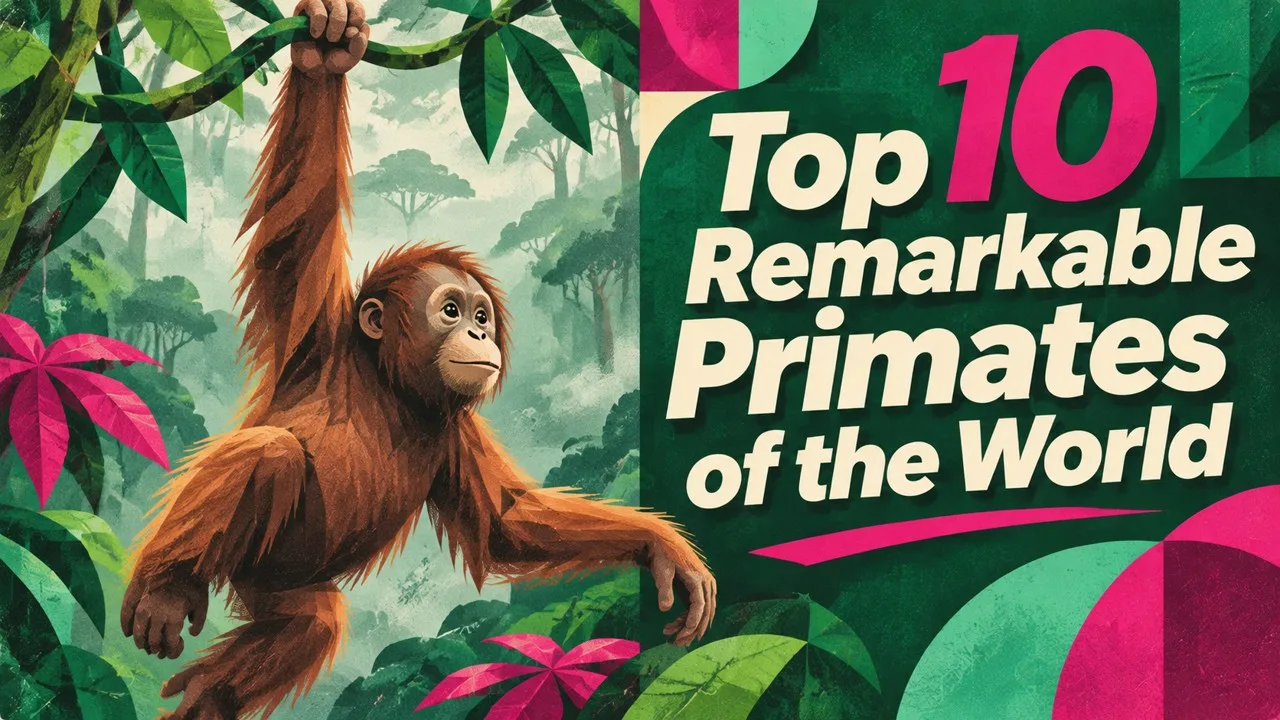
From chimpanzees and orangutans to India's lion-tailed macaque and the tiny tarsier, these ten remarkable primates show how varied our closest relatives are. Primates are the group of mammals that includes humans, apes, monkeys, lemurs and tarsiers. There are more than 500 species, living mainly in the tropical forests of Africa, Asia and the Americas.
Primates are known for their grasping hands, forward-facing eyes and large brains. Many are highly social and intelligent, and some use tools, solve problems and pass on learned habits. This list introduces ten remarkable primates, including two that live in India.
Key Facts
The ten primates below range from great apes that share most of our DNA to a tiny tarsier that fits in the palm of a hand.
Remarkable Primates at a Glance
| # | Primate | Group | Where it lives | Remarkable for |
|---|---|---|---|---|
| 1 | Chimpanzee | Great ape | Central and West Africa | Tool use and culture |
| 2 | Bonobo | Great ape | Democratic Republic of the Congo | Peaceful, female-led societies |
| 3 | Gorilla | Great ape | Central Africa | The largest primate |
| 4 | Orangutan | Great ape | Borneo and Sumatra | The red ape of the trees |
| 5 | Mandrill | Monkey | West Central Africa | The most colourful primate |
| 6 | Proboscis Monkey | Monkey | Borneo | A giant nose and a pot belly |
| 7 | Japanese Macaque | Monkey | Japan | The snow monkey |
| 8 | Lion-tailed Macaque | Monkey | Western Ghats, India | A silver mane and a lion-like tail |
| 9 | Gray Langur | Monkey | Indian subcontinent | The sacred Hanuman langur |
| 10 | Philippine Tarsier | Tarsier | The Philippines | Huge eyes in a tiny body |
1. Chimpanzee
Chimpanzees are among our closest living relatives, sharing about 98 to 99 percent of our DNA. They live in communities in the forests and woodlands of Central and West Africa. [1]
In 1960, the young researcher Jane Goodall watched a chimpanzee in Gombe, Tanzania, use a stripped twig to fish termites from a mound. The observation challenged the idea that only humans make tools. [1]
Since then, chimpanzees have been seen using stones to crack nuts, leaves as sponges and sticks as spears.
Different groups have different habits, passed on by learning, which scientists describe as a form of culture.
Chimpanzees hunt cooperatively, form alliances and can be aggressive towards rival groups.
They are listed as Endangered, threatened by habitat loss, hunting and disease.
Key Figures
- Group: great ape
- Shared DNA with humans: about 98 to 99 percent
- Famous study: Jane Goodall at Gombe from 1960
- Status: Endangered
Why It Made the List
Chimpanzees changed how we think about tool use and culture. They remain a window into our own evolution.
2. Bonobo
The bonobo is the smallest great ape and, along with the chimpanzee, our closest living relative. [2]
Bonobos live only in the rainforests south of the Congo River in the Democratic Republic of the Congo. The river separates them from chimpanzees. [2]
They were recognised as a separate species only in the 20th century, having first been called pygmy chimpanzees.
Bonobo societies are often led by alliances of females, and they tend to resolve tension through social bonding rather than violence.
Bonobos are known for sharing food, even with strangers, in some experiments.
They are Endangered, threatened by hunting and habitat loss in a region affected by conflict.
Researchers have found that bonobos can learn to communicate using symbols and understand many spoken words. Some sanctuaries in the Congo care for orphaned bonobos and return them to the wild.
Key Figures
- Group: great ape
- Range: south of the Congo River
- Social life: female alliances
- Status: Endangered
Why It Made the List
Bonobos show that our closest relatives can be remarkably peaceful. They offer a contrast to the more aggressive chimpanzee.
Related: Top 10 Surprising Animal Partnerships in Nature
3. Gorilla
Gorillas are the largest living primates. Adult males, called silverbacks for the grey hair on their backs, can weigh around 160 to 200 kilograms. [3]
There are two species, the western and eastern gorillas, living in the forests of Central Africa. [3]
Despite their strength, gorillas are mostly gentle plant-eaters, eating leaves, stems and fruit.
Groups are usually led by a dominant silverback, who protects the group and decides where it travels.
The mountain gorilla, a subspecies of the eastern gorilla, was once close to extinction. Thanks to protection and tourism, its numbers have risen to over a thousand.
Researchers such as Dian Fossey helped bring the plight of gorillas to world attention.
Gorillas build fresh nests of leaves and branches to sleep in every night.
Key Figures
- Group: great ape
- Male weight: about 160 to 200 kg
- Species: western and eastern
- Mountain gorillas: over 1,000
Why It Made the List
The gorilla is the giant of the primate world. The recovery of mountain gorillas is a conservation success.
4. Orangutan
Orangutans are the only great apes found in Asia, living on the islands of Borneo and Sumatra. Their name comes from Malay words meaning person of the forest. [4]
They are the largest tree-dwelling mammals, spending most of their lives in the forest canopy. [4]
Orangutans are mostly solitary. Mothers care for their young for many years, and the gap between births can be seven or eight years, among the longest of any mammal.
They use tools, such as sticks to extract seeds and leaves as umbrellas in the rain.
There are three species. The Tapanuli orangutan, described in 2017, is the rarest great ape, with only about 800 left.
All orangutans are Critically Endangered, mainly due to the clearing of forests for palm oil plantations and logging.
Key Figures
- Group: great ape
- Range: Borneo and Sumatra
- Species: three
- Status: Critically Endangered
Why It Made the List
Orangutans are Asia's only great apes. Their survival depends on protecting tropical forests.
5. Mandrill
The mandrill is often described as the world's largest monkey. It lives in the rainforests of west central Africa. [5]
Related: Top 10 Amazing Animals of the Amazon Rainforest
Males have striking red and blue skin on their faces and rumps, making them among the most colourful mammals on Earth. The brightest males tend to be the most dominant. [5]
Mandrills live in large groups called hordes, which can include hundreds of animals.
They spend most of their time on the ground, eating fruit, seeds, insects and small animals.
They have large cheek pouches for storing food while they forage.
Mandrills were once thought to be baboons, but genetic studies show they are more closely related to some mangabeys.
Adult males can weigh more than 30 kilograms, about three times as much as females.
Key Figures
- Group: Old World monkey
- Range: west central Africa
- Colours: red and blue face
- Groups: hordes of hundreds
Why It Made the List
The mandrill is the most colourful primate. Its huge hordes are among the largest primate groups.
6. Proboscis Monkey
The proboscis monkey lives only on the island of Borneo, in mangrove forests, swamps and riverside woodlands. [6]
Males have very large, drooping noses, which may help them make loud calls and attract females. [6]
The monkeys eat mainly leaves and unripe fruit, which they digest in a large, chambered stomach. This gives them a pot-bellied look.
They are excellent swimmers, with partly webbed feet, and often leap from trees into rivers.
Proboscis monkeys live in groups and gather in trees along rivers at night.
They are Endangered, mainly because of the loss of their riverside forests.
Their swollen bellies can make up a large part of their body weight after a big meal of leaves. Visitors to Borneo often watch them from boats along rivers such as the Kinabatangan in Sabah.
Key Figures
- Group: Old World monkey
- Range: Borneo
- Feature: large nose in males
- Skill: strong swimmer
Why It Made the List
The proboscis monkey is one of the strangest-looking primates. It is perfectly adapted to life by the water.
7. Japanese Macaque
The Japanese macaque, also called the snow monkey, lives farther north than any other non-human primate. [7]
Some populations live where snow covers the ground for months, and they grow thick fur to survive temperatures well below freezing. [7]
Related: Top 10 Unsettling Facts About Nature
At Jigokudani in central Japan, macaques famously bathe in natural hot springs during winter.
In the 1950s, researchers on the island of Koshima saw a young female wash sweet potatoes in water. The habit spread through the group, an early example of animal culture.
Japanese macaques have also been seen making and playing with snowballs.
They appear often in Japanese art and folklore.
The species is protected in Japan, though conflicts with farmers occur in some areas. The Jigokudani hot springs attract visitors from around the world.
Key Figures
- Group: Old World monkey
- Range: Japan
- Record: northernmost non-human primate
- Famous behaviour: hot spring bathing
Why It Made the List
The snow monkey shows how adaptable primates can be. Its learned habits are a classic example of animal culture.
8. Lion-tailed Macaque
The lion-tailed macaque is found only in the rainforests of the Western Ghats in southern India, in Kerala, Karnataka and Tamil Nadu. [8]
It has black fur and a striking silver-white mane around its face. Its tail ends in a tuft, like a lion's. [8]
The monkey spends most of its time in the upper canopy of tall evergreen forests, eating fruit, seeds, leaves and insects.
It is Endangered, with only a few thousand left in the wild, because of the fragmentation of its forests.
The species became a symbol of the Save Silent Valley movement in Kerala, which helped protect a valuable rainforest from a dam project.
Silent Valley became a national park in 1984.
Its range is now broken into many small patches of forest separated by tea and coffee plantations.
Key Figures
- Group: Old World monkey
- Range: Western Ghats, India
- Feature: silver-white mane
- Status: Endangered
Why It Made the List
The lion-tailed macaque is one of India's most distinctive animals. It helped spark a landmark conservation campaign.
9. Gray Langur
Gray langurs, also known as Hanuman langurs, are long-tailed monkeys with black faces and grey fur. They are found across much of the Indian subcontinent. [9]
In Hinduism they are associated with the god Hanuman, and they are often treated with respect near temples. [9]
Langurs live in forests, villages and cities, from the plains to high in the Himalayas.
Related: Top 10 Animals That Can Live Without Food for Months
They eat mainly leaves, which they digest with the help of a specialised stomach, along with fruit and flowers.
Scientists now recognise several species of gray langur, which were once grouped as one.
Langurs often live peacefully alongside deer in Indian forests, warning them of predators with alarm calls.
They can leap many metres between trees.
Babies are born with dark fur.
Key Figures
- Group: Old World monkey
- Range: Indian subcontinent
- Also called: Hanuman langur
- Diet: mainly leaves
Why It Made the List
The gray langur is one of India's most familiar primates. Its cultural importance is matched by its ecological role.
10. Philippine Tarsier
The Philippine tarsier is one of the smallest primates, with a body only about 10 to 15 centimetres long. [10]
Each of its eyes is about as big as its brain. The eyes cannot move in their sockets, so the tarsier turns its head almost all the way around instead. [10]
Tarsiers are nocturnal and hunt insects, leaping between branches with long hind legs.
In 2012, researchers found that Philippine tarsiers communicate using ultrasound, at pitches too high for humans to hear.
The tarsier family is about 45 million years old.
Tarsiers are shy and easily stressed. Sanctuaries on the island of Bohol protect them and teach visitors to keep quiet and avoid flash photography.
Its genus, Carlito, was named after Carlito Pizarras, a conservationist who protected tarsiers in Bohol.
Key Figures
- Group: tarsier
- Body length: about 10 to 15 cm
- Eyes: each about as big as its brain
- Communication: ultrasound
Why It Made the List
The tarsier is one of the most unusual primates. It shows the great variety of the primate family.
Conclusion
From giant gorillas to tiny tarsiers, primates show remarkable variety in size, behaviour and intelligence. Many share habits, emotions and abilities once thought to be uniquely human.
More than half of all primate species are threatened with extinction. Protecting their forests helps save our closest relatives.
- ^ [1] "Chimpanzee". Wikipedia. Wikipedia: Chimpanzee Wikipedia: Jane Goodall
- ^ [2] "Bonobo". Wikipedia. Wikipedia: Bonobo Wikipedia: Congo River
- ^ [3] "Gorilla". Wikipedia. Wikipedia: Gorilla Wikipedia: Mountain gorilla Wikipedia: Dian Fossey
- ^ [4] "Orangutan". Wikipedia. Wikipedia: Orangutan Wikipedia: Tapanuli orangutan
- ^ [5] "Mandrill". Wikipedia. Wikipedia: Mandrill Wikipedia: Mangabey
- ^ [6] "Proboscis Monkey". Wikipedia. Wikipedia: Proboscis monkey Wikipedia: Borneo
- ^ [7] "Japanese Macaque". Wikipedia. Wikipedia: Japanese macaque Wikipedia: Jigokudani Monkey Park
- ^ [8] "Lion-tailed Macaque". Wikipedia. Wikipedia: Lion-tailed macaque Wikipedia: Silent Valley National Park
- ^ [9] "Gray Langur". Wikipedia. Wikipedia: Semnopithecus Wikipedia: Hanuman
- ^ [10] "Philippine Tarsier". Wikipedia. Wikipedia: Philippine tarsier Wikipedia: Tarsier




















Discussion
Log in with