






 By
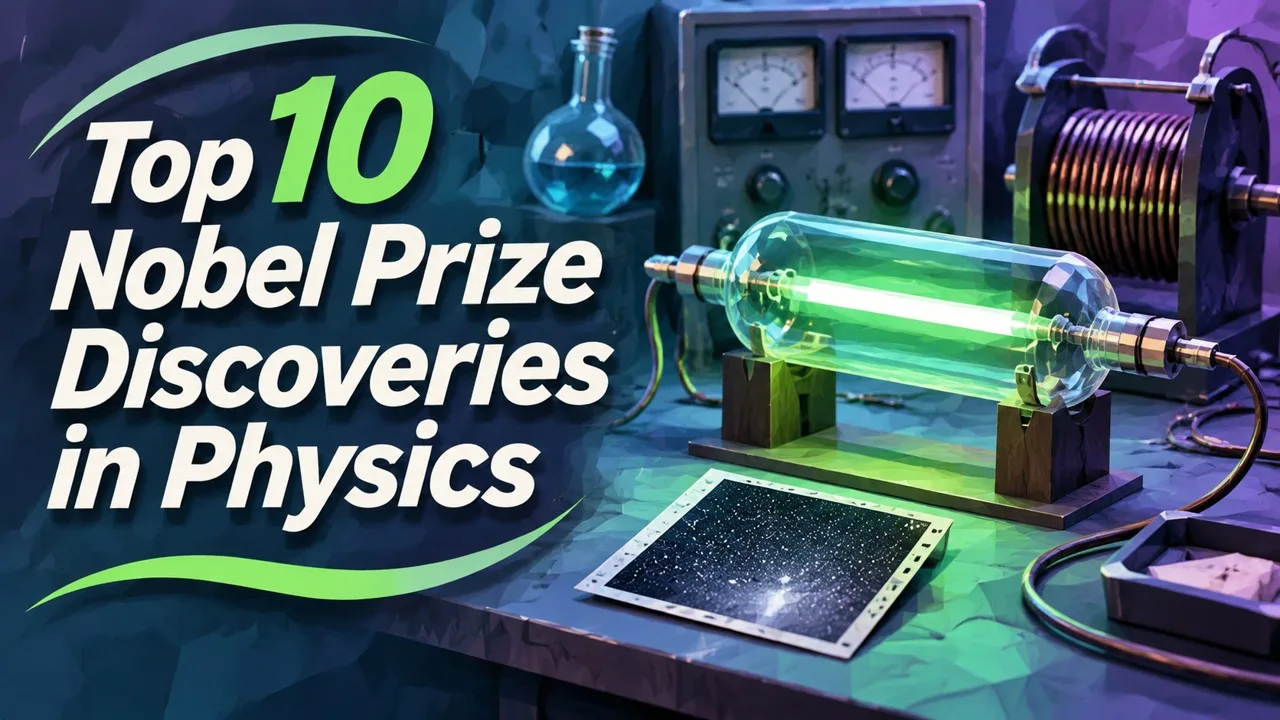
From X-rays and the Raman effect to the Higgs boson and gravitational waves, these ten Nobel Prize discoveries in physics changed how we see the universe. The Nobel Prize in Physics was first awarded in 1901, following the will of the Swedish inventor Alfred Nobel. Since then it has honoured discoveries that reshaped our understanding of matter, light, energy and the cosmos.
Some prize-winning discoveries were made by chance, others after decades of patient work by huge teams. Two of the laureates in this list, C. V. Raman and Subrahmanyan Chandrasekhar, were Indian-born scientists whose work changed physics. Here are ten of the most important discoveries recognised by the prize.
Key Facts
The ten discoveries below are listed in order of the year their discoverers received the Nobel Prize.
Nobel Prize Discoveries in Physics at a Glance
| # | Discovery | Nobel year | Laureates | Why it mattered |
|---|---|---|---|---|
| 1 | X-rays | 1901 | Wilhelm Rontgen | Let doctors see inside the body |
| 2 | Radioactivity | 1903 | Henri Becquerel, Pierre Curie and Marie Curie | Revealed energy inside the atom |
| 3 | Photoelectric Effect | 1921 | Albert Einstein | Showed that light comes in packets |
| 4 | Raman Effect | 1930 | C. V. Raman | Light changes colour when scattered by molecules |
| 5 | Neutron | 1935 | James Chadwick | Found the missing particle in the atom |
| 6 | Transistor | 1956 | William Shockley, John Bardeen and Walter Brattain | Launched the electronic age |
| 7 | Cosmic Microwave Background | 1978 | Arno Penzias and Robert Wilson | Heard the echo of the Big Bang |
| 8 | Chandrasekhar Limit | 1983 | Subrahmanyan Chandrasekhar | Explained the fate of dying stars |
| 9 | Higgs Boson | 2013 | Francois Englert and Peter Higgs | Explained how particles get mass |
| 10 | Gravitational Waves | 2017 | Rainer Weiss, Barry Barish and Kip Thorne | Heard ripples in space-time |
1. X-rays
On 8 November 1895, the German physicist Wilhelm Rontgen was experimenting with a glass tube carrying electric current in his darkened laboratory at Wurzburg. [1]
He noticed that a nearby screen coated with a chemical began to glow, even though the tube was covered with black card. Some invisible rays were passing through. [1]
He called them X-rays, using X for an unknown quantity. Within weeks, he made an image of the bones in his wife's hand, complete with her ring.
The discovery caused a sensation. Hospitals began using X-rays almost immediately to find broken bones and swallowed objects.
In 1901 Rontgen received the first Nobel Prize in Physics. He refused to patent his discovery, wanting it to benefit everyone, and gave his prize money to his university.
The dangers of X-rays were not understood at first, and many early users suffered burns before safety rules were developed.
Key Figures
- Discovered: 8 November 1895
- Nobel Prize: 1901, the first in physics
- First famous image: his wife's hand
- Patent: none
Why It Made the List
X-rays transformed medicine almost overnight. They opened the door to modern physics and medical imaging.
2. Radioactivity
In 1896, the French physicist Henri Becquerel found that uranium salts fogged photographic plates wrapped in black paper, even without sunlight. The uranium itself was giving off rays. [2]
Marie Curie and her husband Pierre took up the work. Marie coined the word radioactivity and showed that it came from the atoms themselves. [2]
In 1898 the Curies discovered two new radioactive elements, polonium and radium, after processing tonnes of mineral ore by hand.
In 1903 Becquerel and the Curies shared the Nobel Prize in Physics. Marie Curie became the first woman to win a Nobel Prize.
She later won a second Nobel, in chemistry in 1911, and remains the only person to win Nobel Prizes in two different sciences.
Radioactivity revealed that atoms were not unchanging and indivisible, leading to nuclear physics, radiotherapy and nuclear power.
Related: Albert Einstein: The Theoretical Physicist Who Redefined Science
Key Figures
- Discovered: 1896
- Nobel Prize: 1903
- New elements: polonium and radium
- First woman laureate: Marie Curie
Why It Made the List
Radioactivity showed that atoms hold enormous energy. Marie Curie's work made her one of history's greatest scientists.
3. Photoelectric Effect
When light shines on certain metals, it knocks electrons out of their surface. This is called the photoelectric effect. [3]
Puzzlingly, dim blue light could release electrons while bright red light could not. Wave theories of light could not explain this. [3]
In 1905, Albert Einstein proposed that light comes in tiny packets of energy, later called photons. Only photons with enough energy can free an electron.
The idea was controversial at first, but experiments by Robert Millikan confirmed Einstein's predictions.
Einstein received the 1921 Nobel Prize in Physics, awarded in 1922, specifically for the photoelectric effect, not for his more famous theory of relativity.
The effect is at work today in solar panels, light sensors and digital cameras.
Key Figures
- Proposed: 1905
- Nobel Prize: 1921, awarded in 1922
- Key idea: light quanta, or photons
- Uses: solar cells and sensors
Why It Made the List
The photoelectric effect helped launch quantum physics. It earned Einstein his only Nobel Prize.
4. Raman Effect
In 1921, while sailing to Europe, the Indian physicist C. V. Raman wondered why the Mediterranean Sea looked so deeply blue. He suspected the scattering of light by water molecules was responsible. [4]
Back in Calcutta, at the Indian Association for the Cultivation of Science, he and his student K. S. Krishnan studied how light scatters in liquids. [4]
On 28 February 1928, they found that a tiny fraction of scattered light changes its wavelength, carrying information about the molecules it meets. This became known as the Raman effect.
In 1930, Raman received the Nobel Prize in Physics, becoming the first Asian to win a Nobel Prize in science.
India celebrates National Science Day every year on 28 February to mark the discovery.
Raman spectroscopy is now used worldwide to identify materials, from medicines to minerals, and even on rovers exploring Mars.
Key Figures
- Discovered: 28 February 1928
- Place: Calcutta, now Kolkata
- Nobel Prize: 1930
- Honoured by: National Science Day in India
Why It Made the List
The Raman effect gave science a powerful tool for identifying substances. It made Raman a national hero in India.
Related: Top 10 Nobel Prize Totals by Country
5. Neutron
By the 1920s, physicists knew that atoms had a tiny nucleus with positively charged protons. But nuclei were heavier than protons alone could explain. [5]
Ernest Rutherford suggested there might be a neutral particle in the nucleus, but it was hard to detect because it carried no charge. [5]
In 1932, James Chadwick, working at the Cavendish Laboratory in Cambridge, showed that a mysterious radiation from beryllium was made of such neutral particles. He called them neutrons.
He received the Nobel Prize in Physics in 1935.
The neutron explained the different forms of elements, called isotopes, and became the key to nuclear fission. Because it has no charge, it can enter a nucleus easily.
Within a decade, neutrons were being used to split atoms in reactors, changing energy and warfare forever.
Key Figures
- Discovered: 1932
- Place: Cavendish Laboratory, Cambridge
- Nobel Prize: 1935
- Charge: none
Why It Made the List
The neutron completed the basic picture of the atom. It led directly to nuclear energy.
6. Transistor
In December 1947, John Bardeen and Walter Brattain at Bell Laboratories in the United States built the first working transistor, a device that could amplify electrical signals using a crystal of germanium. [6]
Their colleague William Shockley soon designed an improved version, the junction transistor. [6]
Transistors replaced bulky, fragile vacuum tubes, making electronics smaller, cheaper and more reliable.
The three men shared the 1956 Nobel Prize in Physics. Bardeen later won a second physics Nobel in 1972 for explaining superconductivity, the only person to win the physics prize twice.
Today billions of tiny transistors are packed onto a single computer chip.
Every smartphone, computer and modern car depends on them, making the transistor one of the most important inventions in history.
Key Figures
- First transistor: December 1947
- Place: Bell Laboratories
- Nobel Prize: 1956
- Double laureate: John Bardeen
Why It Made the List
The transistor made the digital world possible. It is perhaps the most widely manufactured device ever made.
7. Cosmic Microwave Background
In 1964, Arno Penzias and Robert Wilson were using a large horn-shaped radio antenna at Bell Labs in New Jersey when they detected a faint, steady hiss that came from every direction. [7]
They tried everything to get rid of it, even cleaning out pigeon droppings from the antenna, but the signal remained. [7]
Related: Rabindranath Tagore: The Bard of Bengal and Cultural Icon
Nearby scientists at Princeton University realised what it was: the cooled-down radiation left over from the hot early universe, predicted by Big Bang theory.
The radiation has a temperature of only about 2.7 degrees above absolute zero.
Penzias and Wilson shared the 1978 Nobel Prize in Physics. Their discovery provided strong evidence that the universe began in a hot, dense state.
Later space missions mapped tiny variations in this radiation, revealing the seeds of galaxies.
Key Figures
- Detected: 1964
- Place: Bell Labs, New Jersey
- Temperature: about 2.7 kelvin
- Nobel Prize: 1978
Why It Made the List
The cosmic microwave background confirmed the Big Bang. It is the oldest light in the universe.
8. Chandrasekhar Limit
Subrahmanyan Chandrasekhar was born in Lahore in 1910 and studied in Madras, now Chennai. He was the nephew of C. V. Raman. [8]
In 1930, while travelling by ship to study in England, the young Chandrasekhar calculated that a white dwarf star above a certain mass could not support itself and must collapse. [8]
This mass, about 1.4 times that of the Sun, became known as the Chandrasekhar limit.
The famous astronomer Arthur Eddington publicly ridiculed the idea, which delayed its acceptance. Later work showed Chandrasekhar was right, and the limit helps explain supernovae, neutron stars and black holes.
Chandrasekhar shared the 1983 Nobel Prize in Physics for his studies of the structure and evolution of stars.
NASA's Chandra X-ray Observatory was named in his honour.
Key Figures
- Born: 1910, Lahore
- Calculation: 1930
- Limit: about 1.4 solar masses
- Nobel Prize: 1983
Why It Made the List
Chandrasekhar's limit explains how stars die. His perseverance in the face of criticism is an inspiration.
9. Higgs Boson
In 1964, several physicists, including Peter Higgs, Francois Englert and Robert Brout, proposed that an invisible field fills the universe and gives particles their mass. [9]
The theory predicted a new particle, later called the Higgs boson. Finding it required enormous energies. [9]
The Large Hadron Collider at CERN, near Geneva, was built partly to search for it. On 4 July 2012, scientists from the ATLAS and CMS experiments announced its discovery.
Related: Top 10 Historical Mysteries That Have Been Solved
Englert and Higgs shared the 2013 Nobel Prize in Physics. Brout had died in 2011 and could not share the prize, which is not awarded after death.
The particle is sometimes called the God particle, a nickname Higgs himself disliked.
Thousands of scientists from around the world, including India, worked on the experiments that found it.
Key Figures
- Proposed: 1964
- Discovered: announced 4 July 2012
- Collider: Large Hadron Collider, CERN
- Nobel Prize: 2013
Why It Made the List
The Higgs boson completed the Standard Model of particle physics. Its discovery was one of the great scientific events of the century.
10. Gravitational Waves
Albert Einstein predicted in 1916 that massive objects moving violently would send out ripples in space and time, called gravitational waves. He doubted they could ever be detected. [10]
The LIGO observatory in the United States uses two detectors with arms 4 kilometres long. Laser beams measure tiny changes in the arms' length, smaller than the width of a proton. [10]
On 14 September 2015, LIGO detected gravitational waves from two black holes merging about 1.3 billion light years away.
Rainer Weiss, Barry Barish and Kip Thorne shared the 2017 Nobel Prize in Physics for their leading roles in the project.
The discovery opened a new way of studying the universe, by listening to it rather than only looking.
India is building its own LIGO detector in Maharashtra, which will help scientists pinpoint where gravitational waves come from.
Key Figures
- Predicted: 1916
- First detection: 14 September 2015
- Source: merging black holes
- Nobel Prize: 2017
Why It Made the List
Gravitational waves confirmed one of Einstein's boldest predictions. They gave astronomy a new sense.
Conclusion
These discoveries show how physics advances, sometimes through lucky accidents and sometimes through decades of planning and teamwork. Each one changed technology, medicine or our view of the cosmos.
The Nobel Prize in Physics continues to honour such breakthroughs every October. The next great discovery may already be waiting in a laboratory somewhere.
- ^ [1] "X-rays". Wikipedia. Wikipedia: X-ray Wikipedia: Wilhelm Röntgen
- ^ [2] "Radioactivity". Wikipedia. Wikipedia: Radioactive decay Wikipedia: Marie Curie Wikipedia: Henri Becquerel
- ^ [3] "Photoelectric Effect". Wikipedia. Wikipedia: Photoelectric effect Wikipedia: Albert Einstein
- ^ [4] "Raman Effect". Wikipedia. Wikipedia: Raman scattering Wikipedia: C. V. Raman
- ^ [5] "Neutron". Wikipedia. Wikipedia: Neutron Wikipedia: James Chadwick
- ^ [6] "Transistor". Wikipedia. Wikipedia: Transistor Wikipedia: John Bardeen
- ^ [7] "Cosmic Microwave Background". Wikipedia. Wikipedia: Cosmic microwave background Wikipedia: Arno Allan Penzias Wikipedia: Robert Woodrow Wilson
- ^ [8] "Chandrasekhar Limit". Wikipedia. Wikipedia: Chandrasekhar limit Wikipedia: Subrahmanyan Chandrasekhar
- ^ [9] "Higgs Boson". Wikipedia. Wikipedia: Higgs boson Wikipedia: Peter Higgs Wikipedia: Large Hadron Collider
- ^ [10] "Gravitational Waves". Wikipedia. Wikipedia: Gravitational wave Wikipedia: LIGO Wikipedia: LIGO-India





















Discussion
Log in with