






Top 10 Major Historical Events That Happened on Christmas Eve
 By Dhiraj Sharma · Published
Share Post
Loading…
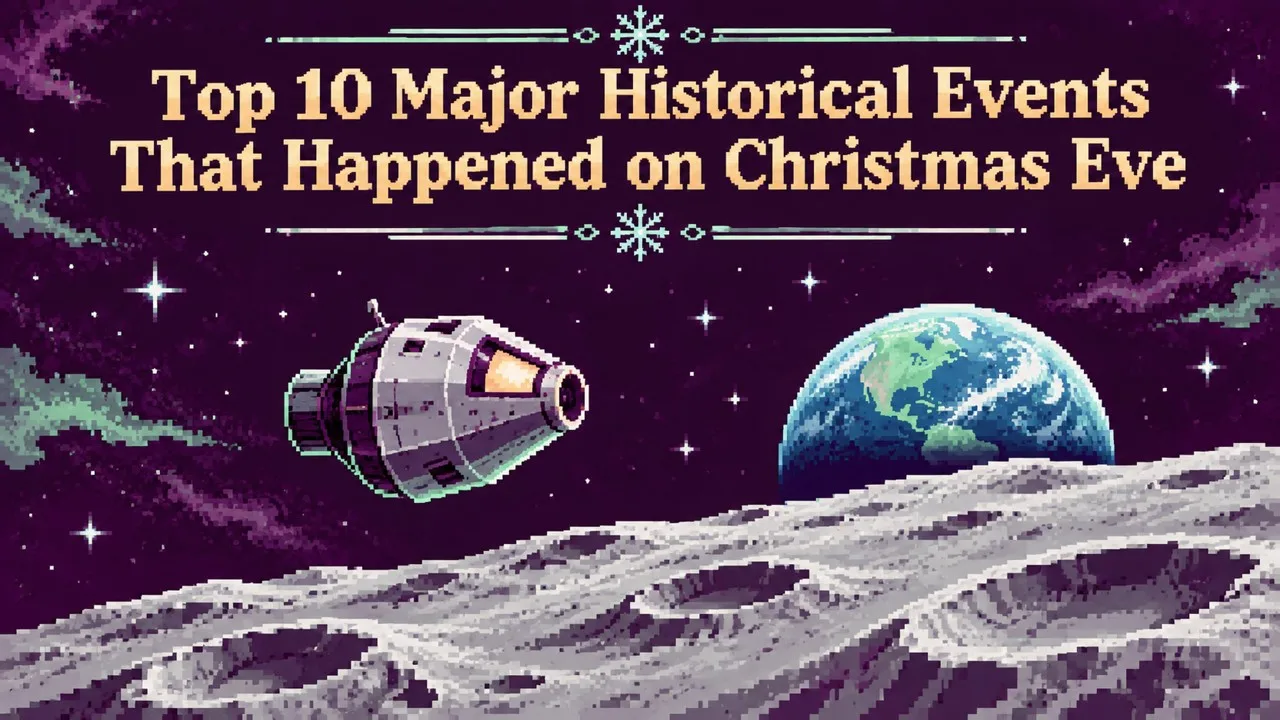
A peace treaty, an opera premiere, a truce in the trenches and a photograph of Earth from the Moon: ten major events that took place on Christmas Eve. For many people, Christmas Eve is a time of quiet anticipation, spent with family, at church or preparing for the next day. Yet history does not pause for the holidays. Over the centuries, December 24 has seen treaties signed, wars begun, discoveries made and landmark moments in exploration.
Some of these events were planned around the date, chosen deliberately for their symbolism. Others simply happened to fall on Christmas Eve, sometimes making them more memorable because of the contrast with the festive season.
The events below come from many parts of the world, from the Pacific Ocean and North Africa to Paris, Cairo and the Moon. They include moments of hope and celebration as well as violence and conflict.
Several of them had consequences that lasted for decades. A treaty ended a war, a new nation was born, a rocket opened a new era in space and an invasion started a long and devastating conflict.
The ten events are arranged in chronological order, spanning nearly two centuries. In each case, the date is well documented, though the details of some events have been debated by historians.
Together, they show how a single date on the calendar can collect a surprising variety of history, connecting people and places that otherwise have little in common.
They also remind us that while many people are celebrating, others are working, traveling, fighting or making decisions that will shape the future.
Looking back at what happened on Christmas Eve offers a different way of seeing history, one that cuts across countries and centuries through the lens of a single day.
Dates matter in history partly because they help us place events side by side. Knowing that a peace treaty and a famous opera premiere shared the same calendar date, decades apart, can make both easier to remember and can prompt questions about what else was happening in the world at the time. Each entry below includes the place where the event happened and the year, so readers can follow the story across continents and generations.
Key Facts
| # | Event | Where | Year |
|---|---|---|---|
| 1 | Captain Cook sights Kiritimati | Central Pacific Ocean | 1777 |
| 2 | The plot of the rue Saint-Nicaise | Paris, France | 1800 |
| 3 | The Treaty of Ghent | Ghent, present-day Belgium | 1814 |
| 4 | Aida opens | Cairo, Egypt | 1871 |
| 5 | The Christmas truce begins | Western Front, Belgium and France | 1914 |
| 6 | Eisenhower is announced as invasion commander | United States | 1943 |
| 7 | Libya becomes independent | Tripoli and Benghazi, Libya | 1951 |
| 8 | Apollo 8 orbits the Moon | Lunar orbit | 1968 |
| 9 | Ariane 1 launches | Kourou, French Guiana | 1979 |
| 10 | Soviet intervention in Afghanistan | Afghanistan | 1979 |
1. An Island Named for the Season
During his third voyage of exploration, the British navigator James Cook came upon a large coral atoll in the central Pacific on December 24, 1777. Because of the date, he named it Christmas Island [1].
The atoll, now known as Kiritimati, is part of the Republic of Kiribati. It is one of the largest coral atolls in the world by land area, and it has become known for its birdlife and fishing [1].
Related: Top 10 Overlooked Events of World War II
Kiritimati lies in one of the world's farthest forward time zones, so it is among the first inhabited places to greet each new day and each new year. The name Kiritimati is the local spelling of Christmas in the Gilbertese language.
2. A Bomb on the Way to the Opera
On Christmas Eve in 1800, Napoleon Bonaparte, then First Consul of France, was traveling by carriage to attend a performance of Joseph Haydn's oratorio The Creation. On a narrow street called the rue Saint-Nicaise, a bomb hidden in a cart exploded [2].
Napoleon's carriage had passed just moments before, and he escaped unharmed. The explosion killed and injured a number of bystanders and damaged buildings along the street. The plotters were royalists opposed to Napoleon's rule [2].
Napoleon used the attack as a reason to crack down on his political opponents, including many republicans who had nothing to do with the plot. The episode helped strengthen his grip on power in the years before he became emperor.
3. A Treaty That Arrived Too Late
The War of 1812 between the United States and Britain was ended by a treaty signed in the city of Ghent on December 24, 1814. The agreement largely restored the situation that had existed before the war, with no major changes to borders [3].
News traveled slowly across the Atlantic, and fighting continued after the treaty was signed. The most famous example was the Battle of New Orleans in January 1815, in which American forces under Andrew Jackson defeated a British army [3].
The treaty took effect after it was ratified by the United States in February 1815. It began a long period of peace between Britain and the United States, which eventually became close allies.
4. An Opera Premiere in Cairo
Giuseppe Verdi's opera Aida, set in ancient Egypt, had its premiere at the Khedivial Opera House in Cairo on December 24, 1871. It had been commissioned by the ruler of Egypt, Khedive Ismail Pasha, who was eager to bring European culture to his capital [4].
The premiere was delayed partly by the Franco-Prussian War, because the scenery and costumes being made in Paris were trapped during the siege of the city. A popular story claims the opera was written for the opening of the Suez Canal in 1869, but that is a misconception [4].
Related: Germany's Invasion of Poland Began the War in Europe
Verdi did not attend the premiere in Cairo, but he oversaw the European premiere in Milan in early 1872. Aida became one of the most frequently performed operas in the world, famous for its grand Triumphal March.
5. Candles and Carols in No Man's Land
In the first winter of the First World War, many soldiers on the Western Front took part in unofficial truces around Christmas. On Christmas Eve in 1914, German troops in some sectors placed small trees decorated with candles on their trenches and began singing carols [5].
British and French soldiers responded with songs of their own, and in some places men from both sides met in the space between the trenches. They exchanged greetings, food and souvenirs, and helped bury their dead [5].
The truce was not universal, and fighting continued in some areas. Military commanders disapproved, and similar truces were much rarer in later years of the war. The event is remembered as a moment of shared humanity in the midst of a terrible conflict.
6. A Commander Named for D-Day
On December 24, 1943, President Franklin D. Roosevelt announced in a radio address that General Dwight D. Eisenhower had been chosen to command the planned Allied invasion of western Europe [6].
Eisenhower had already led Allied forces in North Africa and Italy. As supreme commander, he was responsible for planning and leading the invasion of Normandy, which took place in June 1944 [6].
The appointment placed Eisenhower at the center of the war in Europe. His success later helped him win the presidency of the United States in 1952.
7. A Nation Born Through the United Nations
On December 24, 1951, Libya declared its independence as the United Kingdom of Libya, with Idris I as its king. The country had been an Italian colony and was administered by Britain and France after the Second World War [7].
Libya was the first country to gain independence through a resolution of the United Nations General Assembly. The new kingdom brought together the regions of Cyrenaica, Tripolitania and Fezzan [7].
Related: Pearl Harbor Did Not Happen in a Vacuum
The discovery of oil later in the 1950s transformed the country's economy. In 1969, the monarchy was overthrown in a coup led by Muammar Gaddafi, who ruled for more than four decades.
8. Earthrise and a Reading From Genesis
On Christmas Eve in 1968, the astronauts of Apollo 8, Frank Borman, Jim Lovell and William Anders, became the first humans to orbit the Moon. During their orbits, Anders photographed the Earth rising over the lunar horizon [8].
The photograph, known as Earthrise, became one of the most famous images ever taken. It showed the Earth as a small, fragile world in the darkness of space, and it is often credited with helping inspire the environmental movement [8].
That evening, the astronauts read the opening verses of the Book of Genesis during a television broadcast watched by a huge audience around the world. The mission came at the end of a turbulent year marked by war and political violence.
9. Europe's First Ariane Rocket
On December 24, 1979, the European Space Agency launched its first Ariane rocket from the Guiana Space Centre in Kourou, French Guiana. The launch was a success, placing a test payload into orbit [9].
The Ariane program gave Europe independent access to space, reducing its reliance on the United States and the Soviet Union for launching satellites. Its company, Arianespace, became one of the world's leading commercial launch providers [9].
Later versions, including the Ariane 5, launched many important missions, among them the James Webb Space Telescope on December 25, 2021, almost exactly forty-two years after the first launch.
10. The Start of a Long War
On December 24, 1979, Soviet forces began a large airlift of troops into Afghanistan. Within days, Soviet special forces stormed the presidential palace in Kabul and killed the country's leader, replacing him with a government more acceptable to Moscow [10].
Related: Top 10 Times Music Was Used as a Weapon
The intervention began a war that lasted nearly ten years. Soviet troops fought against Afghan resistance fighters, known as mujahideen, who received support from the United States, Pakistan and other countries [10].
The war caused enormous loss of life and created millions of refugees. Soviet forces withdrew in 1989, and the conflict is often seen as one of the factors that contributed to the collapse of the Soviet Union.
Conclusion
These events show how much history can happen on a single date. Christmas Eve has seen peace treaties and invasions, opera premieres and rocket launches, discoveries and dramatic escapes.
Some of these moments became symbols of hope, like the Christmas truce and the Earthrise photograph. Others marked the beginning of long and painful conflicts.
The contrast between the holiday and the events that took place on it can make them especially memorable. It reminds us that history continues even during times of celebration.
Looking at a single date across the centuries offers a fresh way to explore the past, revealing connections that might otherwise go unnoticed.
Next Christmas Eve, it may be worth remembering the people who, on that same date, made history in ways large and small.
For readers who want to learn more, the references below point to detailed accounts of each event. Many of them have been studied at length by historians, and some, such as the Christmas truce and the Apollo 8 mission, continue to inspire books, films and commemorations every December, keeping their memory alive for new generations.
- ^ [1] Accounts of Kiritimati. Wikipedia: Kiritimati Wikipedia: James Cook
- ^ [2] Accounts of the rue Saint-Nicaise plot. Wikipedia: Plot of the rue Saint-Nicaise Wikipedia: French Consulate
- ^ [3] Accounts of the Treaty of Ghent. Wikipedia: Treaty of Ghent Wikipedia: War of 1812
- ^ [4] Accounts of Aida. Wikipedia: Aida Wikipedia: Khedivial Opera House
- ^ [5] Accounts of the Christmas truce. Wikipedia: Christmas truce Wikipedia: Western Front
- ^ [6] Accounts of Eisenhower's appointment. Wikipedia: Operation Overlord Wikipedia: Dwight D. Eisenhower
- ^ [7] Accounts of Libyan independence. Wikipedia: Kingdom of Libya Wikipedia: Idris of Libya
- ^ [8] Accounts of Apollo 8. Wikipedia: Apollo 8 Wikipedia: Earthrise
- ^ [9] Accounts of Ariane 1. Wikipedia: Ariane 1 Wikipedia: Guiana Space Centre
- ^ [10] Accounts of the Soviet-Afghan War. Wikipedia: Soviet-Afghan War Wikipedia: mujahideen



















Discussion
Log in with