





Top 10 Times Animals Got the Better of Historical Leaders
 By Dhiraj Sharma · Published
Share Post
Loading…
A bear, a runaway pig, a swarm of rabbits and an army-defying flock of emus: ten times animals upstaged, embarrassed or defeated powerful leaders. Kings, emperors and presidents command armies and shape nations, yet history records many occasions when an animal proved harder to manage than any rival. Some of these encounters were fatal, while others were merely embarrassing.
The ten episodes below come from chronicles, memoirs, newspaper reports and official records. Several of the older stories survive only in a single source, and where the details are uncertain, that is noted.
Taken together, they show that power offers little protection against a stumbling horse, a frightened herd or a determined bird. In some cases, the animal became more famous than the occasion it disrupted.
They are arranged in chronological order, from an early medieval Spanish king to a twenty-first century summit.
Animals have always been part of the lives of rulers. Horses carried them into battle and on ceremonial processions, dogs accompanied them on hunts and in their homes, and exotic creatures were exchanged as diplomatic gifts. Royal menageries and presidential pets became symbols of status and personality. With so many animals close at hand, it is hardly surprising that some of them ended up shaping events in unexpected ways.
Key Facts
| # | Animal | Leader and year | Outcome |
|---|---|---|---|
| 1 | Bear | Favila of Asturias, 739 | The king was killed |
| 2 | Pig | Philip of France, 1131 | The heir to the throne died |
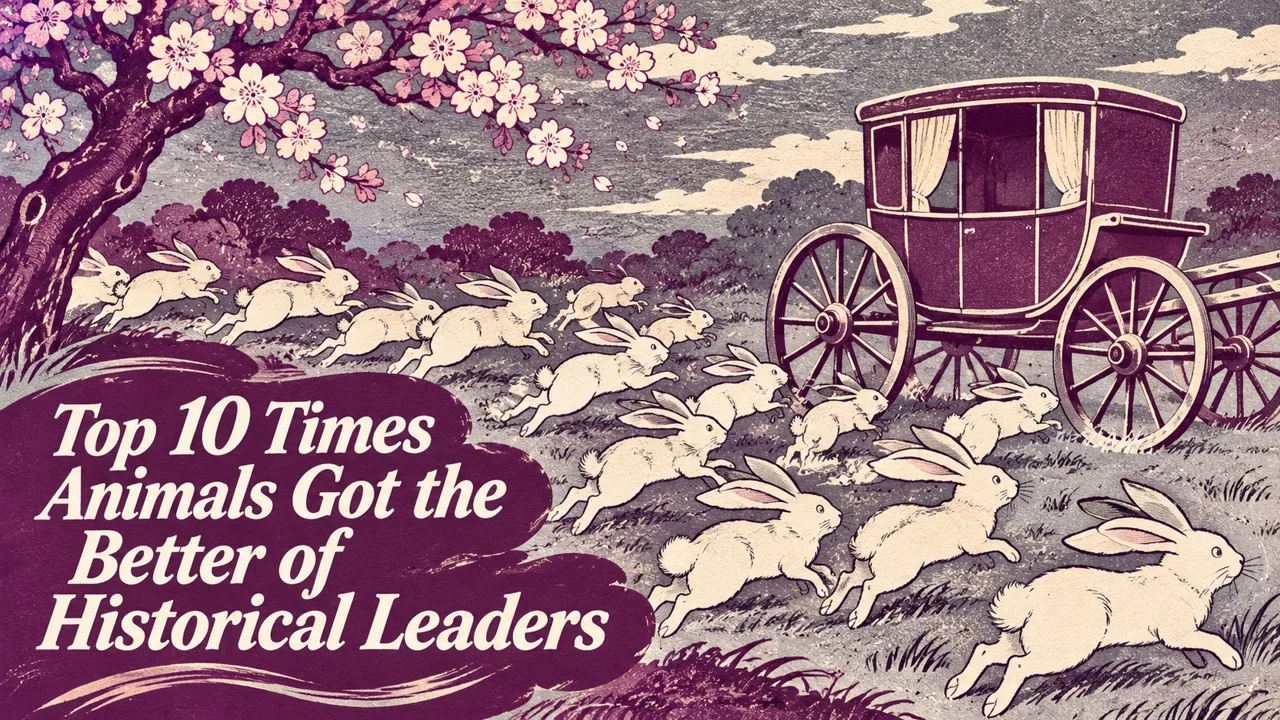
| 3 | Rabbits | Napoleon, 1807 | The emperor retreated to his carriage |
| 4 | Parrot | Andrew Jackson, 1845 | The bird was removed from the service |
| 5 | Black bear | Theodore Roosevelt, 1902 | A toy was named after him |
| 6 | Dog | Edward VII, 1910 | The dog walked ahead of nine monarchs |
| 7 | Raccoon | Calvin Coolidge, 1926 | The intended meal became a pet |
| 8 | Emus | Australian government, 1932 | The military withdrew |
| 9 | Swamp rabbit | Jimmy Carter, 1979 | A story that dogged the president |
| 10 | Dog | Angela Merkel and Vladimir Putin, 2007 | A widely discussed photograph |
1. A Fatal Hunt
Favila was the second king of Asturias, the small Christian kingdom in northern Spain founded by his father, Pelagius, who is traditionally credited with the victory at Covadonga. Favila came to the throne in 737, but his reign lasted only about two years [1].
According to medieval chronicles, he was killed by a bear while hunting in 739. One chronicle attributes his death to his own recklessness, suggesting that he took on the animal without proper caution. Few other details of his short reign are known [1].
Favila was buried with his wife, Froiluba, in the Church of Santa Cruz at Cangas de Onís, which he had founded. He was succeeded by his brother-in-law, Alfonso I, whose long reign greatly expanded the kingdom.
2. The Pig in the Street
Philip was the eldest son of King Louis VI of France and had been crowned as junior co-king in 1129, a common practice to secure the succession. In October 1131, while he was riding through Paris, a pig ran under his horse [2].
The horse stumbled and threw the teenage prince, who died of his injuries the next day. He was about fifteen years old. Pigs commonly roamed the streets of medieval towns, where they scavenged for food waste [2].
Related: Top 10 Most Amazing Animal Stories
Philip's death put his younger brother, Louis, on the path to the throne. Louis was quickly crowned as co-king at Reims by Pope Innocent II and later ruled as Louis VII. He had been destined for a career in the church before his brother's accident.
3. The Rabbit Charge
In July 1807, after the Treaties of Tilsit, Napoleon's chief of staff, Louis-Alexandre Berthier, reportedly organized a rabbit hunt to celebrate. The story is mainly known from the memoirs of the French general Paul Thiébault, so its details should be treated with some caution [3].
According to the account, hundreds of rabbits were released for the hunt. Instead of running away, they rushed toward Napoleon and his party, swarming around the emperor's legs. The hunters tried to drive them off, but the rabbits kept coming [3].
The usual explanation is that the animals were tame rabbits bought from farmers, rather than wild ones, and they expected to be fed. Napoleon is said to have withdrawn to his carriage as the rabbits followed. The story has often been retold as a humorous footnote to his career.
4. A Parrot at the Funeral
Andrew Jackson, the seventh president of the United States, died at his home, the Hermitage, near Nashville, Tennessee, in June 1845. Among his household was a parrot named Poll, which he had bought for his wife, Rachel [4].
According to an account given decades later by a minister, William Menefee Norment, the parrot began swearing loudly during Jackson's funeral. The bird was said to have learned the words from its owner, and it had to be carried out of the house [4].
The story appeared in a history of Jackson's life in Tennessee published in the early twentieth century. Since it relies on one recollection written long after the event, historians generally treat it as possible but uncertain.
5. The Bear He Refused to Shoot
In November 1902, President Theodore Roosevelt joined a bear hunt in Mississippi. After several days without success, members of the party cornered a black bear and tied it to a tree so that the president could shoot it [5].
Roosevelt refused, considering it unsportsmanlike to kill a captive animal. The episode was depicted in a cartoon by Clifford Berryman in The Washington Post, and the image of the president sparing the bear became widely popular [5].
Related: Top 10 Historical Facts That Sound Fake but Are True
A shop owner in Brooklyn, Morris Michtom, created a stuffed toy bear and named it after the president. Around the same time, the German company Steiff was producing toy bears, and the teddy bear became one of the most popular toys in the world.
6. The Dog Who Led the Kings
Caesar was a wire fox terrier belonging to King Edward VII of the United Kingdom. He accompanied the king on many of his travels and wore a collar engraved with the words "I am Caesar. I belong to the King [6]."
When Edward died in May 1910, Caesar walked in the funeral procession behind the coffin, ahead of nine reigning monarchs, including Kaiser Wilhelm II of Germany. Some accounts suggest that the Kaiser was annoyed at being placed behind a dog [6].
Queen Alexandra took care of Caesar after the king's death. A book written as if by the dog, titled Where's Master?, was published in 1910 and proved popular. Caesar is depicted at the feet of the king's tomb effigy in St George's Chapel, Windsor.
7. The Thanksgiving Guest
In November 1926, a supporter in Mississippi sent a live raccoon to the White House, intending it to be served as part of the Thanksgiving dinner. Raccoon meat was eaten in parts of the United States at the time [7].
President Calvin Coolidge and his wife, Grace, decided not to eat the animal. Instead, they kept her as a pet and named her Rebecca. She was given an embroidered collar and became one of the most famous animals at the White House [7].
Rebecca took part in the White House Easter Egg Roll and traveled with the Coolidges. She also escaped several times and was difficult to keep confined. She was eventually sent to a zoo in Washington, DC.
Related: Top 10 Unexpected Abilities Found in Animals
8. The Emu War
In 1932, farmers in Western Australia complained that around 20,000 emus were destroying their wheat crops. Many of the farmers were former soldiers, and they asked the government for military help [8].
The Minister of Defence, Sir George Pearce, approved the deployment of a small group of soldiers under Major G. P. W. Meredith, armed with two Lewis guns and 10,000 rounds of ammunition. The emus, however, scattered into small groups and proved very hard to hit [8].
After weeks of effort, the operation was withdrawn, and the press mocked it widely. Meredith reportedly praised the birds' ability to withstand gunfire. The government later relied on a bounty system and fencing to control the emus.
9. The Swimming Rabbit
In April 1979, President Jimmy Carter was fishing from a small boat near his hometown of Plains, Georgia, when a rabbit swam toward him. Carter splashed water at the animal with a paddle, and it swam away [9].
The incident might have been forgotten, but Carter mentioned it to his staff, and press secretary Jody Powell later told the story to a reporter. In August 1979, it appeared on the front page of The Washington Post under the headline "President Attacked by Rabbit [9]."
The story became a symbol, for his critics, of a presidency in difficulty, and it was widely mocked by cartoonists. A White House photograph of the encounter was released after Carter left office.
10. The Labrador at the Summit
In January 2007, the German chancellor Angela Merkel met the Russian president Vladimir Putin at his residence in Sochi. During the meeting, Putin's black Labrador, Konni, entered the room and sniffed around Merkel's chair [10].
Merkel is known to have a fear of dogs, reportedly after being bitten in 1995. Photographs of her looking uneasy as the dog approached were widely published, and some commentators interpreted the moment as a deliberate show of power [10].
Related: Top 10 Times Animals Triggered Human Disasters by Accident
Putin later said that he had not known of her fear and had not intended to frighten her. Merkel herself suggested that she understood why he might have done it. The episode is often cited in discussions of the personal side of diplomacy.
Conclusion
These episodes range from tragedy to comedy. A bear and a pig changed the course of royal successions, while a parrot and a raccoon became minor footnotes in presidential history.
Several of the stories depend on a single source or were retold many times before being written down. That uncertainty is part of their history, and it is worth keeping in mind when they are repeated.
What they have in common is that animals do not respect rank. A hunting accident, a crowded street or a flock of birds can bring even the most powerful people down to earth.
The animals themselves had no way of knowing who they were dealing with, which is perhaps why these stories remain so memorable.
Modern leaders are still surrounded by animals, from official pets to guard dogs and ceremonial horses, and cameras now record every awkward moment. The next memorable encounter may be only a photograph away, ready to join this long and colorful tradition.
History, it seems, is never entirely in human hands, however powerful those hands may be.
Sometimes the smallest players steal the show.
- ^ [1] Accounts of Favila. Wikipedia: Favila of Asturias Wikipedia: Kingdom of Asturias
- ^ [2] Accounts of Prince Philip. Wikipedia: Philip of France (1116-1131) Wikipedia: Louis VII of France
- ^ [3] Accounts of the Tilsit treaties. Wikipedia: Treaties of Tilsit Wikipedia: Louis-Alexandre Berthier
- ^ [4] Accounts of Poll. Wikipedia: Poll (parrot) Wikipedia: Andrew Jackson
- ^ [5] Accounts of the teddy bear. Wikipedia: Teddy bear Wikipedia: Clifford K. Berryman
- ^ [6] Accounts of Caesar. Wikipedia: Caesar (dog) Wikipedia: Edward VII
- ^ [7] Accounts of Rebecca. Wikipedia: Rebecca (raccoon) Wikipedia: Calvin Coolidge
- ^ [8] Accounts of the Emu War. Wikipedia: Emu War Wikipedia: Emu
- ^ [9] Accounts of the rabbit incident. Wikipedia: Jimmy Carter rabbit incident Wikipedia: Jody Powell
- ^ [10] Accounts of Konni. Wikipedia: Konni (dog) Wikipedia: Angela Merkel






















Discussion
Log in with