




 By
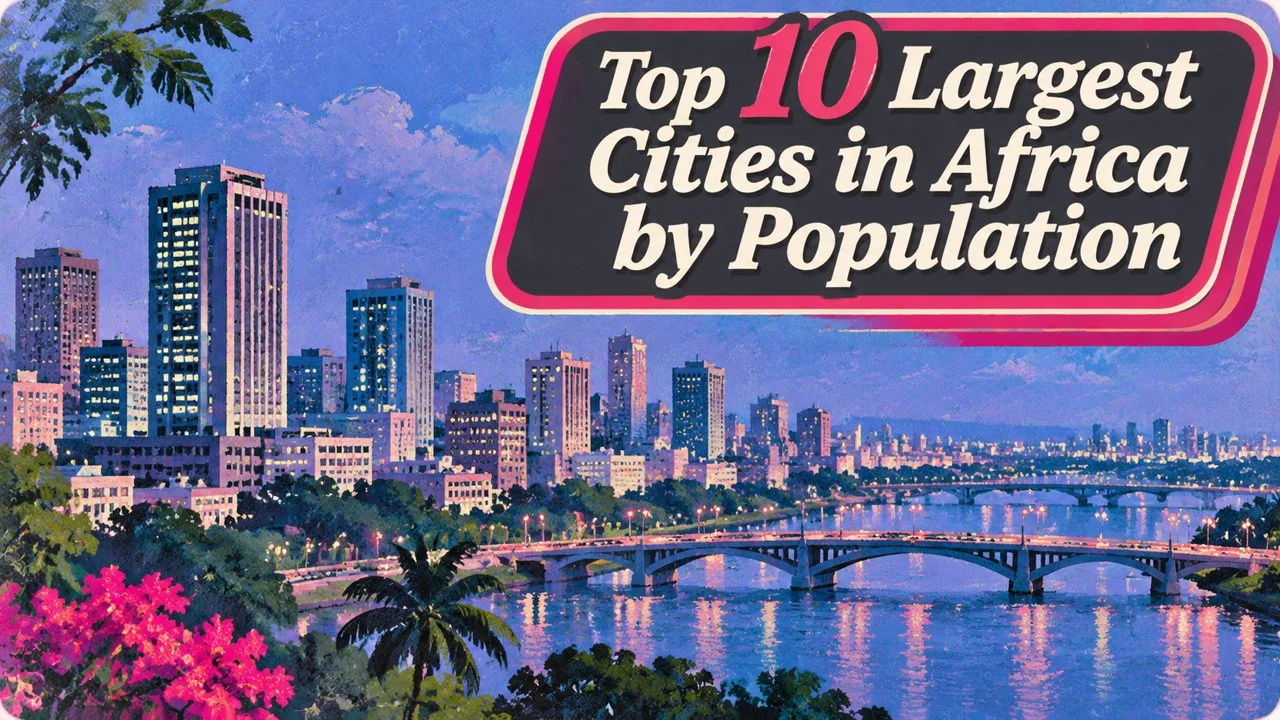
From Cairo, Kinshasa and Lagos to Luanda, Dar es Salaam and Nairobi, these ten largest cities in Africa by population show the continent's rapid urban growth. Africa is the fastest-urbanising continent in the world. Cities that were small towns a century ago are now home to millions of people, and several are on course to become among the largest cities on Earth.
Counting city populations is difficult, because figures depend on where boundaries are drawn and when censuses were last held. This list uses approximate United Nations estimates for urban areas around the mid-2020s, so rankings may differ slightly from other sources.
Key Facts
The ten cities below each have an estimated urban population of around five million people or more.
The Largest Cities in Africa at a Glance
| # | City | Country | Approximate metro population | Known for |
|---|---|---|---|---|
| 1 | Cairo | Egypt | About 22 million | Africa's largest urban area |
| 2 | Kinshasa | Democratic Republic of the Congo | About 17 million | One of the largest French-speaking cities |
| 3 | Lagos | Nigeria | About 15 to 17 million | Africa's commercial powerhouse |
| 4 | Luanda | Angola | About 10 million | An oil-rich Atlantic capital |
| 5 | Dar es Salaam | Tanzania | About 8 million | East Africa's great port city |
| 6 | Khartoum | Sudan | About 6 million before the war | Where the two Niles meet |
| 7 | Johannesburg | South Africa | About 6 million | The city of the gold rush |
| 8 | Abidjan | Cote d'Ivoire | About 6 million | West Africa's lagoon metropolis |
| 9 | Alexandria | Egypt | About 5.5 million | A city founded by Alexander the Great |
| 10 | Nairobi | Kenya | About 5 million | A capital with a national park |
1. Cairo
Greater Cairo is the largest urban area in Africa and the Arab world, with an estimated population of about 22 million. [1]
The city lies on the Nile, just south of where the river spreads into its delta. Cairo was founded in 969 CE by the Fatimid dynasty, near earlier settlements. [1]
Its historic centre, known as Islamic Cairo, is filled with medieval mosques, markets and madrasas, and is a UNESCO World Heritage Site.
The pyramids of Giza stand on the city's western edge.
Cairo opened Africa's first metro system in 1987, and the network continues to grow.
Egypt is building a New Administrative Capital east of Cairo to ease congestion and house government offices.
Its population density in some districts is among the highest in the world, and traffic is famously heavy. The city is also a centre of Arabic-language film, publishing and media.
Key Figures
- Country: Egypt
- Population: about 22 million
- Founded: 969 CE
- River: the Nile
Why It Made the List
Cairo is Africa's greatest metropolis. Its history spans more than a thousand years.
2. Kinshasa
Kinshasa, the capital of the Democratic Republic of the Congo, has an estimated population of around 17 million and is growing rapidly. [2]
It is often described as the largest French-speaking city in the world. [2]
The city lies on the Congo River directly across from Brazzaville, capital of the Republic of the Congo. The two are among the closest pair of capital cities in the world.
It was founded as a trading post in 1881 and was called Leopoldville until 1966.
Kinshasa is famous for its music, especially Congolese rumba, which UNESCO recognised as intangible cultural heritage in 2021.
Many residents live in informal settlements, and the city faces challenges with transport, housing and flooding.
Its population has grown more than tenfold since independence in 1960. Lingala is widely spoken alongside French.
Key Figures
- Country: DR Congo
- Population: about 17 million
- Former name: Leopoldville
- Music: Congolese rumba
Why It Made the List
Kinshasa is one of the fastest-growing megacities on Earth. Its music influences all of Africa.
Related: Top 10 Most Populous Cities in India
3. Lagos
Lagos is Nigeria's largest city and one of the biggest in Africa. Estimates of its population vary widely, with many sources placing it at around 15 million or more. [3]
The city is built around a lagoon and islands on the Atlantic coast, linked by long bridges such as the Third Mainland Bridge. [3]
Lagos was Nigeria's capital until 1991, when the government moved to Abuja, but it remains the country's economic heart.
It is the centre of Nollywood, one of the world's largest film industries, and a hub of Afrobeats music.
Its port is one of the busiest in West Africa, and the city has a thriving technology sector.
Traffic jams, flooding and housing shortages are major challenges as the population grows.
Key Figures
- Country: Nigeria
- Population: about 15 to 17 million, estimates vary
- Former capital: until 1991
- Culture: Nollywood and Afrobeats
Why It Made the List
Lagos is Africa's most dynamic commercial city. Its creative industries reach audiences around the world.
4. Luanda
Luanda, the capital of Angola, has an estimated metropolitan population of around 10 million. [4]
It was founded by the Portuguese in 1576 and became one of their most important colonial cities in Africa. [4]
After a long civil war ended in 2002, oil wealth fuelled rapid construction of towers, roads and waterfront developments.
For several years, Luanda was ranked among the most expensive cities in the world for foreign workers.
Its seafront promenade, the Marginal, and the sandy peninsula of the Ilha are popular places to relax.
Despite its wealth, many residents live in informal neighbourhoods called musseques.
The city's bay is one of the finest natural harbours on Africa's Atlantic coast, and new satellite towns have been built on its outskirts to ease crowding. Portuguese is the main language.
Key Figures
- Country: Angola
- Population: about 10 million
- Founded: 1576
- Economy: oil
Why It Made the List
Luanda shows both the promise and inequality of resource wealth. It is one of Africa's fastest-changing capitals.
Related: Top 10 Most Bizarre Phobias: Strange Fears That Exist
5. Dar es Salaam
Dar es Salaam is Tanzania's largest city, with an estimated population of around 8 million. Its name means house or haven of peace. [5]
It was founded in the 1860s by the Sultan of Zanzibar and later became the capital of German East Africa and then of independent Tanzania. [5]
Although the official capital moved to Dodoma, Dar es Salaam remains the country's commercial centre.
Its port serves several landlocked neighbours, including Zambia, Malawi and Rwanda.
The city has a long-established community of Indian origin, and Indian traders helped shape its markets and architecture.
Dar es Salaam is one of the fastest-growing cities in the world.
Its bustling Kariakoo market is one of the largest in East Africa. A new bus rapid transit system has helped reduce travel times.
Key Figures
- Country: Tanzania
- Population: about 8 million
- Name meaning: haven of peace
- Role: major port
Why It Made the List
Dar es Salaam is East Africa's gateway to the Indian Ocean. Its Indian heritage connects it to South Asia.
6. Khartoum
Khartoum, the capital of Sudan, stands where the Blue Nile and the White Nile meet to form the main Nile. [6]
Together with Omdurman and Khartoum North, it forms a large urban area, which had an estimated population of more than 6 million before 2023. [6]
The city became the capital of Sudan in the 19th century under Egyptian rule.
The confluence of the two rivers, with their different colours, is a famous sight.
Since April 2023, war in Sudan has caused enormous destruction in Khartoum, and millions of residents have been forced to flee.
The true population of the city is now very uncertain because of the conflict.
Before the war, the city had a busy cultural life, with universities, museums and markets.
Key Figures
- Country: Sudan
- Population: about 6 million before 2023
- Rivers: Blue Nile and White Nile
- Twin cities: Omdurman and Khartoum North
Why It Made the List
Khartoum is one of Africa's great river cities. Its recent suffering shows how conflict reshapes cities.
7. Johannesburg
Johannesburg was founded in 1886 after gold was discovered on the Witwatersrand ridge. It grew into South Africa's largest city. [7]
Related: Top 10 Oldest Buildings in the World
The wider urban region of Gauteng is home to well over 10 million people, making it the economic heart of southern Africa. [7]
Mahatma Gandhi lived in Johannesburg from 1903 to 1914 and launched his first satyagraha campaign there in 1906.
The township of Soweto played a central role in the struggle against apartheid, including the student uprising of 1976.
Johannesburg is home to South Africa's Constitutional Court and the Johannesburg Stock Exchange, the largest in Africa.
Today it is a centre of finance, mining companies, media and the arts.
The city stands about 1,750 metres above sea level on the Highveld plateau.
Key Figures
- Country: South Africa
- Population: about 6 million in the city region
- Founded: 1886
- Indian link: Gandhi's satyagraha, 1906
Why It Made the List
Johannesburg is Africa's financial powerhouse. Its history links mining, liberation and Mahatma Gandhi.
8. Abidjan
Abidjan is the largest city and economic capital of Cote d'Ivoire, with an estimated population of around 6 million. [8]
It is built around the Ebrie Lagoon, and its business district, the Plateau, is known for its modern towers. [8]
Although Yamoussoukro became the official capital in 1983, most government activity remains in Abidjan.
The city's port is one of the busiest in West Africa, exporting cocoa, coffee and other goods. Cote d'Ivoire is the world's largest cocoa producer.
Abidjan is known for its lively music scene, including coupe-decale.
The city has recovered strongly from periods of political conflict in the 2000s and 2010s.
Its population has grown quickly as people have moved from rural areas and neighbouring countries in search of work. New bridges and a planned metro line aim to ease traffic across the lagoon.
Key Figures
- Country: Cote d'Ivoire
- Population: about 6 million
- Setting: the Ebrie Lagoon
- Export: cocoa
Why It Made the List
Abidjan is a major West African business and cultural hub. Its lagoon setting is distinctive.
9. Alexandria
Alexandria, Egypt's second-largest city, has an estimated population of more than 5 million. [9]
It was founded in 331 BCE by Alexander the Great and became one of the greatest cities of the ancient world. [9]
Related: The Science Behind Auroras: How Solar Winds Create Colorful Skies
Ancient Alexandria was home to the famous Library of Alexandria and the Pharos lighthouse, one of the Seven Wonders of the Ancient World.
The modern Bibliotheca Alexandrina, opened in 2002, honours the memory of the ancient library.
Alexandria is Egypt's main port on the Mediterranean and a popular summer resort.
Its long seafront, the Corniche, stretches for many kilometres along the coast.
The city has long had a cosmopolitan character, with Greek, Italian and other communities living there in the 19th and 20th centuries. It is also known for its seafood restaurants.
Key Figures
- Country: Egypt
- Population: over 5 million
- Founded: 331 BCE
- Ancient wonder: the Pharos lighthouse
Why It Made the List
Alexandria links the ancient world with modern Egypt. Its history of learning still inspires.
10. Nairobi
Nairobi, the capital of Kenya, has an estimated population of around 5 million. [10]
It began in 1899 as a depot on the Uganda Railway, which was built largely by tens of thousands of labourers brought from India. [10]
Nairobi National Park lies just outside the city centre, where lions, giraffes and rhinos can be seen with skyscrapers in the background.
The city is a major hub for technology and innovation, sometimes called Silicon Savannah. Kenya pioneered mobile money with M-Pesa in 2007.
Nairobi hosts the headquarters of the United Nations Environment Programme.
Kenya's large Indian-origin community has played an important role in Nairobi's commerce and culture.
The city sits at about 1,795 metres above sea level, giving it a mild climate.
Key Figures
- Country: Kenya
- Population: about 5 million
- Founded: 1899
- Unique feature: a national park at its edge
Why It Made the List
Nairobi blends wildlife, innovation and diplomacy. Its origins are closely tied to Indian railway workers.
Conclusion
Africa's largest cities are growing faster than almost any others on Earth. By the middle of this century, several may rank among the world's biggest megacities.
These cities face challenges in housing, transport and services, but they are also centres of creativity, business and culture shaping Africa's future.
- ^ [1] "Cairo". Wikipedia. Wikipedia: Cairo Wikipedia: Historic Cairo
- ^ [2] "Kinshasa". Wikipedia. Wikipedia: Kinshasa Wikipedia: Congolese rumba
- ^ [3] "Lagos". Wikipedia. Wikipedia: Lagos Wikipedia: Nollywood
- ^ [4] "Luanda". Wikipedia. Wikipedia: Luanda Wikipedia: Angola
- ^ [5] "Dar es Salaam". Wikipedia. Wikipedia: Dar es Salaam Wikipedia: Indians in Tanzania
- ^ [6] "Khartoum". Wikipedia. Wikipedia: Khartoum Wikipedia: Omdurman
- ^ [7] "Johannesburg". Wikipedia. Wikipedia: Johannesburg Wikipedia: Satyagraha
- ^ [8] "Abidjan". Wikipedia. Wikipedia: Abidjan Wikipedia: Ébrié Lagoon
- ^ [9] "Alexandria". Wikipedia. Wikipedia: Alexandria Wikipedia: Library of Alexandria
- ^ [10] "Nairobi". Wikipedia. Wikipedia: Nairobi Wikipedia: Uganda Railway Wikipedia: Nairobi National Park



















Discussion
Log in with