





 By
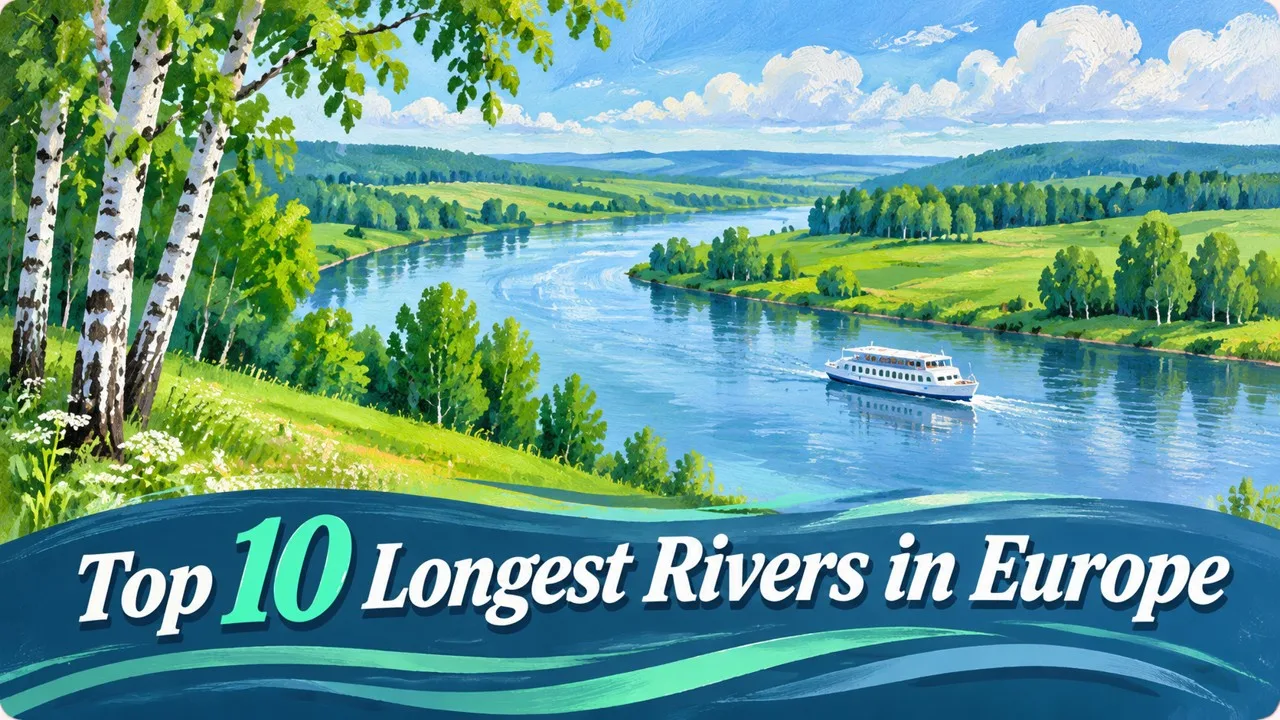
From the mighty Volga and the Danube to the Ural, Dnieper and Don, these ten longest rivers in Europe carry history, trade and wildlife across the continent. Europe's rivers have shaped its history for thousands of years. They carried traders and invaders, powered mills and factories, and gave rise to great cities on their banks.
The longest European rivers are mostly in the east, flowing across the vast plains of Russia and Ukraine towards the Caspian Sea, the Black Sea and the Arctic Ocean. Lengths vary slightly between sources, depending on how sources and mouths are measured. This list ranks ten of the longest rivers in Europe.
Key Facts
The ten rivers below range from about 1,350 to more than 3,500 kilometres in length, and several are larger than any river in Western Europe.
The Longest Rivers in Europe at a Glance
| # | River | Length | Countries | Flows into |
|---|---|---|---|---|
| 1 | Volga | About 3,530 km | Russia | The Caspian Sea |
| 2 | Danube | About 2,850 km | Ten countries, from Germany to Romania | The Black Sea |
| 3 | Ural | About 2,430 km | Russia and Kazakhstan | The Caspian Sea |
| 4 | Dnieper | About 2,200 km | Russia, Belarus and Ukraine | The Black Sea |
| 5 | Don | About 1,870 km | Russia | The Sea of Azov |
| 6 | Pechora | About 1,810 km | Russia | The Barents Sea, Arctic Ocean |
| 7 | Kama | About 1,805 km | Russia | The Volga |
| 8 | Oka | About 1,500 km | Russia | The Volga |
| 9 | Belaya | About 1,430 km | Russia | The Kama |
| 10 | Dniester | About 1,350 km | Ukraine and Moldova | The Black Sea |
1. Volga
The Volga is the longest river in Europe, flowing about 3,530 kilometres through central and southern Russia. [1]
It rises in the Valdai Hills northwest of Moscow and empties into the Caspian Sea, which has no outlet to the ocean. [1]
The Volga also carries more water than any other European river and drains a basin larger than many countries.
Many major Russian cities stand on its banks, including Nizhny Novgorod, Kazan, Samara and Volgograd, formerly Stalingrad.
Russians call it Mother Volga, and it features in countless songs, paintings and stories.
Its delta is a vast wetland rich in birds and fish, including sturgeon, famous for caviar, although overfishing has made them rare.
A series of large dams and reservoirs, built mainly in the Soviet era, turned much of the river into a chain of lakes. Canals link the Volga with the Baltic Sea, the White Sea and the Don, making it the backbone of Russia's inland waterways.
Key Figures
- Length: about 3,530 km
- Country: Russia
- Mouth: the Caspian Sea
- Major cities: Kazan, Samara, Volgograd
Why It Made the List
The Volga is Europe's greatest river. It is the heart of Russia's history and culture.
2. Danube
The Danube is Europe's second-longest river, flowing about 2,850 kilometres from the Black Forest in Germany to the Black Sea. [2]
It flows through or along the borders of ten countries, more than any other river in the world. [2]
Four capital cities stand on its banks: Vienna, Bratislava, Budapest and Belgrade.
For centuries the Danube formed part of the northern frontier of the Roman Empire.
Johann Strauss II made the river famous with his waltz The Blue Danube, first performed in 1867.
The Danube Delta in Romania and Ukraine is one of Europe's largest wetlands and a UNESCO World Heritage Site.
Related: Top 10 Great Rivers of Europe's Capital Cities
At the Iron Gates, the river forces its way through a narrow gorge between the Carpathian and Balkan mountains, forming part of the border between Serbia and Romania. River cruises along the Danube are among the most popular in Europe.
Key Figures
- Length: about 2,850 km
- Countries: ten
- Capitals: Vienna, Bratislava, Budapest, Belgrade
- Mouth: the Black Sea
Why It Made the List
The Danube links more countries than any other river. It is a symbol of Central European culture.
3. Ural
The Ural River is about 2,430 kilometres long, making it the third-longest river in Europe. [3]
It rises in the southern Ural Mountains and flows south through Russia and Kazakhstan to the Caspian Sea. [3]
The river is traditionally considered part of the boundary between Europe and Asia, so cities on its banks, such as Orenburg and Atyrau, sit on both continents.
Its old name was the Yaik. It was renamed the Ural in 1775 by Catherine the Great after a Cossack uprising.
The Ural is an important spawning river for sturgeon.
Much of its course passes through dry steppe, so its waters are vital for farming and towns.
It flows through wide steppe landscapes where it often changes its course, leaving behind old channels and lakes. Fishing communities along its lower reaches have long depended on its seasonal floods.
Key Figures
- Length: about 2,430 km
- Countries: Russia and Kazakhstan
- Mouth: the Caspian Sea
- Role: part of the Europe-Asia boundary
Why It Made the List
The Ural is a river between continents. It shows how geography and politics meet.
4. Dnieper
The Dnieper is about 2,200 kilometres long and is the longest river in Ukraine and Belarus. [4]
It rises in the Valdai Hills of Russia and flows south through Belarus and Ukraine to the Black Sea. [4]
Kyiv, the capital of Ukraine, was founded on its banks more than a thousand years ago.
In medieval times, Norse traders used the river as part of a route from the Baltic Sea to Constantinople.
A chain of large dams and reservoirs was built along the Dnieper in the 20th century to produce electricity.
In June 2023, the Kakhovka Dam on the lower Dnieper was destroyed, causing major flooding and environmental damage.
Related: Top 10 Longest Rivers in North America
The city of Dnipro also takes its name from the river.
Key Figures
- Length: about 2,200 km
- Countries: Russia, Belarus, Ukraine
- Mouth: the Black Sea
- Capital on its banks: Kyiv
Why It Made the List
The Dnieper is central to the history of Eastern Europe. It has been a trade route, a power source and a frontier.
5. Don
The Don is the fifth-longest river in Europe, flowing about 1,870 kilometres from central Russia to the Sea of Azov. [5]
It rises near Tula, south of Moscow, and enters the sea near the city of Rostov-on-Don. [5]
The ancient Greeks knew it as the Tanais and considered it a boundary between Europe and Asia.
The river is closely linked with the Don Cossacks, who settled along its banks.
The Volga-Don Canal, opened in 1952, connects the Don with the Volga, linking the Black and Caspian seas.
Mikhail Sholokhov's novel And Quiet Flows the Don helped him win the Nobel Prize in Literature in 1965.
The river is slow-moving and wide in its lower course, and it has long been important for grain transport and fishing. Its basin includes some of the most fertile black-earth farmland in Russia.
Key Figures
- Length: about 1,870 km
- Country: Russia
- Mouth: the Sea of Azov
- Link: the Volga-Don Canal, 1952
Why It Made the List
The Don is a river of history, literature and Cossack culture. It connects Russia's great waterways.
6. Pechora
The Pechora is about 1,810 kilometres long and flows north from the Ural Mountains to the Arctic Ocean. [6]
Most of its course lies in the Komi Republic of northwestern Russia, a land of forests, bogs and tundra. [6]
The river empties into the Pechora Sea, part of the Barents Sea.
Its upper basin includes the Virgin Komi Forests, one of the largest areas of untouched forest in Europe and a UNESCO World Heritage Site.
The Pechora is home to salmon and other cold-water fish, and supports the traditional life of the Komi and Nenets peoples.
The river is frozen for much of the year, typically from autumn until late spring.
Oil and gas development in the region has raised concerns about pollution, and conservation groups monitor the river's health. In spring, ice break-up can cause major floods along its banks.
Related: Top 10 Longest Rivers in India
Key Figures
- Length: about 1,810 km
- Country: Russia
- Mouth: the Barents Sea
- Nearby wilderness: Virgin Komi Forests
Why It Made the List
The Pechora is Europe's great Arctic river. It flows through some of the continent's wildest land.
7. Kama
The Kama is about 1,805 kilometres long and is the largest tributary of the Volga. [7]
It rises in the Udmurt Republic and makes a huge loop before joining the Volga south of Kazan. [7]
At their meeting point, the Kama actually carries more water than the Volga.
The city of Perm, an industrial centre near the Ural Mountains, stands on the Kama.
Large dams on the Kama create reservoirs used for hydroelectric power and shipping.
Its Tatar name is Chulman.
Its name may come from an Udmurt word meaning river. The Kama basin includes major oil fields and industrial towns, and the river has long carried timber, salt and metals from the Ural region. Riverboats sailed between Perm and Kazan for well over a century.
Key Figures
- Length: about 1,805 km
- Country: Russia
- Flows into: the Volga
- Major city: Perm
Why It Made the List
The Kama is a giant tributary that rivals its parent river. It is vital to Russia's industry and transport.
8. Oka
The Oka is about 1,500 kilometres long and is the largest right-bank tributary of the Volga. [8]
It flows through central Russia, passing the regions of Oryol, Tula, Kaluga, Moscow and Ryazan. [8]
The Oka joins the Volga at Nizhny Novgorod, one of Russia's historic trading cities.
Moscow stands on one of the Oka's tributaries, the Moskva River, from which the city likely takes its name.
The river is navigable for much of its length and has long carried trade.
Its banks are home to the Oka Nature Reserve, known for protecting rare birds and the Russian desman, a small water mammal.
The historic towns of Kaluga, Ryazan and Murom lie on its banks, and several old monasteries overlook the water. Its wide floodplain meadows are important for wildlife and farming.
Key Figures
- Length: about 1,500 km
- Country: Russia
- Flows into: the Volga at Nizhny Novgorod
- Tributary: the Moskva River
Why It Made the List
The Oka is the river of central Russia. It links Moscow's region with the Volga.
Related: Top 10 Longest Rivers in the World
9. Belaya
The Belaya, whose name means white river, is about 1,430 kilometres long. [9]
It rises in the southern Ural Mountains and flows through the Republic of Bashkortostan. [9]
The city of Ufa, capital of Bashkortostan, stands near its confluence with the Ufa River.
The Belaya flows into the Kama, which then joins the Volga.
Its upper course flows through limestone country with caves, including Kapova Cave, known for its prehistoric paintings.
The river is popular for rafting and boating in its upper reaches.
The river is navigable in its lower course and has long carried timber and oil products. Bashkortostan's forests, steppes and mountains line its valley, and the Shulgan-Tash nature reserve protects wild honeybees in the area. In spring, melting snow from the Urals swells the river.
Key Figures
- Length: about 1,430 km
- Country: Russia
- Flows into: the Kama
- Major city: Ufa
Why It Made the List
The Belaya is a long but little-known river. Its valley holds ancient art and beautiful scenery.
10. Dniester
The Dniester is about 1,350 kilometres long. It rises in the Carpathian Mountains of western Ukraine. [10]
It flows through Ukraine and Moldova before reaching the Black Sea. [10]
For part of its course, it separates Moldova from the breakaway region of Transnistria.
Ancient Greeks founded the colony of Tyras near its mouth, and medieval fortresses guarded its banks.
The river supplies drinking water to millions of people, including much of Moldova.
Its winding valleys and canyons are known for their scenery and vineyards.
The river runs through deep canyons in places, and the Dniester Canyon in western Ukraine is a popular destination for rafting and hiking. A large hydroelectric complex near Novodnistrovsk generates electricity for Ukraine.
Key Figures
- Length: about 1,350 km
- Countries: Ukraine and Moldova
- Mouth: the Black Sea
- Source: the Carpathian Mountains
Why It Made the List
The Dniester is a vital river for Ukraine and Moldova. It has been a border and a lifeline for centuries.
Conclusion
Europe's longest rivers flow mostly through its eastern plains, while famous western rivers such as the Rhine, Elbe and Loire are shorter but no less important.
These rivers supply water, power and transport, and they support rich wildlife. Protecting them from pollution and overuse is a shared European challenge.
- ^ [1] "Volga". Wikipedia. Wikipedia: Volga Wikipedia: Volga Delta
- ^ [2] "Danube". Wikipedia. Wikipedia: Danube Wikipedia: Danube Delta
- ^ [3] "Ural". Wikipedia. Wikipedia: Ural (river) Wikipedia: Boundaries between the continents
- ^ [4] "Dnieper". Wikipedia. Wikipedia: Dnieper Wikipedia: Trade route from the Varangians to the Greeks
- ^ [5] "Don". Wikipedia. Wikipedia: Don (river) Wikipedia: Volga–Don Canal
- ^ [6] "Pechora". Wikipedia. Wikipedia: Pechora (river) Wikipedia: Virgin Komi Forests
- ^ [7] "Kama". Wikipedia. Wikipedia: Kama (river) Wikipedia: Perm, Russia
- ^ [8] "Oka". Wikipedia. Wikipedia: Oka (river) Wikipedia: Moskva (river)
- ^ [9] "Belaya". Wikipedia. Wikipedia: Belaya (Kama) Wikipedia: Kapova Cave
- ^ [10] "Dniester". Wikipedia. Wikipedia: Dniester Wikipedia: Transnistria


















Discussion
Log in with