




 By
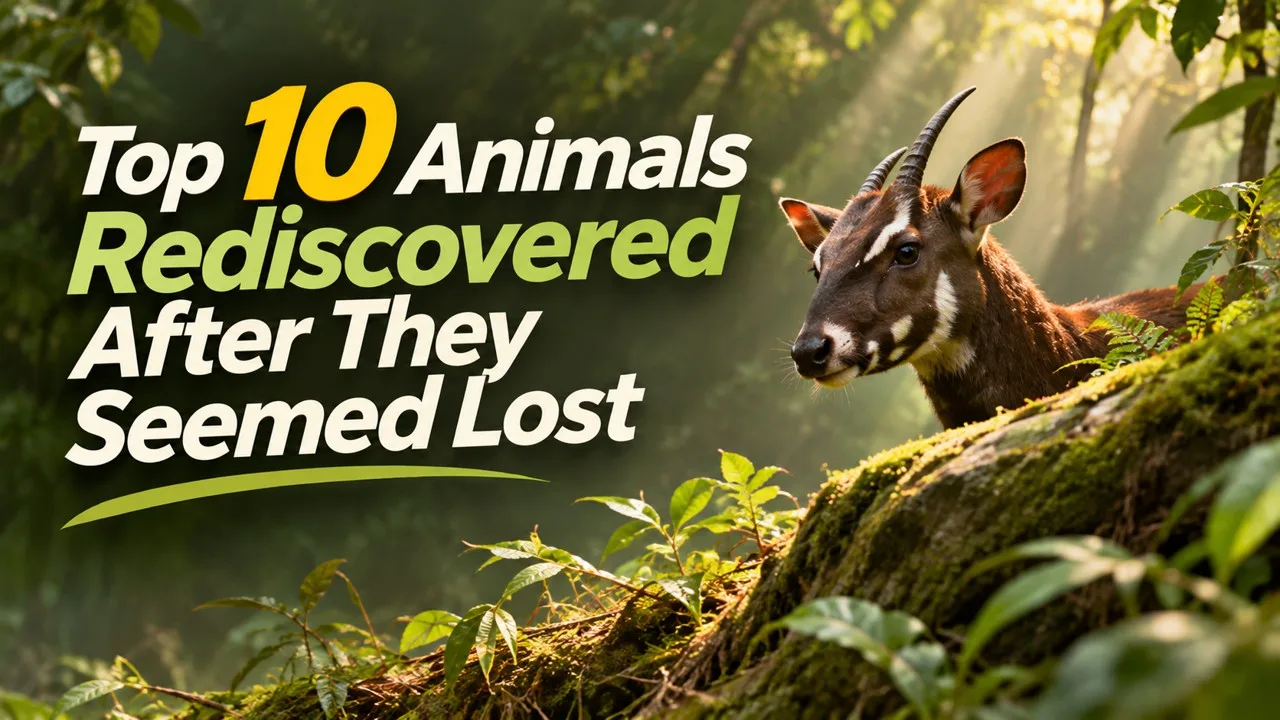
A lark unseen since 1931 and a golden mole missing since 1937 have been found again; this list sticks to rediscoveries, not a first film of a known shark. A species can vanish from the scientific record and still be living in a forest, a dune, or a mountain that researchers have not recently searched [1][6][8]. The ten cases below are animals that later showed up again, on a camera, in a survey, or in a specimen that had been misfiled [3][7][10]. One popular candidate, a deep-water shark that was filmed after years of being known only from stray catches, is a first good look, not a rediscovery, and is replaced here by a chevrotain that camera traps found after a long gap [7]. This article will not treat a remnant as a resurrection, will not borrow a likeness, and will not turn a market stall or a war into a scene [5][8]. Several of these animals remain rare or endangered [2][3]. The list is also distinct from an earlier one on conservation programs that helped species persist [2].
A rediscovery is a record, not a miracle. The useful sentence is when the last confirmed sighting was, and what the new record actually is.
Key Facts
These are documented rediscoveries, or first scientific confirmations of animals already known to local people.
Ten Records at a Glance
| Rank | Animal | Careful version |
|---|---|---|
| 1 | Rusty lark | Calendulauda rufa was last securely documented in 1931; field work in Chad in 2026 has been reported as a new record after that long gap |
| 2 | Mountain bongo | A tiny wild Kenyan population remains; camera-trap records from the Maasai Mau Forest followed a period without confirmed images, and the antelope is still critically endangered |
| 3 | Attenborough's echidna | Known from a 1961 specimen in the Cyclops Mountains; a 2023 expedition obtained photographs, including on a last memory card, after local reports that it survived |
| 4 | Silver-backed chevrotain (substituted) | Tragulus versicolor was camera-trapped in Vietnam in 2019 after years without a confirmed record; a first film of the already-known goblin shark is not used here |
| 5 | De Winton's golden mole | Last confirmed in 1937 near Port Nolloth; surveys in the early 2020s, including a trained detection dog and other methods, found the species again |
| 6 | Laotian rock rat | Market specimens in 1996 led to the recognition of Laonastes, a living member of a family long thought to be extinct; later work found living animals |
| 7 | Angolan elephants | Civil war and hunting collapsed numbers; later surveys documented surviving animals in some regions, a remnant, not a ghost story |
| 8 | Cozumel fox | A small island gray fox, not yet formally named as a separate species, was photographed in 2023 after years without a confirmed record |
| 9 | Lesula | A guenon from the Lomami-Congo region, already known to local people, was photographed in the late 2000s and formally described in 2012 |
| 10 | Two Vogelkop marsupials | A pygmy long-fingered possum and a ring-tailed glider, first described from fossils or misfiled specimens, were confirmed living on New Guinea's Vogelkop Peninsula |
1. A Lark, After a Long Silence
The rusty lark, Calendulauda rufa, was last securely represented in the scientific record by specimens collected in 1931 in what is now Niger, a gap long enough that later workers had little recent proof the bird still existed [1]. Field work in 2026, in the Abou Telfane region of Chad, has been reported as a new confirmed record, a typographic fact of date and place rather than a resurrection [1]. The unexpected fact is the length of the silence, not a change in the bird. This article will treat the 2026 report as a rediscovery claim to be filed with ordinary ornithological caution, and it will not invent a second range map. The careful fact is the 1931 last secure collection, and the later Chad record as reported.
A century without a specimen can still be a failure of looking. The looking, when it succeeds, is the news.
2. A Forest Remnant, Still Endangered
The mountain bongo, a Kenyan antelope already reduced to a tiny wild population, with a larger number in captive breeding, is not a species that had to be invented again [2]. What had gone quiet was a particular forest. After a stretch without confirmed camera-trap images from the Maasai Mau, later cameras recorded the animal again, a remnant in a known historical locality, not a new creation [2]. The unexpected fact is the gap in the pictures, not the existence of the antelope. This article will not confuse a breeding program with a wild return, and it will not treat the record as a recovery complete. The subspecies remains critically endangered. The careful fact is the later photograph, and the still-small wild number.
A camera can find an animal that a census had begun to doubt. The doubt was about one forest; the danger to the subspecies remains.
Related: Top 10 Animals Once Thought Extinct That Turned Up Alive
3. A Photograph, on a Last Card
Attenborough's long-beaked echidna, Zaglossus attenboroughi, was long represented in science mainly by a specimen collected in 1961 in the Cyclops Mountains of Indonesian New Guinea, while people who live in those mountains continued to report the animal [3]. A 2023 expedition obtained camera evidence, including images remembered in popular accounts as coming off a last memory card, which is a nice narrative fact if true and still, at bottom, a photograph of a known, rare monotreme [3]. The unexpected fact is how little the scientific collection had, not how unknown the animal was locally. This article will not use a namesake's likeness, and it will not treat Indigenous knowledge as an afterthought. The careful fact is the 1961 specimen, the local reports, and the later pictures.
A monotreme can be "lost" only to a museum catalogue. The catalogue, in this case, needed a picture, and eventually received one.
4. A Chevrotain, in Place of a Shark
The silver-backed chevrotain, Tragulus versicolor, a small hoofed mammal of Vietnam, went years without a confirmed scientific record and was then photographed by camera traps in 2019, a genuine rediscovery of an animal that had slipped out of view [4]. This entry is a substitution. The goblin shark, sometimes listed because it was finally filmed in deep water, was already a described species known from accidental catches; a first good film is a documentation milestone, not a return from the lost [4]. The unexpected fact is the difference between those two achievements. This article will keep the chevrotain, and the camera, and will leave the shark in the fauna where it already stood. The careful fact is the 2019 confirmation after a long gap.
A small deer-like animal can hide in plain forest. The hiding is why a camera trap, not a deep-sea first, belongs on a rediscovery list.
5. A Mole of the Dunes, Found Again
De Winton's golden mole, Cryptochloris wintoni, was last confirmed in 1937 in coastal dunes near Port Nolloth, South Africa, and was later feared extinct, in part because it "swims" through sand rather than leaving an obvious burrow [5]. Surveys in the early 2020s, using environmental clues, a trained detection dog, and follow-up methods, found the species again [5]. The unexpected fact is the combination of old absence and modern detection, not a golden nugget with feet. This article will not borrow a likeness of a dog or a researcher, and it will not turn a search into a treasure hunt. The careful fact is the 1937 last confirmation, and the later recovery of a living record.
Related: Top 10 Unique Animals Found Only in Africa
A sand-swimming mole can be almost unsearchable until the method changes. The method, when it works, is the rediscovery.
6. A Family Thought Finished
In 1996, remains of an unfamiliar rodent offered for sale as food in a market at Thakhek, Laos, were recognized as something science had not catalogued, later named Laonastes aenigmamus, the Laotian rock rat or kha-nyou [6]. Further work showed that it belongs to a family, Diatomyidae, otherwise known from fossils and long thought extinct, and living animals were later documented in the limestone country where local people already knew them [6]. The unexpected fact is the timescale of the family's return to the living list, not a dramatic stall. This article will mention the market origin as a fact of how the specimen arrived, without a scene. The careful fact is the living family, and the earlier gap in the scientific, not the local, record.
A market can be a museum by accident. The accident is how a "fossil" family re-entered zoology, not a story about a boy and a corpse.
7. A Collapse, and Then a Count
Angola's long civil war, from 1975 to 2002, together with hunting for ivory and meat, reduced elephant numbers drastically, and some landscapes were left dangerous or emptied for years after the fighting stopped [7]. Later aerial counts, dung surveys and other fieldwork documented surviving elephants in parts of the country, animals that had not all vanished even when the maps went quiet [7]. The unexpected fact is persistence, not a haunting. This article will not describe weapons, wounds, or mines, and it will not use "ghost" as anything but a journalistic habit to retire. The careful fact is a collapsed population and a later confirmed remnant, which is not the same as a recovered nation of elephants.
A war can empty a count. A later count can find that emptiness was not complete, and still be a somber record.
Related: Top 10 Species That Survived Against the Odds
8. A Small Fox, Still without a Formal Name
Cozumel, off the Yucatán Peninsula, has long had a population of unusually small gray foxes, known from bones and from rare sightings, but not formally described as a separate species [8]. After a last widely cited reliable sighting in 2001, years passed without a confirmed record, and then, in 2023, the animal was photographed again [8]. The unexpected fact is the combination of an old archaeological presence and a thin modern file. The careful fact is taxonomic caution: a dwarf island fox can be real as a population and still lack a settled species name. This article will not invent a Latin binomial, and it will not treat a single season's photograph as a completed description.
An island can keep a fox that science has not finished naming. The photograph of 2023 is a record; it is not, by itself, a monograph.
9. A Monkey New to Science, Known at Home
In the forests between the Lomami and Congo rivers, local communities already had a name, often given as likweli, for a dark guenon that later workers photographed in the late 2000s and formally described in 2012 as Cercopithecus lomamiensis, the lesula [9]. Popular retellings sometimes file the animal among the colobus monkeys, which is a mistake of family; the lesula is a guenon, and the reduced-thumb story belongs to colobus, not to this species [9]. The unexpected fact is the delay, not the secrecy of the people who lived beside it. This article will not treat a first research photograph as a discovery of an unknown world. The careful fact is the 2012 description, and the earlier local knowledge.
A new species can be new only in a journal. The journal, in this case, was catching up.
Related: Top 25 Interesting Facts About the Solar System
10. Fossils, a Misfiled Skin, and a Living Forest
On the Vogelkop Peninsula of New Guinea, two small marsupials, a pygmy long-fingered possum and a ring-tailed glider, entered the literature in ways that made them look like animals of the past: one was described from fossils, and a modern specimen collected in the 1990s spent years misidentified in a museum drawer [10]. Later field work confirmed both as living animals of the same forests [10]. The unexpected fact is the filing error as much as the fossil. A species can be "extinct" in a typological sense and extant in a tree. This article will not invent a return from deep time beyond what the dates support; the fossils are of a late, not a Mesozoic, period, and the living animals are their modern counterparts or close kin as the papers argue. The careful fact is the confirmation in the living fauna.
A drawer can hide a living species. The forest, it turned out, had not needed to hide it quite so well.
Conclusion
The ten records above are a lark after a long gap, a bongo still endangered in a Kenyan forest, an echidna photographed in the Cyclops, a Vietnamese chevrotain standing in for a shark that was never lost, a golden mole of the dunes, a Laotian rodent that brought a family back onto the living list, Angolan elephants counted again after a collapse, a Cozumel fox still short of a formal name, a guenon described after local people already knew it, and two Vogelkop marsupials recovered from fossils and a misfiled skin. None of them is a resurrection.
A lost animal is often a lost record. The decent way to list a rediscovery is to keep the date, the method and the remaining rarity in view, and to leave first films of already-known species for another kind of list.
- ^ [1] Ornithological accounts of the rusty lark, Calendulauda rufa, including the 1931 specimens and later reported field records in Chad. Britannica: lark
- ^ [2] Conservation accounts of the mountain bongo in Kenya, including camera-trap records and the subspecies' critically endangered status. Britannica: bongo Britannica: Kenya
- ^ [3] Reports of Attenborough's long-beaked echidna in the Cyclops Mountains, including the 1961 specimen, local knowledge, and 2023 photographic confirmation. Britannica: echidna Britannica: monotreme
- ^ [4] Accounts of the 2019 camera-trap rediscovery of the silver-backed chevrotain in Vietnam, used here in place of a first film of the already-described goblin shark. Britannica: chevrotain
- ^ [5] Reports of the rediscovery of De Winton's golden mole in South African coastal dunes, after a last confirmed record in 1937. Britannica: golden mole
- ^ [6] The recognition of the Laotian rock rat, Laonastes aenigmamus, from 1990s specimens and the survival of the family Diatomyidae, without a market scene. Britannica: rodent Britannica: Laos
- ^ [7] Wildlife surveys of elephants in Angola after the 1975-2002 civil war, describing a remnant population without graphic wartime detail. Britannica: elephant Britannica: Angola
- ^ [8] Accounts of the small gray foxes of Cozumel, including a 2023 photograph after a long gap, and the still-unsettled taxonomy. Britannica: gray fox Britannica: Cozumel Island
- ^ [9] The 2012 description of the lesula, Cercopithecus lomamiensis, as a guenon already known to local communities in the Lomami-Congo region. Britannica: guenon Britannica: Congo River
- ^ [10] Reports of living pygmy long-fingered possums and ring-tailed gliders on New Guinea's Vogelkop Peninsula, including earlier fossil or misidentified museum material. Britannica: marsupial Britannica: New Guinea





















Discussion
Log in with