





 By
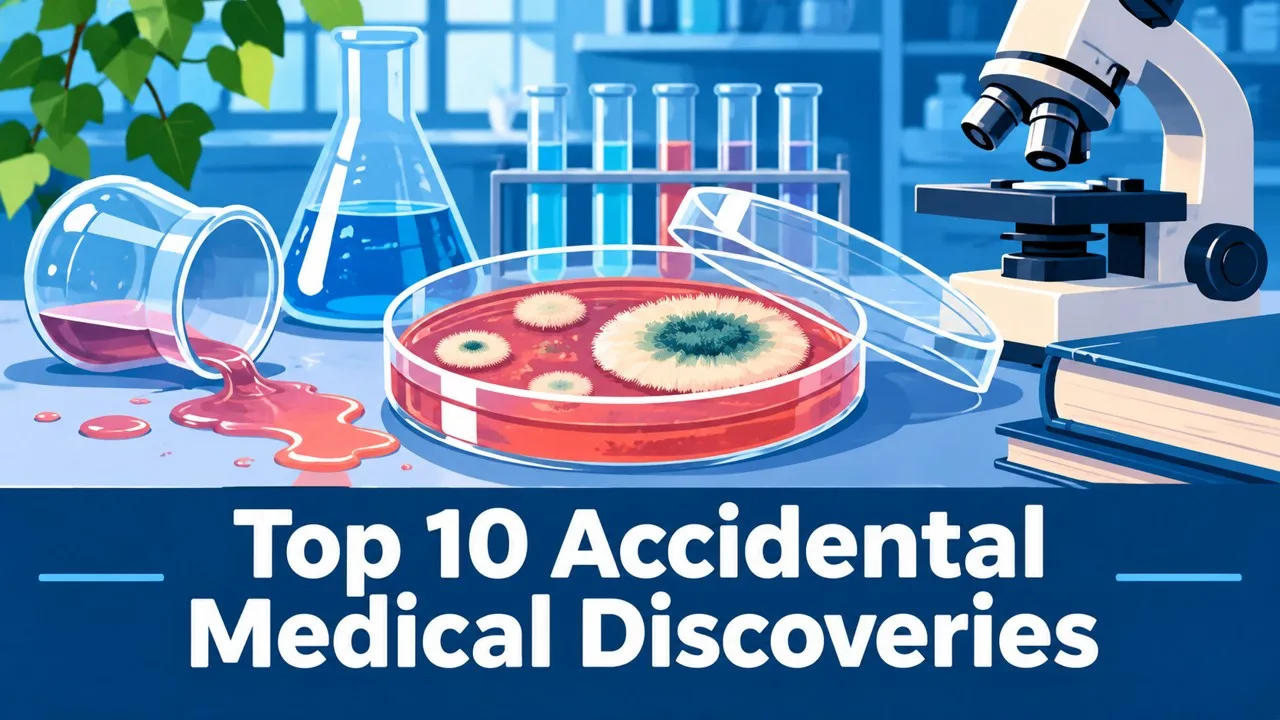
Some major medical advances began as accidents, from a moldy dish that led to penicillin to a wrong resistor that helped create the implantable pacemaker. Medical progress is usually imagined as a careful, step-by-step process, with scientists designing experiments to answer precise questions. Much of the time, that is how it works. But some of the most important breakthroughs in medicine came from mistakes, contaminated samples, unexpected side effects and chance observations.
Scientists have a word for this: serendipity, the art of finding something valuable while looking for something else. The famous chemist Louis Pasteur put it another way, saying that chance favors the prepared mind. In almost every case below, the accident would have meant nothing if the person involved had not noticed it and understood its importance.
The ten discoveries below are penicillin, X-rays, sildenafil, warfarin, the implantable pacemaker, anesthesia with nitrous oxide, minoxidil, cisplatin, the first antidepressant drugs and heparin. Together they have treated or diagnosed hundreds of millions of people.
The accounts are based on documented histories of medicine. Some of the stories have been simplified or romanticized in popular retellings, and where historians disagree about the details or about who deserves credit, that is noted.
These stories are also a reminder that turning an accident into a treatment usually takes years of further work. Discovery is only the beginning; testing, refining and producing a medicine often require large teams and long effort.
Key Facts
| # | Discovery | What was being studied | Year of the accident |
|---|---|---|---|
| 1 | Penicillin | Bacteria that cause infections | 1928 |
| 2 | X-rays | Cathode rays in a glass tube | 1895 |
| 3 | Sildenafil | A treatment for chest pain and heart disease | Early 1990s |
| 4 | Warfarin | A mysterious disease in cattle | 1920s to 1940s |
| 5 | Implantable pacemaker | A circuit to record heart sounds | 1956 |
| 6 | Nitrous oxide anesthesia | Public entertainment with laughing gas | 1844 |
| 7 | Minoxidil | A drug for high blood pressure | 1970s |
| 8 | Cisplatin | Effects of electric fields on bacteria | 1965 |
| 9 | Early antidepressants | Drugs for tuberculosis | Early 1950s |
| 10 | Heparin | Substances that help blood clot | 1916 |
1. A Moldy Dish
In September 1928, the Scottish bacteriologist Alexander Fleming returned to his laboratory at St Mary's Hospital in London after a holiday. On one of his culture plates of Staphylococcus bacteria, he noticed a patch of mold, and around it, a clear zone where the bacteria had died [1].
Fleming identified the mold as a type of Penicillium and named the substance it produced penicillin. He published his findings in 1929, but he struggled to purify it in useful amounts, and for years it attracted little attention [1].
In the late 1930s and early 1940s, Howard Florey, Ernst Chain and their team at Oxford found ways to purify and test penicillin. Mass production during the Second World War saved many lives. Fleming, Florey and Chain shared the Nobel Prize in Physiology or Medicine in 1945.
2. A Glowing Screen
In November 1895, the German physicist Wilhelm Rontgen was experimenting with cathode ray tubes in his laboratory in Wurzburg. Although the tube was covered in black cardboard, he noticed that a nearby screen coated with a fluorescent chemical began to glow [2].
Rontgen realized that some unknown kind of ray was passing through the cardboard. He called it X-radiation, because its nature was unknown. Within weeks, he made an image of the bones in his wife's hand, showing her ring [2].
Related: Top 10 Accidental Inventions That Changed Everyday Life
The discovery spread around the world almost immediately, and doctors began using X-rays to find bullets and broken bones within months. Rontgen received the first Nobel Prize in Physics in 1901. The dangers of radiation were not understood at first, and early users suffered serious injuries.
3. A Side Effect in Drug Trials
In the early 1990s, researchers at the drug company Pfizer in Sandwich, England, were testing a compound called sildenafil as a possible treatment for angina, chest pain caused by reduced blood flow to the heart. The results for angina were disappointing [3].
However, men in the trials reported an unexpected side effect: improved erections. The company changed direction and developed the drug as a treatment for erectile dysfunction. It was approved in the United States in 1998 under the brand name Viagra and became one of the best known drugs in the world [3].
Sildenafil was later approved as a treatment for pulmonary arterial hypertension, a serious lung condition, under another brand name. Its story shows how a failed drug for one condition can turn out to be useful for something else entirely.
4. Bleeding Cattle
In the 1920s, farmers in North America noticed that cattle were dying of internal bleeding after eating spoiled sweet clover hay. The condition became known as sweet clover disease, and veterinarians linked it to moldy feed [4].
At the University of Wisconsin, the chemist Karl Paul Link and his team identified the substance responsible, dicoumarol, in 1940. They then developed related compounds. One, named warfarin after the Wisconsin Alumni Research Foundation that funded the work, was introduced as a rat poison in 1948 [4].
Doctors were at first wary of a rat poison, but warfarin was approved for medical use in the 1950s as a blood thinner to prevent clots. President Dwight Eisenhower was among the patients treated with it after his heart attack in 1955. It remains widely used today.
5. The Wrong Resistor
In 1956, the American engineer Wilson Greatbatch was building a device to record heart rhythms at the University at Buffalo. He reached into a box for a resistor and accidentally installed one with the wrong value [5].
Related: Top 10 Most Advanced Hospitals in the World
Instead of recording, the circuit produced regular electrical pulses. Greatbatch realized the pulses resembled a heartbeat and could potentially be used to drive the heart of a patient whose natural rhythm had failed [5].
Working with the surgeon William Chardack, he developed an implantable pacemaker, which was successfully placed in a patient in 1960. Greatbatch also helped develop long-lasting lithium batteries for pacemakers. Today millions of people live with implanted pacemakers, though many other inventors contributed to their development.
6. A Stage Show With Laughing Gas
In the early nineteenth century, nitrous oxide, known as laughing gas, was mainly used for entertainment. People paid to inhale it at public shows and enjoyed its giddy effects [6].
In December 1844, the dentist Horace Wells attended such a show in Hartford, Connecticut. He noticed that a man under the influence of the gas injured his leg but seemed to feel no pain. The next day, Wells had one of his own teeth extracted while breathing nitrous oxide and reported feeling little pain [6].
Wells tried to demonstrate the method in Boston in 1845, but the demonstration was judged a failure. A year later, William Morton publicly demonstrated ether anesthesia in Boston. Nitrous oxide nevertheless became widely used in dentistry and remains in use today.
7. Hair Growth From a Blood Pressure Pill
Minoxidil was developed by the drug company Upjohn and was first approved as a pill for severe high blood pressure in the late 1970s. It worked by relaxing blood vessels [7].
Doctors soon noticed a surprising side effect. Many patients taking the drug began growing hair, sometimes on their faces and bodies as well as their heads. Researchers wondered whether the drug could be used to treat baldness [7].
Related: Top 10 Rare Medical Conditions You've Never Heard Of
A version applied directly to the scalp was approved in the United States in 1988, sold under the brand name Rogaine. It became one of the most widely used treatments for hair loss. Scientists still do not fully understand exactly how minoxidil stimulates hair growth.
8. Bacteria That Stopped Dividing
In 1965, the biophysicist Barnett Rosenberg and his colleagues at Michigan State University were studying how electric fields affect bacteria. They passed a current through a culture of E. coli using platinum electrodes [8].
The bacteria stopped dividing and grew into long filaments. The team discovered that the cause was not the electricity itself, but platinum compounds formed from the electrodes. One of them, cisplatin, had been made by chemists in the nineteenth century, but its biological effects were unknown [8].
Rosenberg reasoned that a substance that stopped cell division might work against cancer. Cisplatin was approved for medical use in 1978 and transformed treatment of several cancers, especially testicular cancer, which became curable in most cases.
9. Cheerful Tuberculosis Patients
In the early 1950s, doctors were testing new drugs against tuberculosis, including isoniazid and its relative iproniazid. In some hospitals, staff noticed that patients receiving the drugs seemed unusually cheerful and energetic, even though their illness had not changed dramatically [9].
Psychiatrists began testing iproniazid as a treatment for depression. It belonged to a class of drugs later known as monoamine oxidase inhibitors, which affect chemical messengers in the brain. Iproniazid was marketed as an antidepressant in the late 1950s [9].
It was later withdrawn because of liver damage, but its discovery helped launch modern drug treatment for depression. At around the same time, another accidental finding with the drug imipramine led to a second class of antidepressants.
Related: Top 10 Famous Astronomical Observatories
10. An Unexpected Anticoagulant
In 1916, Jay McLean, a medical student at Johns Hopkins University, was working in the laboratory of the physiologist William Howell. His task was to find substances in animal tissues that promoted blood clotting [10].
Instead, McLean found an extract from the liver that prevented blood from clotting. Howell and his colleagues continued the research and named the substance heparin, from the Greek word for liver. The question of how much credit belongs to McLean versus Howell has been debated [10].
Heparin was purified and tested in the 1930s and became one of the most important drugs in medicine. It is used in surgery, dialysis and the treatment of blood clots, and it remains on the World Health Organization's list of essential medicines.
Conclusion
These discoveries show the role of chance in science. But they also show that chance alone is not enough. In every case, someone had to notice the unexpected result, recognize its importance and follow it up with years of careful work.
Many accidental discoveries were nearly missed. Fleming's penicillin was almost forgotten, and Wells's anesthesia demonstration failed in public. The road from an accident to a widely used treatment is rarely smooth.
The stories also show the value of curiosity. Researchers who are open to surprises, rather than only looking for what they expect, are often the ones who make the most important discoveries.
Modern drug development still benefits from unexpected results. Researchers now routinely review side effects reported in trials for clues to new uses, a practice known as drug repurposing, which has turned several older medicines into treatments for different conditions.
Chance, in other words, still has a place in the laboratory.
- ^ [1] Accounts of penicillin's discovery. Wikipedia: history of penicillin Wikipedia: Alexander Fleming
- ^ [2] Accounts of the discovery of X-rays. Wikipedia: Wilhelm Rontgen Wikipedia: X-ray
- ^ [3] Accounts of sildenafil. Wikipedia: sildenafil Wikipedia: pulmonary hypertension
- ^ [4] Accounts of warfarin. Wikipedia: warfarin Wikipedia: Karl Paul Link
- ^ [5] Accounts of the pacemaker. Wikipedia: Wilson Greatbatch Wikipedia: artificial cardiac pacemaker
- ^ [6] Accounts of nitrous oxide anesthesia. Wikipedia: Horace Wells Wikipedia: nitrous oxide
- ^ [7] Accounts of minoxidil. Wikipedia: minoxidil Wikipedia: hair loss
- ^ [8] Accounts of cisplatin. Wikipedia: cisplatin Wikipedia: Barnett Rosenberg
- ^ [9] Accounts of early antidepressants. Wikipedia: iproniazid Wikipedia: monoamine oxidase inhibitor
- ^ [10] Accounts of heparin. Wikipedia: heparin Wikipedia: Jay McLean




















Discussion
Log in with