





 By
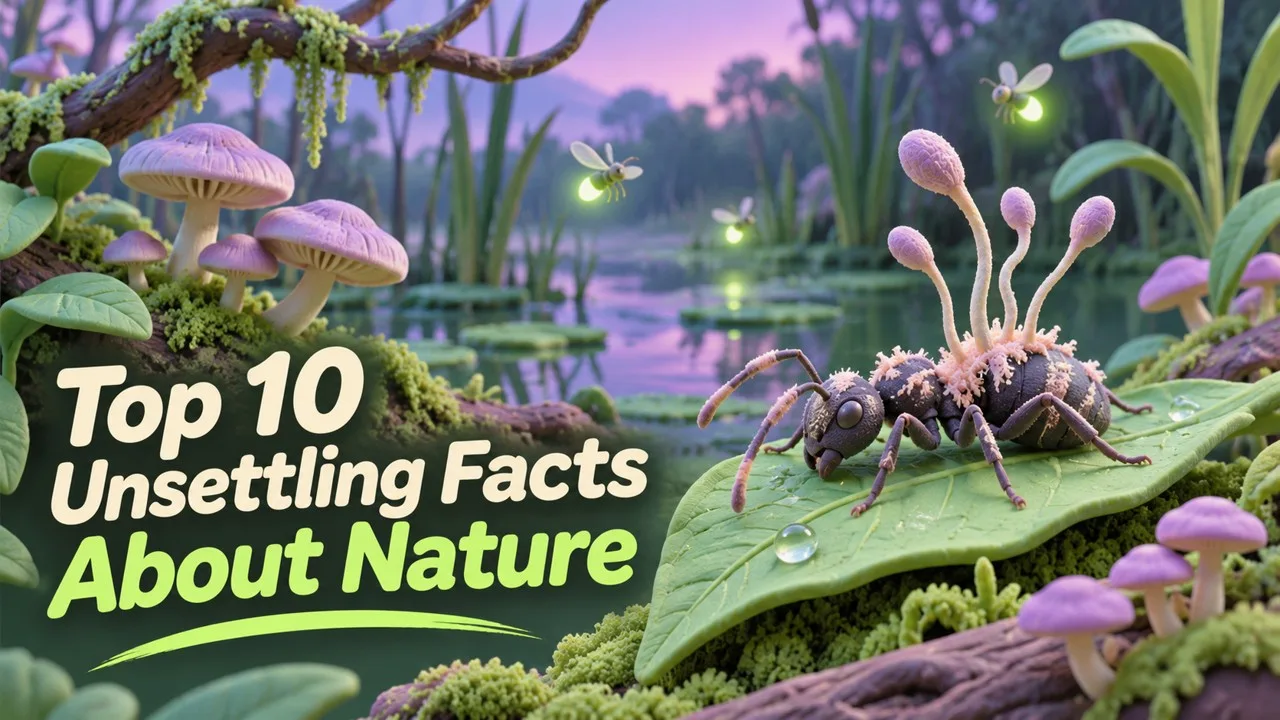
Zombie ants, tongue-replacing parasites, cannibal shark embryos and a lake that coats corpses in salt: ten unsettling facts about the natural world. Nature documentaries often focus on beauty: soaring birds, blooming flowers and playful animals. But the natural world also contains strategies that can seem disturbing to human eyes, from parasites that control their hosts to embryos that eat their siblings.
These behaviors are not cruel in a moral sense. They are the products of evolution, shaped over millions of years because they help organisms survive and reproduce. Scientists study them to understand how complex relationships between species develop.
Some of these examples have inspired horror fiction and video games. Others pose real risks to people, livestock or ecosystems. Many remain only partly understood.
The ten examples below show how strange, ruthless and inventive life on Earth can be.
Key Facts
| # | Organism or place | Unsettling trait | Where found |
|---|---|---|---|
| 1 | Zombie-ant fungus | Takes over an ant's behavior | Tropical forests |
| 2 | Toxoplasma gondii | Changes rodent behavior | Worldwide |
| 3 | Tongue-eating louse | Replaces a fish's tongue | Eastern Pacific |
| 4 | Emerald cockroach wasp | Turns cockroaches into obedient hosts | Tropical regions |
| 5 | Horsehair worms | Make insects jump into water | Worldwide |
| 6 | Leucochloridium flatworm | Turns snail eyestalks into lures | Europe and North America |
| 7 | Sand tiger shark | Embryos eat their siblings | Coastal waters worldwide |
| 8 | Common cuckoo | Tricks other birds into raising its young | Europe, Asia and Africa |
| 9 | Gympie-gympie stinging tree | Delivers long-lasting pain | Australia |
| 10 | Lake Natron | Calcifies animals that die in it | Tanzania |
1. A Fungus That Steers Ants
In tropical forests, a fungus called Ophiocordyceps unilateralis infects carpenter ants. As the fungus grows inside an infected ant, the insect leaves its colony and climbs a plant to a particular height above the forest floor [1].
There, the ant clamps its jaws onto a leaf vein and dies. The fungus then grows a stalk from the back of the ant's head and releases spores that can infect other ants below. Research suggests that the fungus surrounds and invades the ant's muscles rather than directly attacking its brain [1].
Fossil leaves from Germany, around 48 million years old, show bite marks similar to those made by infected ants, suggesting that the relationship is ancient. The fungus inspired the video game and television series The Last of Us. Ant colonies have evolved some defenses: healthy workers may carry infected nestmates far away from the nest. Scientists have identified many related species of Ophiocordyceps, each of which appears to specialize in a particular species of ant.
2. A Parasite That Makes Mice Fearless
Toxoplasma gondii is a single-celled parasite that can infect most warm-blooded animals, but it can reproduce sexually only inside cats. To complete its life cycle, it must get from an infected rodent into a cat [2].
Studies have found that infected rats and mice lose their natural fear of cat odors and may even be attracted to them, making them more likely to be eaten. Scientists are still studying how the parasite produces this change [2].
Humans can also be infected, often through undercooked meat or contact with cat feces. Estimates suggest that a large share of the world's population carries the parasite, usually without symptoms, although it can be dangerous during pregnancy and for people with weakened immune systems. Some studies have suggested links between infection and changes in human behavior or mental health, but these findings are debated and have not established cause and effect. Health authorities advise pregnant women to avoid changing cat litter where possible.
Related: Top 10 Surprising Animal Partnerships in Nature
3. A Louse That Replaces a Tongue
The tongue-eating louse, Cymothoa exigua, is a small crustacean that enters fish through their gills. The female attaches to the base of the fish's tongue and feeds on its blood [3].
Over time, the tongue withers away. The parasite then attaches itself to the remaining stub and effectively functions as the fish's tongue, a rare case of a parasite replacing a host organ [3].
The fish can continue to eat, and the parasite appears to feed mainly on blood and mucus. The louse is not considered harmful to humans, although people have occasionally found one when preparing fish. Cymothoa exigua was first scientifically described in the 1880s. Many related species of isopods parasitize fish in different parts of the world, and some attach to the gills or skin rather than the mouth.
4. A Wasp That Walks Its Prey
The emerald cockroach wasp, found in tropical regions of Africa, Asia and the Pacific, hunts cockroaches much larger than itself. It first stings a cockroach in the thorax, briefly paralyzing its front legs [4].
The wasp then delivers a second, carefully targeted sting into the cockroach's brain. The venom does not paralyze the insect but removes its drive to escape. The wasp bites off part of each antenna and leads the cockroach to a burrow, holding the antenna like a leash [4].
Inside the burrow, the wasp lays an egg on the cockroach and seals the entrance. The larva hatches, feeds on the living cockroach and eventually develops inside its body. Scientists have studied the wasp's venom to understand how it changes the cockroach's behavior, and it has been found to block certain chemical signals in the insect's brain. A cockroach stung this way can still walk normally but does not try to flee.
5. Worms That Drive Crickets to Water
Horsehair worms are long, thin parasites that develop inside insects such as crickets and grasshoppers. The adult worms live in water, but their larvae grow inside land-dwelling hosts [5].
When the worm is ready to emerge, the infected insect often seeks out water and jumps in, where it may drown. The worm then wriggles out of its host, sometimes growing several times longer than the insect's body [5].
Related: Top 10 Unexpected Abilities Found in Animals
Researchers have found that the worms appear to alter the chemistry of their hosts' brains. Horsehair worms are harmless to humans and pets, although finding one in a drinking bowl can be alarming. Some researchers have suggested that infected insects jumping into streams may be a significant source of food for fish. One study in Japan estimated that crickets driven into the water by horsehair worms provided a large share of the energy intake of a population of trout.
6. A Snail With Pulsing Eyestalks
Leucochloridium paradoxum is a parasitic flatworm that infects land snails. Inside the snail, it forms brightly colored, striped sacs that swell into the snail's eyestalks [6].
The sacs pulsate, making the eyestalks look like wriggling caterpillars. Infected snails are also more likely to move into open, well-lit places, where birds can see them [6].
When a bird pecks at the eyestalks and eats them, the parasite completes its life cycle in the bird's gut. Its eggs are released in the bird's droppings, which are eaten by snails, starting the cycle again. The broodsacs are thought to pulsate more strongly in light, making them more visible to birds during the day. Videos of infected snails have circulated widely online because of their bizarre appearance.
7. Sibling Cannibalism Before Birth
Sand tiger sharks give birth to live young, but their pregnancies include a grim competition. In each of the female's two uteri, several embryos develop at first [7].
The largest and most developed embryo in each uterus eats its smaller siblings and then feeds on unfertilized eggs. As a result, only two pups are usually born, one from each uterus [7].
The surviving pups are about a meter long at birth, which gives them a better chance of surviving in the ocean. Scientists call the behavior intrauterine cannibalism. Because each female produces only two pups every two or three years, sand tiger shark populations recover slowly from overfishing. The species is listed as critically endangered by the International Union for Conservation of Nature.
Related: Top 10 Animals That Can Live Without Food for Months
8. A Chick That Evicts Its Rivals
Female common cuckoos lay their eggs in the nests of other birds, such as reed warblers. Their eggs often closely resemble those of the host species in color and pattern [8].
When the cuckoo chick hatches, usually before the host's own chicks, it pushes the host's eggs or chicks out of the nest. The foster parents then raise the cuckoo as their own, even when it grows much larger than they are [8].
The chick's begging calls are said to resemble those of a whole brood of host chicks, encouraging its foster parents to bring more food. Some host species have evolved defenses, such as rejecting eggs that look unusual. Female cuckoos are thought to specialize in particular host species, and their eggs tend to match those of the host they target. Cuckoos have been associated with deception for centuries, which is reflected in the word cuckold.
9. A Plant That Causes Months of Pain
The gympie-gympie, a stinging tree native to rainforests in northeastern Australia, is covered in tiny hollow hairs. When touched, the hairs break off and inject toxins into the skin [9].
The sting is described as extremely painful, and the pain can return for weeks or even months, especially when the affected skin is touched or exposed to cold water. In 2020, researchers identified a new family of toxins, which they called gympietides [9].
There are anecdotal reports of horses and dogs dying after being stung, though such claims are difficult to verify. Workers in the region sometimes wear protective gear when near the plant. The Australian scientist Marina Hurley, who studied the tree, described being stung during her research and has written about the effects. Despite its reputation, the plant's fruit is eaten by some birds and other animals.
10. A Lake That Preserves the Dead
Lake Natron in northern Tanzania is a shallow salt lake fed by mineral-rich springs. Its water is highly alkaline and can be very hot, making it hostile to most animals [10].
Related: Top 10 Extraordinary Lizards of the World
Birds and bats that die in the lake can become coated in salt deposits and preserved. In 2013, the photographer Nick Brandt published images of such animals, which he posed on branches and rocks after finding them along the shore [10].
Despite the harsh conditions, Lake Natron is the most important breeding site for lesser flamingos in the world. The salty water deters predators, and microorganisms in the lake give it a red color. The lake's alkalinity comes from sodium carbonate and other minerals from the surrounding volcanic landscape, including the nearby volcano Ol Doinyo Lengai. Its pH can exceed 10, making it as alkaline as some household cleaning products.
Conclusion
These examples show that nature is full of strategies that seem strange or disturbing from a human point of view. Parasites, predators and harsh environments all play roles in shaping life on Earth.
Many of these organisms have evolved over millions of years to exploit specific hosts or conditions. Their success demonstrates the power of natural selection.
Studying them can also help scientists understand topics such as behavior, immunity and toxins, and may even lead to new medicines.
Nature can be beautiful and unsettling at the same time, and both sides are worth understanding.
- ^ [1] Accounts of Ophiocordyceps. Wikipedia: Ophiocordyceps unilateralis Wikipedia: carpenter ant
- ^ [2] Accounts of Toxoplasma. Wikipedia: Toxoplasma gondii Wikipedia: toxoplasmosis
- ^ [3] Accounts of the tongue-eating louse. Wikipedia: Cymothoa exigua Wikipedia: Isopoda
- ^ [4] Accounts of the emerald cockroach wasp. Wikipedia: Ampulex compressa Wikipedia: parasitoid wasp
- ^ [5] Accounts of horsehair worms. Wikipedia: Nematomorpha Wikipedia: cricket
- ^ [6] Accounts of Leucochloridium. Wikipedia: Leucochloridium paradoxum Wikipedia: Trematoda
- ^ [7] Accounts of sand tiger sharks. Wikipedia: Sand tiger shark Wikipedia: ovoviviparity
- ^ [8] Accounts of cuckoos. Wikipedia: Common cuckoo Wikipedia: Brood parasitism
- ^ [9] Accounts of the gympie-gympie. Wikipedia: Dendrocnide moroides Wikipedia: trichome
- ^ [10] Accounts of Lake Natron. Wikipedia: Lake Natron Wikipedia: Lesser flamingo


















Discussion
Log in with