






 By
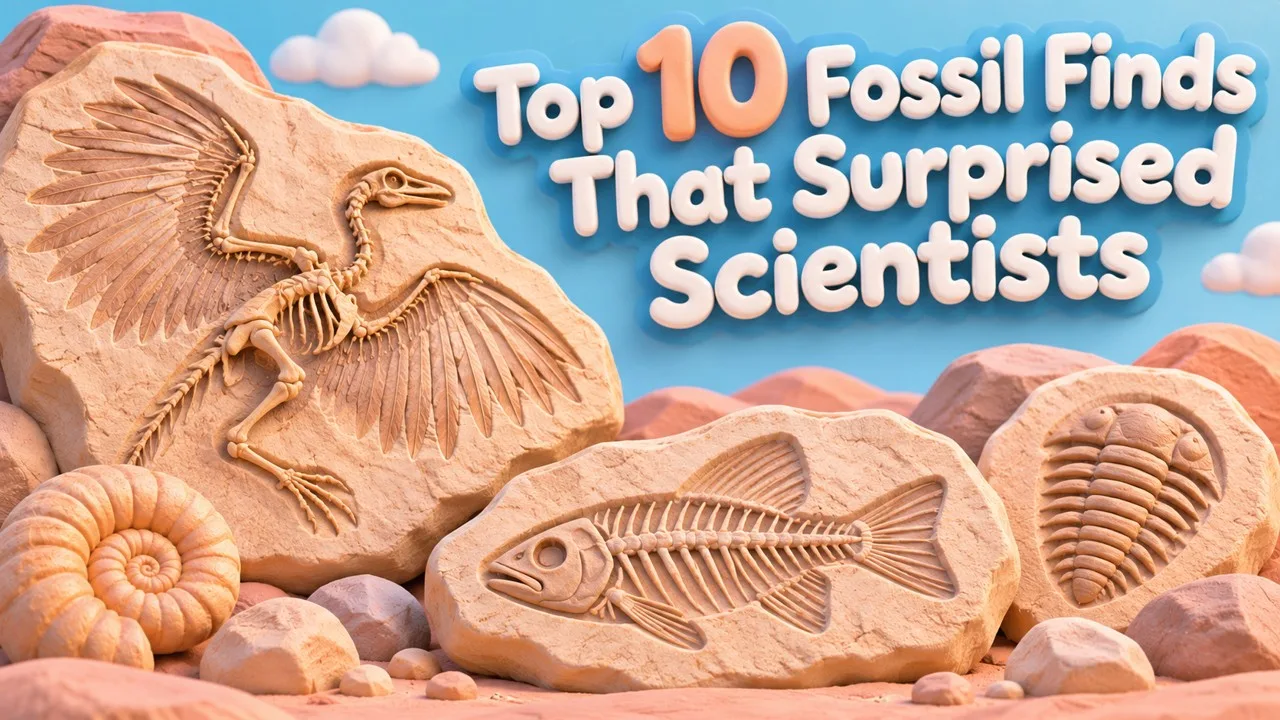
Some fossil finds overturned expectations, from a feathered link between dinosaurs and birds to a living fish once known only from rock. Paleontology moves forward in jumps. Most fossils confirm what researchers already expect, but a few arrive at the wrong time, in the wrong place or in the wrong shape, and force a rethink. Some of those surprises were resolved quickly. Others are still argued over in journals today.
The ten finds below are Archaeopteryx, the Burgess Shale animals, the Precambrian frond Charnia, the misplaced thumb of Iguanodon, the living coelacanth, the feathered dinosaur Sinosauropteryx, the fishapod Tiktaalik, the small human relative Homo floresiensis, the puzzling Tully monster and the sail-backed Spinosaurus. Each is described with its discovery date and what made scientists pause, and contested interpretations are flagged as contested.
Key Facts
| # | Find | Where and when | Why it surprised |
|---|---|---|---|
| 1 | Archaeopteryx | Solnhofen, Bavaria, 1861 | Bird-like feathers on a reptile-like skeleton |
| 2 | The Burgess Shale | British Columbia, 1909 | Exceptional preservation of strange Cambrian animals |
| 3 | Charnia | Charnwood Forest, England, 1950s | Complex life in rocks thought too old for it |
| 4 | Iguanodon | England from the 1820s; Belgium, 1878 | An early reconstruction put a spike in the wrong place |
| 5 | Coelacanth | Off South Africa, 1938 | A group thought extinct for tens of millions of years |
| 6 | Sinosauropteryx | Liaoning, China, 1996 | The first non-bird dinosaur found with feather-like filaments |
| 7 | Tiktaalik | Ellesmere Island, Canada, 2004 | Found by searching rocks of the predicted age |
| 8 | Homo floresiensis | Flores, Indonesia, 2003 | A tiny-bodied human relative in a late period |
| 9 | Tully monster | Mazon Creek, Illinois, 1958 | An animal that resists classification |
| 10 | Spinosaurus | Egypt, 1912 and later; Morocco, 2008 onward | Original bones destroyed; lifestyle still debated |
1. A Feathered Fossil Two Years After Darwin
In 1861, quarry workers in the fine limestone of Solnhofen in Bavaria produced a fossil feather and then a skeleton of an animal about the size of a magpie. It had feathered wings, but also teeth, clawed fingers and a long bony tail. The timing was striking: Charles Darwin's On the Origin of Species had appeared only two years earlier [1].
Archaeopteryx quickly became a central exhibit in arguments about evolution, because it combined traits that people had expected to keep separate. The London specimen was bought by the British Museum, and later specimens, including the superb Berlin specimen found in the 1870s, filled in the picture [1].
Its exact place in the family tree is still discussed. It is often described as an early bird or a close relative of birds, and later discoveries of feathered dinosaurs have made it look less unique. Even so, it remains one of the most important fossils ever found, partly because it arrived exactly when the argument needed it.
2. A Mountain Full of Soft Bodies
In 1909, Charles Walcott of the Smithsonian Institution found a remarkable fossil bed high in the Canadian Rockies. The Burgess Shale, about 508 million years old, preserved not just shells but soft tissue, including legs, guts and eyes, of animals from the Cambrian period [2].
Walcott collected tens of thousands of specimens and fitted many of them into known groups. Later work, especially from the 1960s onward, showed that several were far stranger. Opabinia had five eyes and a long flexible nozzle. Hallucigenia was first reconstructed upside down and back to front, with spines mistaken for legs [2].
The surprise was not only the oddity of the animals but the quality of the record. Such sites, known as Lagerstätten, are rare, and they show how much of early animal life is missing from ordinary fossil beds. The Burgess Shale is now part of a UNESCO World Heritage Site and remains a reference point for the so-called Cambrian explosion.
3. A Schoolgirl's Fossil in Precambrian Rock
Rocks older than the Cambrian were long assumed to contain no complex fossils. In the 1950s, in Charnwood Forest in Leicestershire, a schoolgirl named Tina Negus noticed a frond-shaped impression in rock. Her report was not taken up, and a schoolboy, Roger Mason, later brought a similar find to the geologist Trevor Ford, who described Charnia in 1958 [3].
Related: Top 10 Misidentified Prehistoric Animals and How Science Corrected Them
The importance was the age of the rock. Charnwood's rocks are Precambrian, from the Ediacaran period, and Charnia showed that large, structured organisms existed before the Cambrian. Similar fossils had been found in Australia's Ediacara Hills, but their age had been disputed [3].
Exactly what Charnia was remains uncertain. It looks like a leaf or a sea pen, but it is generally treated as an early animal of a type with no clear living descendants. Its discovery helped establish the Ediacaran biota as a real chapter in the history of life, and Tina Negus later received recognition for her early observation.
4. A Thumb on the Nose
Iguanodon was one of the first dinosaurs to be named, described by Gideon Mantell in the 1820s from teeth that resembled those of an iguana. Early reconstructions, based on scattered bones, imagined a heavy, four-legged lizard-like animal with a horn on its nose [4].
The horn was actually a thumb. In 1878, miners at Bernissart in Belgium found dozens of Iguanodon skeletons in a coal mine. Studied by Louis Dollo and others, the skeletons showed that the conical spike belonged on the hand, not the snout. Dollo mounted the skeletons in an upright, kangaroo-like pose that was itself later revised [4].
Modern reconstructions show Iguanodon as able to walk on four legs and to rear up on two, with a thumb spike whose function is still discussed. The story is a reminder that early paleontology often had to guess from fragments, and that complete skeletons can overturn even confident images, including the famous concrete models at Crystal Palace in London.
5. A Fish Known From Rock, Caught Alive
Coelacanths were known to science as fossils, and the group was thought to have died out around the end of the Cretaceous period, roughly 66 million years ago. In December 1938, a trawler brought a large, steel-blue fish into the port of East London in South Africa, and museum curator Marjorie Courtenay-Latimer recognized that it was unusual [5].
She contacted the ichthyologist J. L. B. Smith, who identified it as a living coelacanth and named it Latimeria in her honor. A second specimen was not obtained until 1952, from the Comoro Islands, and a second species was identified in Indonesia in the late 1990s [5].
Related: Top 10 Ancient Earth Events That Sound Like Science Fiction
Coelacanths are often called living fossils, but the label is misleading. Living coelacanths are not identical to ancient ones, and the group has continued to evolve. The surprise was that a lineage known only from rock had persisted in deep water, unseen by science, while its fossil record seemed to stop.
6. Fuzz on a Small Dinosaur
In 1996, a small predatory dinosaur from the Yixian Formation in Liaoning Province, China, was described with a fringe of fine filaments along its back and tail. Named Sinosauropteryx, it was the first dinosaur outside the bird lineage found with such structures, which are widely interpreted as simple early feathers [6].
The find launched a flood of discoveries. Liaoning's fine volcanic ash deposits have since produced many feathered dinosaurs, showing that feathers appeared long before flight and were widespread among theropods. In 2010, researchers studying pigment structures called melanosomes suggested that Sinosauropteryx had a reddish-brown banded tail [6].
Color reconstructions from fossils are an active and sometimes debated field, but the larger point is settled. The image of dinosaurs as scaly giants had to make room for fuzzy, feathered animals, and the line between dinosaurs and birds became a gradual slope rather than a sharp edge.
7. A Prediction That Came True in the Arctic
Tiktaalik is unusual because scientists went looking for it on purpose. Neil Shubin, Edward Daeschler and Farish Jenkins reasoned that a transitional animal between fish and four-legged vertebrates should appear in rocks of a particular age, around 375 million years old, laid down in shallow streams. They searched such rocks on Ellesmere Island in the Canadian Arctic [7].
In 2004, after several field seasons, they found what they were looking for. Described in 2006, Tiktaalik had scales and fins, but also a flat head, a mobile neck and sturdy fin bones that resemble the beginnings of a limb. It became a famous example of a successful evolutionary prediction [7].
Related: Top 10 Most Bizarre Dinosaurs
Later finds complicated the timeline. Trackways from Poland, reported in 2010, suggest that four-legged animals may have existed even earlier than Tiktaalik. That does not make Tiktaalik less important, but it shows that a transitional fossil represents a type of animal, not necessarily a direct ancestor.
8. A Small Human on an Island
In 2003, an Australian and Indonesian team excavating Liang Bua cave on the island of Flores found the skeleton of a very small adult, about a meter tall, with a small brain. In 2004 they named it Homo floresiensis, and the press quickly nicknamed it the hobbit [8].
The find was controversial. Some researchers argued the skeleton was a modern human with a disease. Further remains and anatomical studies have persuaded most specialists that it is a distinct species. Early estimates placed it very late, but revised dating published in 2016 put the skeletal remains at roughly 100,000 to 60,000 years ago [8].
How it got so small remains debated. One idea is island dwarfism, a process seen in other island animals, and fossils from Mata Menge on Flores, older than 700,000 years, suggest small-bodied hominins lived there for a long time. The find showed that human evolution had more side branches, and more recent ones, than many expected.
9. A Fossil Nobody Can Place
In 1958, an amateur collector named Francis Tully found a strange fossil in the ironstone nodules of Mazon Creek in Illinois, which are about 300 million years old. The animal, later named Tullimonstrum gregarium, had a long body, a narrow snout ending in a claw-like structure and eyes on a crossbar [9].
For decades, experts could not decide what it was. In 2016, two studies argued that it was a vertebrate, possibly related to lampreys. Later work, including a 2023 study using scanning techniques, challenged that idea and suggested it was more likely an invertebrate [9].
Related: Top 10 Animals Once Thought Extinct That Turned Up Alive
The debate continues, and that is the surprise. Thousands of specimens exist, and the Tully monster is the official state fossil of Illinois, yet its basic place in the tree of life is unsettled. It shows how difficult soft-bodied fossils can be to interpret, even when there is plenty of material.
10. A Lost Skeleton and a Disputed Swimmer
Spinosaurus was described in 1915 by the German paleontologist Ernst Stromer from fossils found in Egypt. It had tall spines on its back, forming a sail or hump, and long jaws. Stromer's specimens were kept in Munich and were destroyed during a bombing raid in 1944, leaving researchers with drawings and descriptions [10].
New fossils from Morocco, studied from the 2010s onward, revived interest. Papers led by Nizar Ibrahim in 2014 and 2020 argued that Spinosaurus was highly adapted to water, with dense bones and a paddle-like tail. Other researchers have disputed how well it could swim and have argued that it waded or fed along the shore [10].
The surprise is that one of the largest known predatory dinosaurs is also one of the least settled. Whether it was a true swimmer, a wader or something in between remains a lively argument, which is a good illustration of how much can depend on a few incomplete skeletons.
Conclusion
The ten finds above changed expectations in different ways. Some, like Archaeopteryx and Tiktaalik, filled gaps that theory predicted. Others, like the Burgess Shale, Charnia and Sinosauropteryx, showed whole areas of life that ordinary fossils had hidden. Still others, such as the Tully monster and Spinosaurus, remain open questions.
A fossil does not speak for itself. It is interpreted, re-dated, re-mounted and argued over, and sometimes, as with Iguanodon's thumb, the first reading is simply wrong. That process of correction is how paleontology works, and it is why a single stone can still change a textbook.
- ^ [1] Accounts of the Solnhofen discoveries and the London and Berlin specimens of Archaeopteryx. Wikipedia: Archaeopteryx Wikipedia: Solnhofen limestone
- ^ [2] Background on Walcott's 1909 discovery and later reinterpretations of Opabinia and Hallucigenia. Wikipedia: Burgess Shale Wikipedia: Hallucigenia
- ^ [3] Accounts of Charnia, Tina Negus, Roger Mason and the Ediacaran biota. Wikipedia: Charnia Wikipedia: Ediacaran biota
- ^ [4] Histories of Mantell's Iguanodon and the Bernissart skeletons. Wikipedia: Iguanodon Wikipedia: Crystal Palace Dinosaurs
- ^ [5] Accounts of the 1938 coelacanth, Marjorie Courtenay-Latimer and J. L. B. Smith. Wikipedia: coelacanth Wikipedia: Marjorie Courtenay-Latimer
- ^ [6] Descriptions of Sinosauropteryx and research on fossil pigment structures. Wikipedia: Sinosauropteryx Wikipedia: feathered dinosaur
- ^ [7] Accounts of the Ellesmere Island expeditions and the 2006 description of Tiktaalik. Wikipedia: Tiktaalik Wikipedia: tetrapod
- ^ [8] Background on Liang Bua, the dating revisions and the Mata Menge fossils. Wikipedia: Homo floresiensis Smithsonian Human Origins: Homo floresiensis
- ^ [9] Accounts of Tullimonstrum and the competing vertebrate and invertebrate interpretations. Wikipedia: Tullimonstrum Wikipedia: Mazon Creek fossil beds
- ^ [10] Background on Stromer's specimens, their loss in 1944 and later Moroccan finds. Wikipedia: Spinosaurus Wikipedia: Ernst Stromer



















Discussion
Log in with