






 By
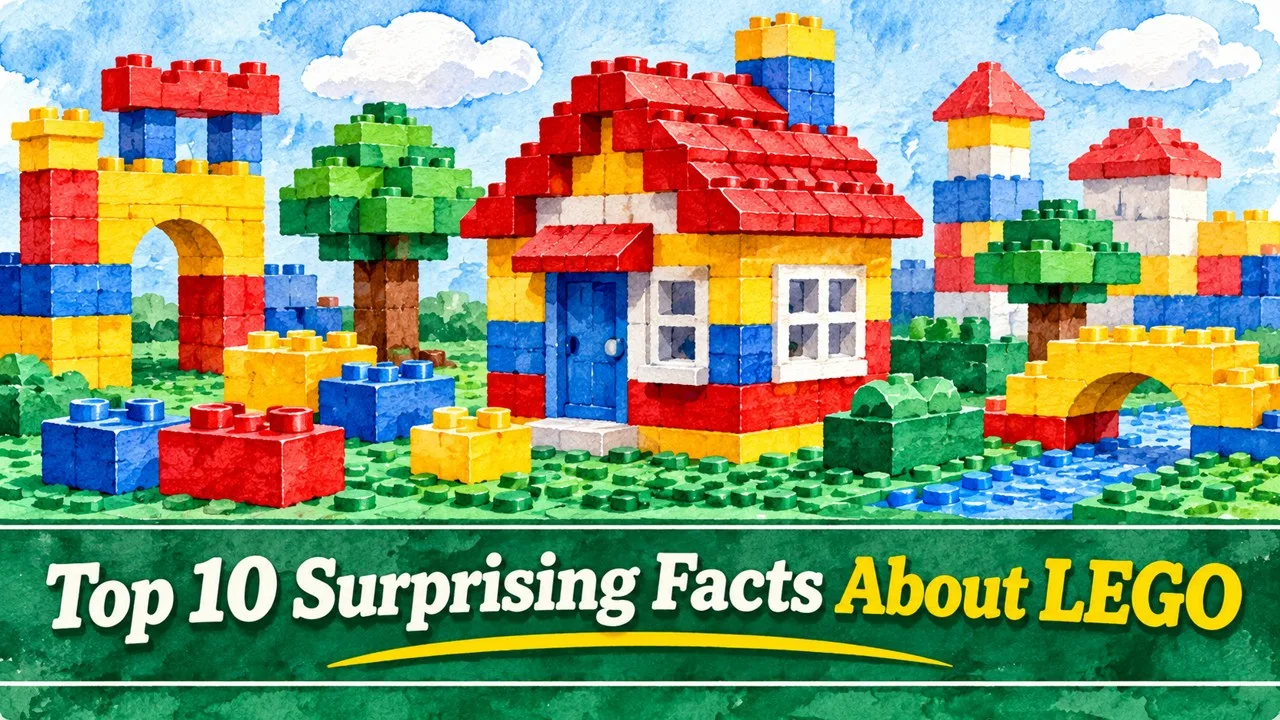
From a Danish carpenter's workshop to millions of bricks lost at sea, ten surprising facts about the history and design of LEGO, the famous toy. LEGO bricks are among the most recognizable toys in the world. Generations of children and adults have used the small interlocking plastic pieces to build houses, spaceships, castles and almost anything else they can imagine.
Behind the colorful bricks lies a long and sometimes surprising history. The company began as a small family business in a Danish village, survived fires and financial crises, and grew into one of the largest toy makers in the world.
Its success depended on a simple but carefully engineered idea. Bricks made decades ago can still connect with bricks made today, a level of compatibility that few other products can claim.
LEGO has also had a strong influence on design, education and popular culture. Its products have inspired theme parks, films, video games and robotics kits used in classrooms.
Some of the facts below concern the origins of the company and its name. Others involve the engineering of the bricks, the mathematics of how they combine and the company's near collapse in the early 2000s.
There is also the curious story of millions of LEGO pieces that fell into the sea off the coast of England in 1997 and are still being found on beaches today.
The facts are drawn from the company's documented history and from widely reported accounts. Where figures vary between sources, that is noted.
Together, they show how a modest wooden toy business became a global brand, and why its little plastic bricks have endured for so long.
LEGO is still owned largely by the descendants of its founder. The Kirk Kristiansen family, as the name is now often spelled, has guided the company through several generations, and family members have played important roles in its strategy, including the decision in the 1950s to build a complete system of play around the brick rather than selling individual toys. That idea, known as the LEGO System of Play, encouraged children to combine sets and keep expanding their collections over time.
LEGO sets have also grown more complex over the decades. Early sets contained relatively few basic pieces, while some modern sets aimed at adult builders contain thousands of parts and detailed instructions.
Key Facts
| # | Fact | Key detail | Year |
|---|---|---|---|
| 1 | The company began with wooden toys | Ole Kirk Christiansen started the business | 1932 |
| 2 | The name comes from Danish words | Leg godt means play well | 1934 |
| 3 | Early bricks were based on Kiddicraft designs | Hilary Fisher Page's self-locking bricks | 1949 |
| 4 | Stud and tube coupling system | Bricks from 1958 still fit modern ones | 1958 |
| 5 | Bricks made from ABS | Acrylonitrile butadiene styrene replaced earlier plastic | 1963 |
| 6 | Small figures with moving arms and legs | The modern minifigure was introduced | 1978 |
| 7 | How many ways six bricks can combine | 915,103,765 combinations | 2005 |
| 8 | Serious financial losses in the early 2000s | A turnaround under new leadership | 2004 |
| 9 | The first Legoland opens | Legoland Billund | 1968 |
| 10 | A container spill off Cornwall | About 4.8 million pieces lost from the Tokio Express | 1997 |
1. A Carpenter's Workshop in Billund
LEGO was founded by Ole Kirk Christiansen, a carpenter in the village of Billund, Denmark. During the economic hardship of the early 1930s, he began making wooden toys, such as ducks and cars, alongside household items like stepladders and ironing boards [1].
Related: Top 10 Most Bizarre Phobias: Strange Fears That Exist
His workshop suffered setbacks, including a fire that destroyed the factory in 1942. Christiansen rebuilt and continued producing toys, and his son Godtfred Kirk Christiansen became increasingly involved in the business [1].
The company later shifted from wood to plastic, but it remained based in Billund. The village became closely associated with the company, and it is home to the original LEGO headquarters and the first Legoland park.
2. A Name That Means Play Well
The name LEGO was adopted in 1934. It comes from the Danish words leg godt, which mean play well. The company has long described this phrase as a summary of its philosophy [2].
It is sometimes noted that lego can also be read in Latin as I gather or I put together. This meaning fits the toy remarkably well, but the company has said it was a coincidence rather than the origin of the name [2].
The name became one of the most recognized brands in the world. The company prefers that LEGO be used as an adjective, as in LEGO bricks, rather than as a noun for the bricks themselves.
3. Inspired by a British Toy
LEGO's first plastic interlocking bricks, introduced in 1949 as Automatic Binding Bricks, were based closely on a design by Kiddicraft, a British company founded by Hilary Fisher Page. Kiddicraft had produced self-locking building bricks in the 1940s [3].
The early LEGO bricks were hollow underneath and did not hold together very firmly. Plastic toys were also not yet widely accepted, and many retailers preferred traditional wooden toys [3].
Page died in 1957, before LEGO became a global success. The LEGO Group later acquired the rights relating to the Kiddicraft bricks, settling any question of ownership over the design.
4. The Patent That Made Bricks Compatible
In 1958, LEGO patented a new design for its bricks. Hollow tubes were added to the underside of each brick so that it gripped the studs on the brick below, giving the toy what the company calls clutch power [4].
This design solved the problem of bricks coming apart too easily. It allowed builders to create larger and more stable structures, and it became the foundation of the modern LEGO system [4].
Related: Top 10 Oldest Buildings in the World
Because the basic design has remained the same, bricks made in 1958 can still connect to bricks made today. This long-term compatibility is one reason families often pass down LEGO collections from one generation to the next.
5. A Switch to Tougher Plastic
Early LEGO bricks were made from cellulose acetate, a plastic that could warp and fade over time. In 1963, the company switched to acrylonitrile butadiene styrene, known as ABS, which is stronger and holds its shape and color better [5].
ABS allows bricks to be molded with extremely small tolerances, so that pieces fit together firmly but can still be pulled apart. The company has said its molds are accurate to within a few thousandths of a millimeter [5].
LEGO has also experimented with more sustainable materials. In 2018, it began producing some botanical elements, such as leaves and trees, from plastic derived from sugarcane.
6. The Arrival of the Minifigure
The modern LEGO minifigure was introduced in 1978. The small figure had movable arms and legs, hands that could grip accessories and a simple smiling face [6].
Minifigures allowed builders to populate their creations with people, such as police officers, astronauts and knights. They quickly became one of the most popular parts of LEGO sets [6].
Over the years, thousands of different minifigures have been produced, including characters from films and television. Many collectors seek out rare figures, and some have become valuable.
7. Millions of Possible Combinations
LEGO once stated that six standard two-by-four bricks of the same color could be combined in about 102 million ways. In 2005, the mathematician Søren Eilers used a computer to recalculate the figure [7].
Related: 10 Sikh Gurus: The Pillars of Sikhism Who Shaped Faith, Equality, Courage, and Humanity
Eilers found that the six bricks could be combined in 915,103,765 different ways. The higher number came from including combinations the earlier calculation had left out [7].
The figure illustrates how quickly possibilities multiply as more bricks are added. Even a modest collection of LEGO pieces offers an almost endless range of possible creations.
8. A Company Near Collapse
In the early 2000s, the LEGO Group faced serious financial trouble. It had expanded into many new products, including clothing, theme parks and video games, and many of these efforts lost money [8].
In 2004, Jørgen Vig Knudstorp became chief executive. The company refocused on its core building toys, cut costs and sold a controlling interest in its Legoland parks to the entertainment company Merlin Entertainments in 2005 [8].
The turnaround was remarkably successful. By the 2010s, LEGO had become one of the largest toy companies in the world, helped by popular licensed sets and the success of The LEGO Movie in 2014.
9. A Theme Park in Billund
The first Legoland park opened in Billund in 1968. It featured models of buildings and landscapes made from millions of LEGO bricks, and it attracted many more visitors than expected in its first season [9].
The park became a major tourist attraction in Denmark. Its success inspired other Legoland parks around the world, including in England, Germany, the United States, Malaysia and Japan [9].
The parks typically feature a miniature area showing famous places and cities built from LEGO bricks, along with rides and attractions aimed at families with young children.
10. Bricks Lost at Sea
On February 13, 1997, the container ship Tokio Express was struck by a large wave off the coast of Cornwall in southwest England. Dozens of containers fell overboard, including one reportedly carrying about 4.8 million LEGO pieces [10].
Related: Top 10 Tallest Buildings in the World
Many of the pieces had sea themes, including octopuses, flippers, life jackets and dragons. Over the following years, LEGO pieces from the spill began washing up on beaches in Cornwall and elsewhere [10].
Beachcombers continue to find pieces decades later. The spill has been studied as an example of how long plastic can persist in the ocean and how far it can travel.
Conclusion
LEGO's history is a story of innovation, persistence and careful design. From a carpenter's workshop in Billund, the company grew into a global brand known for its simple, durable bricks.
Its success depended on engineering choices such as the stud and tube system and the use of ABS plastic, which made the bricks reliable and compatible across generations.
The company also faced serious challenges, including fires and a financial crisis, and it found ways to recover by focusing on what made its products special.
Today, LEGO bricks are used not only for play but also in education, art and design. Adults as well as children build elaborate models, and the company continues to explore new materials.
The next time someone steps on a stray brick, it may help to remember the long and surprising history behind that small piece of plastic.
The bricks have also found uses far beyond the toy box. Architects and engineers have used them to sketch out ideas, teachers use them to explain mathematics and programming, and therapists have used group building sessions to help children develop social skills. Artists have created large sculptures entirely from LEGO bricks, and exhibitions of such work have toured museums and galleries in many countries, attracting visitors of all ages and showing how a simple toy can become a serious creative medium.
- ^ [1] Accounts of Ole Kirk Christiansen. Wikipedia: Ole Kirk Christiansen Wikipedia: Billund
- ^ [2] Accounts of the LEGO name. Wikipedia: Lego Wikipedia: The Lego Group
- ^ [3] Accounts of Kiddicraft. Wikipedia: Kiddicraft Wikipedia: Hilary Fisher Page
- ^ [4] Accounts of the 1958 brick design. Wikipedia: Lego Wikipedia: Godtfred Kirk Christiansen
- ^ [5] Accounts of ABS plastic. Wikipedia: Acrylonitrile butadiene styrene Wikipedia: Lego
- ^ [6] Accounts of the LEGO minifigure. Wikipedia: Lego minifigure Wikipedia: The Lego Group
- ^ [7] Accounts of LEGO combinations. Wikipedia: Lego Wikipedia: Combinatorics
- ^ [8] Accounts of LEGO's financial turnaround. Wikipedia: The Lego Group Wikipedia: The Lego Movie
- ^ [9] Accounts of Legoland Billund. Wikipedia: Legoland Billund Resort Wikipedia: Billund
- ^ [10] Accounts of the Tokio Express spill. Wikipedia: Tokio Express Wikipedia: Marine debris



















Discussion
Log in with