




 By
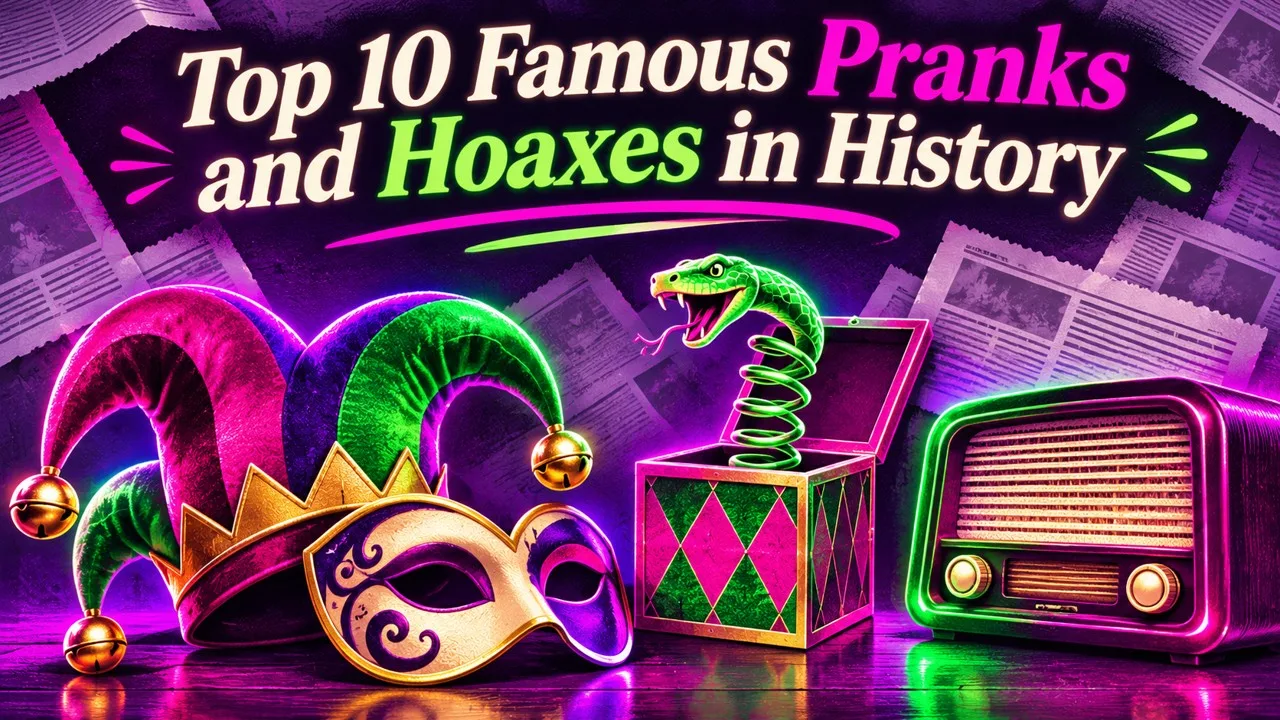
Bat-people on the Moon, a stone giant in a farm field and spaghetti growing on trees: ten of history's most famous pranks and hoaxes. People have always enjoyed a good trick. From elaborate practical jokes among friends to newspaper stories invented to sell more copies, pranks and hoaxes have a long and colorful history.
Some hoaxes were harmless fun, intended to make people laugh once the truth came out. Others were designed to make money, embarrass the powerful or test how easily experts and the public could be fooled.
The most successful hoaxes shared certain features. They appeared in trusted places, such as respected newspapers, scientific journals or national television programs, and they told people something they wanted to believe or found too intriguing to ignore.
Many also relied on the limits of communication at the time. In an age before instant fact-checking, a story printed in a newspaper or broadcast on the radio could spread widely before anyone was able to confirm or deny it.
Several of the hoaxes below took place on April Fools' Day, when audiences might be expected to be on guard. Remarkably, many people were still taken in.
Others lasted for years or even decades. One fake fossil misled scientists for about forty years, and a pair of photographs of fairies convinced a famous author that the creatures were real.
The ten cases below are arranged in chronological order, from a Regency-era practical joke in London to a fast-food advertising campaign in the 1990s. Each one is well documented.
Together, they show the creativity of hoaxers and offer a lasting lesson about the importance of skepticism, even when a story comes from a trusted source.
Key Facts
| # | Hoax | Perpetrator | Year |
|---|---|---|---|
| 1 | The Berners Street hoax | Theodore Hook | 1810 |
| 2 | The Great Moon Hoax | The New York Sun | 1835 |
| 3 | The Cardiff Giant | George Hull | 1869 |
| 4 | The Dreadnought hoax | Horace de Vere Cole and friends | 1910 |
| 5 | Piltdown Man | Unknown, with Charles Dawson suspected | 1912 |
| 6 | The Cottingley Fairies | Elsie Wright and Frances Griffiths | 1917 |
| 7 | The War of the Worlds broadcast | Orson Welles and the Mercury Theatre | 1938 |
| 8 | The spaghetti-tree hoax | The BBC program Panorama | 1957 |
| 9 | Sidd Finch | George Plimpton and Sports Illustrated | 1985 |
| 10 | The Taco Liberty Bell | Taco Bell | 1996 |
1. Chaos on a London Street
In 1810, the writer Theodore Hook reportedly made a bet with a friend that he could turn any house in London into the most talked-about address in the city. He chose 54 Berners Street, the home of a woman named Mrs. Tottenham, and sent out thousands of letters in her name requesting deliveries, visits and services [1].
On the chosen day, a stream of chimney sweeps, coal merchants, bakers, doctors, lawyers and others arrived at the house, along with deliveries of furniture, wedding cakes and even an organ. According to contemporary accounts, some important public figures were also lured to the address, and the street became blocked with crowds and carriages [1].
Hook watched the chaos from a building across the street. Although he was widely suspected, he was never formally punished, and the episode became one of the most famous practical jokes in British history.
Related: Top 20 Archaeological Hoaxes That Fooled the Public
2. Life Discovered on the Moon
In August 1835, the New York Sun newspaper published a series of articles claiming that the famous astronomer Sir John Herschel had discovered life on the Moon using a powerful new telescope. The articles described forests, lakes, unicorn-like animals and winged humanoid creatures [2].
The stories were presented as reprints from a scientific journal that, in fact, was no longer being published. They were full of convincing technical detail, and many readers believed them, at least for a time [2].
The articles are generally attributed to the reporter Richard Adams Locke. The hoax greatly increased the Sun's circulation, and Herschel, who was working in South Africa, was reportedly amused at first but later annoyed by the questions he received.
3. A Stone Giant in a Farm Field
In October 1869, workers digging a well on a farm in Cardiff, New York, uncovered what appeared to be the petrified body of a giant man more than three meters tall. Crowds soon paid to view the figure, which some believed was evidence of the giants mentioned in the Bible [3].
The giant had actually been commissioned by a tobacconist named George Hull, who had it carved from a block of gypsum and buried on his cousin's farm. Hull reportedly came up with the idea after arguing with a minister about whether giants had once walked the Earth [3].
When the showman P. T. Barnum failed to buy the giant, he made his own copy and displayed it, claiming that the original was a fake. The famous phrase about a sucker being born every minute is often linked to this episode, though its origin is disputed and it was probably not said by Barnum.
4. Royalty Aboard a Battleship
In February 1910, the prankster Horace de Vere Cole and a group of friends, including the young writer Virginia Stephen, later known as Virginia Woolf, disguised themselves as members of the Abyssinian royal family. They wore robes, false beards and dark makeup [4].
A telegram sent in the name of a government official arranged for them to visit HMS Dreadnought, the most powerful warship in the Royal Navy at the time. The group was given an official tour and spoke in a made-up language, reportedly exclaiming bunga bunga at what they saw [4].
When the hoax was revealed in the press, the Royal Navy was deeply embarrassed. The prank is remembered today partly because of Woolf's involvement and partly as a striking example of how easily official procedures could be fooled.
Related: Top 10 Famous Historical Events That Did Not Happen
5. The Fossil That Fooled Scientists
In 1912, the amateur archaeologist Charles Dawson announced the discovery of fossil fragments in a gravel pit at Piltdown in England. The remains, which included part of a skull and a jawbone, were presented as a missing link between apes and humans [5].
For decades, many scientists accepted Piltdown Man as genuine, even though it fit poorly with other fossil discoveries. In 1953, researchers using new dating techniques and close examination showed that it was a forgery [5].
The skull was from a modern human, while the jaw came from an orangutan, and the teeth had been filed to look human. The identity of the forger has never been proven, though Dawson is widely regarded as the most likely suspect.
6. Fairies in the Garden
In 1917, two young cousins, Elsie Wright and Frances Griffiths, took photographs in the village of Cottingley, England, that appeared to show them with small fairies. The pictures attracted attention a few years later, when they were promoted by people interested in spiritualism [6].
The author Arthur Conan Doyle, creator of Sherlock Holmes, wrote about the photographs in 1920 and believed they were genuine evidence of fairies. His support helped make the images famous around the world [6].
In the 1980s, the cousins admitted that the fairies had been paper cutouts held in place with hatpins. Frances, however, maintained that the last of the five photographs was genuine.
7. Martians on the Radio
On October 30, 1938, Orson Welles and his Mercury Theatre company broadcast a radio adaptation of H. G. Wells's novel The War of the Worlds. The program was presented as a series of news bulletins describing a Martian invasion in New Jersey [7].
Newspapers the next day reported that the broadcast had caused widespread panic. The episode became famous as an example of the power of mass media to fool the public [7].
Related: History of Bombay: From Seven Islands to Mumbai
It was not intended as a hoax, since the program was announced as a drama. Later researchers have argued that the panic was greatly exaggerated by newspapers, and that relatively few listeners were actually fooled, making the story of the panic itself something of a myth.
8. Spaghetti Growing on Trees
On April 1, 1957, the BBC current affairs program Panorama broadcast a short film showing a family in Switzerland harvesting spaghetti from trees. The segment was narrated by the respected broadcaster Richard Dimbleby, which gave it great credibility [8].
At the time, spaghetti was not a common food in Britain, and many viewers did not know how it was made. After the broadcast, the BBC reportedly received calls from viewers asking how they could grow their own spaghetti trees [8].
The segment is often described as one of the greatest April Fools' Day pranks ever broadcast. It is frequently cited as one of the first times a television program used the date for an elaborate hoax.
9. The Pitcher Who Never Was
On April 1, 1985, Sports Illustrated published an article by the writer George Plimpton about a remarkable baseball prospect named Sidd Finch. According to the article, Finch could throw a baseball at about 168 miles per hour and had learned his skills in Tibet [9].
The story included photographs and quotes, and the New York Mets cooperated with the prank. Many readers believed it, and some sports writers reportedly began asking about the new pitcher [9].
The article included a clue. The first letters of the words in its subtitle spelled out a message wishing readers a happy April Fools' Day. A few weeks later, the magazine announced that Finch had retired.
10. A Fast-Food Chain Buys the Liberty Bell
On April 1, 1996, the fast-food chain Taco Bell placed full-page advertisements in several major newspapers announcing that it had purchased the Liberty Bell to help reduce the national debt. The ads said the bell would be renamed the Taco Liberty Bell [10].
Related: Ukraine: A Historical Overview of Eastern Europe's Heartland
The National Park Service, which looks after the bell in Philadelphia, reportedly received many angry calls. Taco Bell revealed later that day that the announcement was a joke [10].
Even the White House joined in. When asked about the story, the press secretary joked that the government had also sold the Lincoln Memorial to a car company. The prank brought Taco Bell enormous publicity.
Conclusion
These pranks and hoaxes show how creative people can be when they set out to deceive. Some aimed to entertain, others to make money and some to embarrass institutions that seemed too sure of themselves.
They also show how easily audiences can be fooled when a story appears in a trusted source. Respected newspapers, national broadcasters and scientific institutions all played a role in spreading these deceptions.
At the same time, many hoaxes eventually came to light through careful investigation, scientific testing or the confessions of those responsible.
In the modern age of social media, false stories can spread faster than ever. The lessons of these historical hoaxes remain relevant, reminding us to ask questions and check sources.
Still, there is something to admire in a well-crafted, harmless prank, and many of these stories continue to delight people long after the truth was revealed.
- ^ [1] Accounts of the Berners Street hoax. Wikipedia: Berners Street hoax Wikipedia: Theodore Hook
- ^ [2] Accounts of the Great Moon Hoax. Wikipedia: Great Moon Hoax Wikipedia: John Herschel
- ^ [3] Accounts of the Cardiff Giant. Wikipedia: Cardiff Giant Wikipedia: P. T. Barnum
- ^ [4] Accounts of the Dreadnought hoax. Wikipedia: Dreadnought hoax Wikipedia: Virginia Woolf
- ^ [5] Accounts of Piltdown Man. Wikipedia: Piltdown Man Wikipedia: Hoax
- ^ [6] Accounts of the Cottingley Fairies. Wikipedia: Cottingley Fairies Wikipedia: Arthur Conan Doyle
- ^ [7] Accounts of the War of the Worlds broadcast. Wikipedia: The War of the Worlds (1938 radio drama) Wikipedia: Orson Welles
- ^ [8] Accounts of the spaghetti-tree hoax. Wikipedia: Spaghetti-tree hoax Wikipedia: Panorama
- ^ [9] Accounts of Sidd Finch. Wikipedia: Sidd Finch Wikipedia: George Plimpton
- ^ [10] Accounts of the Taco Liberty Bell. Wikipedia: Taco Liberty Bell Wikipedia: Liberty Bell



















Discussion
Log in with