


 By
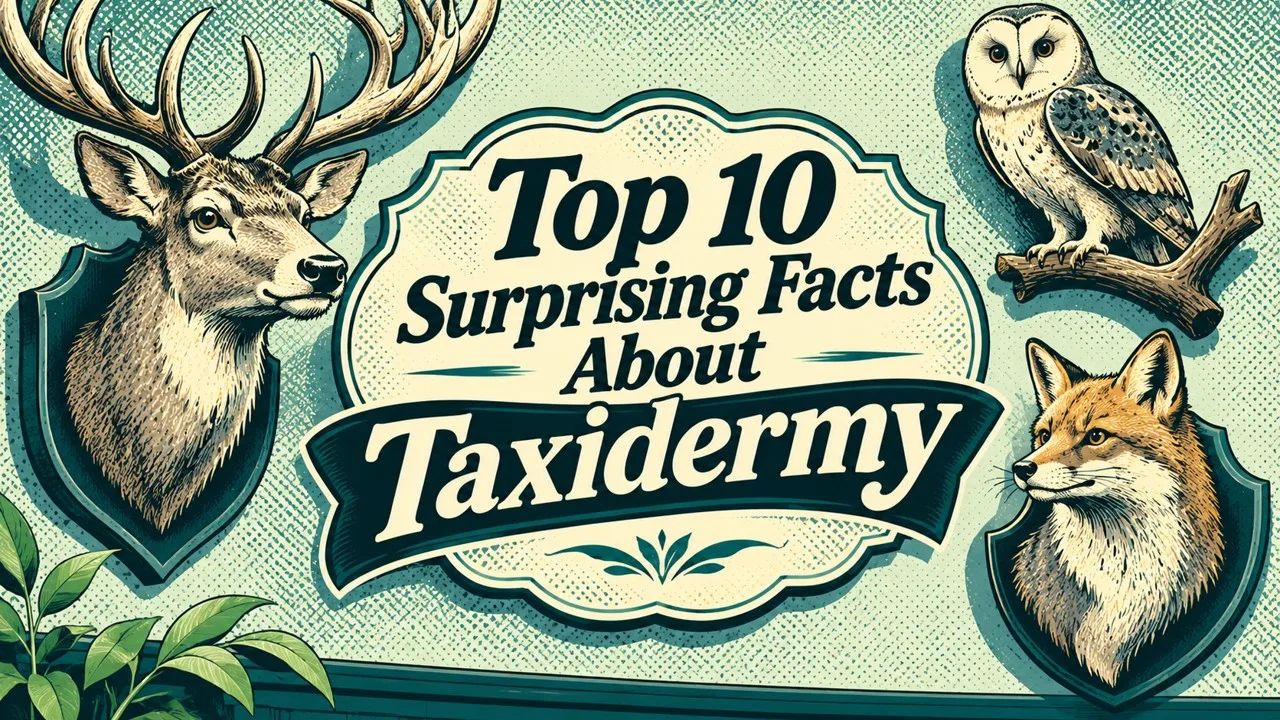
Arsenic soap, an overstuffed walrus, a famous racehorse in three museums and the last passenger pigeon: ten surprising facts about the art of taxidermy. Taxidermy, the art of preserving and mounting the skins of animals, is often associated with dusty hunting trophies and old museum displays. Yet it has a much richer and stranger history than many people realize.
For centuries, taxidermy played an important role in science. Before photography and film, preserved specimens allowed naturalists to study animals from distant lands, and museums used them to show the public creatures they would never otherwise see.
The craft has also been used for art, entertainment and outright deception. Victorian collectors created elaborate scenes of animals dressed in human clothes, and showmen displayed bizarre fake creatures to curious crowds.
Over time, the techniques of taxidermy changed dramatically. Early specimens were often crudely stuffed, while modern taxidermists sculpt detailed forms based on careful study of anatomy.
Some of the methods used in the past were dangerous. Many old specimens were treated with toxic chemicals, which means museum staff today must handle them with great care.
The facts below cover the science of taxidermy, famous specimens, unusual artists and some notorious hoaxes. They include animals that became celebrities and one that became a symbol of extinction.
Taxidermy remains a subject that divides opinion. Some people find it fascinating and beautiful, while others consider it unsettling. Modern taxidermists often work only with animals that died of natural causes or were obtained ethically.
Whatever one's feelings about it, the history of taxidermy offers a surprising look at how people have tried to understand, display and preserve the natural world.
Natural history museums hold enormous collections of preserved animals, many of them never put on public display. Behind the scenes, drawers and cabinets contain millions of bird skins, mammal hides and other specimens gathered over centuries. Scientists use these collections to study how species have changed, to track the spread of pollutants and diseases and even to extract genetic material from animals that died long ago. In this way, specimens prepared by taxidermists generations ago continue to contribute to research that their makers could never have imagined.
Laws now govern much of the trade in preserved animals. International agreements restrict the buying and selling of specimens from endangered species, and taxidermists in many countries need permits to work with protected birds and mammals.
Key Facts
| # | Subject | Place | Period |
|---|---|---|---|
| 1 | Modern mounts use sculpted forms | Workshops and museums | Twentieth century onward |
| 2 | Arsenical soap | European museums and collections | Eighteenth to twentieth centuries |
| 3 | Walter Potter's anthropomorphic scenes | Bramber, Sussex, England | Victorian era |
| 4 | Carl Akeley's methods and dioramas | American Museum of Natural History, New York | Early twentieth century |
| 5 | A famous mistake | Horniman Museum, London | Late nineteenth century |
| 6 | Phar Lap | Melbourne, Canberra and Wellington | 1930s |
| 7 | The Feejee mermaid | Displayed by P. T. Barnum in New York | 1842 |
| 8 | The jackalope | Douglas, Wyoming | 1930s |
| 9 | Martha | Cincinnati Zoo and the Smithsonian Institution | 1914 |
| 10 | Deyrolle | Paris, France | Founded 1831 |
1. Stuffing Is a Misleading Word
The word taxidermy comes from Greek words meaning arrangement and skin. In the past, specimens were often literally stuffed with materials such as straw, rags or cotton, which frequently resulted in lumpy, unnatural shapes that bore little resemblance to the living animal [1].
Related: Top 10 Strange Things That Have Fallen From the Sky
Modern taxidermists rarely stuff animals at all. Instead, they fit the preserved skin over a carefully sculpted form, today often made from polyurethane foam, which reproduces the animal's muscles and posture [1].
Eyes are typically replaced with glass or acrylic, and details such as the nose and mouth may be rebuilt and painted. Many professionals therefore dislike the term stuffed animal, since it does not describe the skill involved in modern work.
2. A Poisonous Preservative
In the eighteenth century, a French apothecary named Jean-Baptiste Bécoeur developed a preservative paste containing arsenic. Known as arsenical soap, it protected skins from insects that would otherwise destroy them [2].
The recipe was published after his death and became widely used by taxidermists and museums. It remained common until the twentieth century, when safer alternatives became available [2].
Because of this, many old specimens in museum collections still contain arsenic. Curators and researchers often wear gloves and protective equipment when handling them, and some museums test specimens for toxic residues.
3. Kittens at a Wedding
The English taxidermist Walter Potter became famous in the Victorian era for creating scenes of animals posed like humans. His first major work depicted the nursery rhyme The Death and Burial of Cock Robin, using many different birds [3].
Potter's other tableaux included kittens dressed for a wedding, rabbits in a schoolroom and squirrels playing cards. His museum in the village of Bramber attracted many visitors [3].
The collection remained on display long after his death, but it was sold at auction in 2003 and dispersed among buyers. Potter's work remains influential among artists who practice what is sometimes called anthropomorphic taxidermy.
4. The Father of Modern Taxidermy
The American naturalist Carl Akeley is often called the father of modern taxidermy. He developed methods for sculpting detailed animal forms, over which skins could be fitted to create lifelike mounts [4].
Akeley also championed the use of dioramas, which display animals in realistic re-creations of their habitats. His work led to the Akeley Hall of African Mammals at the American Museum of Natural History, which opened in 1936 [4].
Related: Top 10 Strange Things That Have Fallen From the Sky
Akeley was also an inventor. He developed a motion picture camera and a device for spraying concrete. He died in 1926 during an expedition in central Africa and was buried there.
5. The Overstuffed Walrus
One of the most famous examples of taxidermy gone wrong is the walrus at the Horniman Museum in London. The animal was mounted in the nineteenth century, and according to the museum, the taxidermists had likely never seen a living walrus [5].
Because they did not know that walruses have loose, wrinkled skin, they stuffed the specimen until it was smooth and round. The result looks much larger and plumper than a real walrus [5].
The walrus has become the museum's best-loved exhibit. It has even appeared on museum merchandise and traveled for an exhibition, showing that mistakes can become treasured in their own right.
6. A Racehorse in Three Museums
Phar Lap was a champion racehorse bred in New Zealand who became a national hero in Australia during the Great Depression. He died suddenly in the United States in 1932, and the cause of his death has been debated ever since [6].
After his death, his remains were divided. His mounted hide is displayed at the Melbourne Museum, his heart is held at the National Museum of Australia in Canberra and his skeleton is at Te Papa in Wellington, New Zealand [6].
The mounted Phar Lap is one of the Melbourne Museum's most popular exhibits. His enormous heart, which was much larger than average, gave rise to the Australian expression a heart as big as Phar Lap.
7. A Fake Mermaid
In 1842, the showman P. T. Barnum exhibited a creature he called the Feejee mermaid. It was presented as the preserved body of a real mermaid caught in the South Pacific [7].
Related: Top 10 Most Bizarre Phobias: Strange Fears That Exist
The object was actually made by joining the upper body of a monkey to the tail of a fish. Objects like this were reportedly created in Japan and other places as curiosities or for religious purposes [7].
The exhibit drew large crowds, helped by clever promotion. Similar fake mermaids can still be seen in museums today, preserved as examples of historical hoaxes.
8. The Horned Rabbit
The jackalope is a mythical animal described as a rabbit with antlers. It became popular in the United States after the Herrick brothers of Douglas, Wyoming, began creating mounts in the 1930s that combined jackrabbit bodies with deer antlers [8].
The mounts became popular souvenirs, and Douglas embraced the jackalope as a local symbol. Many tourist shops in the American West sell jackalope mounts and postcards [8].
Some researchers suggest that stories of horned rabbits may have been inspired by real rabbits infected with a virus that causes horn-like growths on their heads. Similar legends exist in other parts of the world.
9. The Last Passenger Pigeon
The passenger pigeon was once among the most numerous birds in North America, with flocks that reportedly darkened the sky. Overhunting and habitat loss drove the species to extinction [9].
The last known passenger pigeon, a female named Martha, died at the Cincinnati Zoo on September 1, 1914. Her body was frozen in a block of ice and sent to the Smithsonian Institution, where it was preserved and mounted [9].
Martha has been displayed at times as a powerful symbol of extinction. Her story is often used to show how quickly human activity can wipe out even the most abundant species.
10. A Shop of Curiosities in Paris
Deyrolle is a famous shop in Paris that has sold taxidermy, insects and natural history specimens since the nineteenth century. Its wood-paneled rooms filled with animals have attracted scientists, artists and tourists [10].
Related: Top 10 Oldest Buildings in the World
The shop also produced educational wall charts used in French schools, showing animals, plants and the human body. These charts became widely known and are now collected [10].
In 2008, a fire badly damaged the shop and destroyed many specimens. Artists and supporters helped raise money for restoration, and Deyrolle reopened, continuing its long tradition.
Conclusion
Taxidermy has a surprisingly varied history. It has served science, education, art and entertainment, and it has produced both remarkable achievements and memorable mistakes.
Pioneers like Carl Akeley transformed the craft into a scientific art form, while artists like Walter Potter used it to create whimsical scenes that still fascinate people today.
Some of the most famous specimens, from Phar Lap to Martha the passenger pigeon, have become cultural symbols, reminding people of national heroes or of the dangers of extinction.
Modern taxidermy continues to evolve, with greater attention to ethics, safety and accuracy. Museums use preserved specimens for research as well as display, helping scientists study changes in animal populations over time.
Whether people find it beautiful or unsettling, taxidermy remains a remarkable window into our relationship with the natural world.
Taxidermy has also enjoyed a revival in recent years. Classes teaching the basics of the craft have become popular in some cities, attracting artists, students and people curious about anatomy. Competitions judge the accuracy and artistry of mounts, and contemporary artists have used preserved animals in sculptures and installations that explore themes such as extinction, consumption and the boundary between nature and culture. These new practitioners often emphasize ethical sourcing, working only with animals that died naturally, were killed accidentally or came from pest control.
- ^ [1] Accounts of taxidermy methods. Wikipedia: Taxidermy Wikipedia: Diorama
- ^ [2] Accounts of arsenical soap. Wikipedia: Arsenical soap Wikipedia: Taxidermy
- ^ [3] Accounts of Walter Potter. Wikipedia: Walter Potter Wikipedia: Taxidermy
- ^ [4] Accounts of Carl Akeley. Wikipedia: Carl Akeley Wikipedia: Diorama
- ^ [5] Accounts of the Horniman walrus. Wikipedia: Horniman Museum Wikipedia: Walrus
- ^ [6] Accounts of Phar Lap. Wikipedia: Phar Lap Wikipedia: Melbourne Museum
- ^ [7] Accounts of the Feejee mermaid. Wikipedia: Feejee mermaid Wikipedia: P. T. Barnum
- ^ [8] Accounts of the jackalope. Wikipedia: Jackalope Wikipedia: Douglas, Wyoming
- ^ [9] Accounts of Martha the passenger pigeon. Wikipedia: Martha (pigeon) Wikipedia: Passenger pigeon
- ^ [10] Accounts of Deyrolle. Wikipedia: Deyrolle Wikipedia: Taxidermy




















Discussion
Log in with