



 By
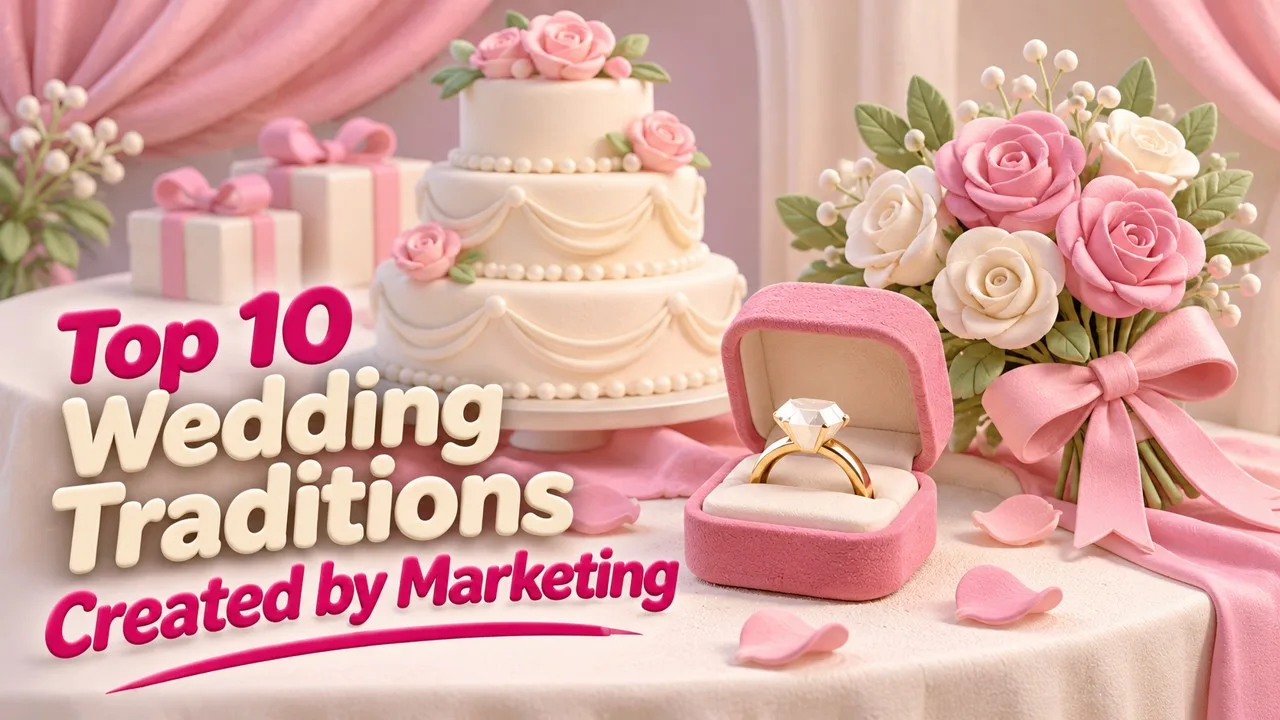
Diamond rings, salary rules, gift registries and anniversary lists: ten wedding traditions that were created or popularized by advertising and retailers. Weddings are often described as some of the most traditional events in life. Many couples follow customs that feel timeless, from diamond engagement rings to white dresses and carefully chosen gifts.
Yet a number of these customs are much younger than people assume. Some were created or greatly expanded by companies that stood to profit from them, working through advertising campaigns, retail promotions and magazines.
That does not mean these traditions are meaningless. Many couples find genuine value in them, and customs often take on real emotional significance regardless of how they began.
Still, understanding their origins can help people make choices that suit their own values and budgets. Knowing that a rule was invented by an advertising agency may make it easier to decide whether to follow it.
The examples below involve jewelers, department stores, magazines and the tourism industry. Some campaigns created entirely new expectations, while others took an existing custom and made it far more widespread.
The diamond industry plays a particularly large role. Over the twentieth century, it shaped expectations about engagement rings in the United States, Japan and elsewhere through some of the most successful advertising campaigns ever created.
Other traditions spread through the influence of royalty and the fashion press, which helped turn the choices of a few wealthy people into widely followed customs.
The ten traditions below are arranged roughly by theme. Where the details of a tradition's origin are uncertain or debated, that is noted.
The wedding industry today is very large. In many countries, couples spend substantial sums on rings, venues, clothing, photography, flowers and travel, and businesses in each of these areas have strong reasons to promote particular customs. Researchers who study consumer culture have often used weddings as an example of how commercial interests and personal meaning can become closely intertwined, so that it becomes difficult to separate what people want from what they have been encouraged to want.
Historians of advertising often point to the diamond industry's campaigns as textbook examples of how marketing can shape behavior over generations, changing what people regard as normal.
Key Facts
| # | Tradition | Promoter | Era |
|---|---|---|---|
| 1 | The diamond engagement ring | De Beers and its advertising agency | 1930s to 1940s |
| 2 | The salary guideline | Diamond industry advertising | 1930s to 1980s |
| 3 | The diamond engagement ring in Japan | De Beers campaign | Late 1960s onward |
| 4 | Men's wedding bands | Jewelers and the double-ring ceremony | 1940s and later |
| 5 | The eternity ring | Diamond industry promotion | Twentieth century |
| 6 | The bridal registry | A Chicago department store | 1924 |
| 7 | Lists of anniversary gifts | Etiquette writers and jewelers | 1920s to 1930s |
| 8 | Bridal magazines | Publishers and advertisers | 1930s onward |
| 9 | A royal fashion spread by the press | Queen Victoria and the fashion press | 1840 onward |
| 10 | Niagara Falls as a honeymoon spot | Railroads, hotels and Hollywood | Nineteenth and twentieth centuries |
1. A Slogan That Changed Engagements
Engagement rings have existed for centuries, but diamonds were not always expected. In the United States, sales of diamonds fell during the Great Depression, and in 1938 the diamond company De Beers hired an advertising agency to promote them [1].
Related: Top 10 Wedding Destinations in the United States
The campaign used films, celebrities and magazine features to link diamonds with romance and lasting love. In 1947, the copywriter Frances Gerety came up with the slogan A diamond is forever, which became one of the most famous advertising lines in history [1].
The slogan suggested that a diamond, like a marriage, should last forever and never be resold. Over the following decades, the diamond engagement ring became the standard expectation for many American couples, and the trade publication Advertising Age later named the line the slogan of the century.
2. How Much to Spend on a Ring
Many people have heard that an engagement ring should cost a certain number of months' salary. This rule did not come from ancient custom but from diamond advertising [2].
During the 1930s, advertisements suggested that a ring might cost about a month's salary. Later campaigns in the 1980s raised the suggested figure to two months, and some advertisements reportedly went further still [2].
Financial advisers often point out that the guideline has no real basis beyond marketing. Many couples now choose to spend whatever amount suits their circumstances, and some opt for alternative stones or vintage rings.
3. Diamonds Arrive in Japan
Before the late 1960s, diamond engagement rings were uncommon in Japan, where marriages followed different traditions. De Beers launched an advertising campaign there aimed at changing that [3].
The ads presented diamond rings as a symbol of modern Western values. They often showed attractive couples in Western settings, linking the rings with a new, prosperous lifestyle [3].
The campaign was remarkably successful. According to commonly cited figures, a large majority of Japanese brides were receiving diamond engagement rings by the early 1980s, making Japan one of the largest markets for diamonds in the world.
4. Rings for Grooms
For much of history, wedding rings were mainly worn by women in many Western countries. In the United States, relatively few men wore wedding bands before the twentieth century [4].
That changed in the 1940s and 1950s. Jewelers promoted double-ring ceremonies, in which both partners exchanged rings, and the idea gained popularity during the Second World War, when rings reminded servicemen of their wives at home [4].
Related: Made in Heaven: Unveiling the Lives of Delhi's Elite Wedding Planners
The promotion helped jewelers sell twice as many rings for each wedding. Today, men's wedding bands are common in many countries, and few people realize the custom was once unusual.
5. A Ring for Anniversaries
An eternity ring is a band set with a continuous line of gemstones, often diamonds. It is usually given to mark a milestone anniversary or the birth of a child [5].
Rings with continuous patterns have a long history, but the modern tradition of giving an eternity ring for an anniversary was heavily promoted by the diamond industry in the twentieth century. The campaigns encouraged married couples to buy more diamonds after the engagement [5].
The eternity ring became popular in Britain and other countries. It shows how marketing can create opportunities for gift giving beyond the wedding itself.
6. Lists of Wanted Gifts
The bridal registry, a list of gifts the couple would like to receive, is often credited to the Chicago department store Marshall Field's, which reportedly introduced the service in 1924 [6].
Couples selected items such as china, silverware and glassware, and guests could purchase them from the store. This helped guests avoid duplicate gifts and helped the store increase sales [6].
Over time, registries spread to other retailers and became a standard part of wedding planning. Today, couples often register online for everything from kitchen appliances to honeymoon experiences.
7. Anniversary Gift Themes
Many people know that the first wedding anniversary is associated with paper, the twenty-fifth with silver and the fiftieth with gold. Some of these associations are old, particularly silver and gold [7].
Detailed lists of gifts for every year became widely known in the twentieth century. The etiquette writer Emily Post published one, and a jewelers' trade group reportedly published an expanded list in 1937, which added more opportunities for buying jewelry [7].
Related: Top 10 Most Bizarre Phobias: Strange Fears That Exist
Different lists have since been published, and modern versions sometimes include items such as electrical appliances or technology. The variety suggests that the lists reflect commercial and cultural trends rather than fixed tradition.
8. Advice for the Bride
Magazines devoted to weddings emerged in the twentieth century. One of the best known, Brides, was founded in 1934, and it offered advice on everything from dresses to etiquette [8].
Bridal magazines depended heavily on advertising from wedding businesses. They helped create a sense of what a proper wedding should include, often encouraging larger and more elaborate celebrations [8].
Along with bridal shows and wedding fairs, these magazines helped turn weddings into a major industry. Today, wedding websites and social media play a similar role.
9. The White Wedding Dress
Before the nineteenth century, many brides wore their best dress, which could be any color. In 1840, Queen Victoria wore a white satin gown for her wedding to Prince Albert [9].
Images of the wedding were widely reproduced in prints and publications, and the white dress became fashionable among wealthy brides. Fashion magazines and dressmakers helped spread the style further [9].
White wedding dresses became the norm in many Western countries during the twentieth century. They are often described as a symbol of purity, but their popularity owed much to royal influence and fashion promotion.
10. The Honeymoon Destination
Niagara Falls has long been promoted as a honeymoon destination. It became popular with newlyweds in the nineteenth century, helped by improved railroads that made the trip easier [10].
Hotels and local businesses marketed the falls to honeymooners, and the area was sometimes called the honeymoon capital of the world. The 1953 film Niagara, starring Marilyn Monroe, added to its romantic image [10].
Related: Top 10 Oldest Buildings in the World
Popular stories claim that famous figures honeymooned there early in the nineteenth century, though some of these accounts are uncertain. Today, couples travel to destinations all over the world, but Niagara Falls remains a popular choice.
Conclusion
Many wedding traditions that feel timeless were created or popularized by companies seeking to sell products. Diamond engagement rings, salary guidelines, bridal registries and anniversary lists all owe a great deal to marketing.
This does not make them any less meaningful to couples who choose them. Traditions often gain significance through use, regardless of their origins.
Understanding where these customs came from can help couples make thoughtful choices. They can decide which traditions suit their values and budgets, and which they would rather skip.
The history of these customs also shows the power of advertising to shape culture. Well-crafted campaigns have changed behavior across entire countries.
For anyone planning a wedding, knowing the origins of these customs can be both interesting and freeing, making room for traditions that truly matter to them.
Some couples are now choosing to create their own traditions instead. They may skip the diamond, write their own vows, hold smaller ceremonies or ask guests to donate to a charity instead of buying gifts from a registry. Others happily embrace the familiar customs, enjoying the sense of continuity they offer. Both approaches are valid, and knowing the history behind each custom simply gives couples more freedom to decide what their own celebration should look like.
Wedding customs have always changed over time, shaped by religion, law, fashion and economics. The influence of modern marketing is simply the latest chapter in that long history, and future generations will no doubt adopt new customs of their own, some of which may also begin as clever ideas from businesses.
- ^ [1] Accounts of the diamond slogan. Wikipedia: A diamond is forever Wikipedia: Frances Gerety
- ^ [2] Accounts of engagement ring spending. Wikipedia: Engagement ring Wikipedia: De Beers
- ^ [3] Accounts of diamonds in Japan. Wikipedia: De Beers Wikipedia: Engagement ring
- ^ [4] Accounts of men's wedding bands. Wikipedia: Wedding ring Wikipedia: Engagement ring
- ^ [5] Accounts of the eternity ring. Wikipedia: Eternity ring Wikipedia: De Beers
- ^ [6] Accounts of the bridal registry. Wikipedia: Bridal registry Wikipedia: Department store
- ^ [7] Accounts of anniversary gifts. Wikipedia: Wedding anniversary Wikipedia: Emily Post
- ^ [8] Accounts of bridal magazines. Wikipedia: Brides Wikipedia: Wedding
- ^ [9] Accounts of the white wedding dress. Wikipedia: White wedding Wikipedia: Wedding dress of Queen Victoria
- ^ [10] Accounts of Niagara Falls honeymoons. Wikipedia: Honeymoon Wikipedia: Niagara (1953 film)



















Discussion
Log in with