





Top 10 Strange Things That Have Fallen From the Sky
 By Dhiraj Sharma · Published
Share Post
Loading…
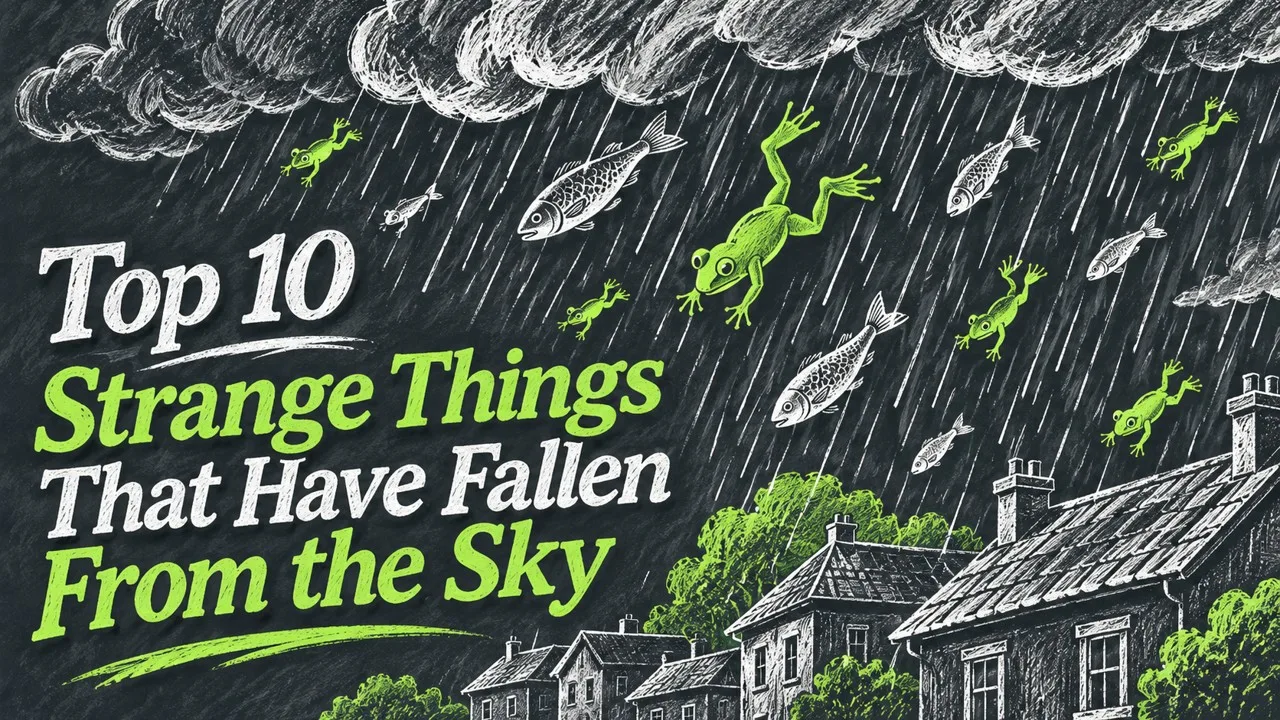
Fish, red rain, blue ice, spiders and a meteorite that hit a woman on her sofa: ten strange things that have really fallen from the sky. Most of the time, the only things that fall from the sky are rain, snow and the occasional leaf blown by the wind. But throughout history, people have reported far stranger showers, from fish and frogs to colored rain and chunks of ice falling from a clear blue sky.
For centuries, such events were seen as omens, miracles or signs of divine anger. Ancient writers recorded rains of blood and stones, and medieval chronicles described showers of animals that seemed impossible to explain.
Today, scientists have explanations for many of these events. Strong winds and storms can lift small animals and carry them long distances. Dust from deserts can color rain red. Aircraft, birds and even outer space can drop unexpected objects onto the ground below.
Some strange falls remain hard to explain fully, and new cases continue to be reported. In many instances, the explanation depends on careful study of the material that fell, which is not always collected or tested.
The ten phenomena below have all been documented, and most have been investigated by scientists. They range from natural weather events to the effects of human technology and rare encounters with rocks from space.
Together, they show that the sky can be a source of genuine surprises, and that even the strangest stories sometimes have a basis in fact.
Many of these events also demonstrate the value of collecting evidence. When people have saved samples of colored rain, strange jelly or fallen ice, scientists have often been able to solve mysteries that would otherwise have remained the stuff of legend.
Ancient authors were fascinated by such events. The Roman writer Pliny the Elder described rains of milk, blood, flesh and iron in his encyclopedia of natural history, and similar reports appear in Greek, Chinese and medieval European sources. Later, in the early twentieth century, the American writer Charles Fort collected hundreds of newspaper reports of strange falls, and his name is still attached to the study of unexplained phenomena. Many of the cases he gathered have since been explained, while others remain curious footnotes.
Key Facts
| # | Phenomenon | Where | Explanation |
|---|---|---|---|
| 1 | Rain of fish | Yoro, Honduras and elsewhere | Possibly waterspouts or fish emerging from flooded ground |
| 2 | Colored rain | Kerala, India, 2001 | Spores of a common alga |
| 3 | Dust-colored rain | Southern and western Europe | Dust from the Sahara Desert |
| 4 | Frozen aircraft waste | Near airports and flight paths | Leaks from aircraft toilet systems |
| 5 | Mysterious jelly | Britain and elsewhere | Possibly the remains of frogs or toads |
| 6 | Sylacauga meteorite | Alabama, United States, 1954 | A rock from space |
| 7 | Ballooning spiders | Goulburn, Australia and elsewhere | Spiders traveling on silk threads |
| 8 | Record hailstones | Vivian, South Dakota, 2010 | Strong updrafts in thunderstorms |
| 9 | Megacryometeors | Spain, 2000, and elsewhere | Not fully understood |
| 10 | Mass bird deaths | Beebe, Arkansas, 2010 to 2011 | Fireworks startled birds into the night |
1. Fish Rain
Reports of fish falling from the sky have come from many parts of the world. In the town of Yoro in Honduras, residents describe an annual event, known as the rain of fish, in which small fish are found on the ground after heavy storms [1].
One common explanation for rains of fish and frogs is that waterspouts or strong updrafts lift small animals from lakes or rivers and drop them elsewhere. In some cases, however, fish may simply emerge from flooded underground waterways during heavy rain [1].
The rain of fish in Yoro has become a local festival. Whatever its exact cause, it shows how unusual weather can create events that seem almost miraculous.
Related: Top 10 Strange Things That Have Fallen From the Sky
2. Red Rain
In 2001, red rain fell over parts of the Indian state of Kerala for several weeks. Some people feared that the color was blood, and the event attracted international attention [2].
Scientists studied samples and found that the color came from tiny cells. A widely accepted explanation is that the cells were spores of a type of green alga called Trentepohlia, which grows on trees and buildings in the region and may have been lifted into the air [2].
One researcher proposed that the cells came from space, but this idea has been widely rejected by other scientists. The red rain remains a famous example of a natural event that sparked wild speculation.
3. Blood Rain in Europe
In Europe, rain sometimes falls with a red, orange or brown tint, leaving dusty marks on cars and windows. In the past, such events were described as blood rain and seen as bad omens [3].
The cause is dust from the Sahara Desert, lifted by strong winds and carried thousands of kilometers north. When rain falls through the dusty air, it brings the particles down [3].
Saharan dust events have become well known in recent years, with dramatic orange skies over parts of Europe. The dust can affect air quality and even the color of snow in the Alps.
4. Blue Ice
Occasionally, chunks of blue ice have fallen from the sky, sometimes damaging homes and cars. The blue color comes from the disinfectant used in aircraft toilets [4].
The ice forms when waste leaks from an aircraft's lavatory system and freezes at high altitude. As the plane descends into warmer air, the ice may break off and fall to the ground [4].
Modern aircraft design has made such incidents rare, and airlines are required to maintain their systems carefully. But blue ice remains one of the more unpleasant things that can fall from the sky.
5. Star Jelly
For centuries, people in Britain and elsewhere have reported finding blobs of clear jelly on the ground, often after meteor showers. In folklore, the substance was called star jelly and thought to be the remains of falling stars [5].
Related: Top 10 Extremes and Records on Planet Earth
Investigations have suggested several possible explanations. One widely cited idea is that the jelly comes from the egg-bearing parts of frogs or toads, eaten by predators such as birds, which leave behind the material that swells with water [5].
Other suggestions include slime molds, algae or bacteria. Star jelly shows how natural explanations can lie behind stories once linked to the heavens.
6. A Meteorite on the Sofa
On November 30, 1954, a meteorite crashed through the roof of a house in Sylacauga, Alabama, bounced off a radio and struck a woman named Ann Hodges, who was resting on her sofa. She was left with a large bruise but otherwise recovered [6].
Hodges is often described as the first person known to have been struck and injured by a meteorite in a well-documented case. The meteorite, weighing several kilograms, is now in a museum in Alabama [6].
Thousands of meteorites fall to Earth each year, but most land in oceans or remote areas. The chance of being hit by one is extremely low, which makes the Sylacauga event remarkable.
7. Spider Rain
Many young spiders travel by a method called ballooning. They release threads of silk that catch the wind, and possibly electric fields in the air, carrying them long distances, sometimes hundreds of kilometers [7].
When large numbers of spiders balloon at once, they can create what looks like a shower of spiders and silk. In 2015, residents of Goulburn in Australia reported a fall of silk and spiders that covered parts of the area [7].
Such events, sometimes called angel hair, have been described for centuries. They show how small creatures use the sky as a highway.
Related: Ball Lightning: The Mysterious Spherical Phenomenon
8. Giant Hail
Hail forms when strong updrafts in thunderstorms carry raindrops high into freezing parts of the cloud, where they grow layer by layer before falling. The stronger the updraft, the larger the hail can become [8].
In July 2010, a hailstone that fell in Vivian, South Dakota, measured about twenty centimeters in diameter, setting a record in the United States for the largest hailstone by diameter and weight [8].
Large hail can damage cars, roofs and crops, and occasionally injure people and animals. It is one of the most costly weather hazards in some parts of the world.
9. Ice From a Clear Sky
In January 2000, large chunks of ice fell from clear skies in Spain over several days. Some weighed several kilograms. Scientists studied the ice and found that it did not come from aircraft or ordinary hailstorms [9].
These falls became known as megacryometeors. Researchers have suggested that they may form under unusual conditions in the upper atmosphere, perhaps linked to changes in temperature and humidity [9].
The exact cause is still debated, and similar events have been reported in other countries. Megacryometeors remain one of the more mysterious things to fall from the sky.
10. Falling Birds
On New Year's Eve 2010, thousands of red-winged blackbirds fell from the sky over the town of Beebe, Arkansas. Residents woke to find dead birds in yards and streets [10].
Investigations suggested that fireworks had startled the birds from their roosts. Flying in the dark, they collided with objects or with each other, suffering fatal injuries [10].
The event attracted international attention and sparked speculation about mysterious causes. Similar events have been reported elsewhere, often linked to storms, fireworks or other disturbances.
Related: Top 10 Unusual Local Phenomena Around the World
Conclusion
These strange falls show that the sky can be full of surprises. Fish, red rain, spiders and ice have all fallen to Earth, each with its own explanation.
Many of these events were once seen as omens or miracles. Today, scientists can usually explain them through weather, biology or human technology, though some remain partly mysterious.
The stories also show the importance of investigation. By studying samples and records, researchers have been able to separate fact from legend.
Next time you hear of something strange falling from the sky, it may be worth looking closer. There is often a fascinating explanation waiting to be found.
The sky above us is a busy place, carrying dust, animals, ice and the occasional visitor from space, and it still has the power to astonish.
Climate change may affect how often some of these events happen. Scientists are studying whether stronger storms could produce more large hail, and whether changing wind patterns could carry desert dust to new places more often. Better weather radar, satellites and smartphone cameras mean that unusual falls are now recorded in far more detail than in the past, giving researchers new data to work with and fewer mysteries to puzzle over.
So keep an eye on the sky, and perhaps an umbrella close at hand. You never quite know what the next shower might bring.
Nature, it seems, still enjoys keeping us guessing, and that is part of what makes these stories so memorable.
- ^ [1] Accounts of animal rains. Wikipedia: rain of animals Wikipedia: Lluvia de peces
- ^ [2] Accounts of red rain. Wikipedia: Red rain in Kerala Wikipedia: Trentepohlia
- ^ [3] Accounts of blood rain. Wikipedia: blood rain Wikipedia: Saharan dust
- ^ [4] Accounts of blue ice. Wikipedia: blue ice (aviation) Wikipedia: aircraft lavatory
- ^ [5] Accounts of star jelly. Wikipedia: star jelly Wikipedia: slime mold
- ^ [6] Accounts of the Sylacauga meteorite. Wikipedia: Sylacauga meteorite Wikipedia: meteorite
- ^ [7] Accounts of ballooning spiders. Wikipedia: ballooning (spider) Wikipedia: spider silk
- ^ [8] Accounts of hail. Wikipedia: hail Wikipedia: thunderstorm
- ^ [9] Accounts of megacryometeors. Wikipedia: megacryometeor Wikipedia: ice
- ^ [10] Accounts of the Beebe bird deaths. Wikipedia: Beebe, Arkansas Wikipedia: red-winged blackbird





















Discussion
Log in with