





 By
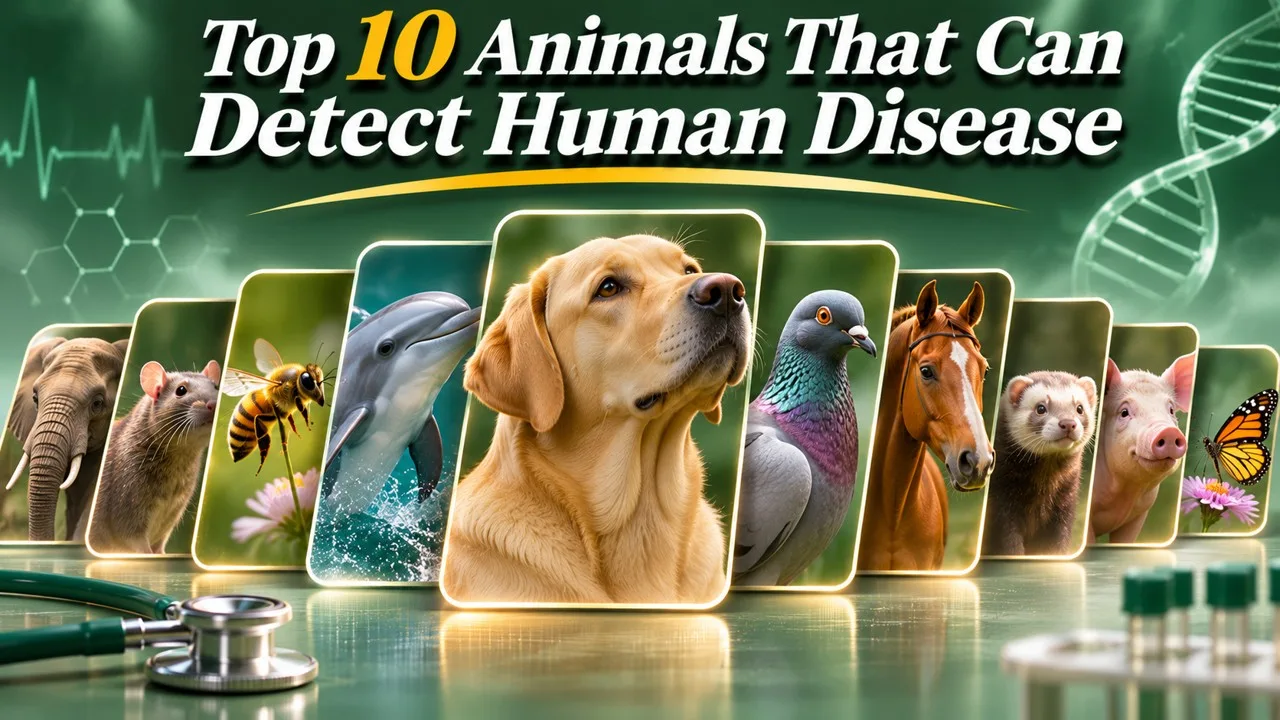
Trained dogs, rats and even ants have flagged disease-related odors in studies; that is research, not a reason to ask a house pet for a diagnosis. A number of animals, and some people, can notice a chemical or visual change that goes with an illness [1][6][10]. In formal work, that skill is tested, scored, and kept inside a protocol [1][6]. This article is not medical advice, and it is not a license to delay a clinic because a rat, a dog, or a family cat seemed interested in a person [2][6][10]. The ten entries below are documented studies or documented jobs, with the thinner claims labeled as such [9][10].
A trained nose can be a research instrument. It is not, in these paragraphs, a home device.
Key Facts
Disease detection by animals is usually a story about volatile chemicals, training, and lab or field trials. Results vary by species, by disease, and by the quality of the test.
Ten Cases at a Glance
| Rank | Detector | Careful version |
|---|---|---|
| 1 | Rats | African giant pouched rats have been trained to flag tuberculosis in sputum samples in formal programs |
| 2 | Bees | Bees can be trained to respond to specific odors, including some disease-related volatiles, in early research |
| 3 | Pigeons | Pigeons have distinguished some medical images of disease from normal samples in laboratory tasks; they are not clinicians |
| 4 | Ants | Some ants can be trained, quickly, to treat a cancer-related odor as a cue; the work is still experimental |
| 5 | Dogs | Trained dogs are the best-documented animal detectors, for several conditions, still as complements to ordinary testing |
| 6 | Fruit flies | Fruit flies have been used as odor sensors for some cancer-related chemical signatures in the lab |
| 7 | Worms | Nematodes such as C. elegans have been reported to move toward certain cancer-related odors; this is laboratory work |
| 8 | Locusts | Researchers have used locust olfaction as a biosensor in experimental setups, not as a farmyard test |
| 9 | Cats | Stories of cats noticing illness are common; controlled evidence is much weaker than for dogs |
| 10 | Humans | Some people, including clinicians and a few unusually sensitive smellers, can notice disease-related odors; that is not a substitute for a test |
1. A Rat, a Sample, and a Protocol
African giant pouched rats, trained in programs associated with APOPO and with public-health partners, have been used to screen sputum samples for tuberculosis, a second pass that can catch cases missed by a first look under a microscope [1]. The animals work in a controlled setting, for a food reward, on a line of samples, not as household pets wandering a clinic [1]. Land-mine work by the same tradition of training is a different story. The unexpected fact, for disease, is throughput and cost in places where laboratory capacity is tight. The ethical and scientific fact is that a flagged sample still needs a medical process around it. This article will not describe a training method that a reader could treat as a kit.
A rat can be a colleague in a very particular room. It is not a diagnosis in a cage.
2. A Short Memory for a Scent
Bees can learn to extend a proboscis, or otherwise respond, when a specific odor is paired with a reward, a fact that scientists have used to ask whether the insects can flag volatiles associated with some infections or cancers [2]. The work is real and mostly early: small samples, laboratory conditions, and a question of whether a hive-based sensor is ever practical [2]. The unexpected fact is speed. A bee can be trained to a new odor in a short time, which is why the idea keeps appearing in papers. The careful fact is that a promising response in a dish of air is not a screening program, and it is not a reason to stand in a garden and wait for a medical opinion.
A flower is the bee's usual workplace. A clinic is not, except as an experiment.
Related: Top 10 Most Intelligent Animals
3. A Bird that Can Sort a Picture
Pigeons, already famous for visual discrimination, have been trained in laboratory studies to distinguish some stained slides or medical images of diseased tissue from controls, at levels well above chance after enough practice [3]. The work, including a widely discussed study on histopathology images, is a comment on how much of a visual pattern can be learned without a medical degree [3]. It is not a proposal to replace a pathologist with a loft. The unexpected fact is that a bird's eye, in a narrow task, can follow a cue that a person would also, with training, follow. The careful fact is that medicine is more than a two-alternative picture test, and that this article is not advice about reading anyone's scans.
A pigeon can be a proof of concept for machine vision as much as for zoology. The concept belongs in a paper, not in a waiting room.
4. A Fast Trainee in a Petri Dish
Some ants, in recent experimental work, have been trained to associate a reward with the odor of samples related to cancer, and then to prefer that odor later, a protocol that can take only a few exposures [4]. The appeal is obvious: ants are cheap, easy to house, and chemically sophisticated. The limits are also obvious. The studies are still small, the step from a laboratory odor to a clinical test is long, and a nest is not a diagnostic service [4]. The unexpected fact is how little time it can take to attach a behavior to a smell in an insect that already lives by chemistry. The careful fact is "experimental."
An ant can tell two airs apart. A hospital needs more than that, and it already knows that it does.
5. The Best-Documented Nose
Dogs are the animal for which disease-detection claims have the longest, and usually the most careful, paper trail: trained animals have been studied on cancers, on malaria, on blood-sugar emergencies, on Parkinson's-related odor, and on other conditions, with results that vary by lab, by target, and by how honestly the trials were blinded [5]. A companion article in this project has already treated the Parkinson's odor story at more length. The point here is broader. A trained dog can be a serious research instrument and, in some tight settings, a useful alarm, without being a general diagnostician [5]. This is not medical advice, and it is not a recommendation to rely on a pet. The unexpected fact is chemical, as it is with rats: a disease can have a smell, and a dog can be taught to say so. The careful fact is the word "taught," and the further word "tested."
Related: Top 10 Facts About Cats
A good trial looks dull on purpose. That dullness is the difference between a study and a story about a remarkable animal.
6. A Fly as a Sensor Chip
Fruit flies, with their well-mapped olfactory system, have been used in laboratories as living detectors of volatile compounds associated with some cancers and other conditions, sometimes by watching behavior, sometimes by recording from the insect's own odor circuits [6]. The unexpected fact is technical. An animal that is already a workhorse of genetics can also be a nose for a chemist. The careful fact is the setting. These are engineered experiments, not a bowl of fruit in a kitchen that happens to double as a clinic [6]. No one should delay a test because a fly landed, or did not land, on a bench.
A model organism can moonlight as a sensor. The moonlight, here, is still inside a laboratory.
7. A Worm that Moves toward a Cue
The nematode Caenorhabditis elegans, another celebrity of the biology lab, has been reported to crawl toward certain odors from cancer cells or from urine samples of patients, a behavior that some groups have tried to turn into a formal assay [7]. The papers are interesting and still in the proving stage: reproducibility, specificity, and a realistic false-positive rate all matter, and they are not all settled [7]. The unexpected fact is that a millimetre-long worm, with a tiny nervous system, can still make a chemical choice that lines up, sometimes, with a disease label. The careful fact is that "sometimes" is doing a lot of work, and that this is not a home test.
A worm can be a living gradient-follower. A diagnosis is a different kind of statement, and it belongs to a clinician.
Related: Top 10 Animals That Can Live Without Food for Months
8. A Locust, Used as a Detector
Researchers have, in experimental work, tapped the locust's acute olfactory system, including recordings from its brain or antennae, to distinguish sets of volatile compounds, in some cases including cancer-related signatures [8]. The write-ups can sound like science fiction: an insect as a component in a biosensor. The reality is a laboratory rig, a set of odors, and a question about whether biology can outperform a cheap electronic nose in a narrow task [8]. This article will not describe a method for building such a rig, and it will not pretend that a locust in a field is doing medical work. The unexpected fact is only that a pest insect has a nose worth borrowing, in the most controlled sense of the word.
A biosensor can have once been an animal. It is still a device, and it is still experimental.
9. A Weaker File than the Dog's
Cats appear in many anecdotes: a cat that sat on a painful spot, a cat that stayed with a person who later received a diagnosis, a cat that seemed to know a seizure or a faint before it happened [9]. A few case reports and small observations exist. What does not yet exist, on anything like the scale of the dog literature, is a body of blinded, repeated trials that would let a cautious writer treat the cat as a documented detector [9]. The unexpected fact, such as it is, may be social. People live closely with cats and then read meaning into a change of habit, and sometimes they may be right. The careful fact is that "sometimes" and "may" are the strongest words this entry should carry.
A thin file is still a file. It should not be padded into a medical claim, and it should not be thrown out as if animals never notice a change in a person. It should stay thin until the trials are better.
Related: Top 10 Most Dangerous Wild Animals in Canada
10. The Oldest Detector in the Room
Humans have long noticed that some diseases have a smell, from the old clinical handbooks to modern work on volatile compounds, and a few people have unusually sharp noses that have, in documented cases, flagged a change later tied to a diagnosis [10]. Clinicians also detect disease in other ways that are easy to forget on a list of animals: pattern, sound, and the look of a person. None of that makes an untrained bystander a test, and none of it is a reason to skip a laboratory [10]. The unexpected fact is humility. Before the dog, the rat, and the ant, the first detector was a person in a room, sometimes right, sometimes wrong, and always in need of a second method. This article is not medical advice.
A human can be a sensitive instrument. The point of modern medicine is that the instrument is not asked to work alone.
Conclusion
The ten detectors above are not equals, and they should not be sold as a single miracle of the animal kingdom. Dogs and trained rats have the most practical paper behind them. Bees, ants, flies, worms, and locusts are, in this story, laboratory tools of decreasing closeness to a clinic. Pigeons can sort a picture in a narrow task. Cats have stories. Humans have always been in the room. What they share, when the work is honest, is a chemical or visual cue and a test that tries to see whether the cue is real. What they do not share is a right to become anyone's diagnosis.
If a study is promising, the next step is a better study, and then a clinician. It is not a pet, a hive, or a worm on a kitchen table.
- ^ [1] Program and research reports on African giant pouched rats trained to screen sputum for tuberculosis. Britannica: Tuberculosis
- ^ [2] Experimental work on conditioning bees to disease-related or other target odors. Britannica: Bee
- ^ [3] Laboratory studies of pigeons discriminating medical images of diseased and normal tissue. Britannica: Pigeon
- ^ [4] Experimental training of ants on cancer-related odor cues, treated as early research. Britannica: Ant
- ^ [5] Reviews of trained dogs in disease detection, including the limits of trial design, cited here as research, not as a home test. Britannica: Dog
- ^ [6] Laboratory use of fruit-fly olfaction as a sensor for disease-related volatiles. Britannica: Fruit fly
- ^ [7] Reports of C. elegans moving toward certain cancer-related odors, treated as unsettled assay work. Britannica: Nematode
- ^ [8] Experimental biosensor work that uses locust olfactory systems, described at a high level only. Britannica: Locust
- ^ [9] The limited, mostly anecdotal record of cats apparently noticing illness, contrasted with the stronger dog literature. Britannica: Cat
- ^ [10] Historical and modern observations of disease-related odors noticed by people, including clinicians, distinguished from formal diagnostic tests. Britannica: Diagnosis



















Discussion
Log in with