






 By
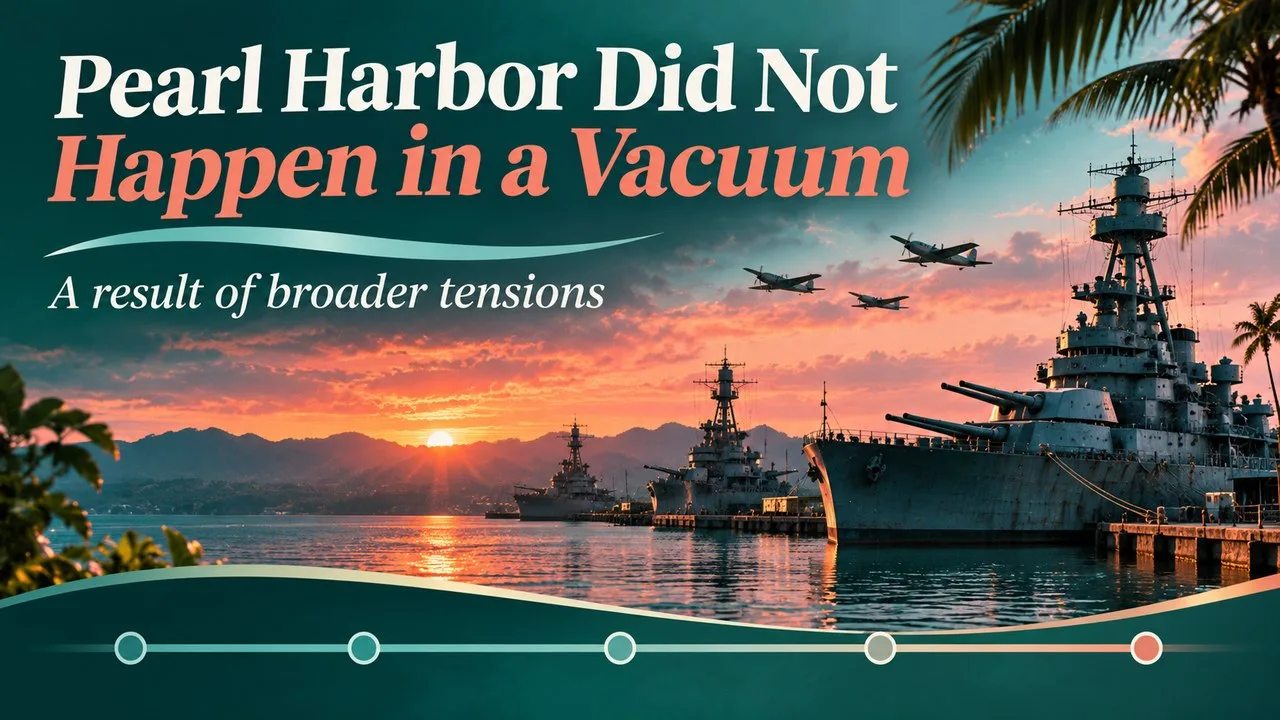
Pearl Harbor did not happen in a vacuum: Japan's 1941 attack followed a decade of war in China, a pact with Germany and an American oil embargo.[1][2]
This Finepedia guide, updated in November 2026, sets the attack of 7 December 1941 in its wider context: the long road from Manchuria to Hawaii, the diplomatic deadlock of 1941, the other targets struck that same day and the way the raid joined two regional wars into one. It is number 13 in Top 20 World War II Facts: Little-Known Details.
Key Facts
| Attribute | Detail |
|---|---|
| Date | 7 December 1941, Hawaii time |
| Attacker | Japanese carrier force under Vice Admiral Chuichi Nagumo |
| Planner | Admiral Isoroku Yamamoto |
| Background | War in China since 1937; Tripartite Pact of 1940; US oil embargo of 1941 |
| Other targets that day | The Philippines, Guam, Wake, Midway, Malaya, Singapore and Hong Kong |
| American dead | 2,403, including 68 civilians |
| Japanese losses | 29 aircraft and five midget submarines |
| Immediate result | US declaration of war on Japan on 8 December |
Sources: Naval History and Heritage Command, Office of the Historian and Wikipedia.[2][1][3]
The Long Road from Manchuria
The Naval History and Heritage Command (NHHC), the US Navy's official history office, traces the road to war back to the 1930s, when disputes over China pulled Japan and the United States apart.[2]
Manchuria and China
Japan seized Manchuria from China in September 1931.[2][4] On 7 July 1937, fighting between Chinese and Japanese troops at the Marco Polo Bridge outside Beijing turned into all-out war.[1][4] The US Holocaust Memorial Museum (USHMM) treats this as the opening of the Pacific war, four years before Pearl Harbor.[4]
American Ambivalence
At first, US officials were cautious. According to the Office of the Historian at the State Department, they opposed Japanese expansion in China but did not think American interests there were worth a war.[1] When Japanese aircraft sank the gunboat USS Panay near Nanjing in December 1937, killing three, Washington accepted an apology and compensation.[1][3] Even so, the Panay incident and the brutal capture of Nanjing turned American public sympathy firmly towards China.[1][3]
From Trade Partner to Target
The United States was then Japan's main supplier of oil, steel, iron and other materials its army needed.[1] That dependence became the key to the crisis.
Ending the Trade Treaty
In January 1940 the American commercial treaty with Japan lapsed. This let the Roosevelt administration restrict military supplies as leverage to make Japan halt its aggression in China, while it increased credits and later Lend-Lease aid to the Chinese government.[1]
The Pacific Fleet Moves to Hawaii
In 1940 Roosevelt moved the Pacific Fleet's main base from San Diego to Pearl Harbor and strengthened American forces in the Philippines, hoping to deter Japan.[3][2] The move put the fleet within reach of a Japanese strike.
Embargo
After Japan moved into French Indochina with the agreement of the Vichy regime, the United States froze Japanese assets and imposed a full embargo, including oil. Wikipedia dates the end of American oil exports to July 1941.[1][3] NHHC notes that Japan, poor in natural resources, saw the oil embargo as a threat to its survival.[2]
Related: Germany's Invasion of Poland Began the War in Europe
Linking Asia and Europe
Japan's diplomacy tied its war in China to the war in Europe.
The Tripartite Pact
On 27 September 1940 Japan joined Germany and Italy in the Tripartite Pact. The partners recognised each other's leadership of new orders in Europe and greater East Asia and promised mutual help against any power not yet in the war, a clause aimed at the United States.[5][4] The Office of the Historian says the treaty tied the European and Asian wars together and made China a likely partner in a worldwide struggle against fascism.[1]
Germany's Encouragement
Berlin pushed Tokyo towards a clash. The National WWII Museum describes a meeting on 28 November 1941 at which Foreign Minister Joachim von Ribbentrop told Japan's ambassador, Hiroshi Ōshima, that a showdown with the United States could not be avoided. A Japanese account intercepted by the Americans has Ribbentrop promising that Germany would join at once if Japan went to war.[6] Hitler hoped a Pacific war would keep the Americans busy far from Europe.[6]
Neutrality with the USSR
In April 1941 Japan signed a non-aggression agreement with the USSR.[6][1] The Office of the Historian notes that this signalled Japan would push south into Southeast Asia, where American interests were greater, rather than north.[1]
The Failed Negotiations of 1941
Talks between Washington and Tokyo continued through 1941 but made little progress.[1]
The central obstacle was China. American opinion strongly favoured the Chinese, so any deal had to involve a Japanese withdrawal, which Japan's military leaders would not accept.[1][3] Japan's final proposal of 20 November offered to leave southern Indochina in return for the lifting of sanctions, oil supplies and an end to aid to China. The American reply of 26 November, known as the Hull note, called for Japan to leave China and Indochina.[3]
Short of fuel under the embargo and convinced that Washington would not compromise, Japan's leaders decided to act quickly.[1][2] American leaders, by contrast, still hoped for a settlement and doubted Japan could strike US territory.[1]
Planning the Attack
Japan's plan was to seize the resource-rich lands of Southeast Asia, knowing this meant war with America. The US Pacific Fleet at Pearl Harbor stood in the way.[2][3]
Related: Germany Declared War on the United States
Admiral Isoroku Yamamoto, commander of Japan's Combined Fleet, designed a surprise blow to cripple the fleet at the start. NHHC lists its keys as careful preparation, surprise and aircraft carriers used on a scale never seen before. Pilots began training in spring 1941, and the naval staff approved the plan in October.[2][3]
The strike force, six large carriers with 24 escorts under Vice Admiral Chuichi Nagumo, sailed in secrecy from the Kuril Islands on 26 November 1941, the same day the Hull note was handed over in Washington.[2][3]
The Attack
The carriers launched the first wave of 181 aircraft at six in the morning, from a position about 200 miles north of Oahu.[2] A radar station at Opana detected the incoming planes at 7:00 a.m., but the report was dismissed as a flight of American bombers due that morning.[2]
The bombs began falling just before eight o'clock. Japanese aircraft struck the battleships at Pearl Harbor and the airfields around Oahu at the same moment, so that American planes could not take off. A second wave of 170 aircraft followed about half an hour after the first.[2][3] Wikipedia gives a total of 353 aircraft in the two waves, slightly more than the 351 implied by NHHC's figures.[3][2]
The Toll
The raid was over shortly before 10 a.m., having lasted under two hours.[2] Its cost was severe:
- 21 ships sunk or damaged, including all eight battleships present.[2][3]
- 188 aircraft destroyed and 159 damaged, by NHHC's count; Wikipedia says more than 180 destroyed.[2][3]
- 2,403 Americans killed, among them 68 civilians, and 1,178 wounded.[2][3]
- 1,177 men killed on USS Arizona alone, about half the total.[2][3]
Japanese losses were light: 29 aircraft, which NHHC puts at under a tenth of the attacking force, plus five midget submarines and, by Wikipedia's count, 130 men.[3][2]
Related: The War Ended on Different Dates in Europe and Asia
What Japan Missed
The raid was a tactical success but left important gaps.
Warnings Not Acted On
Before dawn a US destroyer, USS Ward, and a patrol plane attacked a submarine seen near the harbour entrance, and the radar sighting at Opana came almost an hour before the bombs fell. Neither report led to a general alert.[2][3]
Carriers and Fuel
The three American aircraft carriers based at Pearl Harbor were at sea. Japan also left the base's oil storage tanks and repair yards largely untouched, facilities that NHHC says played an important part in the later Allied victory.[2][3]
Ships Raised Again
Salvage crews eventually brought nearly every damaged vessel back into service. Only Arizona, Oklahoma and the old target ship Utah were never returned to service.[2][3]
One Attack Among Many
Pearl Harbor was only one part of a much wider offensive. Within roughly seven hours Japan also hit American positions in the Philippines, on Guam and on Wake and Midway, along with British-held Hong Kong, Malaya and Singapore.[3][7]
President Roosevelt listed these attacks in his address to Congress on 8 December. He also noted that Japan's ambassador had delivered a reply to the latest American note an hour after the bombing began, with no warning of war.[7] Congress declared war that afternoon with only one dissenting vote, cast by Jeannette Rankin in the House, and Roosevelt signed the declaration at 4 p.m.[7][3] Britain also declared war on Japan on 8 December. Tokyo's formal declaration against America and Britain was dated 8 December, Japanese time, but Wikipedia notes it was not handed over until a day later, so the bombs fell before any declaration had been delivered.[3]
Comparison: Before and After
| Feature | Before 7 December 1941 | After 7 December 1941 |
|---|---|---|
| US status | Neutral, but aiding Britain and China | At war with Japan, then Germany and Italy |
| War in Asia | Japan against China since 1937 | Part of a global war |
| War in Europe | Germany against Britain and the USSR | Joined by the United States |
| American opinion | Deeply divided | United behind the war |
Sources: Office of the Historian, NHHC and Wikipedia.[1][2][3]
Timeline
| Date | Event |
|---|---|
| September 1931 | Japan seizes Manchuria[2][4] |
| 7 July 1937 | Marco Polo Bridge clash begins full-scale war in China[1][4] |
| December 1937 | USS Panay sunk near Nanjing[1][3] |
| 27 September 1940 | Tripartite Pact signed[5][4] |
| April 1941 | Japan's neutrality pact with the USSR[6][1] |
| July 1941 | US oil exports to Japan end[3][1] |
| 26 November 1941 | Hull note delivered; Japanese fleet sails[3][2] |
| 7 December 1941 | Attack on Pearl Harbor[2][3] |
| 8 December 1941 | United States declares war on Japan[7][1] |
| 11 December 1941 | Germany and Italy join the war against America[3][6] |
Key Figures
- 4 years: length of the war in China before Pearl Harbor.[1][4]
- 6: Japanese aircraft carriers in the strike force.[2][3]
- About 200 miles: distance from Oahu when the first wave launched.[2]
- 2,403: Americans killed in the attack.[2][3]
- 29: Japanese aircraft lost.[2][3]
Common Misconceptions
One misconception is that the attack came out of nowhere. In fact Japan and the United States had been in open economic conflict for more than a year, and Roosevelt himself said the distance from Japan showed the raid had been planned days or weeks earlier.[1][7]
Another is that Pearl Harbor by itself put America into the European war. Germany was not obliged by the Tripartite Pact to join a war Japan had started, but it chose to declare war on 11 December, which turned two regional conflicts into one world war.[6][3]
Related: Midway Turned the Tide in the Pacific
Frequently Asked Questions
Why did Japan attack Pearl Harbor?
Japan wanted to seize the resources of Southeast Asia after the US oil embargo, and it aimed to disable the Pacific Fleet so it could not interfere.[2][3]
Was Pearl Harbor the only target on 7 December?
No. Japan also struck the Philippines, Guam, Wake, Midway, Malaya, Singapore and Hong Kong within about seven hours.[3][7]
How many Americans were killed in the attack?
NHHC and Wikipedia both give 2,403 American dead, including 68 civilians.[2][3]
Why were the US carriers not hit?
They were away from the harbour. Enterprise and Lexington were delivering aircraft to Wake and Midway, and Saratoga was on the West Coast.[2][3]
How did Pearl Harbor change the war?
It made the United States a combatant against Japan, and Germany's declaration of war four days later linked the wars in Asia and Europe.[1][6]
Conclusion
Pearl Harbor was the climax of a long confrontation, not a bolt from the blue. A decade of Japanese expansion in China, the alliance with Germany and Italy, and American sanctions culminating in the oil embargo all pushed the two countries towards war.
NHHC concludes that the shock of the attack united a divided nation behind victory, and within days America was fighting in both Asia and Europe.[2][1]
See all 20 in Top 20 World War II Facts: Little-Known Details
See also
- Top 20 World War II Facts: Little-Known Details
- Top 10 Overlooked Events of World War II
- Top 10 Real Intelligence Operations That Sound Like Fiction
- ^ [1] "Japan, China, the United States and the Road to Pearl Harbor, 1937–41". Office of the Historian, US Department of State. Office of the Historian
- ^ [2] "Overview of The Pearl Harbor Attack, 7 December 1941". Naval History and Heritage Command. NHHC
- ^ [3] "Attack on Pearl Harbor". Wikipedia. Wikipedia
- ^ [4] "Axis Powers in World War II". Holocaust Encyclopedia, US Holocaust Memorial Museum. USHMM
- ^ [5] "Three-Power Pact Between Germany, Italy, and Japan, Signed at Berlin, September 27, 1940". The Avalon Project, Yale Law School. Avalon Project
- ^ [6] "Hitler's Declaration of War on the United States" (Sean Scanlon). The National WWII Museum. National WWII Museum
- ^ [7] "Joint Address to Congress Leading to a Declaration of War Against Japan (1941)". National Archives. National Archives

























Discussion
Log in with