





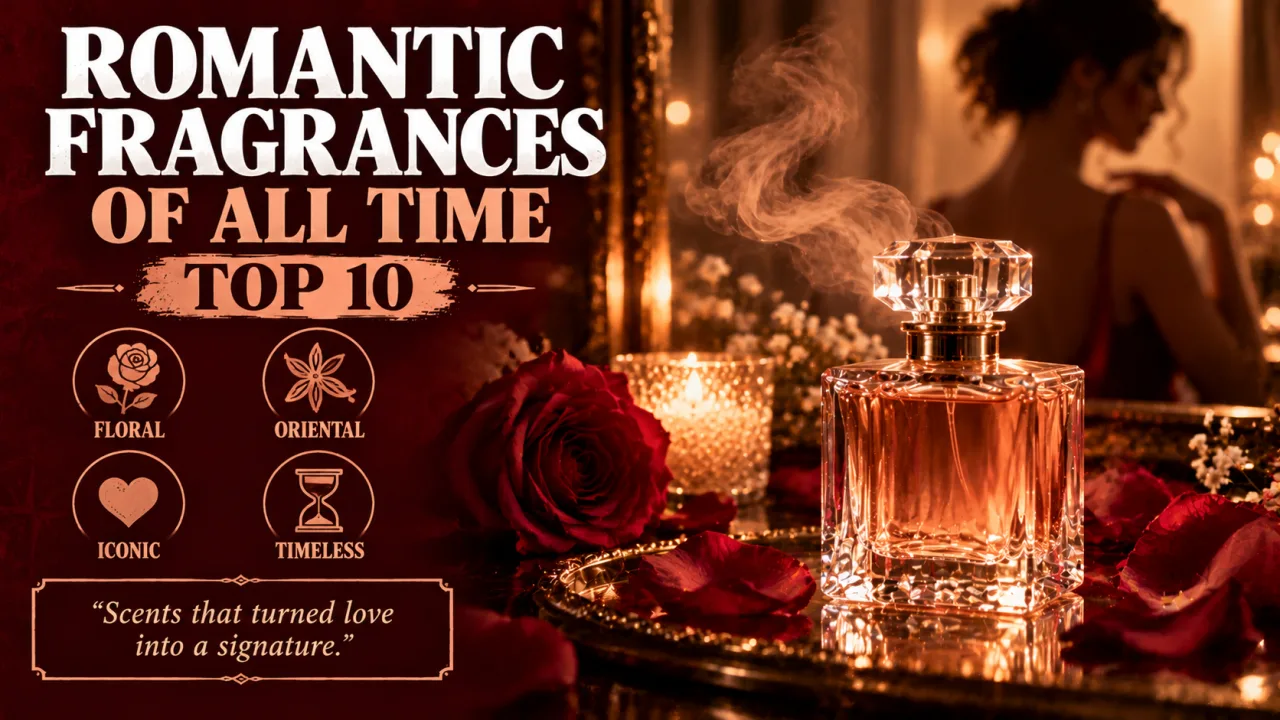
The ten most romantic fragrances of all time, from Shalimar and Joy to Fracas and Angel, are perfumes whose love stories and sensual notes still define desire.
Some perfumes simply smell pleasant. A smaller group has become shorthand for romance itself, worn on wedding days, gifted on anniversaries and remembered decades later as the scent of a particular person. This guide picks ten of those landmark fragrances, explains where each one came from, what it actually smells like and why it earned a place in the history of seduction.
Our selection is based on four things: how long the fragrance has stayed in production or in cultural memory, the story behind its creation, the regard of perfume critics and historians, and how closely it has been linked with love and intimacy in advertising, film and everyday life. The list is arranged in order of launch, from the 1920s to the 2000s, so you can follow how the idea of a romantic scent changed over a century. Notes are given as the houses and critics have described them; modern bottles are often reformulated, so today's versions may differ from the originals.
At a Glance
| No. | Fragrance | House | Perfumer | Year | Scent family |
|---|---|---|---|---|---|
| 1 | Chanel No. 5 | Chanel | Ernest Beaux | 1921 | Floral aldehyde |
| 2 | Shalimar | Guerlain | Jacques Guerlain | 1925 | Oriental (amber) |
| 3 | Joy | Jean Patou | Henri Alméras | 1929 | Floral |
| 4 | Miss Dior | Christian Dior | Paul Vacher and Jean Carles | 1947 | Floral chypre |
| 5 | Fracas | Robert Piguet | Germaine Cellier | 1948 | White floral (tuberose) |
| 6 | L'Air du Temps | Nina Ricci | Francis Fabron | 1948 | Spicy floral |
| 7 | Opium | Yves Saint Laurent | Jean Amic and Jean-Louis Sieuzac | 1977 | Oriental spicy |
| 8 | Angel | Thierry Mugler | Olivier Cresp and Yves de Chiris | 1992 | Gourmand |
| 9 | Flowerbomb | Viktor and Rolf | Olivier Polge and team | 2004 | Floral gourmand |
| 10 | Black Orchid | Tom Ford | Estée Lauder Companies team | 2006 | Dark woody floral |
What Makes a Fragrance Feel Romantic
Romance in perfume is partly chemistry and partly storytelling. Perfumers build a scent in layers, often described with a musical metaphor of top, heart and base notes. The top notes are the light, quick-evaporating materials you notice first, such as citrus or lavender. The heart arrives a few minutes later and usually carries the main flowers. The base notes, such as musk, amber, vanilla and woods, are the last to appear and the longest to linger on skin and clothing.
The Notes Most Linked With Romance
Certain materials turn up again and again in perfumes sold as romantic or sensual:
- Rose and jasmine, the two classic flowers of French perfumery, grown for centuries around Grasse in southern France.
- Tuberose and orange blossom, creamy white flowers with a rich, almost skin-like warmth.
- Vanilla and tonka bean, sweet materials that feel comforting and edible.
- Musk, amber and sandalwood, soft base notes that sit close to the skin.
- Spices such as clove and cinnamon, which add heat and drama.
Why Stories Matter
A perfume is also sold through an image. Many of the fragrances on this list became romantic icons because of the legend attached to them: an emperor's love for his wife, a film star's answer to a reporter, a designer's tribute to his sister. Those stories have kept people buying these bottles long after the original advertising campaigns ended.
1. Chanel No. 5
Chanel No. 5 is probably the most famous perfume in the world, and few bottles are as closely tied to glamour and desire. It was the first fragrance launched by the French designer Gabrielle "Coco" Chanel, and it has been in production for more than a century.
| Attribute | Details |
|---|---|
| House | Chanel |
| Perfumer | Ernest Beaux |
| Launched | 5 May 1921, Paris |
| Scent family | Floral aldehyde |
| Famous wearer | Marilyn Monroe |
Origins
In 1920 Chanel asked the French-Russian perfumer Ernest Beaux to create a modern scent for the liberated women of the decade. Beaux had worked for A. Rallet and Company, perfumer to the Russian imperial court, and he built on a rose and jasmine base he had developed there. He presented Chanel with a set of numbered sample vials, and she chose the fifth. Chanel had long treated five as a lucky number, so the sample kept its name, and the scent was launched in her rue Cambon boutique on the fifth day of the fifth month of 1921.
Key Features
- A bold dose of aldehydes, synthetic materials that give the opening a sparkling, clean lift.
- A heart of jasmine and rose, with jasmine and tuberose oils traditionally sourced from fields near Grasse.
- Iris root and musks that soften the dry-down.
- A plain, square-shouldered bottle that deliberately avoided the fussy crystal designs of the era.
Significance
No. 5 proved that a fragrance could be abstract rather than a copy of a single flower, which changed the direction of modern perfumery. Commercially, it became the anchor of Parfums Chanel, the company set up in 1924 with the Wertheimer brothers to make and distribute it worldwide. During the Second World War, bottles bought by American soldiers became souvenirs carried home to wives and sweethearts, cementing the scent's romantic reputation.
In Popular Culture
Marilyn Monroe made the perfume a symbol of intimacy when Life magazine reported in 1952 that she wore nothing to bed but Chanel No. 5. Andy Warhol later turned the bottle into pop art. The faces of the fragrance have included Catherine Deneuve, Nicole Kidman, in a lavish 2004 short film directed by Baz Luhrmann, Audrey Tautou and Brad Pitt, the first man to front the scent.
Interesting Facts
- The bottle's octagonal stopper first appeared in 1924, when the bottle itself was strengthened for shipping.
- A small pocket bottle was introduced in 1934 to reach a wider group of buyers.
- The parfum, eau de toilette and eau de parfum are separate compositions created in different decades.
- Coco Chanel herself appeared as the face of the scent in a 1937 advertisement.
2. Shalimar
Shalimar is the perfume most directly inspired by a love story. Guerlain's creator drew on the tale of the Mughal emperor Shah Jahan and his wife Mumtaz Mahal, for whom the Taj Mahal was built, and the result became one of the defining warm, sensual perfumes of the 20th century.
| Attribute | Details |
|---|---|
| House | Guerlain |
| Perfumer | Jacques Guerlain |
| Created | 1921, relaunched 1925 |
| Scent family | Oriental, now often called amber |
| Signature notes | Bergamot, iris, vanilla, tonka bean, incense |
Origins
Jacques Guerlain composed the fragrance in 1921. A dispute with another company over the name forced Guerlain to sell it for a time as "No. 90". Once the matter was settled, Shalimar was presented again in 1925 at the International Exhibition of Modern Decorative and Industrial Arts in Paris. Its name refers to the Shalimar Gardens of Lahore, associated with the same imperial family. A well-known story says the formula took shape when Guerlain poured ethylvanillin, a powerful vanilla-like molecule, into a bottle of Jicky, a house fragrance from 1889.
Key Features
- A bright opening of bergamot and lemon.
- A heart of iris, jasmine and rose.
- A rich base of vanilla, tonka bean, incense, opopanax, sandalwood, leather and musk.
- A bottle designed by Raymond Guerlain, made by Baccarat, with a fan-shaped blue stopper inspired by a piece of family silverware.
Significance
Shalimar became the model for the oriental family, the warm, resinous and vanilla-heavy style that still dominates evening perfumes today. In the 1920s it was popular with flappers and gained a slightly rebellious image. Nearly a century later it remained one of Guerlain's best sellers, with roughly 108 bottles reported sold every hour in 2017.
In Popular Culture
The photographer Helmut Newton shot a Shalimar campaign in 1997. In 2013 Guerlain released a cinematic advert, "The Legend of Shalimar", starring Natalia Vodianova, directed by Bruno Aveillan and set to music by Hans Zimmer.
Interesting Facts
- The original 1925 formula is preserved at the Osmothèque, the perfume archive in Versailles.
- The bottle won an award at the 1925 decorative arts exhibition.
- A lighter version, Shalimar Light, appeared in 2004 and was replaced by Eau de Shalimar in 2008.
3. Joy
Joy by Jean Patou was marketed as a pure luxury at the worst possible moment, and it worked. Built from enormous quantities of jasmine and rose, it became a symbol of extravagant, old-fashioned romance and was once voted the scent of the century.
| Attribute | Details |
|---|---|
| House | Jean Patou |
| Perfumer | Henri Alméras |
| Created | 1929 |
| Scent family | Floral |
| Award | FiFi "Scent of the Century", 2000 |
Origins
The Paris couturier Jean Patou commissioned Joy after the Wall Street crash of 1929 hit the fortunes of his wealthy American clients. Rather than create something cheap, he and the perfumer Henri Alméras went in the opposite direction, producing a costly, concentrated floral. Alméras had trained in Grasse and had served alongside Patou during the First World War, which helped forge their working relationship.
Key Features
- A heart built almost entirely on jasmine and rose; about 10,000 jasmine flowers and 28 dozen roses were said to go into 30 ml of the parfum.
- Supporting flowers including ylang-ylang, champak and tuberose.
- A blend designed to smell like the idea of a flower rather than any single bloom.
- A simple, classical bottle designed by the architect Louis Süe.
Significance
Joy showed that luxury itself could be a selling point, even in a depression. It became the most famous Patou fragrance and a reference point for the grand floral style. Critics such as Luca Turin have praised the way it achieves an abstract, idealised flower.
In Popular Culture
At the Fragrance Foundation FiFi Awards in 2000, the public voted Joy the "Scent of the Century", ahead of its long-time rival Chanel No. 5.
Interesting Facts
- The original Joy is no longer produced; a separate fragrance named Joy was launched by Dior in 2018 after LVMH acquired the Patou house.
- Patou launched Enjoy, a younger take on the classic, in 2002.
- The original 1930 formula is kept at the Osmothèque.
4. Miss Dior
Miss Dior carries one of the most touching stories in perfumery. Christian Dior named it after his younger sister Catherine, a French Resistance fighter who survived wartime deportation, and launched it in the same year as his famous New Look collection.
| Attribute | Details |
|---|---|
| House | Christian Dior |
| Perfumers | Paul Vacher and Jean Carles |
| Launched | 1947 |
| Scent family | Floral chypre |
| Named for | Catherine Dior |
Origins
Dior opened his fashion house in 1947, and he wanted a perfume to accompany the full-skirted silhouettes of the New Look. Paul Vacher and Jean Carles created a green, leathery floral chypre, a style built on contrasts between fresh citrus and deep mossy woods. The name was a tribute to Catherine Dior, known in the family as Miss Dior.
Key Features
- Top notes of mandarin, gardenia and bergamot.
- A heart of jasmine, narcissus, neroli and rose.
- A base of patchouli, oak moss and sandalwood, with leather and galbanum for edge.
- An original glass bottle etched with a houndstooth pattern.
Significance
Miss Dior linked a fashion house's identity to its fragrance from the very start, a model nearly every designer label has since followed. The name has been reused over the years: the fruity Miss Dior Chérie arrived in 2005, and in 2011 the original was reworked and renamed Miss Dior Original while the Chérie version took the simple Miss Dior name.
In Popular Culture
The fragrance and its many versions were celebrated in a 2013 exhibition at the Grand Palais in Paris. Its sweet, flower-filled modern adverts have kept the name associated with youthful romance.
Interesting Facts
- Miss Dior Chérie famously featured strawberry and caramelised popcorn notes when it launched.
- François Demachy, Dior's in-house perfumer from 2006, oversaw the later reworkings.
- The houndstooth motif echoed a fabric pattern used in Dior's fashion.
5. Fracas
Fracas is the tuberose perfume against which all others are measured. Bold, creamy and impossible to ignore, it has been in production for more than 75 years and remains a favourite of people who want their perfume to make an entrance.
| Attribute | Details |
|---|---|
| House | Robert Piguet |
| Perfumer | Germaine Cellier |
| Launched | 1948 |
| Scent family | White floral |
| Key flower | Tuberose |
Origins
Germaine Cellier was one of the very few women working as a professional perfumer in the 1940s. Working for the designer Robert Piguet, she had already made the daring leather scent Bandit. For Fracas she turned to tuberose, a waxy white Mexican flower distilled for perfume since the 17th century. She dedicated the result to the actress Edwige Feuillère.
Key Features
- A large dose of Indian tuberose absolute at its centre.
- Tunisian orange blossom, French jasmine and Italian iris root to make the flower feel lifelike.
- Violet leaf for a green, fresh contrast.
- Strong sillage, the trail of scent a wearer leaves in a room.
Significance
Fracas defined the tuberose genre. Frédéric Malle, founder of a respected niche perfume line, once said that anyone making a tuberose fragrance is trying to copy Fracas. Madonna's scent Truth or Dare was based on it, partly because her mother had worn it. Modern versions have been revised over time, with perfumer Aurélien Guichard responsible for the formula from 2008.
In Popular Culture
The critic Luca Turin gave Fracas five stars in Perfumes: The A-Z Guide, and Chandler Burr of The New York Times also awarded it five stars. The musician Courtney Love is among its well-known fans.
Interesting Facts
- Tuberose is unrelated to the rose despite its name.
- Cellier also created Vent Vert for Balmain, considered the first "green" perfume.
- Fracas means "uproar" or "crash" in French.
6. L'Air du Temps
L'Air du Temps is a gentler kind of romance. Released by Nina Ricci in the hopeful years after the Second World War, it is a soft, spicy floral sold in a bottle crowned with doves, a symbol of love and peace.
| Attribute | Details |
|---|---|
| House | Nina Ricci |
| Perfumer | Francis Fabron |
| Launched | 1948 |
| Scent family | Spicy floral |
| Bottle | Lalique crystal |
Origins
Robert Ricci, the son of the designer Nina Ricci, wanted to expand the family house into perfumery. He worked with the perfumer Francis Fabron to create the house's breakthrough fragrance. The name translates as "the spirit of the times", fitting a scent launched as Europe looked toward peace.
Key Features
- A soft spicy floral, often described with carnation at its heart.
- One of the first perfumes to use a large amount of benzyl salicylate, a material that gives a smooth, floral, slightly powdery glow.
- A gentle, airy character rather than a heavy evening style.
- An original crystal bottle by Lalique.
Significance
L'Air du Temps became one of the best-selling perfumes of its era and established Nina Ricci as a fragrance house. Its doves stopper made it one of the most recognisable bottles in the world and a popular gift for brides and new couples.
In Popular Culture
In the 1991 film The Silence of the Lambs, Hannibal Lecter identifies L'Air du Temps as a scent that Clarice Starling sometimes wears, a small detail that gave the classic a fresh moment of fame.
Interesting Facts
- Robert Ricci lived from 1905 to 1988 and ran the business side of the house.
- The fragrance is still sold today, more than 75 years after its launch.
- Benzyl salicylate later became common across many floral perfumes.
7. Opium
Opium is romance at its most dramatic. Yves Saint Laurent's spicy oriental caused a scandal with its name in 1977, yet the controversy only made it more desirable, and it remains a byword for heady evening glamour.
| Attribute | Details |
|---|---|
| House | Yves Saint Laurent |
| Perfumers | Jean Amic and Jean-Louis Sieuzac |
| Launched | 1977 |
| Scent family | Oriental spicy |
| Bottle designer | Pierre Dinand |
Origins
Saint Laurent wanted a perfume that captured his fascination with an imagined East. The perfumers Jean Amic and Jean-Louis Sieuzac created a dense blend of spice, flowers and resins. The red container, designed by Pierre Dinand, was based on the inro, a small lacquered Japanese case once worn hanging from a kimono sash to carry perfume, herbs or medicine.
Key Features
- Top notes of mandarin, plum, clove, coriander, pepper and bay leaf.
- A floral heart of jasmine, rose and lily of the valley with carnation, cinnamon, peach and orris.
- A deep base of sandalwood, cedar, myrrh, opopanax, labdanum, benzoin, amber, musk, patchouli and vetiver.
- Heavy, long-lasting projection designed for evening wear.
Significance
The name drew complaints, including from Chinese American groups who objected to its link with a drug that had devastated lives in China. The press coverage pushed sales upward, and Opium became a best seller that defined the opulent perfume style of the late 1970s and 1980s.
In Popular Culture
The 1978 American launch was held aboard the historic sailing ship Peking in New York, with the writer Truman Capote among the guests. In 2000 a sensual print campaign featuring the model Sophie Dahl drew more than 700 complaints to the British Advertising Standards Authority and was withdrawn from billboards in the United Kingdom.
Interesting Facts
- A bronze Buddha statue decorated with orchids was displayed at the launch party, a choice later criticised as culturally insensitive.
- Opium is among the most cited examples of advertising controversy boosting a product.
- The scent has been reformulated and reissued several times since 1977.
8. Angel
Angel changed what a romantic perfume could smell like. Thierry Mugler's star-shaped bottle introduced the gourmand style, perfumes that smell partly of sweets and desserts, and it became one of the best-selling fragrances of the modern era.
| Attribute | Details |
|---|---|
| House | Thierry Mugler |
| Perfumers | Olivier Cresp and Yves de Chiris |
| Launched | 1992 |
| Scent family | Gourmand |
| Award | FiFi Award Hall of Fame, 2007 |
Origins
In the early 1990s most prestige perfumes were floral or oriental. Mugler, a designer known for theatrical fashion, backed something unusual: a blend of patchouli with sugary notes inspired by fairground treats. The perfumers Olivier Cresp and Yves de Chiris built the formula, and it is credited as the first modern gourmand.
Key Features
- Patchouli, an earthy, woody note, as the backbone.
- Praline and vanilla for a dessert-like sweetness.
- Red berries for a bright, fruity edge.
- A blue, irregular star-shaped bottle that became instantly recognisable.
Significance
Angel opened the door for a whole generation of sweet, edible-smelling scents, from Miss Dior Chérie to La Vie est Belle. As of 2011 it was ranked the fifth best-selling perfume of all time in the United States, and it once outsold Chanel No. 5 in France. Together with its sister scent Alien, it has been reported to generate around $280 million in annual sales.
In Popular Culture
The faces of Angel have included Jerry Hall, Naomi Watts, Eva Mendes, Toni Garrn and Georgia May Jagger. In 2023 the actress Hunter Schafer became the new face of the line.
Interesting Facts
- Angel stayed in production even after Mugler's women's fashion line closed.
- Its refillable bottles encouraged customers to return to the same scent.
- It is one of the most polarising perfumes ever made: people tend to love it or dislike it.
9. Flowerbomb
Flowerbomb is a modern answer to the classic romantic floral. The Dutch design duo Viktor and Rolf launched it as a sweet "explosion" of flowers in a grenade-shaped bottle, and it quickly became a gift-counter favourite.
| Attribute | Details |
|---|---|
| House | Viktor and Rolf |
| Perfumers | Team including Olivier Polge and Dominique Ropion |
| Launched | 2004 |
| Scent family | Floral gourmand |
| Bottle | Faceted, grenade-shaped flacon |
Origins
Viktor Horsting and Rolf Snoeren made their name in conceptual fashion before moving into fragrance. Their first women's perfume was created at the fragrance house IFF, where Olivier Polge, later head perfumer at Chanel, worked on it alongside colleagues including Dominique Ropion. The idea was simple: a bouquet so lush it seemed to burst open.
Key Features
- A floral heart commonly described as jasmine, orchid, freesia and rose.
- A sweet, warm base with patchouli and musk.
- A playful bottle shaped like a cut crystal grenade, turning the "bomb" name into an object.
- A style that bridges the classic floral and the newer gourmand family.
Significance
Flowerbomb showed how a designer house could build a lasting signature scent in the 21st century. Its success led to a long line of versions and to the brand's men's fragrance Spicebomb in 2012, which Polge also helped create.
In Popular Culture
The perfume's name and bottle have made it one of the most recognisable modern gifts for Valentine's Day and anniversaries, and its pink packaging is widely copied.
Interesting Facts
- Viktor and Rolf later added Bonbon in 2014, a scent inspired by caramel.
- Olivier Polge also co-created Lancôme's La Vie est Belle in 2012.
- Polge took over as Chanel's head perfumer in 2015, succeeding his father, Jacques Polge.
10. Black Orchid
Black Orchid is the dark, mysterious end of the romantic spectrum. The first fragrance from Tom Ford Beauty, it was launched in 2006 as a deliberately luxurious, sensual scent built around an almost black flower.
| Attribute | Details |
|---|---|
| House | Tom Ford Beauty |
| Producer | Estée Lauder Companies |
| Launched | November 2006 |
| Scent family | Dark woody floral |
| Signature notes | Black truffle, bergamot, vanilla, lotus wood |
Origins
Tom Ford had developed a rare black orchid as a house flower while creative director at Yves Saint Laurent. After starting his own label, he partnered with Estée Lauder Companies, and the perfume's name was made public in February 2006. A grower was asked to produce the darkest orchid possible, and that idea became the heart of the fragrance.
Key Features
- An unusual combination of black truffle and bergamot in the opening.
- A floral heart inspired by a deep, dark orchid.
- A warm base with vanilla and lotus wood.
- A black, fluted glass bottle with an engraved gold label, recalling classic black perfume bottles of the 1920s and 1930s.
Significance
Black Orchid launched Tom Ford as a serious fragrance name and helped popularise the idea of unisex, dark, luxurious scents. It was backed by a reported $20 million global advertising campaign and debuted at Saks Fifth Avenue in New York, with Julia Restoin Roitfeld as its ambassador.
In Popular Culture
The bottle was photographed by Irving Penn, and British Vogue ran a five-page gatefold for the launch in December 2006. Burberry later sold the eau de parfum in limited-edition black crystal Lalique bottles.
Interesting Facts
- Ford has said he holds the patent for the orchid named after him, which he described as a deep, dark chocolate colour.
- The launch party was held at Top of the Rock in New York, with curtains sprayed with the perfume.
- It was first sold in a small number of upscale stores before a wider rollout.
Comparison Table: Choosing Your Romantic Scent
| Fragrance | Mood | Best for | Intensity |
|---|---|---|---|
| Chanel No. 5 | Timeless, polished | Formal dinners, weddings | Medium to strong |
| Shalimar | Warm, sensual | Winter evenings | Strong |
| Joy | Lavish, floral | Anniversaries | Medium |
| Miss Dior | Fresh, elegant | Daytime dates | Light to medium |
| Fracas | Bold, creamy | Night out | Very strong |
| L'Air du Temps | Tender, gentle | Spring and weddings | Light |
| Opium | Dramatic, spicy | Evening events | Very strong |
| Angel | Sweet, playful | Cold weather | Strong |
| Flowerbomb | Pretty, sweet | Gifts, Valentine's Day | Medium |
| Black Orchid | Dark, mysterious | Late-night occasions | Strong |
How to Choose and Wear a Romantic Fragrance
The right romantic perfume depends on the wearer, the season and the setting. A heavy oriental that feels perfect on a winter evening can be overwhelming in a warm office. Try any fragrance on skin rather than on a paper strip, and wait at least half an hour before deciding, because the base notes that carry the lasting impression take time to appear.
Simple Tips
- Apply to pulse points such as the wrists and the base of the neck, where body warmth helps the scent develop.
- Use fewer sprays of powerful scents like Fracas, Opium and Angel.
- Choose lighter florals such as L'Air du Temps or Miss Dior for daytime.
- Keep bottles away from heat and sunlight to protect the formula.
- Remember that versions with the same name can differ by concentration and year.
Gifting a Perfume
If you are buying a fragrance as a romantic gift, notice what the person already wears. Someone who loves fresh, clean scents may not enjoy a dense oriental, while a fan of sweet notes could be delighted by a gourmand. A small travel size or a discovery set is a safe way to test a new direction.
Why These Fragrances Still Matter
These ten perfumes span more than 80 years, yet several of them are still sold today. They show how the language of romance in scent shifted from abstract florals and resinous orientals to sweet gourmands and dark modern woods. Archives such as the Osmothèque in Versailles, founded in 1990 and home to more than 3,000 perfumes, keep original formulas so that future generations can smell the classics as they first were.
They also prove that perfume is a form of memory. A single breath of a familiar scent can bring back a first date, a wedding or a parent, which is why these bottles continue to be handed down, gifted and rediscovered.
Frequently Asked Questions
What is the most romantic perfume of all time?
There is no official ranking, but Chanel No. 5 is the most frequently named. Its launch in 1921, its link with Marilyn Monroe and a century of glamorous advertising have made it a symbol of seduction. Shalimar is a strong rival because it was directly inspired by the love story of Shah Jahan and Mumtaz Mahal.
Which perfume notes are considered the most romantic?
Rose, jasmine, tuberose and orange blossom are the flowers most associated with romance, while vanilla, musk, amber and sandalwood give warmth and closeness on the skin. Spices like clove and cinnamon add passion. Many classic romantic perfumes combine a rich floral heart with a soft, lingering base of these materials.
Is Joy by Jean Patou still available?
The original Joy created by Henri Alméras in 1929 is no longer produced. After LVMH bought the Patou house in 2018, Dior launched a different perfume using the Joy name. Collectors can still find vintage bottles, and the original formula is preserved in the archives of the Osmothèque in Versailles.
What does Fracas smell like?
Fracas is a rich, creamy white floral built around Indian tuberose, supported by orange blossom, jasmine, iris and violet leaf. It is intense and has a long trail. Critics consider it the benchmark tuberose perfume, and many later tuberose fragrances, including Madonna's Truth or Dare, were inspired by it.
Why was Opium controversial?
The name of the Yves Saint Laurent perfume drew criticism for appearing to glamorise drug use and for ignoring the harm opium caused in Chinese history. A Chinese American group asked for a name change and an apology. In 2000, a sensual Sophie Dahl advert drew hundreds of complaints in Britain and was withdrawn.
What is a gourmand fragrance?
A gourmand fragrance uses notes that smell edible, such as vanilla, caramel, praline, chocolate or red fruit. Thierry Mugler's Angel, launched in 1992, is credited as the first modern gourmand. The style has since spread to many popular romantic perfumes, including Flowerbomb and Lancôme's La Vie est Belle.
Do vintage and modern versions smell the same?
Often they do not. Many classic perfumes have been reformulated because of changing ingredient rules, costs or supply. Different concentrations, such as eau de toilette and parfum, may also be separate compositions. If you love a classic scent, it is worth comparing a recent bottle with older stock before buying.
Conclusion
From the sparkling aldehydes of Chanel No. 5 to the dark truffle and orchid of Black Orchid, the most romantic fragrances of the past century share one quality: they tell a story the wearer wants to be part of. Some were born from legends of emperors and sisters, others from bold perfumers who broke the rules of their time. Whether you prefer a gentle floral or a dramatic oriental, these ten classics remain the best place to start.
For more lists about love and beauty, read our guides to the most fragrant flowers for your garden and the most romantic ways to propose.
- Chanel No. 5, Wikipedia
- Shalimar (perfume), Wikipedia
- Joy (perfume), Wikipedia
- Henri Alméras, Wikipedia
- Miss Dior, Wikipedia
- Fracas (perfume), Wikipedia
- Germaine Cellier, Wikipedia
- L'Air du Temps (perfume), Wikipedia
- Opium (perfume), Wikipedia
- Angel (perfume), Wikipedia
- Viktor and Rolf, Wikipedia
- Olivier Polge, Wikipedia
- Tom Ford (brand), Wikipedia
- Perfume, Wikipedia
- Osmothèque, Wikipedia
- The New York Times, Chandler Burr review of Fracas
- Luca Turin and Tania Sanchez, Perfumes: The A-Z Guide
- 10mosttoday, "10 Most Romantic Fragrances You Can't Resist" (topic reference)















Log in with