









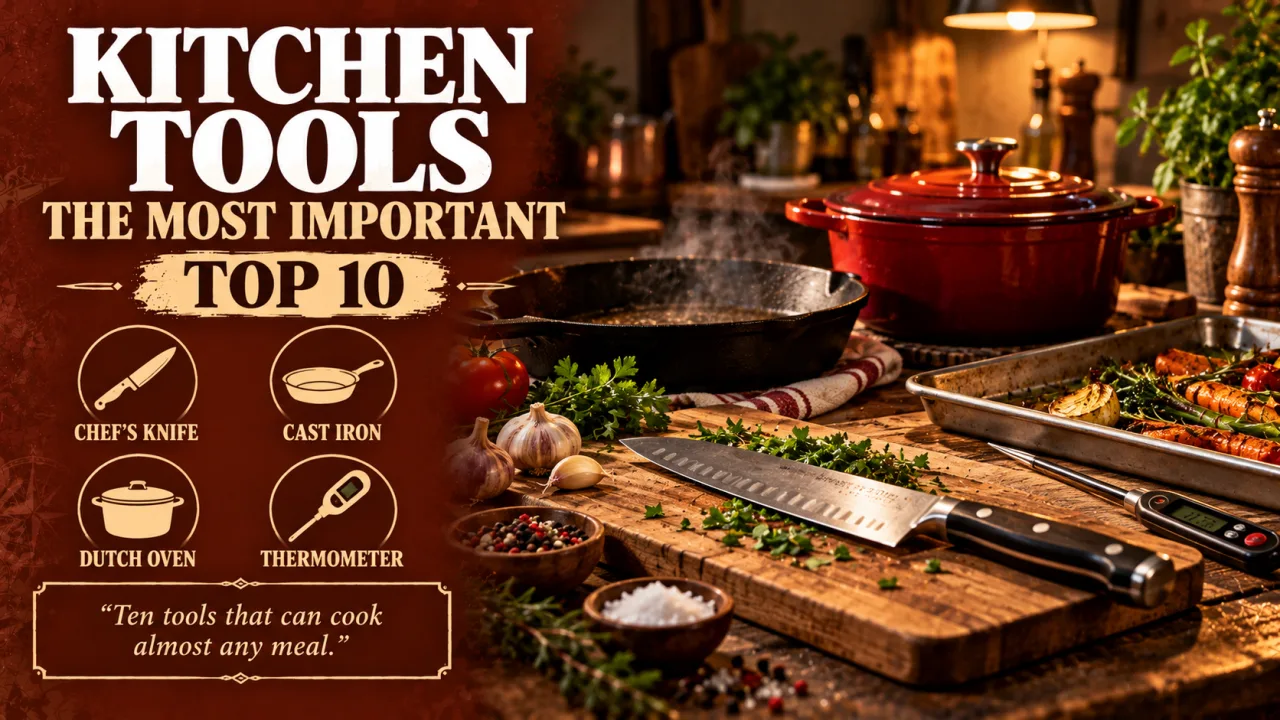
The most important kitchen tools are ten workhorses, from a sharp chef's knife to an instant-read thermometer, that let a home cook make almost any meal.
Walk into any cookware shop and you will find thousands of gadgets, each promising to make one job a little easier. Most of them end up in a drawer. Professional cooks and food-safety agencies tend to agree on something much simpler: a handful of well-chosen, durable pieces does nearly all the real work, and the rest is optional. This guide, current as of October 2026, picks ten of those essentials and explains what each one is, where it came from, what to look for when buying it, how to use it well and how to keep it safe and clean.
The list draws on guidance from the United States Department of Agriculture (USDA), the Food and Drug Administration (FDA) and university food-safety research. It avoids brand recommendations and prices, focusing instead on materials, sizes and habits that will still matter in ten years.
How We Chose These Tools
Every tool on this list had to pass four tests. Together they separate a genuine essential from a nice-to-have.
- Versatility: the tool must be useful across many recipes and cuisines, not just one dish.
- Frequency: a typical home cook should reach for it several times a week.
- Safety: it either prevents injury or illness directly, or makes safe technique easier.
- Longevity: a good example should last years, ideally decades, with basic care.
The order runs roughly from preparation to cooking to finishing, following the path food takes through a kitchen. It is not a strict ranking of importance, because a kitchen missing any one of these pieces will feel the gap quickly. A few strong contenders that just missed the cut appear in the Honorable Mentions section further down.
At a Glance
| No. | Tool | Main job | Common materials | Key figure |
|---|---|---|---|---|
| 1 | Chef's knife | Chopping, slicing, mincing | Stainless, carbon or laminated steel | Typical blade about 20 cm (8 in) |
| 2 | Cutting board | Safe, knife-friendly work surface | Hardwood, bamboo, polyethylene | Sanitize with 1 tbsp bleach per US gallon |
| 3 | Skillet | Searing, frying, sautéing | Cast iron, clad stainless, carbon steel | Usually 20 to 30 cm (8 to 12 in) across |
| 4 | Dutch oven | Braising, stewing, baking bread | Bare or enameled cast iron | Casting patent granted in 1707 |
| 5 | Instant-read thermometer | Checking doneness and safety | Digital thermocouple or thermistor | Poultry safe at 165°F (74°C) |
| 6 | Sheet pan | Roasting, baking, prep tray | Aluminum, aluminized steel | US half sheet 18 × 13 in |
| 7 | Measuring cups and spoons | Accurate recipes and baking | Stainless steel, glass, plastic | US legal cup 240 ml |
| 8 | Mixing bowls | Mixing, marinating, holding prep | Stainless steel, glass, ceramic | Borosilicate kitchen glass sold from 1915 |
| 9 | Tongs | Turning and lifting hot food | Stainless steel, silicone tips | Tongs depicted in Egypt around 1450 BCE |
| 10 | Colander and fine-mesh strainer | Draining, rinsing, sifting | Stainless steel, enamel, plastic | Name from Latin colum, sieve |
1. Chef's Knife
If you could buy only one tool, most cooks would choose a good chef's knife. Also called a cook's knife, it is a medium to large general-purpose blade designed to handle almost every cutting task, from dicing onions and mincing garlic to slicing meat and breaking down a whole chicken. It is not the best knife for any single job, but it is good enough at nearly all of them, and that is precisely its value.
Why It Matters
Preparation is where most cooking time goes, and nearly all of it involves cutting. A comfortable, balanced, sharp knife makes that work faster, and evenly cut pieces cook evenly.
The chef's knife originally developed for slicing and disjointing large cuts of beef and mutton. Over time it became the primary all-round knife for most Western cooks. In Japan a parallel story unfolded: in the 1940s the santoku, whose name is usually translated as "three virtues", was created to combine the jobs of separate fish, meat and vegetable knives into one general-purpose blade.
What to Look For
Blade length is the first decision. A typical European chef's knife has a blade of about 20 centimetres (8 inches) and a width near 4 centimetres, although models run from about 15 to 36 centimetres (6 to 14 inches). For most home cooks the 20-centimetre size offers the best mix of reach and control. A santoku, with a blade usually between 13 and 20 centimetres, is a popular alternative for people who prefer a shorter, flatter edge.
Blades are either forged or stamped. Forged blades are hammered from a heated blank and often run full-tang, meaning the metal extends through the handle. Stamped blades are cut from sheet steel and heat-treated. Good knives are made both ways today, so comfort in the hand matters more than the method.
The steel itself shapes how the knife behaves:
- Carbon steel, roughly 1% carbon, takes a very keen edge and is easy to sharpen, but it rusts and stains if left wet and develops a dark patina over time.
- Stainless steel contains at least 10.5% chromium, which resists corrosion. It needs less care, though cheaper grades do not hold an edge as long.
- Laminated blades sandwich a hard cutting core between tougher outer layers to combine sharpness with resilience.
- Ceramic blades hold an edge for a long time but can chip or break if dropped and need special tools to resharpen.
How to Use and Care for It
Hold the knife with a pinch grip, thumb and forefinger on the blade just ahead of the handle, and curl the fingertips of your guiding hand under so the knuckles, not the nails, face the blade. Let the knife rock or glide through the food rather than forcing it straight down.
Two maintenance tasks are often confused. Honing on a steel rod realigns an edge that has rolled over in use and is done often. Sharpening on a stone or sharpener actually removes metal to create a fresh edge and is needed far less frequently. Western kitchen knives are usually sharpened to an edge angle of about 20 to 22 degrees per side, while traditional East Asian knives, made of harder steel, are commonly taken to about 15 to 18 degrees.
Wash and dry the knife by hand soon after use, especially carbon steel. Store it in a block, on a magnetic strip or in a blade guard rather than loose in a drawer, where the edge gets damaged and fingers get cut.
Key Figures
- Typical European blade: about 20 cm (8 in) long, 4 cm wide
- Range of available lengths: about 15 to 36 cm (6 to 14 in)
- Stainless steel: at least 10.5% chromium
- Western edge angle: about 20 to 22 degrees per side
- Western knife hardness: generally 52 to 58 on the Rockwell C scale
- Santoku created: 1940s, Japan
2. Cutting Board
A cutting board protects your countertop, protects your knife edge and, used correctly, protects your family from foodborne illness. People have chopped food on flat stones and wooden slabs for thousands of years, but the modern debate about which material is safest is surprisingly recent and surprisingly interesting.
Why It Matters
Glass, marble, stone and steel boards look smart but blunt or chip knife edges quickly. A good board is firm yet slightly forgiving, easy to clean and large enough to work on comfortably.
The board is also the main crossroads for germs in a kitchen. Raw meat juices can carry bacteria such as Salmonella and E. coli, and if that same surface is then used for salad or bread, which are not cooked again, those bacteria go straight onto the plate. The FDA and USDA both advise using one board for fresh produce and bread and a separate one for raw meat, poultry and seafood.
Wood or Plastic?
For decades plastic was assumed to be the more hygienic choice. Research led by Dean Cliver at the University of California, Davis, challenged that idea. In a study published in 1994 in the Journal of Food Protection, his team contaminated small blocks cut from new and used boards, nine hardwoods and several plastics plus hard rubber, with bacteria including E. coli O157:H7, Listeria and Salmonella. Bacteria were readily recovered from plastic and could multiply overnight, while recoveries from wood were generally lower. Even when very large numbers were applied, counts recovered from wood after 12 hours had dropped by at least 98%. The authors concluded their results did not support the common claim that plastic is more sanitary than wood.
The same research found a practical catch: knife-scarred plastic boards became very hard to clean by hand. Other studies have reached mixed conclusions, so the official USDA position is balanced. Consumers may choose either wood or a nonporous surface such as plastic for raw meat and poultry, as long as the board is kept clean and replaced when worn.
What to Look For
- Hardwoods with a tight grain and small pores, such as maple, cherry, walnut and birch, resist deep scoring and absorb less liquid. Large-pored woods such as red oak hold dirt and make poor boards.
- Bamboo is harder and less porous than most hardwoods, absorbs little moisture and resists knife scars, according to the USDA.
- Polyethylene (HDPE) boards are light and dishwasher friendly, and colour-coded sets make separating raw meat from produce easy.
- Size matters: a board too small for the job encourages food to spill onto the counter. Pick one that comfortably fits a whole chicken or a large cabbage.
- A damp cloth or non-slip mat underneath stops the board sliding, a simple step that prevents many cuts.
Care and Safety
The USDA recommends washing every board with hot, soapy water after each use, rinsing, and air drying or patting dry with clean paper towels. Nonporous acrylic, plastic or glass boards and solid wood boards can go in a dishwasher, but laminated wooden boards may crack and split. Both wood and plastic boards can be sanitized with 1 tablespoon of unscented liquid chlorine bleach per gallon of water: flood the surface, let it stand for several minutes, then rinse and dry.
Wooden boards benefit from a periodic rub with food-grade mineral oil, which slows water absorption and cracking. Avoid ordinary cooking oils for this purpose, since they can turn rancid. Whatever the material, the USDA advice is clear: once a board is excessively worn or develops hard-to-clean grooves, throw it away.
Key Figures
- Sanitizing solution: 1 tbsp unscented liquid bleach per US gallon of water
- Cliver study: 9 hardwoods tested against 4 plastics plus hard rubber
- Bacterial reduction on wood after 12 hours: at least 98%, often above 99.9%
- Recommended minimum: 2 boards, one for raw animal foods and one for ready-to-eat foods
3. Skillet
The skillet, also called a frying pan or frypan, is the pan most cooks use every single day. It is a flat-bottomed pan, typically 20 to 30 centimetres (8 to 12 inches) across, with low sides that flare outward and a long handle. That shape lets moisture escape quickly, which is exactly what you want for browning meat, frying eggs, toasting spices or making a quick pan sauce.
A Short History
Copper frying pans were already in use in ancient Mesopotamia. The Greeks knew the frying pan as the tágēnon and the Romans as the patella or sartago. Before kitchen stoves spread in the mid-19th century, many households cooked over an open hearth in a three-legged cast-iron pan called a spider, which could stand in the coals. Flat-bottomed cast-iron skillets appeared in the late 19th century once stoves made legs unnecessary.
The 20th century brought new options. In 1954 Marc Grégoire patented in France a way to bond PTFE, a slick fluoropolymer, to aluminium, launching the non-stick pan. Clad pans, which bond a conductive aluminium or copper core between layers of stainless steel, became common as well.
Choosing a Material
Each material behaves differently on the stove, so many cooks eventually own two skillets: one for high-heat searing and one non-stick pan for eggs and delicate fish.
- Cast iron heats slowly and unevenly but holds heat extremely well, which makes it superb for searing steaks and baking cornbread. It is heavy and must be seasoned.
- Clad stainless steel heats evenly, does not react with acidic foods and can go in the oven. Food sticks if the pan is not hot enough, but the browned bits that stick are the base of good pan sauces.
- Carbon steel is lighter than cast iron, heats faster and builds up a slick seasoning over time, which is why it is common in professional kitchens.
- Non-stick coated pans release food easily and need little fat, but the coating is softer than metal and is damaged by metal utensils and very high heat.
Seasoning and Care
Seasoning is a thin layer of fat that has been heated until it polymerizes into a hard, protective coating. It stops bare cast iron and carbon steel from rusting and creates a naturally slick surface. To season, coat the clean, dry pan with a very thin film of oil and heat it to around or just above the oil's smoke point; repeated cooking builds the layer further.
Several myths surround cast-iron care. Tests by America's Test Kitchen found that small amounts of dish soap do not damage seasoning, and that cooking acidic foods for short periods has no noticeable effect, although simmering a strongly acidic tomato sauce for more than 30 minutes produced a metallic taste. A conventional dishwasher, however, will strip the seasoning. Dry the pan promptly after washing, ideally over low heat, and wipe in a few drops of oil before storing.
Bare cast iron also adds iron to food. In one study, the iron content of spaghetti sauce cooked in cast iron rose from 0.61 to 5.77 milligrams per 100 grams. That can help people low in iron, but people with haemochromatosis, a condition of iron overload, are advised to avoid bare cast iron.
Key Figures
- Typical diameter: 20 to 30 cm (8 to 12 in)
- Non-stick bonding process patented: 1954, France
- Iron in spaghetti sauce cooked in cast iron: 0.61 to 5.77 mg per 100 g
- Old seasoning burns off at roughly 500°C, as in an oven self-cleaning cycle
4. Dutch Oven
A Dutch oven is a heavy, thick-walled pot with a tight-fitting lid. It is usually cast iron, either bare and seasoned or coated in enamel, although aluminium and ceramic versions exist. In many countries the same vessel is simply called a casserole, from a French word meaning cooking pot. Few pieces of cookware are as versatile: it browns, braises, stews, simmers stock, deep-fries and even bakes crusty bread.
A Short History
The name traces back to a piece of early industrial espionage. In the 17th century the Dutch were the cheapest producers of brass cookware. Around 1704 the English ironmaster Abraham Darby visited the Netherlands and studied how Dutch founders cast brass pots in sand moulds instead of loam and clay. Back in Bristol he adapted the method to cheaper cast iron, and in 1707 he took out a patent on casting iron pots in sand. The term "Dutch oven" has been in use since at least 1710.
In colonial America the pot evolved again, gaining legs to stand over coals and a flanged lid that could hold hot embers on top, turning it into a portable oven. Dutch ovens were valuable enough to be named in wills: Mary Ball Washington, mother of George Washington, divided her "iron kitchen furniture" in a will dated 20 May 1788. The Lewis and Clark expedition carried one while exploring the American Northwest between 1804 and 1806, and today the Dutch oven is the official state cooking pot of Texas, Utah and Arkansas.
What to Look For
- Enameled cast iron, sometimes called a French oven, needs no seasoning, does not react with acidic sauces and is easy to clean. It costs more and the enamel can chip.
- Bare cast iron is cheaper and tougher, and the camp-style version with legs and a rimmed lid works over open coals.
- Choose a size that fits your household and your oven. A pot that is too large wastes heat and is hard to lift; one that is too small crowds meat and stops it browning.
- Look for sturdy loop handles and a snug lid.
How to Use It
The thick walls spread heat gently and hold it for a long time, which is ideal for long, slow cooking. A typical braise starts on the stovetop, browning meat in batches, then adds liquid, covers and finishes in a low oven for hours. The same heat retention makes the pot good for frying, because the oil temperature drops less when food goes in.
Care and Safety
Enamel can chip if the pot is dropped, overheated or shocked by cold water while still hot, so let it cool before washing. Bare cast iron needs the same seasoning care as a skillet. The lid has a safety bonus: the National Fire Protection Association (NFPA) notes that a small grease fire in a pan can be smothered by sliding a lid over it and turning off the burner, then leaving the pan covered until completely cool.
Key Figures
- Darby's sand-casting patent: 1707
- Term "Dutch oven" recorded: since at least 1710
- Carried by Lewis and Clark: 1804 to 1806
- Official state cooking pot of: Texas, Utah, Arkansas
5. Instant-Read Thermometer
The instant-read thermometer is the least glamorous tool on this list and possibly the most important for health. It takes the guesswork out of cooking meat, poultry, fish and egg dishes, and it is the only reliable way to know food has reached a temperature that kills harmful bacteria.
Why It Matters
Foodborne illness is common. US federal agencies estimate that it causes roughly 48 million illnesses, 128,000 hospitalizations and 3,000 deaths in the United States each year. Many cooks still judge doneness by colour or texture, but the USDA is blunt: colour is not a reliable indicator of safety. In one USDA study, 21% of participants relied on visual cues such as colour and grill marks to decide whether hamburgers were cooked. Ground beef can turn brown on the outside before it is safe inside.
A thermometer also prevents the opposite problem. Without one, many people overcook chicken and pork into dryness simply to be sure. Knowing the real temperature lets you stop at the right moment.
Types of Food Thermometer
| Type | Approximate reading time | Notes |
|---|---|---|
| Thermocouple (digital) | 2 to 5 seconds | Fastest; thin probe reads thin foods; can be calibrated |
| Thermistor (digital) | About 10 seconds | Probe about 1/8 inch thick; some models can be calibrated |
| Instant-read dial (bimetal) | 15 to 20 seconds | Averages along 2 to 3 inches of stem; poor for thin foods |
| Oven-safe dial (bimetal) | 1 to 2 minutes | Stays in roasts while cooking |
| Wireless or smart probe | Continuous | Stays in food and reports to a phone or base unit |
For most home cooks a digital thermocouple or thermistor model offers the best balance of speed and accuracy. Bimetal "pop-up" timers, used in turkeys since 1965, are reliable to within 1 to 2°F, but the USDA still recommends confirming with a conventional thermometer.
How to Use It
Insert the probe into the thickest part of the food, away from bone, fat or gristle. For thin items such as burgers, chops or chicken breasts, slide it in from the side so the sensing area sits in the centre. Check whole poultry in three places: the innermost thigh, the innermost wing and the thickest part of the breast. Large roasts should be checked in several spots.
Most food thermometers are accurate to within 2 to 4°F. To calibrate, stir ice and water in a glass, immerse the stem at least 2 inches without touching the sides, and wait 30 seconds. It should read 32°F (0°C). Boiling water should read 212°F (100°C) at sea level, but water boils at lower temperatures at altitude.
Safe Minimum Internal Temperatures
| Food | Safe minimum internal temperature |
|---|---|
| Beef, pork, veal, lamb steaks, chops and roasts | 145°F (63°C) plus a 3-minute rest |
| Raw ham, fresh or smoked | 145°F (63°C) plus a 3-minute rest |
| Fish (fin fish) | 145°F (63°C) or until flesh is opaque and flakes |
| Ground meat and sausage (non-poultry) | 160°F (71°C) |
| Egg dishes | 160°F (71°C) |
| All poultry, including ground poultry and stuffing | 165°F (74°C) |
| Leftovers and casseroles | 165°F (74°C) |
| Precooked ham from USDA-inspected plants (reheat) | 140°F (60°C) |
Source: USDA and FoodSafety.gov charts, as of October 2026.
Care and Safety
Wash the probe in hot, soapy water after each use, but do not immerse the body of most digital units. Store the probe in its sheath, since the tip is sharp. Unless the maker says otherwise, never leave an instant-read thermometer in food in the oven; plastic faces can melt.
Key Figures
- US foodborne illness each year: about 48 million cases, 128,000 hospitalizations, 3,000 deaths
- Typical accuracy: within 2 to 4°F
- Thermocouple reading time: 2 to 5 seconds
- Poultry: 165°F (74°C); ground meat: 160°F (71°C); whole cuts: 145°F (63°C)
- Ice-water calibration point: 32°F (0°C)
6. Sheet Pan
The rimmed sheet pan, also called a baking sheet or baking tray, is a flat rectangular metal pan with a low lip all around. Bakers use it for cookies and sheet cakes, but its real power in a home kitchen is roasting: vegetables, chicken thighs, fish fillets and whole one-pan dinners all come out well browned because the low sides let hot air reach the food.
Sizes and Standards
Professional kitchens use standard sizes so that racks, ovens and shelving all fit together. In the United States, a full sheet pan measures 26 × 18 inches (660 × 460 mm), which is too large for most home ovens. The half sheet, 18 × 13 inches (460 × 330 mm), is the home cook's sweet spot and roughly matches the biggest baking sheets sold in supermarkets. A quarter sheet, 9 × 13 inches, suits small batches, and a 10 × 15-inch jelly roll pan sits in between. In Europe, kitchen pan dimensions follow the Gastronorm system standardised as EN 631.
A pan with a continuous rim on all four sides is technically a jelly roll pan or rimmed baking sheet. A cookie sheet has at least one flat edge so baked goods slide off easily. For general cooking, the rimmed version is far more useful, because it catches juices and fat.
What to Look For
- Material: most commercial pans are aluminium, which conducts heat well. Aluminized steel combines an aluminium-silicon surface with a stronger steel core.
- Thickness and rigidity: a heavier gauge resists warping at high oven temperatures. Rims also add stiffness.
- Colour: mass, conductivity and colour all affect how evenly a pan cooks, so expect a dark pan to behave differently from a shiny one.
- Accessories: a wire cooling rack that fits inside the pan turns it into a roasting rack, and parchment paper simplifies clean-up.
How to Use and Care for It
Spread food in a single layer with space between pieces. Crowding traps steam and gives pale, soggy results instead of browning. Hand-washing helps uncoated aluminium keep its finish, and a little discolouration does not affect cooking.
Key Figures
- US full sheet: 26 × 18 in (660 × 460 mm)
- US half sheet: 18 × 13 in (460 × 330 mm)
- US quarter sheet: 9 × 13 in (230 × 330 mm)
- Typical commercial rim: about 25 mm (1 in)
- European standard: Gastronorm, EN 631
7. Measuring Cups and Spoons
Cooking forgives improvisation; baking often does not. Measuring cups and spoons translate a recipe into the same result every time, and they are the tools that let you follow written recipes from around the world. A digital kitchen scale is an excellent companion and, for baking, often an upgrade.
A Short History
Standardized measurement in home kitchens owes a great deal to Fannie Farmer. In 1896 she published The Boston Cooking-School Cook Book, a book her publisher doubted so much that the first edition was limited to 3,000 copies, printed at her own expense. It became one of the best-known American cookbooks, eventually containing 1,850 recipes, and Farmer is credited with helping to standardize the system of measurements used in American cooking, encouraging precise, level measures in place of vague handfuls and pinches.
Not All Cups Are Equal
A "cup" means different things in different places, which explains many failed international recipes:
| Unit | Volume | Where used |
|---|---|---|
| US customary cup | About 236.6 ml | Traditional American recipes |
| US legal cup | 240 ml | US nutrition labels |
| Metric cup | 250 ml | Australia, Canada, New Zealand and others |
| Metric tablespoon | 15 ml | UK, US labels, most metric recipes |
| Australian tablespoon | 20 ml | Australia |
| Teaspoon | 5 ml | Widely used standard |
In most places one tablespoon equals three teaspoons. In Australia, where the tablespoon is larger, it equals four.
Dry Versus Liquid Measures
Dry measuring cups come in nested sets, typically 1/4, 1/3, 1/2 and 1 cup, and are meant to be filled to the brim and levelled with a straight edge. Liquid measuring cups are usually clear glass or plastic jugs with a spout and markings below the rim, so you can pour without spilling and read the level at eye height.
The weakness of volume measures is ingredients that compress. One cup of all-purpose flour sifted into the cup and levelled weighs about 100 grams, while a cup scooped straight from the bag weighs about 140 grams. That 40% difference is enough to turn a tender cake into a dry one, which is why many bakers weigh flour instead.
What to Look For and Care
Choose stainless steel dry cups and spoons with markings stamped or engraved into the metal rather than printed, since printed labels wear off. A heat-resistant glass jug can go into the microwave for melting butter or warming milk. Check that the spoons are not so deep that they will not fit into narrow spice jars. All are easy to wash; dry stainless pieces fully before nesting them.
Key Figures
- Boston Cooking-School Cook Book published: 1896
- First edition: 3,000 copies
- US legal cup: 240 ml; metric cup: 250 ml
- Teaspoon: 5 ml; metric tablespoon: 15 ml
- Flour per cup: about 100 g sifted versus about 140 g scooped
8. Mixing Bowls
Mixing bowls seem too basic to need explaining, yet a good nested set is used in almost every recipe: whisking eggs, tossing salads, marinating meat, proving dough, holding chopped vegetables and catching peelings. Professional cooks talk about mise en place, having everything prepped and in its place before the heat goes on, and bowls are how that happens at home.
Materials Compared
- Stainless steel bowls are light, unbreakable and cheap, and they chill quickly, which helps when whipping cream. They are not microwave safe.
- Heat-resistant glass bowls let you see what is inside, go into the microwave and can sit over a pan of simmering water for melting chocolate. They are heavy and can break.
- Ceramic bowls are stable and attractive for serving but heavy and prone to chipping.
- Plastic bowls are light and cheap but scratch, can absorb odours and fats, and do not suit very hot ingredients.
The glass bowl has a notable history. In 1908 scientists at Corning Glass Works developed a low-expansion borosilicate glass, building on work by the German chemist Otto Schott, who first made borosilicate glass in 1893. After a scientist's wife successfully baked in a cut-down battery jar, the company launched heat-resistant kitchen glassware to the public in 1915. From the 1930s much kitchen glassware also came in tempered soda-lime glass, which behaves differently under sudden temperature changes, so it is wise to follow each maker's instructions on oven and stovetop use.
What to Look For
- A nested set of at least three sizes, from a small bowl for a couple of eggs to a large one for salad or bread dough.
- A wide, rounded shape that lets a whisk or spatula reach every part of the bottom.
- A flat base or rubberised foot to stop the bowl spinning, and a rolled rim that is easy to grip.
Care and Safety
Most stainless and glass bowls are dishwasher safe. Avoid moving glass straight from a hot oven or stovetop into cold water or onto a wet surface. Following FDA guidance, always marinate raw meat in the refrigerator, and never reuse a marinade that has held raw food unless you bring it to a boil first.
Key Figures
- Borosilicate glass first made: 1893, by Otto Schott
- Low-expansion glass developed at Corning: 1908
- Heat-resistant kitchen glassware launched: 1915
- Recommended set: at least three nested sizes
9. Tongs
A good pair of kitchen tongs works like a heat-proof extension of your hand. They turn steaks and sausages, lift pasta from boiling water, toss salads, move roasting vegetables around a hot pan and pull dishes out of the oven rack's reach. For many cooks they replace a whole drawer of forks, turners and serving spoons.
A Short History
Tongs are among the oldest tools humans have made. They were known in ancient Egypt, and an Egyptian wall painting from around 1450 BCE shows a crucible held between two metal bars. Blacksmiths and foundry workers still rely on heavy tongs today, and kitchen tongs work on the same principle. Table versions followed too: sugar tongs, usually silver, were made for serving lump sugar, and serving tongs for asparagus appeared in 18th-century England.
What to Look For
- Spring-loaded stainless steel tongs with scalloped ends grip both delicate and heavy foods.
- A locking mechanism keeps them closed for storage; check that it is easy to operate with one hand.
- Length matters: longer tongs keep your hands farther from grills, hot oil and splattering pans, while shorter tongs give more control for plating.
- Silicone or nylon tips protect non-stick coatings, but bare metal grips more firmly and tolerates very high heat.
- Comfortable handles that do not dig into the palm when squeezing hard.
How to Use Them Safely
Hold tongs near the end of the handles for leverage. When grilling or roasting, the biggest safety issue is cross-contamination: tongs that just touched raw chicken should not then serve the cooked chicken. Follow the same principle the FDA applies to plates and use a clean pair, or wash them in hot, soapy water, before handling cooked food.
Care
Stainless tongs are dishwasher safe. Replace silicone tips that are torn or melted, and keep the hinge free of trapped food.
Key Figures
- Tongs depicted in an Egyptian wall painting: around 1450 BCE
- Serving asparagus tongs introduced: 18th-century England
- Most common kitchen material: stainless steel
10. Colander and Fine-Mesh Strainer
A colander is a bowl perforated with holes, used to drain pasta, potatoes and boiled vegetables or to rinse produce. The word comes from the Latin colum, meaning sieve. A fine-mesh strainer, its smaller cousin, catches what a colander lets through: rice grains, quinoa, seeds, lumps in gravy and the fine pulp of stocks and purées. Together they handle almost every separating job in a kitchen.
Why It Matters
Draining a large pot of pasta by holding the lid at an angle is a classic way to scald your hands or lose half the dinner down the sink. A stable colander set firmly in the sink makes the job safe. The FDA also advises rinsing fresh fruit and vegetables under running tap water, including those with skins and rinds that are not eaten, and scrubbing firm produce with a clean brush, a task a colander makes easy.
Types
- Bowl-shaped colanders with a ring base or feet stand securely in the sink.
- Collapsible silicone colanders save space in small kitchens.
- Fine-mesh strainers, usually stainless steel mesh on a metal frame, sift flour and icing sugar and strain sauces.
- A chinois is a conical fine strainer used in professional kitchens for very smooth sauces; a tamis, or drum sieve, is a flat screen used for sieving and puréeing.
What to Look For
Colanders are made of light metal such as aluminium or thin stainless steel, as well as plastic, silicone, ceramic and enamelware. Stainless steel with many evenly spaced holes drains fastest and lasts longest. Make sure the holes are small enough that thin pasta or rice cannot slip through, and that the colander is large enough for a full pot. For the strainer, look for a sturdy frame, mesh that is securely attached and a hook on the rim that rests across a bowl or pot.
Care
Rinse immediately after use, before starch dries in the holes. Use a brush on fine mesh, tapping it rather than scraping hard, which can distort the weave. Dry metal pieces fully to prevent spotting.
Key Figures
- Origin of the word: Latin colum, sieve
- Main materials: stainless steel, aluminium, enamel, plastic, silicone
- Specialist relatives: chinois (conical) and tamis (drum sieve)
Honorable Mentions
These tools narrowly missed the top ten, and most kitchens will want several of them eventually.
Wooden Spoon and Silicone Spatula
The wooden spoon has a long history: a small wooden ladle from the Iron Age, around 250 BC, was excavated at the Glastonbury Lake Village in England. Wood does not conduct heat as readily as metal and will not scratch non-stick pans, which is why it remains the classic tool for stirring sauces and risotto. A flexible heat-resistant silicone spatula is its modern partner, scraping every last bit of batter from a bowl and folding ingredients gently.
Vegetable Peeler
Peelers come in two main shapes. Straight peelers, such as the French design invented in 1928 by Victor Pouzet, hold the blade in line with the handle. Y-shaped peelers, with the blade across the handle like a safety razor, were popularised by a 1947 design from Alfred Neweczerzal of Davos, Switzerland, now regarded as a Swiss design icon and pictured on a Swiss postage stamp in 2004. A sharp peeler removes skin thinly with less waste than a paring knife.
Rasp Grater and Box Grater
The fine rasp grater began life as a woodworking tool before cooks adopted it in the 1990s for zesting citrus and grating hard cheese, nutmeg, ginger and garlic. A sturdy box grater with several faces handles larger shredding jobs.
Oven Mitts
Good mitts combine thermal insulation with cotton or heat-resistant synthetic outer layers, and silicone versions resist water and steam. The NFPA also warns that potholders and other combustibles left too close to a burner are a common way for cooking fires to start.
Materials and Care Compared
| Material | Typical tools | Strengths | Weaknesses | Care |
|---|---|---|---|---|
| Stainless steel | Knives, clad pans, bowls, tongs, colanders, measuring sets | Corrosion resistant, non-reactive, durable | Food can stick in pans; uneven heating unless clad | Dishwasher safe in most cases; dry to avoid spots |
| Carbon steel | Knives, skillets | Takes a keen edge; light; seasons well | Rusts and stains if left wet | Hand wash, dry at once, oil lightly |
| Cast iron | Skillets, Dutch ovens | Excellent heat retention, very durable | Heavy, rusts if unseasoned, reacts with long acidic cooking | Hand wash, dry over heat, oil; never dishwasher |
| Enameled cast iron | Dutch ovens, skillets | Non-reactive, no seasoning, easy cleaning | Enamel can chip or crack with heat shock | Cool before washing; avoid metal scouring |
| Aluminium | Sheet pans, colanders, clad cores | Light, conducts heat well | Soft, can warp or discolour | Hand wash to preserve finish |
| Hardwood and bamboo | Cutting boards, spoons | Kind to knives, low conductivity | Absorbs water, can crack | Hand wash, dry upright, oil with mineral oil |
| Plastic (HDPE) | Cutting boards, bowls, colanders | Light, cheap, dishwasher safe | Scars deeply, harder to clean when worn | Replace when grooved |
| Borosilicate or tempered glass | Bowls, liquid measures | See-through, microwave safe | Heavy, breakable, sensitive to sudden temperature changes | Avoid moving hot glass to cold or wet surfaces |
| Silicone | Spatulas, tong tips, mitts | Flexible, heat resistant, non-scratch | Can tear; may hold odours | Dishwasher safe; check for damage |
Common Mistakes When Building a Kitchen
Many new cooks buy too much and use too little. A few habits stretch a modest budget much further.
- Buying a large boxed knife set: most of its blades go unused. One good chef's knife, a paring knife and a serrated bread knife cover nearly every need.
- Choosing a cutting board that is too small, which spreads raw juices onto the counter.
- Cooking meat by eye: a thermometer is cheaper than one ruined roast and far cheaper than a bout of food poisoning.
- Leaving cooking unattended: the NFPA reports that during 2017 to 2021 cooking was the leading cause of reported US home fires and home fire injuries, and unattended cooking was the leading factor.
- Washing everything in the dishwasher: it is fine for stainless bowls and tongs, but harmful to knives, wooden boards and seasoned cast iron.
To put the fire figure in context, the NFPA estimates that cooking caused an average of 158,400 reported home structure fires a year in the United States in that period, about 44% of all reported home fires. Good tools and steady attention at the stove are a large part of a safe kitchen.
Planning healthier meals with your new kit? See our guide to the healthiest foods for senior citizens, our list of unhealthy foods to limit and better swaps, and our overview of the most common food allergies. For more on fire risks at home, read our ranking of the most common causes of house fires.
Frequently Asked Questions
What is the single most important kitchen tool?
Most cooks name the chef's knife, because nearly every recipe starts with cutting. A comfortable, sharp blade of about 20 centimetres handles vegetables, meat, herbs and fruit. From a food-safety standpoint, however, an instant-read thermometer is just as essential, since the USDA says it is the only reliable way to confirm meat and poultry are safely cooked.
Are wooden or plastic cutting boards more hygienic?
Neither material is automatically safer. University of California, Davis research found bacteria were generally harder to recover from wood than from plastic, while knife-scarred plastic was very difficult to clean by hand. The USDA accepts both. What matters most is washing in hot, soapy water, using separate boards for raw meat and ready-to-eat foods, and replacing worn boards.
What size chef's knife should a beginner buy?
A blade of about 20 centimetres (8 inches) suits most home cooks. It is long enough to slice a large onion or melon yet small enough to control easily. People with smaller hands, or who prefer a lighter knife, often like a santoku or a 15 to 18 centimetre chef's knife. Comfort in your own hand matters more than any brand or specification.
Can I use soap on a cast-iron skillet?
Yes, in small amounts. Tests by America's Test Kitchen found that a little dish soap does not damage a well-seasoned surface, because seasoning is polymerized oil bonded to the metal rather than loose grease. Avoid soaking the pan and never put it in a dishwasher. Dry it promptly over low heat and wipe in a thin film of oil before storing it.
What temperature should chicken reach?
All poultry, including whole birds, breasts, thighs, wings, ground poultry and stuffing, should reach a safe minimum internal temperature of 165°F (74°C), according to the USDA. Measure in the thickest part of the meat, away from bone. For whole birds, check the inner thigh, the inner wing and the thickest part of the breast.
Do I really need both a colander and a strainer?
They overlap, but each does something the other cannot. A large colander drains a full pot of pasta or potatoes quickly and holds a big batch of washed vegetables. A fine-mesh strainer catches rice, quinoa and small seeds that would slip through colander holes, and it also sifts flour and smooths sauces. Most busy kitchens use both every week.
How often should I sharpen my kitchen knives?
It depends on use and steel. Honing on a steel realigns the edge and can be done every few sessions. True sharpening, which removes metal, is needed far less often, typically when honing no longer restores a clean cut through a tomato skin or sheet of paper. Harder Japanese-style steels usually hold an edge longer than softer Western steels.
Conclusion
A well-equipped kitchen is not about owning everything. It is about owning the right few things and knowing how to use them. A sharp chef's knife and a sound cutting board handle preparation. A skillet and a Dutch oven cover nearly every stovetop and oven method between them. A thermometer turns food safety from guesswork into fact, and a sheet pan, measuring tools, mixing bowls, tongs and a colander fill in the rest.
Many of these tools have histories stretching back centuries, and the best examples will last for decades with simple care. As of October 2026, the advice from food-safety agencies remains the same as ever: keep raw and ready-to-eat foods apart, cook to the right internal temperature, wash tools in hot, soapy water and replace worn equipment. Start with these ten essentials, learn them well, and add specialist gadgets only when a real need appears.
- USDA Food Safety and Inspection Service, Cutting Boards: https://www.fsis.usda.gov/food-safety/safe-food-handling-and-preparation/food-safety-basics/cutting-boards
- USDA Food Safety and Inspection Service, Food Thermometers: https://www.fsis.usda.gov/food-safety/safe-food-handling-and-preparation/food-safety-basics/kitchen-thermometers
- FoodSafety.gov, Safe Minimum Internal Temperature Chart: https://www.foodsafety.gov/food-safety-charts/safe-minimum-internal-temperatures
- US Food and Drug Administration, Safe Food Handling: https://www.fda.gov/food/buy-store-serve-safe-food/safe-food-handling
- US Code of Federal Regulations, 21 CFR 101.9 (household measures for nutrition labeling): https://www.ecfr.gov/current/title-21/chapter-I/subchapter-B/part-101/subpart-A/section-101.9
- Ak, N. O., Cliver, D. O. and Kaspar, C. W., Cutting Boards of Plastic and Wood Contaminated Experimentally with Bacteria, Journal of Food Protection (1994): https://pubmed.ncbi.nlm.nih.gov/31113021/
- University of Arizona Cooperative Extension, Cutting Boards (Plastic vs. Wood): https://extension.arizona.edu/sites/extension.arizona.edu/files/pubs/az1076.pdf
- NC State University News, Fast Facts About Cutting Boards and Food Safety in Your Kitchen: https://news.ncsu.edu/2014/09/cutting-boards-food-safety/
- National Fire Protection Association, Home Cooking Fires (2023): https://www.nfpa.org/education-and-research/research/nfpa-research/fire-statistical-reports/home-cooking-fires
- Wikipedia, Chef's knife: https://en.wikipedia.org/wiki/Chef%27s_knife
- Wikipedia, Santoku: https://en.wikipedia.org/wiki/Santoku
- Wikipedia, Knife sharpening: https://en.wikipedia.org/wiki/Knife_sharpening
- Wikipedia, Stainless steel: https://en.wikipedia.org/wiki/Stainless_steel
- Wikipedia, Cutting board: https://en.wikipedia.org/wiki/Cutting_board
- Wikipedia, Frying pan: https://en.wikipedia.org/wiki/Frying_pan
- Wikipedia, Cast-iron cookware: https://en.wikipedia.org/wiki/Cast-iron_cookware
- Wikipedia, Seasoning (cookware): https://en.wikipedia.org/wiki/Seasoning_(cookware)
- Wikipedia, Dutch oven: https://en.wikipedia.org/wiki/Dutch_oven
- Wikipedia, Abraham Darby I: https://en.wikipedia.org/wiki/Abraham_Darby_I
- Wikipedia, Sheet pan: https://en.wikipedia.org/wiki/Sheet_pan
- Wikipedia, Fannie Farmer: https://en.wikipedia.org/wiki/Fannie_Farmer
- Wikipedia, Cup (unit): https://en.wikipedia.org/wiki/Cup_(unit)
- Wikipedia, Measuring cup: https://en.wikipedia.org/wiki/Measuring_cup
- Wikipedia, Tablespoon: https://en.wikipedia.org/wiki/Tablespoon
- Wikipedia, Pyrex: https://en.wikipedia.org/wiki/Pyrex
- Wikipedia, Tongs: https://en.wikipedia.org/wiki/Tongs
- Wikipedia, Colander: https://en.wikipedia.org/wiki/Colander
- Wikipedia, Sieve: https://en.wikipedia.org/wiki/Sieve
- Wikipedia, Wooden spoon: https://en.wikipedia.org/wiki/Wooden_spoon
- Wikipedia, Peeler: https://en.wikipedia.org/wiki/Peeler
- Wikipedia, Oven glove: https://en.wikipedia.org/wiki/Oven_glove
- 10MostToday, 10 Most Important Kitchen Tools (topic prompt): https://10mosttoday.com/10-most-important-kitchen-tools/

















Log in with