









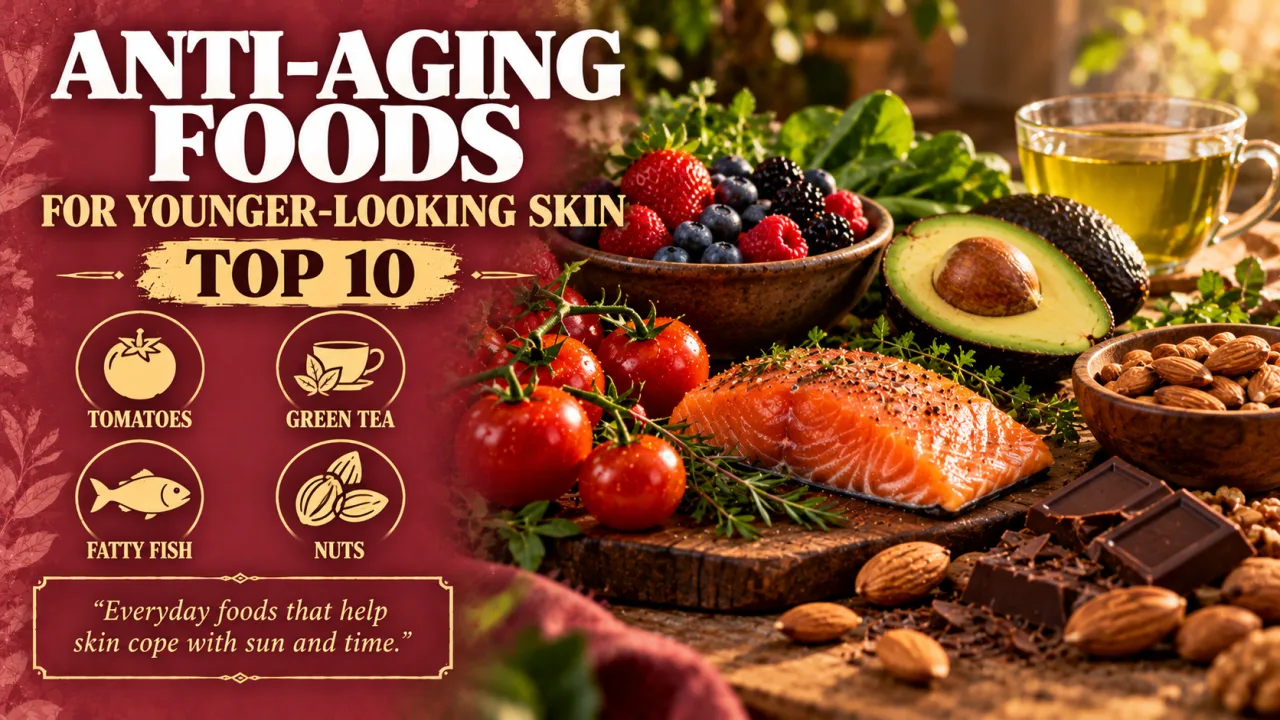
The best anti-aging foods for skin that looks younger, led by tomatoes, cocoa and green tea, supply nutrients that help skin cope with sunlight and time.
Every face changes with age. Skin gradually becomes thinner and drier, collagen production slows, and fine lines appear. Dermatologists separate this natural, intrinsic ageing from photoageing, the extra damage caused by years of ultraviolet light, which shows up as deeper wrinkles, rough texture, lost elasticity and uneven pigment. The American Academy of Dermatology (AAD) says the sun plays a major role in prematurely ageing skin, and it names smoking as another powerful accelerator.
Diet sits further down that list, but it is not irrelevant. Over the past 25 years, researchers have fed volunteers tomato paste, cocoa drinks, green tea, almonds and avocados, then measured how their skin reacted to controlled doses of UV light or how their wrinkles changed. Large population studies in the United States, France, Australia, Greece and Sweden have also compared what people eat with how their skin looks. The results are encouraging in places, modest in others and occasionally disappointing. This guide, current as of October 2026, ranks ten foods by how well the evidence holds up, explains what each one supplies, and is open about where the research is thin.
A quick note before the list: this article is general information, not medical advice. No food reverses ageing, and none of these foods replaces sunscreen. If you have a skin condition, take medicines that interact with diet, or are thinking about high-dose supplements, speak with a doctor or a registered dietitian first.
How We Chose These Foods
Skin claims are everywhere in food marketing, and many anti-ageing lists repeat each other without checking the science. For this ranking, every food had to clear several hurdles.
- Human evidence: priority went to foods tested in controlled trials on people, with measured outcomes such as sunburn sensitivity, wrinkle depth, elasticity or skin thickness.
- Food, not just pills: the food itself, or a realistic serving of it, had to be studied or supply nutrients with a known role in skin. Where the main trials used concentrated extracts or supplements, that is stated clearly.
- A plausible mechanism: the food needs a recognised way of helping, such as supplying vitamin C for collagen synthesis or pigments that absorb part of the UV burden.
- Safety at normal intakes: each food should be safe for most adults in ordinary amounts, with cautions noted where they apply.
Trial details were taken from abstracts indexed in PubMed, and nutrient figures come from the US National Institutes of Health Office of Dietary Supplements (ODS) and the USDA FoodData Central database. Population studies can show a link between a diet and better skin, but they cannot prove the food caused it, because people who eat well often also smoke less and protect themselves from the sun. Most feeding trials are small, short and conducted in women with fair skin, so their results may not apply to everyone.
The order runs from the strongest and most consistent evidence to the most preliminary. Foods lower on the list are still worth eating; they simply have fewer or smaller studies behind their skin effects.
At a Glance
| No. | Food | Key nutrient | What studies measured | Strength of evidence |
|---|---|---|---|---|
| 1 | Tomatoes and tomato paste | Lycopene | Less redness after UV exposure, markers of collagen protection | Several RCTs and a meta-analysis |
| 2 | Cocoa and high-flavanol dark chocolate | Cocoa flavanols | UV redness, wrinkles, elasticity, skin thickness | Several RCTs, mixed results |
| 3 | Green tea | Catechins (EGCG) | UV redness, elasticity, skin roughness | Two RCTs with opposite results |
| 4 | Fatty fish | EPA and DHA omega-3 fats | Sunburn threshold, UV-induced DNA damage markers | Supplement RCTs, population data |
| 5 | Vitamin C-rich fruits and vegetables | Vitamin C | Wrinkled appearance, dryness | Large population study, established biology |
| 6 | Almonds and other nuts | Vitamin E, healthy fats | Wrinkle severity and width | Two small RCTs |
| 7 | Extra virgin olive oil | Monounsaturated fat | Severity of photoageing | Large population studies |
| 8 | Leafy greens and mixed vegetables | Carotenoids, vitamins C and E | Wrinkling at sun-exposed sites | Population studies |
| 9 | Sweet potatoes and carrots | Beta-carotene | UV redness | Supplement trials, mixed results |
| 10 | Avocado | Monounsaturated fat, vitamin E | Elasticity and firmness | One small pilot RCT |
1. Tomatoes and Tomato Paste
Tomatoes earn first place because their skin research is the most consistent of any everyday food. The key ingredient is lycopene, the red carotenoid pigment that colours ripe tomatoes. Concentrated tomato products such as paste and puree contain far more of it, gram for gram, than fresh tomatoes.
Key Nutrients
According to USDA FoodData Central, canned tomato puree without added salt contains about 21.8 milligrams of lycopene per 100 grams, compared with about 2.6 milligrams in raw ripe tomatoes and 4.5 milligrams in raw watermelon. The puree also provides beta-carotene, vitamin E and potassium. Lycopene is fat-soluble, which is why the clinical trials served tomato paste together with olive oil rather than on its own. Laboratory work suggests lycopene is one of the most effective carotenoids at neutralising reactive oxygen species, the unstable molecules that UV light generates in skin.
What the Research Shows
In a German study published in the Journal of Nutrition in 2001, Wilhelm Stahl and colleagues gave volunteers 40 grams of tomato paste, supplying roughly 16 milligrams of lycopene, with 10 grams of olive oil every day for 10 weeks. After 10 weeks, the reddening caused by a measured dose of UV light was about 40 percent lower than in the control group. At week four there was no difference, which shows the effect takes time to build. The study was small, with 9 people eating tomato paste and 10 controls.
A British trial by M. Rizwan, Lesley Rhodes and colleagues, published in the British Journal of Dermatology in 2011, followed 20 women aged 21 to 47. Half ate 55 grams of tomato paste in olive oil daily for 12 weeks. The tomato group became measurably less red after UV exposure, although the standard sunburn threshold did not change significantly. Skin biopsies showed lower levels of MMP-1, an enzyme that breaks down collagen, a rise in procollagen, the building block of new collagen, and less UV-related damage to mitochondrial DNA.
In 2023, researchers at Zhengzhou University in China pooled 21 intervention trials of tomato and lycopene in a meta-analysis published in Critical Reviews in Food Science and Nutrition. Tomato and lycopene were associated with significantly less redness, lower MMP-1 and less pigmentation, as well as a higher sunburn threshold and greater skin thickness and density.
How to Eat It
Two to three tablespoons of tomato paste stirred into soups, stews, curries, sauces or a pasta sauce with a little olive oil comes close to the amounts used in trials. Tomato puree, passata and slow-cooked tomato sauces are easy alternatives. Fresh tomatoes and watermelon add lycopene too, though in much smaller concentrations.
Things to Keep in Mind
Every trial lasted weeks or months, and benefits appeared only after regular daily intake. The protection measured is modest, the standard sunburn threshold did not change in the 2011 trial, and none of the authors presented tomato as a replacement for sunscreen. Some trials used purified lycopene supplements rather than food. Canned tomato products can be high in salt, so choose low-salt versions where possible.
Key Figures
- Lycopene in canned tomato puree: about 21.8 mg per 100 g (USDA)
- Dose in trials: 40 to 55 g tomato paste a day, about 16 mg lycopene, eaten with olive oil
- UV redness (2001 trial): about 40 percent lower after 10 weeks
- Meta-analysis: 21 intervention trials pooled (2023)
- Time to effect: no measurable change at 4 weeks; benefits at 10 to 12 weeks
2. Cocoa and High-Flavanol Dark Chocolate
Cocoa beans are rich in flavanols, a family of plant compounds that has been studied for its effects on blood vessels and, more recently, on skin. The catch is that ordinary chocolate bars lose much of their flavanol content during processing, so the skin trials used specially made high-flavanol cocoa drinks or chocolate.
Key Nutrients
The main active compounds are flavanols such as epicatechin and catechin, together with procyanidins. Researchers believe they may improve blood flow to the skin and help protect against UV-induced oxidative stress. Dark chocolate also supplies iron, magnesium and fibre, but it is energy-dense and usually contains added sugar and fat.
What the Research Shows
In a 12-week German trial published in the Journal of Nutrition in 2006, Ulrike Heinrich, Wilhelm Stahl and colleagues gave women a cocoa drink providing either 326 milligrams of flavanols a day or a low-flavanol version with 27 milligrams. In the high-flavanol group, UV-induced redness fell by 15 percent after six weeks and 25 percent after 12 weeks. Skin also became thicker and denser, rising from 1.11 to 1.24 millimetres in thickness, and water loss through the skin dropped, while the low-flavanol group showed no such changes.
A London study by Stefanie Williams and colleagues, published in the Journal of Cosmetic Dermatology in 2009, gave 30 volunteers 20 grams a day of either high-flavanol or conventional dark chocolate for 12 weeks. The amount of UV needed to cause redness more than doubled in the high-flavanol group, while the low-flavanol chocolate produced no significant change.
The longest trial so far, by Hyun-Sun Yoon and colleagues in South Korea, was published in the Journal of Nutrition in 2016. Women aged 43 to 86 drank a cocoa beverage supplying 320 milligrams of cocoa flavanols or a placebo for 24 weeks. Wrinkle depth improved by 8.7 percentage points more than placebo, and elasticity rose by 8.6 percentage points, although hydration did not change.
Not every trial agrees. In a study of 74 women in Quebec City, Canada, published in Nutrition Journal in 2014, Mogollon and colleagues found that 30 grams a day of high-flavanol chocolate for 12 weeks gave no statistically significant protection against UV sensitivity compared with low-flavanol chocolate, although skin elasticity at the temple improved slightly.
How to Eat It
Unsweetened natural cocoa powder stirred into milk, oats or yogurt is the most practical way to get flavanols without a lot of sugar. If you prefer chocolate, a small square or two of dark chocolate with a high cocoa percentage is a reasonable treat. The 2009 trial is a reminder that the way chocolate is made matters, since standard manufacturing greatly reduces the flavanols found in fresh cocoa beans.
Things to Keep in Mind
Chocolate bars are not a health food. The products used in trials were designed to preserve flavanols, and most supermarket chocolate contains far less. Because chocolate adds calories and sugar, the AAD's warning that a diet high in sugar and refined carbohydrates can accelerate skin ageing applies here too.
Key Figures
- Flavanol dose in positive trials: about 320 to 326 mg a day
- UV redness (2006 trial): 15 percent lower at 6 weeks, 25 percent lower at 12 weeks
- Wrinkle depth (2016 trial): 8.7 percentage points better than placebo after 24 weeks
- Null result: 74 women, 30 g a day of high-flavanol chocolate, no significant UV protection (2014)
- Low-flavanol chocolate: no significant change in UV sensitivity (2009 trial)
3. Green Tea
Green tea is one of the most studied drinks in nutrition science, and its main compounds, the catechins, have attracted attention for skin as well as heart and metabolic health. The skin evidence is genuinely split, which is why it sits in third place rather than higher.
Key Nutrients
The most abundant catechin is epigallocatechin gallate, usually shortened to EGCG. Green tea is also a source of caffeine. According to the US National Center for Complementary and Integrative Health (NCCIH), green, black and oolong teas all come from the same plant, Camellia sinensis; green tea leaves are steamed, pan fried and dried but not fermented, which helps preserve the catechins.
What the Research Shows
In a 12-week German trial published in the Journal of Nutrition in 2011, Heinrich and colleagues gave 60 women either a green tea polyphenol drink providing 1,402 milligrams of catechins a day or a placebo. UV-induced redness fell by 16 percent at six weeks and 25 percent at 12 weeks in the green tea group. Elasticity, roughness, skin density and blood flow to the skin also improved.
A small study by Clarke and colleagues at the universities of Leeds and Manchester, published in 2016, found that green tea catechins and their metabolites do reach human skin after 11 volunteers took green tea daily for three months, which supports a plausible mechanism.
However, a UK randomised controlled trial by Farrar and colleagues, published in the American Journal of Clinical Nutrition in 2015, found no benefit. Fifty adults took a green tea extract supplying 540 milligrams of catechins, plus 50 milligrams of vitamin C, twice a day for three months, and there was no significant difference from placebo in sunburn threshold, redness or markers of skin inflammation.
How to Eat It
Brewed green tea, hot or cold, is the simplest form. Matcha, a powdered green tea, gives a more concentrated drink. A cup of tea supplies far fewer catechins than the 2011 trial drink, so it makes sense to treat green tea as a pleasant everyday habit and a replacement for sugary drinks rather than as a skin treatment.
Things to Keep in Mind
The NCCIH notes that liver injury has been reported in some people using green tea products, mainly concentrated extracts in tablet or capsule form, although such cases are uncommon. Brewed tea has not raised the same concern. Green tea contains caffeine, so people who are pregnant, breastfeeding or sensitive to caffeine should keep intake moderate and seek advice where unsure.
Key Figures
- Catechin dose in the positive 2011 trial: 1,402 mg a day for 12 weeks
- UV redness (2011): 16 percent lower at 6 weeks, 25 percent lower at 12 weeks
- Null result (2015): 50 adults, 540 mg catechins twice daily, no significant effect
- Main catechin: epigallocatechin gallate (EGCG)
- Safety: rare liver injury reported mainly with concentrated extracts (NCCIH)
4. Fatty Fish
Salmon, mackerel, herring, sardines and trout are the richest food sources of the long-chain omega-3 fats EPA and DHA. These fats become part of cell membranes throughout the body, including the skin, and they influence how the body handles inflammation.
Key Nutrients
According to USDA figures compiled by the Harvard T.H. Chan School of Public Health, a 3-ounce (85-gram) serving of raw farmed Atlantic salmon contains about 733 milligrams of EPA and 935 milligrams of DHA. The ODS notes that the body can convert the plant omega-3 ALA, found in flaxseed, chia and walnuts, into EPA and DHA only in very small amounts, so eating fish or seafood is the practical way to raise levels.
What the Research Shows
Most of the skin research used fish oil supplements rather than fish itself. In a study led by Lesley Rhodes and published in Carcinogenesis in 2003, 42 people took 4 grams a day of purified EPA or a comparison oil for three months. In the EPA group, the UV dose needed to cause sunburn rose from about 36 to 49 mJ per square centimetre, and the number of skin cells showing p53, a marker of UV-related DNA damage, roughly halved.
A later trial by Sarah Pilkington and colleagues, published in the American Journal of Clinical Nutrition in 2013, gave 79 women 5 grams of omega-3 oil a day for three months. It found only a partial reduction in UV-induced suppression of the skin's immune response, which was not statistically significant overall.
Population data add some support. In the international Food Habits in Later Life study, published in 2001, older people who ate more fish tended to have less wrinkling on sun-exposed skin, though the link with fish weakened once other foods were taken into account. The ODS also notes that a genuine omega-3 deficiency can cause rough, scaly skin and an itchy rash, which shows these fats matter for normal skin.
How to Eat It
The Dietary Guidelines for Americans, as summarised by the US Food and Drug Administration (FDA), recommend at least 8 ounces of seafood a week for adults, which is roughly two servings. Baked salmon, grilled mackerel, sardines on wholegrain toast and smoked trout in salads are easy ways to reach that.
Things to Keep in Mind
The FDA and the ODS both advise choosing fish that are lower in mercury, such as salmon, sardines, herring and trout, particularly during pregnancy and breastfeeding. The skin results for high-dose fish oil do not automatically apply to eating fish twice a week. The FDA recommends no more than 5 grams a day of EPA and DHA combined from supplements, and high doses can increase bleeding risk in people taking blood thinners such as warfarin.
Key Figures
- EPA plus DHA in 85 g of raw farmed Atlantic salmon: about 1.7 g (USDA via Harvard)
- Dose in the 2003 trial: 4 g purified EPA a day for 3 months, 42 participants
- Sunburn threshold (2003): rose from about 36 to 49 mJ per square centimetre
- Recommended seafood intake: at least 8 ounces a week for adults
- Supplement ceiling advised by the FDA: 5 g a day of EPA and DHA combined
5. Vitamin C-Rich Fruits and Vegetables
Vitamin C is one of the few nutrients with a direct, well-established role in skin structure. The ODS states that the body needs vitamin C to make collagen, the protein that gives skin its strength. When vitamin C is severely lacking, as in scurvy, wounds heal poorly because collagen cannot be built properly.
Key Nutrients
The richest everyday sources, according to the ODS, include raw red pepper (about 95 milligrams in half a cup), an orange (about 70 milligrams), a kiwifruit (about 64 milligrams), half a cup of cooked broccoli (about 51 milligrams) and half a cup of strawberries (about 49 milligrams). Adult men need 90 milligrams a day and adult women 75 milligrams, and smokers need an extra 35 milligrams because smoking increases oxidative stress.
What the Research Shows
In a large analysis of the US NHANES I survey, published in the American Journal of Clinical Nutrition in 2007, Cosgrove and colleagues examined the diets and skin of 4,025 women aged 40 to 74. Women with higher vitamin C intakes were less likely to have a wrinkled appearance and age-related dryness, and the links held after accounting for age, race, education, income, sunlight exposure, menopausal status, body mass index, supplement use and physical activity. The lead author worked for the research division of a consumer-goods company, which the paper discloses.
A 2017 review in the journal Nutrients by Juliet Pullar and colleagues at the University of Otago in New Zealand described how normal skin holds high concentrations of vitamin C, which stimulates collagen production and assists antioxidant protection against UV damage. The authors pointed out that the benefit of topical vitamin C, compared with simply eating enough of it, is poorly understood. The review was partly funded by a kiwifruit marketer, which the paper discloses.
How to Eat It
The ODS notes that five varied servings of fruit and vegetables a day can provide more than 200 milligrams of vitamin C. A practical day might include an orange or kiwifruit at breakfast, raw pepper strips with lunch and broccoli or Brussels sprouts with dinner. Because vitamin C is water-soluble and destroyed by heat, raw fruit and quickly steamed or microwaved vegetables keep more of it than vegetables boiled for a long time.
Things to Keep in Mind
More is not better beyond meeting your needs. The ODS sets an upper limit of 2,000 milligrams a day for adults, and high doses from supplements can cause diarrhoea, nausea and stomach cramps. People with a history of kidney stones should talk to a doctor before taking vitamin C supplements. Topical vitamin C serums are a separate topic and are not covered by these dietary studies.
Key Figures
- Daily needs: 90 mg for men, 75 mg for women, plus 35 mg for smokers (ODS)
- Red pepper, raw, half a cup: about 95 mg
- Kiwifruit, one medium: about 64 mg
- Population study: 4,025 US women aged 40 to 74 (NHANES I)
- Upper limit for adults: 2,000 mg a day
6. Almonds and Other Nuts
Nuts are among the best food sources of vitamin E, a fat-soluble antioxidant, and they also provide unsaturated fats, including the omega-6 fat linoleic acid. Almonds are the nut with the most direct skin research.
Key Nutrients
According to the ODS, one ounce (28 grams) of dry-roasted sunflower seeds supplies about 7.4 milligrams of vitamin E, dry-roasted almonds about 6.8 milligrams and hazelnuts about 4.3 milligrams, against an adult requirement of 15 milligrams a day. The ODS describes vitamin E as an antioxidant that helps protect cells from free radicals, including those produced by UV light from the sun, and notes that most Americans eat less than the recommended amount.
What the Research Shows
At the University of California, Davis, a dermatology research group ran two randomised trials in postmenopausal women with fair skin (Fitzpatrick types I and II). In the first, published in Phytotherapy Research in 2019, women ate almonds making up 20 percent of their daily calories or a calorie-matched snack for 16 weeks. Of 31 women enrolled, 28 completed the study, and wrinkle severity and width fell significantly in the almond group.
A follow-up trial with more participants, published in Nutrients in 2021, extended the period to 24 weeks. Average wrinkle severity in the almond group fell by 15 percent at week 16 and 16 percent at week 24 compared with baseline, and facial pigment intensity dropped by 20 percent. Skin hydration and water loss did not differ from the control group.
Population data point the same way. In the NHANES I analysis described above, women with higher intakes of linoleic acid, found in nuts, seeds and many plant oils, were less likely to have age-related dryness and thinning of the skin.
How to Eat It
A small handful of almonds, about one ounce, makes an easy snack. Flaked almonds or chopped hazelnuts can be scattered over porridge, salads and vegetables, and sunflower seeds work well in bread, granola and salads. For more ideas, see Finepedia's guide to the most nutritious seeds for your diet.
Things to Keep in Mind
The trials used a large amount of almonds, about one-fifth of daily calories, and involved only small groups of fair-skinned women after menopause. Nuts are energy-dense, so they work best as a replacement for less healthy snacks rather than an addition. Tree nut allergy is common and can be severe. The ODS reports no adverse effects from vitamin E in food, but high-dose vitamin E supplements have been linked to a higher risk of haemorrhagic stroke and can interact with blood thinners.
Key Figures
- Vitamin E in 1 oz dry-roasted almonds: about 6.8 mg; sunflower seeds about 7.4 mg (ODS)
- Adult vitamin E requirement: 15 mg a day
- Almond dose in trials: 20 percent of daily calories
- Wrinkle severity (2021 trial): 15 percent lower at 16 weeks and 16 percent lower at 24 weeks
- Facial pigment intensity (2021 trial): 20 percent lower
7. Extra Virgin Olive Oil
Olive oil is central to the traditional Mediterranean diet, and two large observational studies have linked it to less sun-related skin ageing. Extra virgin olive oil is the least processed grade and makes a good everyday choice for cooking and dressings.
Key Nutrients
The Harvard T.H. Chan School of Public Health lists olive oil, along with avocados and nuts such as almonds and hazelnuts, as a major source of monounsaturated fat. Harvard notes that eating monounsaturated and polyunsaturated fats in place of refined carbohydrates lowers harmful LDL cholesterol and raises protective HDL cholesterol.
What the Research Shows
In 2012, Latreille and colleagues in France analysed data from the long-running SU.VI.MAX cohort, which included 1,264 women and 1,655 men aged 45 to 60. Published in PLoS One, the study found that a higher intake of monounsaturated fat from olive oil was associated with a lower risk of severe photoageing, while monounsaturated fat from animal sources showed no such link. The lead author worked at a research centre linked to the cosmetics industry, which the paper lists.
The international Food Habits in Later Life study, published in the Journal of the American College of Nutrition in 2001, examined 453 older people in Australia, Greece and Sweden. Higher intakes of olive oil, vegetables and legumes were linked to less wrinkling on sun-exposed skin, and together these foods explained about 20 percent of the difference in skin damage between people. High butter intake was linked to more wrinkling.
How to Eat It
Use extra virgin olive oil as your main cooking and salad oil, drizzle it over cooked vegetables, beans and grains, and use it in place of butter where possible. The tomato trials described above served the paste with olive oil, so the two make a natural pairing.
Things to Keep in Mind
Both studies were observational, so they cannot show that olive oil itself caused the difference. People who use more olive oil may also eat more vegetables and less processed food. Olive oil is rich in calories, at about 884 per 100 grams according to USDA data, or roughly 120 per tablespoon, so the benefit comes from swapping it for other fats rather than adding more.
Key Figures
- French cohort: 1,264 women and 1,655 men aged 45 to 60 (SU.VI.MAX)
- Finding: more olive-oil monounsaturated fat, lower risk of severe photoageing
- Older-adult study: 453 people in Australia, Greece and Sweden (2001)
- Variation explained by vegetables, legumes and olive oil together: about 20 percent
- Animal-source monounsaturated fat: no association with photoageing
8. Leafy Greens and Mixed Vegetables
Spinach, kale, broccoli, lettuce and other vegetables contribute a mix of carotenoids, vitamin C and vitamin E. No single green vegetable has strong skin trials of its own, but overall vegetable intake shows up repeatedly in studies of skin ageing.
Key Nutrients
The ODS lists spinach, broccoli and other green leafy vegetables among good sources of provitamin A carotenoids, and half a cup of boiled spinach supplies about 1.9 milligrams of vitamin E. Broccoli adds a useful amount of vitamin C as well.
What the Research Shows
In the Food Habits in Later Life study, vegetable intake had the strongest protective association of any food group, with a correlation coefficient of about minus 0.31 against wrinkling. The AAD also says that findings from a few studies suggest that eating plenty of fresh fruits and vegetables may help prevent the damage that leads to premature skin ageing, and that a diet high in sugar or other refined carbohydrates may accelerate it.
Because these studies measure overall diet, they cannot separate the effect of spinach from that of broccoli, carrots or tomatoes. The most reasonable reading is that a vegetable-rich eating pattern as a whole is linked to better-looking skin.
How to Eat It
Aim to include vegetables at most meals: a handful of spinach wilted into eggs or curry, a side salad dressed with olive oil, roasted broccoli or a vegetable soup. Older adults looking for practical meal ideas can find more in Finepedia's list of healthy foods for senior citizens.
Things to Keep in Mind
The evidence here comes from observational studies of whole diets, so it shows an association rather than proof of cause. Vitamin C is destroyed by heat, so the ODS suggests steaming or microwaving vegetables rather than boiling them for long periods. Anyone on a medically restricted diet or taking medicines affected by diet should check with their doctor before making big changes.
Key Figures
- Vegetable intake vs wrinkling: correlation of about minus 0.31 in older adults (2001)
- Vitamin E in half a cup of boiled spinach: about 1.9 mg (ODS)
- Main nutrients: carotenoids, vitamins C and E
- AAD view: fruit and vegetables may help prevent damage that leads to premature skin ageing
- Evidence type: dietary-pattern studies rather than single-food trials
9. Sweet Potatoes and Carrots
Orange vegetables owe their colour to beta-carotene, the most common provitamin A carotenoid. The body converts part of it into vitamin A. According to the ODS, eating very large amounts of beta-carotene can turn the skin yellow-orange, a harmless change that fades when intake falls.
Key Nutrients
According to USDA FoodData Central, 100 grams of sweet potato baked in its skin supplies about 961 micrograms of vitamin A activity, and 100 grams of raw carrot about 835 micrograms. The ODS sets the adult requirement at 900 micrograms a day for men and 700 micrograms for women, so a 100-gram portion of either vegetable covers or comes close to a day's needs. The ODS also lists winter squash, broccoli, spinach, mangoes, apricots and cantaloupe as good sources.
What the Research Shows
In a trial published in the American Journal of Clinical Nutrition in 2000, Stahl and colleagues at Heinrich Heine University Dusseldorf gave volunteers 25 milligrams of carotenoids a day, with or without vitamin E, for 12 weeks. Redness after UV exposure was reduced from week eight onwards. However, this used concentrated supplements, not food.
A much larger Australian trial gives a more sobering view. In the Nambour study, published in the Annals of Internal Medicine in 2013, Hughes and colleagues randomly assigned 903 adults under 55 to daily or occasional sunscreen use and to 30 milligrams of beta-carotene or a placebo. After four and a half years, beta-carotene supplements had no overall effect on skin ageing, while daily sunscreen did. Together, these studies suggest that beta-carotene is best obtained from colourful vegetables as part of a balanced diet, not relied on as a skin treatment.
How to Eat It
Roast sweet potato wedges or carrots with a little olive oil, add grated carrot to salads and slaws, and blend winter squash into soups. Because vitamin A and its carotenoid precursors are fat-soluble, it makes sense to eat these vegetables as part of a meal that contains some fat.
Things to Keep in Mind
The ODS warns that smokers, former smokers and people exposed to asbestos who take high-dose beta-carotene supplements have a higher risk of lung cancer and death. The warning concerns high-dose supplements, not orange vegetables eaten as part of ordinary meals. Pregnant women should avoid high-dose supplements of preformed vitamin A, which can cause birth defects; vegetables containing beta-carotene do not carry the same concern.
Key Figures
- Vitamin A activity in 100 g baked sweet potato: about 961 micrograms RAE (USDA)
- Vitamin A activity in 100 g raw carrot: about 835 micrograms RAE (USDA)
- Adult requirement: 900 micrograms for men, 700 micrograms for women (ODS)
- Nambour trial (2013): 903 adults, 30 mg beta-carotene, no overall effect on skin ageing
- Supplement caution: higher lung cancer risk in smokers taking high-dose beta-carotene
10. Avocado
Avocados are rich in monounsaturated fat and also supply vitamin E, fibre and carotenoids. They earn a place on this list thanks to one small but well-designed trial, so the evidence is promising rather than settled.
Key Nutrients
According to USDA FoodData Central, 100 grams of raw avocado contains about 160 calories, 14.7 grams of fat, 6.7 grams of fibre and 2.07 milligrams of vitamin E. Harvard lists avocados among the main sources of monounsaturated fat, the same type found in olive oil.
What the Research Shows
In a pilot trial at the University of California, Los Angeles, published in the Journal of Cosmetic Dermatology in 2022, Henning and colleagues randomly assigned 39 healthy, overweight women aged 27 to 73 to eat one avocado a day or continue their usual diet for eight weeks. Skin elasticity and firmness on the forehead increased in the avocado group, and firmness improved significantly compared with the control group. There was no change in hydration, pigmentation, oiliness or resistance to UVB light. The authors declared no conflicts of interest and called for further studies.
How to Eat It
Mash avocado on wholegrain toast, slice it into salads or grain bowls, or blend it into a smoothie. Adding avocado to a salad of tomatoes, carrots and leafy greens combines several foods from this list in a single dish.
Things to Keep in Mind
The trial was small, lasted only eight weeks and measured only a few skin features. A whole avocado a day adds substantial calories, so it works best in place of other fats.
Key Figures
- Trial size and length: 39 women, one avocado a day, 8 weeks (2022)
- Findings: higher forehead elasticity and firmness; no change in hydration or UV resistance
- Fat in 100 g raw avocado: about 14.7 g
- Fibre in 100 g raw avocado: about 6.7 g
- Vitamin E in 100 g raw avocado: about 2.07 mg
Anti-Aging Foods Compared
| Food | Key nutrient | Main skin benefit studied | Typical serving |
|---|---|---|---|
| Tomatoes and tomato paste | Lycopene | Less UV redness, collagen-related markers | 2 to 3 tbsp paste with olive oil, or a portion of tomato sauce |
| Cocoa and dark chocolate | Cocoa flavanols | UV redness, wrinkles, elasticity, skin thickness | A drink made with unsweetened cocoa powder |
| Green tea | Catechins (EGCG) | UV redness, elasticity, roughness | A cup of freshly brewed green tea |
| Fatty fish | EPA and DHA | Sunburn threshold, UV-related DNA damage markers | About 4 oz, twice a week |
| Vitamin C-rich produce | Vitamin C | Collagen synthesis, less wrinkled appearance | 1 orange or kiwifruit, or half a cup of red pepper |
| Almonds and nuts | Vitamin E, linoleic acid | Wrinkle severity, pigmentation | About 1 oz (a small handful) |
| Extra virgin olive oil | Monounsaturated fat | Lower risk of severe photoageing | 1 to 2 tbsp in place of other fats |
| Leafy greens and vegetables | Carotenoids, vitamins C and E | Less wrinkling at sun-exposed sites | Vegetables at most meals |
| Sweet potatoes and carrots | Beta-carotene | UV redness (supplement trials) | 1 medium sweet potato or carrot |
| Avocado | Monounsaturated fat, vitamin E | Elasticity and firmness | Half to one avocado |
Serving sizes are practical everyday amounts, not doses proven to produce the effects measured in trials. Several of the trials used larger amounts or concentrated products.
Habits That Matter More Than Any Food
Food can support skin, but the biggest influences on visible ageing are habits. As of October 2026, dermatologists' advice centres on three of them.
- Sunscreen and sun protection: in the Nambour trial, adults who applied broad-spectrum sunscreen every day showed no detectable increase in skin ageing over four and a half years, and their skin aged 24 percent less than that of people who used sunscreen only when they chose to. The AAD recommends a broad-spectrum, water-resistant sunscreen of SPF 30 or higher on all skin not covered by clothing, plus shade, protective clothing and avoiding tanning beds. It calls sunscreen the closest thing we have to a fountain of youth.
- Not smoking: the AAD says smoking greatly speeds up skin ageing, causing wrinkles and a dull, sallow complexion. Smokers also need an extra 35 milligrams of vitamin C a day, according to the ODS.
- Good sleep: in a 2015 study of 60 women published in Clinical and Experimental Dermatology, poor sleepers showed more signs of intrinsic skin ageing and their skin barrier recovered more slowly than that of good sleepers, who had 30 percent greater barrier recovery 72 hours after a standard test. A 2017 Swedish study found that people photographed after two nights of restricted sleep were rated as less attractive and less healthy. The evidence is not uniform, since a 2019 study found no measurable change in facial features after one night without sleep.
The AAD also advises drinking less alcohol, which dehydrates and damages the skin, and limiting sugar and refined carbohydrates. Finepedia's guide to the most unhealthy foods to limit and better swaps covers practical ways to cut back.
Frequently Asked Questions
Can anti-aging foods replace sunscreen?
No. The best food trials showed modest reductions in sunburn redness after weeks of daily intake, while the Nambour trial found that daily sunscreen use slowed visible skin ageing over several years. Diet works best as a support alongside sun protection, never as a substitute.
How long does it take for diet to affect the skin?
Most positive trials ran for 8 to 24 weeks, and the 2001 tomato study found no measurable change at four weeks. Expect gradual changes over months, if any, rather than quick results.
Which food is best for collagen?
Vitamin C is essential for making collagen, so fruits and vegetables such as red peppers, oranges, kiwifruit, strawberries and broccoli are the most direct dietary support. In the 2011 tomato paste trial, skin samples also showed more procollagen and less of the collagen-degrading enzyme MMP-1.
Is dark chocolate good for your skin?
Specially made high-flavanol cocoa improved UV resistance, wrinkles or elasticity in several trials, but one well-designed trial found no significant UV protection. Ordinary chocolate bars contain fewer flavanols and add sugar, so unsweetened cocoa powder is the more sensible choice.
Should I take supplements instead?
Supplements are not a shortcut. Beta-carotene supplements did not slow skin ageing in the Nambour trial, a green tea extract trial found no benefit, and high doses of beta-carotene, vitamin E and green tea extract carry their own risks. Anyone considering supplements should discuss them with a doctor or pharmacist.
Do sugar and alcohol age your skin?
The AAD says that a diet high in sugar or other refined carbohydrates can accelerate ageing and that alcohol dehydrates and damages the skin over time. Cutting back on both is a sensible step for skin and general health.
Conclusion
There is no single food that turns back the clock, but the research gives some foods better credentials than others. Tomato paste eaten with olive oil has the most consistent evidence for reducing UV-induced redness. High-flavanol cocoa and green tea have promising but mixed trial results, while fatty fish, vitamin C-rich produce, nuts, olive oil, vegetables, orange vegetables and avocado each supply nutrients with a recognised role in skin health and some human evidence behind them.
The common thread is a varied, plant-rich diet with healthy fats and regular fish, which matches general dietary advice. Combine these anti-aging foods with daily sunscreen, no smoking, enough sleep and moderate alcohol, and you give your skin the best realistic chance of ageing well. As always, check with a healthcare professional before making major changes or starting supplements.
- Stahl W, et al. Dietary tomato paste protects against ultraviolet light-induced erythema in humans, J Nutr 2001: https://pubmed.ncbi.nlm.nih.gov/11340098/
- Rizwan M, et al. Tomato paste rich in lycopene protects against cutaneous photodamage in humans in vivo, Br J Dermatol 2011: https://pubmed.ncbi.nlm.nih.gov/20854436/
- Zhang X, et al. The effect of tomato and lycopene on clinical characteristics and molecular markers of UV-induced skin deterioration: a systematic review and meta-analysis of intervention trials, Crit Rev Food Sci Nutr 2024 (online 2023): https://pubmed.ncbi.nlm.nih.gov/36606553/
- Heinrich U, et al. Long-term ingestion of high flavanol cocoa provides photoprotection against UV-induced erythema, J Nutr 2006: https://pubmed.ncbi.nlm.nih.gov/16702322/
- Williams S, et al. Eating chocolate can significantly protect the skin from UV light, J Cosmet Dermatol 2009: https://pubmed.ncbi.nlm.nih.gov/19735513/
- Yoon HS, et al. Cocoa flavanol supplementation influences skin conditions of photo-aged women, J Nutr 2016: https://pubmed.ncbi.nlm.nih.gov/26581682/
- Mogollon JA, et al. Chocolate flavanols and skin photoprotection: a parallel, double-blind, randomized clinical trial, Nutr J 2014: https://pubmed.ncbi.nlm.nih.gov/24970388/
- Heinrich U, et al. Green tea polyphenols provide photoprotection, increase microcirculation, and modulate skin properties of women, J Nutr 2011: https://pubmed.ncbi.nlm.nih.gov/21525260/
- Clarke KA, et al. Green tea catechins and their metabolites in human skin before and after exposure to ultraviolet radiation, J Nutr Biochem 2016: https://pubmed.ncbi.nlm.nih.gov/26454512/
- Farrar MD, et al. A randomized controlled trial of green tea catechins in protection against ultraviolet radiation-induced cutaneous inflammation, Am J Clin Nutr 2015: https://pubmed.ncbi.nlm.nih.gov/26178731/
- Rhodes LE, et al. Effect of eicosapentaenoic acid on UVR-related cancer risk in humans, Carcinogenesis 2003: https://pubmed.ncbi.nlm.nih.gov/12771037/
- Pilkington SM, et al. Randomized controlled trial of oral omega-3 PUFA in solar-simulated radiation-induced suppression of human cutaneous immune responses, Am J Clin Nutr 2013: https://pubmed.ncbi.nlm.nih.gov/23364005/
- Pilkington SM, et al. Omega-3 polyunsaturated fatty acids: photoprotective macronutrients, Exp Dermatol 2011: https://pubmed.ncbi.nlm.nih.gov/21569104/
- Cosgrove MC, et al. Dietary nutrient intakes and skin-aging appearance among middle-aged American women, Am J Clin Nutr 2007: https://pubmed.ncbi.nlm.nih.gov/17921406/
- Pullar JM, et al. The roles of vitamin C in skin health, Nutrients 2017: https://pubmed.ncbi.nlm.nih.gov/28805671/
- Foolad N, et al. Prospective randomized controlled pilot study on the effects of almond consumption on skin lipids and wrinkles, Phytother Res 2019: https://pubmed.ncbi.nlm.nih.gov/31576607/
- Rybak I, et al. Prospective randomized controlled trial on the effects of almonds on facial wrinkles and pigmentation, Nutrients 2021: https://pubmed.ncbi.nlm.nih.gov/33673587/
- Latreille J, et al. Dietary monounsaturated fatty acids intake and risk of skin photoaging, PLoS One 2012: https://pubmed.ncbi.nlm.nih.gov/22970231/
- Purba MB, et al. Skin wrinkling: can food make a difference?, J Am Coll Nutr 2001: https://pubmed.ncbi.nlm.nih.gov/11293471/
- Stahl W, et al. Carotenoids and carotenoids plus vitamin E protect against ultraviolet light-induced erythema in humans, Am J Clin Nutr 2000: https://pubmed.ncbi.nlm.nih.gov/10702175/
- Hughes MC, et al. Sunscreen and prevention of skin aging: a randomized trial, Ann Intern Med 2013: https://pubmed.ncbi.nlm.nih.gov/23732711/
- Henning SM, et al. Avocado consumption increased skin elasticity and firmness in women: a pilot study, J Cosmet Dermatol 2022: https://pubmed.ncbi.nlm.nih.gov/35037373/
- Oyetakin-White P, et al. Does poor sleep quality affect skin ageing?, Clin Exp Dermatol 2015: https://pubmed.ncbi.nlm.nih.gov/25266053/
- Sundelin T, et al. Negative effects of restricted sleep on facial appearance and social appeal, R Soc Open Sci 2017: https://pubmed.ncbi.nlm.nih.gov/28572989/
- Holding BC, et al. The effect of sleep deprivation on objective and subjective measures of facial appearance, J Sleep Res 2019: https://pubmed.ncbi.nlm.nih.gov/31006920/
- NIH Office of Dietary Supplements, Vitamin C fact sheet: https://ods.od.nih.gov/factsheets/VitaminC-HealthProfessional/
- NIH Office of Dietary Supplements, Vitamin E fact sheet: https://ods.od.nih.gov/factsheets/VitaminE-HealthProfessional/
- NIH Office of Dietary Supplements, Vitamin A and Carotenoids fact sheet: https://ods.od.nih.gov/factsheets/VitaminA-Consumer/
- NIH Office of Dietary Supplements, Omega-3 Fatty Acids fact sheet: https://ods.od.nih.gov/factsheets/Omega3FattyAcids-Consumer/
- NCCIH, Green Tea: https://www.nccih.nih.gov/health/green-tea
- US Food and Drug Administration, Advice about Eating Fish: https://www.fda.gov/food/consumers/advice-about-eating-fish
- Harvard T.H. Chan School of Public Health, Omega-3 Fatty Acids: An Essential Contribution: https://nutritionsource.hsph.harvard.edu/omega-3-fats/
- Harvard T.H. Chan School of Public Health, Types of Fat: https://www.hsph.harvard.edu/nutritionsource/what-should-you-eat/fats-and-cholesterol/types-of-fat/
- American Academy of Dermatology, 11 ways to reduce premature skin aging: https://www.aad.org/public/everyday-care/skin-care-secrets/anti-aging/reduce-premature-aging-skin
- American Academy of Dermatology, 10 skin care secrets for healthier-looking skin: https://www.aad.org/public/everyday-care/skin-care-secrets/routine/healthier-looking-skin
- USDA FoodData Central: https://fdc.nal.usda.gov/
- 10MostToday (topic prompt only; no wording or order reused): https://10mosttoday.com/


















Log in with