






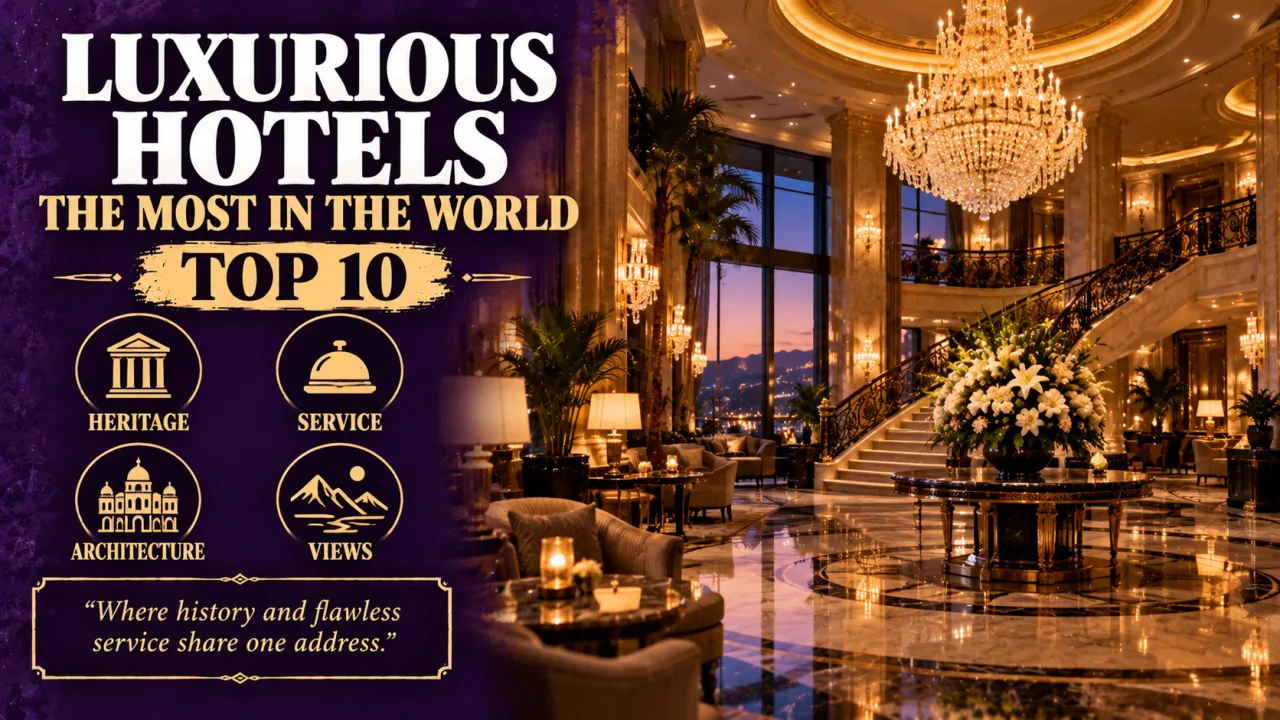
The most luxurious hotels in the world, as of October 2026, blend deep heritage with flawless service, from the Ritz Paris and Raffles to Aman Tokyo.
Luxury in a hotel is easy to advertise and hard to deliver. Marble lobbies and gold taps can be bought, but a house that has welcomed writers, royalty and film stars for more than a century, while still remembering how a regular guest takes their tea, is something money alone cannot build. The properties on this list have earned their reputations slowly, through decades of service, careful restoration and a refusal to cut corners.
This Finepedia guide picks ten hotels that are open and operating as of October 2026, spread across Europe, Asia, Africa, North America and the South Pacific. For each one you will find a Quick Facts table, a short history, a look at the rooms and suites, the experiences guests remember, what sets the hotel apart and a list of key figures. Opening dates, room counts and suite sizes have been checked against the hotels' own fact sheets and websites and confirmed with reputable press reports or reference works. Prices change daily and by season, so this article avoids quoting nightly rates.
How We Chose These Hotels
There is no official scoreboard for luxury, and many published lists are sponsored or based on a single reader vote. Finepedia's list is an editorial judgement built on five openly stated factors, weighed together rather than added up into a precise score.
- Heritage: how long the hotel has operated at the top level, and whether its building is protected as a monument or landmark.
- Service: the depth of personal attention, from butlers and chauffeurs to staff who know returning guests by name.
- Design and setting: architecture, interiors and location, whether a palace on a lake or a sanctuary on the top floors of a skyscraper.
- Signature rooms: the quality of standard rooms as well as the famous suites that define each property.
- Character: the stories, cocktails, traditions and famous guests that make a stay feel like part of history.
Every hotel had to be fully operating in October 2026. That rule removed one obvious name. Dubai's sail-shaped Burj Al Arab closed in April 2026 for a phased restoration of about 18 months and is scheduled to reopen in October 2027, so it appears among the near misses below rather than in the ten. Private-island resorts priced by the night are covered separately in Finepedia's guide to the most expensive resorts in the world, so this list focuses on hotels whose fame rests on history, service and design rather than on price tags.
Most Luxurious Hotels in the World at a Glance
| Rank | Hotel | City or island | Country | Opened | Rooms and suites |
|---|---|---|---|---|---|
| 1 | The Ritz Paris | Paris | France | 1898 | 142 keys, half of them suites |
| 2 | Raffles Singapore | Singapore | Singapore | 1887 | 115 suites |
| 3 | The Peninsula Hong Kong | Hong Kong | China | 1928 | 297 rooms, including 53 suites |
| 4 | Aman Tokyo | Tokyo | Japan | 2014 | 84 rooms and suites |
| 5 | Taj Lake Palace | Udaipur | India | 1963 as a hotel (palace c.1746) | 65 rooms and 18 suites |
| 6 | Hotel du Cap-Eden-Roc | Cap d'Antibes | France | 1889 | 111 rooms and suites plus 4 villas |
| 7 | La Mamounia | Marrakech | Morocco | 1923 | 209 keys, including 3 riads |
| 8 | The Savoy | London | United Kingdom | 1889 | about 268 rooms and suites |
| 9 | The Plaza | New York City | United States | 1907 | 282 rooms, including 102 suites |
| 10 | Four Seasons Resort Bora Bora | Bora Bora | French Polynesia | 2008 | 108 overwater bungalows and 7 villa estates |
1. The Ritz Paris
| Attribute | Details |
|---|---|
| Location | 15 Place Vendôme, 1st arrondissement, Paris, France |
| Opened | 1898, founded by Swiss hotelier César Ritz with chef Auguste Escoffier |
| Ownership | Independent; bought by Mohamed Al-Fayed in 1979 |
| Rooms and suites | 142 keys, of which 71 are suites |
| Signature feature | Bar Hemingway, the Chanel Spa and the Suite Impériale |
History
César Ritz had already made his name running grand hotels when he decided to open a house under his own name. He chose an eighteenth-century mansion on the Place Vendôme, kept its classical façade, and rebuilt the interior behind it with comforts that were rare at the time, including private bathrooms for guests. The hotel opened in 1898 with Auguste Escoffier, the most celebrated French chef of the era, in charge of the kitchens, and the word ritzy soon entered the English language as shorthand for elegance.
Over the following decades the Ritz became a second home to writers and artists. Marcel Proust and Ernest Hemingway were regulars, and Coco Chanel lived in the hotel for more than three decades. Mohamed Al-Fayed bought the Ritz in 1979 and funded a long restoration in the 1980s. In 2012 the hotel closed for the first time in its history for a four-year renovation led by architect and designer Thierry W. Despont, and it reopened on 6 June 2016.
Rooms and Suites
The restoration left the Ritz with 142 keys and an unusual balance: exactly half of them, 71, are suites. Rooms are furnished with antiques and period details that were carefully restored. The Prestige Suites carry the names of guests who shaped the hotel's story, among them Coco Chanel, Ernest Hemingway, F. Scott Fitzgerald, Marcel Proust, Maria Callas, Charlie Chaplin and the Duke of Windsor.
The most famous of all is the Suite Impériale, the most palatial of the hotel's rooms. Its reception room and wood panelling are classified as a French historic monument, which means the suite is protected in the same way as a heritage building. Some rooms look over the Place Vendôme, while others face the hotel's gardens.
Signature Experiences
Bar Hemingway is small, wood-panelled and famous for its cocktails and its collection of memorabilia from the novelist. The restored hotel also opened the world's first Chanel Spa, created with the fashion house its founder once lived above. The Grand Jardin, the hotel's large garden, hosts summer dining, and a private tunnel from the car park lets well-known visitors arrive unseen.
Why It Stands Out
Few hotels can claim to have defined the very idea of a luxury hotel. The Ritz combined a palace setting, private bathrooms and a world-famous kitchen at a time when most hotels offered far less, and the 2016 restoration modernised the wiring and technology without changing the atmosphere. Its mix of protected historic interiors, a high ratio of suites and an almost literary guest list puts it first on Finepedia's list.
Key Figures
- Opened: 1898
- Address: 15 Place Vendôme, Paris
- Keys: 142, including 71 suites
- Renovation: closed 2012, reopened 6 June 2016
- Coco Chanel lived at the hotel for about 34 years, according to the hotel's reopening announcement
2. Raffles Singapore
| Attribute | Details |
|---|---|
| Location | 1 Beach Road, Singapore |
| Opened | 1 December 1887, by the Armenian Sarkies Brothers |
| Ownership | Owned by Katara Hospitality since 2010; managed by Accor under the Raffles brand |
| Rooms and suites | 115 suites |
| Signature feature | The Long Bar, birthplace of the Singapore Sling, and round-the-clock butler service |
History
Raffles began life as a modest bungalow hotel opened by the Sarkies Brothers, Armenian hoteliers who later expanded and rebuilt it. It took its name from Sir Stamford Raffles, the British official who founded modern Singapore. The white, colonnaded main building that defines the hotel today was completed in 1899 in a Neo-Renaissance style.
Raffles survived wars, occupation and economic slumps, and in 1987 the government gazetted it as a National Monument. The hotel closed in stages from 2017 for its most thorough restoration in decades, which renewed the suites, restaurants and public spaces. It reopened on 1 August 2019 and remains the flagship of the Raffles brand, now part of Accor.
Rooms and Suites
Raffles is an all-suite hotel. Its 115 suites are arranged around verandas and tropical courtyards rather than along long corridors, a layout that keeps the feeling of a private colonial residence. High ceilings, teak floors and ceiling fans sit alongside modern bathrooms and discreet technology. Every guest is looked after by a team of butlers, a tradition the hotel still highlights as one of its defining services.
Signature Experiences
The Long Bar is where the Singapore Sling was first mixed in 1915, and the gin-based pink cocktail remains the drink most visitors order. The hotel's dining line-up includes the Tiffin Room, which recalls the hotel's dining room of 1892, the French restaurant 1887 by André, and afternoon tea in the Grand Lobby. The Writers Bar honours the novelists and poets who stayed at the hotel over the past century.
Why It Stands Out
Raffles is one of the few nineteenth-century grand hotels anywhere still operating as a hotel, and its National Monument status protects the building for future generations. Its all-suite layout, personal butlers and famous bar make it the benchmark for colonial-era luxury in Asia, while the 2019 restoration ensures it competes with the newest hotels in the region.
Key Figures
- Opened: 1 December 1887
- National Monument: gazetted in 1987
- Suites: 115
- Singapore Sling created: 1915, at the Long Bar
- Reopened after restoration: 1 August 2019
3. The Peninsula Hong Kong
| Attribute | Details |
|---|---|
| Location | Salisbury Road, Tsim Sha Tsui, Kowloon, Hong Kong |
| Opened | 11 December 1928 |
| Ownership | The Hongkong and Shanghai Hotels group, controlled by the Kadoorie family |
| Rooms and suites | 297 rooms, including 53 suites |
| Signature feature | Rolls-Royce fleet in Peninsula green and twin rooftop helipads |
History
The Peninsula was built by members of the Kadoorie family with the aim of creating the finest hotel east of Suez. It opened on 11 December 1928 in a six-storey building facing the quays where ocean liners and the Kowloon railway terminus brought travellers to Hong Kong. After the disruption of the Second World War it soon regained its place as the city's most fashionable address.
In 1994 a 30-storey tower was added behind the original building, nearly doubling the number of rooms and introducing twin helipads on the roof. The hotel is still the flagship of The Peninsula Hotels, and locals and visitors alike call it the Grande Dame of the Far East.
Rooms and Suites
According to the hotel's current fact sheet, The Peninsula has 297 guest rooms, including 53 suites, and every room measures at least 41 square metres. Two suites stand above the rest. The Marco Polo Suite measures 210 square metres, while the Peninsula Suite covers 377 square metres, with views over Victoria Harbour.
Signature Experiences
The hotel's fleet of long-wheelbase Rolls-Royce Phantoms, painted in the signature Peninsula green, has become a symbol of Hong Kong itself, and a new generation of bespoke Phantoms entered service in April 2025. Guests can also arrive or go sightseeing by helicopter from the rooftop helipads. Afternoon tea in The Lobby, served with a string quartet, has been a Hong Kong ritual for about 95 years, and the hotel's eight restaurants and bar include Gaddi's for classic European cuisine and Spring Moon for Cantonese dishes.
Why It Stands Out
Few hotels anywhere match The Peninsula for transport alone, from chauffeured Rolls-Royces to rooftop helicopters. Add generous rooms, two Michelin-starred restaurants listed on its fact sheet and nearly a century of continuous family ownership, and it remains the reference point for luxury in Hong Kong.
Key Figures
- Opened: 11 December 1928
- Tower added: 1994, 30 storeys
- Rooms: 297, including 53 suites
- Minimum room size: 41 square metres
- Peninsula Suite: 377 square metres
4. Aman Tokyo
| Attribute | Details |
|---|---|
| Location | Otemachi Tower, Chiyoda, Tokyo, Japan |
| Opened | 22 December 2014 |
| Operator | Aman |
| Rooms and suites | 84 rooms and suites |
| Signature feature | A lobby nearly 30 metres high and a 30-metre indoor pool above the city |
History
Aman built its reputation on small, secluded resorts in places such as Bali, Thailand and Bhutan. Aman Tokyo was the brand's first city hotel, and its opening on 22 December 2014 marked Aman's arrival in Japan. Rather than build a standalone property, Aman took the top six floors, levels 33 to 38, of the newly completed Otemachi Tower in the capital's financial district, close to Tokyo Station and the Imperial Palace.
The hotel was designed by Kerry Hill Architects, the Singapore-based firm behind several other Aman properties. Its goal was to bring the calm of a traditional Japanese house into a modern skyscraper, using camphor wood, stone and washi paper instead of the glossy finishes common in city hotels.
Rooms and Suites
All 84 rooms and suites have floor-to-ceiling windows, shoji-style sliding doors and a deep stone furo bathtub. The Signature Suites start at 121 square metres, while the Aman Suite measures 157 square metres and looks out over the skyline. On clear days, guests can see the Imperial Palace Gardens and, in the distance, Mount Fuji.
Signature Experiences
The Aman Spa is one of the largest hotel spas in Tokyo, with onsen-style hot baths, steam rooms, yoga and Pilates studios and a 30-metre swimming pool with city views. Dining includes Arva, an Italian restaurant, and Musashi by Aman, a small counter serving Edomae-style omakase sushi. Bathrooms with deep stone tubs and city views turn even a short stay into a ritual.
Why It Stands Out
Aman Tokyo shows that luxury does not need gilt or chandeliers. Its double-height lobby, natural materials and quiet design create a sense of silence that is rare in one of the world's busiest cities. For travellers who value space and calm over ornament, it is the most refined address in Japan.
Key Figures
- Opened: 22 December 2014
- Floors: top six levels (33 to 38) of the Otemachi Tower
- Rooms and suites: 84
- Aman Suite: 157 square metres
- Spa pool: 30 metres long
5. Taj Lake Palace, Udaipur
| Attribute | Details |
|---|---|
| Location | Jag Niwas island, Lake Pichola, Udaipur, Rajasthan, India |
| Opened | Built c.1743 to 1746; converted into a hotel in 1963 |
| Operator | Indian Hotels Company Limited (IHCL), under the Taj brand since 1971 |
| Rooms and suites | 65 rooms and 18 suites |
| Signature feature | A white marble palace that appears to float on the lake |
History
The palace was built of white marble between about 1743 and 1746 by Maharana Jagat Singh II of the House of Mewar as a summer retreat on a small island in Lake Pichola. Known originally as Jag Niwas, it was used by the royal family to escape the heat of the Rajasthan summer, and its courtyards, fountains and gardens were designed to catch every breeze off the water.
After Indian independence, the royal family looked for new ways to preserve its properties. In 1963 Jag Niwas became one of the first Indian palaces to be turned into a luxury hotel, and in 1971 the family entrusted its management to IHCL, the company behind Taj Hotels. The palace was restored with stained glass, chandeliers and marble floors and renamed the Taj Lake Palace.
Rooms and Suites
The hotel has 65 rooms and 18 suites, many with views across the water to the City Palace and the Aravalli hills. The grand suites keep the palace's original painted walls, carved arches and stained-glass windows, while the rooms combine Rajasthani craftsmanship with modern comfort. Because the hotel sits on its own island, arrival is by boat, which adds a sense of occasion before guests even reach the lobby.
Signature Experiences
The palace's restaurants are open only to resident guests. The three restaurants are Neel Kamal, Bhairo and Jharokha, and drinks are served at the Amrit Sagar bar. The J Wellness Circle spa offers Ayurvedic and international therapies. Film fans know the palace from the 1983 James Bond film Octopussy, in which it appeared as the home of the title character.
Why It Stands Out
There are larger palace hotels in India, but none with a setting quite like this one: a marble palace rising directly from the water, reached only by boat. Its royal history, restored interiors and guests-only dining create a level of privacy that city hotels cannot match, and it remains the defining image of romantic luxury in India.
Key Figures
- Built: c.1743 to 1746 by Maharana Jagat Singh II
- Converted to a hotel: 1963
- Managed by IHCL: since 1971
- Rooms and suites: 65 rooms and 18 suites
- Restaurants and bars: 3 restaurants and 1 bar
6. Hotel du Cap-Eden-Roc
| Attribute | Details |
|---|---|
| Location | Cap d'Antibes, French Riviera, France |
| Opened | January 1889 as the Grand Hotel du Cap (launch of Villa Soleil in 1870) |
| Operator | Oetker Collection |
| Rooms and suites | 111 rooms and suites plus 4 private villas |
| Signature feature | The Eden-Roc Pavilion and its seawater pool cut into the rocks |
History
The story begins with Villa Soleil, envisioned in 1865 by Hippolyte de Villemessant, founder of the newspaper Le Figaro, as a retreat for writers. With backing from French aristocrats, the villa was launched with a lavish party on 26 February 1870. The project then faded, and the building stood forgotten until a young Italian hotelier, Antoine Sella, discovered it in 1887.
Sella opened the Grand Hotel du Cap in January 1889, and in 1914 he added the Eden-Roc Pavilion and a seawater swimming pool at the edge of the cliffs. Over the twentieth century the hotel welcomed Pablo Picasso, Marc Chagall, F. Scott Fitzgerald and generations of film stars and directors attending the Cannes Film Festival nearby. It is now part of the Oetker Collection.
Rooms and Suites
The hotel's 111 rooms and suites are spread over three buildings: the historic Villa Soleil, the sea-facing Eden-Roc Pavilion and the quieter Les Deux Fontaines residence. The largest is the Eden-Roc Suite, with about 200 square metres of indoor and outdoor space including a rooftop terrace. Four private villas complete the estate for families and groups who want even more privacy.
Signature Experiences
The Grande Allée, a long garden path, leads from the main house through pine woods to the Eden-Roc Pavilion and the sea. The seawater pool carved into the rocks remains one of the most photographed in Europe. Guests can lunch above the water, take boats along the coast, or simply spend the day in a private cabana.
Why It Stands Out
Hotel du Cap-Eden-Roc is a seasonal hotel, which is part of its appeal: it opens only for the summer months, and its 2026 season ran from 20 April to 18 October. That limited calendar, its huge private grounds and more than 130 years of Riviera history make a stay feel like an invitation to a private estate rather than a hotel booking.
Key Figures
- Villa Soleil launch party: 26 February 1870
- Hotel opened: January 1889
- Eden-Roc Pavilion and seawater pool: 1914
- Rooms and suites: 111, plus 4 villas
- 2026 season: 20 April to 18 October
7. La Mamounia, Marrakech
| Attribute | Details |
|---|---|
| Location | Marrakech, Morocco, beside the walls of the medina |
| Opened | 1923 |
| Architects | Henri Prost and Antoine Marchisio |
| Rooms and suites | 209 keys: 135 rooms, 71 suites and 3 riads |
| Signature feature | Historic gardens and the Churchill Suite |
History
The land beneath La Mamounia was an orchard that the eighteenth-century Alaouite Sultan Mohammed Ben Abdallah gave to his son as a wedding present. Two centuries later the Moroccan Railway Company chose the site for a grand hotel, and the French architects Henri Prost and Antoine Marchisio designed a building that blended traditional Moroccan craftsmanship with Art Deco style. La Mamounia opened in 1923.
Winston Churchill spent winters at the hotel to paint the light over the Atlas Mountains and described it in a letter to his wife as one of the best hotels he had ever visited. The hotel was extended in 1946, with the painter Jacques Majorelle involved in the work. The French designer Jacques Garcia carried out a major makeover between 2006 and 2009, and the hotel marked its centenary in 2023 with new additions to its public spaces.
Rooms and Suites
In hotel terms La Mamounia has 209 keys: 135 rooms, 71 suites and 3 riads with their own entrances, pools and terraces. Rooms are decorated with zellige tiles, carved stone and mashrabiya wooden screens. The Churchill Suite, at 107 square metres, has two bedrooms, a balcony over the gardens he loved to paint and portraits that recall its famous namesake.
Signature Experiences
The gardens, planted with roses, orange, olive and palm trees, are the heart of the hotel, with views towards the Koutoubia Mosque and the Atlas Mountains. Guests can choose between four bars, including Le Churchill and restaurants opened in 2020 with renowned chefs Jean-Georges Vongerichten, Pierre Hermé and Simone Zanoni. The spa and hammams offer traditional Moroccan rituals.
Why It Stands Out
La Mamounia combines a century of history with some of the finest Moroccan craftsmanship in any hotel. Its gardens give it the feel of a private palace in the middle of a busy city, and its association with Winston Churchill gives it a story few hotels can match. It is Africa's representative on this list, and a worthy one.
Key Figures
- Opened: 1923
- Keys: 209 (135 rooms, 71 suites, 3 riads)
- Churchill Suite: 107 square metres
- Jacques Garcia renovation: 2006 to 2009
- Centenary: 2023
8. The Savoy, London
| Attribute | Details |
|---|---|
| Location | The Strand, London, United Kingdom, overlooking the River Thames |
| Opened | 6 August 1889, built by Richard D'Oyly Carte |
| Operator | Fairmont Hotels and Resorts (Accor) |
| Rooms and suites | About 268 rooms and suites after the 2010 restoration |
| Signature feature | The American Bar and the private road of Savoy Court |
History
The impresario Richard D'Oyly Carte built the Savoy next to his Savoy Theatre, using profits from the Gilbert and Sullivan operas he produced. Designed by the architect Thomas Edward Collcutt, the hotel opened on 6 August 1889 and was among the first in Britain to install electric lighting throughout and electric lifts. César Ritz served as its first manager and Auguste Escoffier as head chef, almost a decade before they opened the Ritz in Paris.
The hotel closed in December 2007 for a restoration of nearly three years that cost about £220 million. Designer Pierre-Yves Rochon led the interiors, and the Savoy reopened on 10 October 2010 under Fairmont management, with its rooms, wiring and public spaces renewed.
Rooms and Suites
The 2010 restoration covered all 268 rooms and suites and added a two-bedroom Royal Suite. Thirty-eight river suites and rooms overlook the Thames. Rooms are decorated either in Edwardian or Art Deco style, reflecting the two great periods of the hotel's history, and many enjoy views across the river or the London skyline.
Signature Experiences
The American Bar describes itself as the original cocktail bar in London and has been home to some of the most influential bartenders in history. The Savoy Grill serves British classics in an Art Deco dining room, while Restaurant 1890 offers a more intimate tasting menu. Afternoon tea is served under the glass dome of The Gallery with live piano. The hotel is approached by Savoy Court, a private road just off the Strand.
Why It Stands Out
The Savoy helped invent modern hotel luxury, introducing electric light and lifts and bringing Ritz and Escoffier to London. Its blend of theatrical history, riverside rooms and legendary bars keeps it at the centre of London social life more than 135 years after it opened.
Key Figures
- Opened: 6 August 1889
- Architect: Thomas Edward Collcutt
- Restoration: about £220 million, reopened 10 October 2010
- Rooms and suites: 268 after the restoration
- River rooms and suites: 38
9. The Plaza, New York
| Attribute | Details |
|---|---|
| Location | 768 Fifth Avenue at Central Park South, New York City, United States |
| Opened | 1 October 1907 |
| Operator | Fairmont Hotels and Resorts |
| Rooms and suites | 282 rooms, including 102 suites |
| Signature feature | Afternoon tea in the Palm Court and the Eloise legacy |
History
The present Plaza replaced an earlier hotel of the same name that was demolished in 1905. Designed by the architect Henry Janeway Hardenbergh in a French Renaissance chateau style, the new building took 27 months to construct, cost 12.5 million dollars and opened on 1 October 1907. From the start it hosted world leaders, industrialists and Broadway stars.
The Plaza was designated a New York City Landmark in 1969 and added to the National Register of Historic Places in 1978. Its long list of famous moments includes the Beatles' visit in February 1964, Truman Capote's Black and White Ball on 28 November 1966 and the film Home Alone 2: Lost in New York (1992). The architect Frank Lloyd Wright lived in one of its suites for six years. A major renovation in the late 2000s turned part of the building into private residences while keeping the hotel's historic public rooms.
Rooms and Suites
The hotel offers 282 guest rooms, including 102 suites. Rooms combine classic crown mouldings and finely finished woodwork with contemporary art and rich fabrics. The Legacy Suites collection, the hotel's newest and most exclusive accommodation, includes suites with views over Central Park.
Signature Experiences
Afternoon tea in the Palm Court, beneath a restored stained-glass ceiling, is a New York tradition. The hotel also has the Champagne Bar. Children know the Plaza as the home of Eloise, the mischievous six-year-old created by Kay Thompson in a 1955 book, and the hotel still celebrates her story.
Why It Stands Out
The Plaza is the most famous hotel in the most famous city in the United States. Its location on the corner of Central Park and Fifth Avenue, its landmark status and its starring role in films and books give it a place in popular culture that no other American hotel can match.
Key Figures
- Opened: 1 October 1907
- Construction cost: 12.5 million dollars, built in 27 months
- Rooms: 282, including 102 suites
- New York City Landmark: 1969
- National Register of Historic Places: 1978
10. Four Seasons Resort Bora Bora
| Attribute | Details |
|---|---|
| Location | Motu Tehotu, Bora Bora, French Polynesia |
| Opened | September 2008 |
| Operator | Four Seasons Hotels and Resorts |
| Rooms and suites | 115: 108 overwater bungalow suites and 7 beachfront villa estates |
| Signature feature | Overwater bungalows facing Mount Otemanu and the Ruahatu Lagoon Sanctuary |
History
Four Seasons opened its Bora Bora resort in September 2008 on Motu Tehotu, one of the coral islets in the ring of reef around Bora Bora's main island. The architects Didier Lefort and Pierre-Jean Picart designed it in a Tahitian style, while the design firm BAMO created the interiors. The resort looks across the lagoon to Mount Otemanu and Mount Pahia.
Rooms and Suites
The resort has 115 accommodations. Most of them, 108 in total, are overwater bungalow suites with sun decks and direct access to the lagoon. The 7 beachfront villa estates offer up to three bedrooms. The largest, the Three-Bedroom Premier Beachfront Villa Estate, sits on more than an acre of white-sand beach.
Signature Experiences
Breakfast can arrive by canoe, delivered across the lagoon to the bungalow deck. The resort's Ruahatu Lagoon Sanctuary is a protected inner-lagoon area where guests can snorkel and learn about marine life with the resort's marine biologist. The spa sits beneath a soaring 22-metre ceiling, and the restaurants include Arii Moana, Tere Nui, Fare Hoa and Vaimiti.
Why It Stands Out
Many resorts have overwater bungalows, but few combine them with the views of Mount Otemanu and Mount Pahia, a dedicated marine sanctuary and the service standards of a global luxury brand. It earns its place as the list's ultimate island escape and the most remote hotel among the ten.
Key Figures
- Opened: September 2008
- Accommodations: 115
- Overwater bungalow suites: 108
- Beachfront villa estates: 7
- Spa ceiling height: 22 metres
Comparison: Style, Signature Space and Best For
| Hotel | Style | Signature space | Best for |
|---|---|---|---|
| The Ritz Paris | Belle Époque palace | Bar Hemingway | Classic Parisian glamour |
| Raffles Singapore | Colonial-era all-suite hotel | The Long Bar | Heritage lovers and cocktail fans |
| The Peninsula Hong Kong | Grand harbourfront hotel | The Lobby at teatime | Travellers who value transport and service |
| Aman Tokyo | Minimalist sky-high sanctuary | The double-height lobby | Calm in a busy city |
| Taj Lake Palace | Royal summer palace | The marble courtyards on the water | Romance and royal history |
| Hotel du Cap-Eden-Roc | Riviera estate | The seawater pool in the rocks | Summer escapes in total privacy |
| La Mamounia | Moroccan palace with Art Deco touches | The gardens | Craftsmanship and gardens |
| The Savoy | Edwardian and Art Deco riverside hotel | The American Bar | Theatre and cocktail culture |
| The Plaza | French Renaissance-style landmark | The Palm Court | Families and New York first-timers |
| Four Seasons Resort Bora Bora | Overwater island resort | The lagoon bungalow deck | Honeymoons and ocean lovers |
Hotels That Just Missed the List
Many other hotels could earn a place on a different day. These were the closest contenders Finepedia considered.
- Burj Al Arab, Dubai: the sail-shaped tower is closed for a restoration that began in April 2026 and is expected to reopen in October 2027.
- Emirates Palace Mandarin Oriental, Abu Dhabi: a vast palace hotel with private beach and gardens.
- Cheval Blanc Paris: a modern palace hotel overlooking the Seine.
- Bürgenstock Resort, Lake Lucerne: a mountaintop resort with lake views and a famous infinity pool.
- Taj Mahal Palace, Mumbai: the 1903 landmark facing the Gateway of India.
- Badrutt's Palace, St. Moritz: an Alpine winter classic run by the same family for generations.
For a very different angle on hotels, Finepedia also lists the biggest hotels in the world ranked by sheer size.
Tips for Booking a Luxury Hotel Stay
A stay at one of these hotels is a major expense, so a little planning helps you get the most from it.
- Book directly or through an experienced travel adviser. Many luxury hotels add perks such as breakfast, room upgrades or late check-out for direct and adviser bookings.
- Check the season. Hotel du Cap-Eden-Roc opens only from spring to autumn, while Udaipur and Marrakech are most comfortable in the cooler months from October to March.
- Read the room descriptions carefully. View, size and building can change the experience completely, for example a river room at the Savoy or a harbour view at The Peninsula.
- Reserve signature experiences early. Afternoon tea, famous bars and the best restaurants often fill up weeks in advance.
- Ask about transfers. Some hotels offer chauffeured cars, boats or helicopters, and these need to be booked before you arrive.
- Learn the house customs. Small habits, from dress codes in historic bars to tipping practices, can make a stay smoother. Finepedia's list of hotel room secrets you should know has more practical advice.
Frequently Asked Questions
What is the most luxurious hotel in the world?
There is no official answer, because luxury depends on taste. Finepedia ranks the Ritz Paris first as of October 2026 for its protected historic interiors, high share of suites and more than a century of famous guests. Raffles Singapore, The Peninsula Hong Kong and Aman Tokyo follow closely, each defining luxury in its own region.
How did Finepedia choose the most luxurious hotels in the world?
The list weighs five factors: heritage, depth of service, design and setting, the quality of rooms and signature suites, and character such as traditions and famous guests. Every hotel had to be open in October 2026, and the ten were picked to cover five continents rather than a single region. It is an editorial judgement, not a sponsored ranking.
Why is the Burj Al Arab not on the list?
The Burj Al Arab in Dubai closed in April 2026 for a phased restoration expected to take about 18 months, with reopening planned for October 2027. Because this list includes only hotels that were operating in October 2026, it appears among the near misses instead. It is likely to return to similar lists once the work is finished.
Which of these hotels is the oldest?
Raffles Singapore, which opened in 1887, is the oldest hotel on the list in terms of continuous hotel use, followed by Hotel du Cap-Eden-Roc and the Savoy, both opened in 1889. The Taj Lake Palace building is far older, dating from the 1740s, but it only became a hotel in 1963 after centuries as a royal summer palace.
Which luxury hotel is best for a honeymoon?
Four Seasons Resort Bora Bora is the classic honeymoon choice, with overwater bungalows and breakfast delivered by canoe. The Taj Lake Palace in Udaipur offers a more historic kind of romance, with marble courtyards on the water and arrival by boat. Hotel du Cap-Eden-Roc suits couples who want Riviera glamour in summer.
Are these hotels open all year?
Most of the hotels on this list are open year-round. The main exception is Hotel du Cap-Eden-Roc, which operates as a seasonal hotel and in 2026 welcomed guests from 20 April to 18 October. Opening dates can change from year to year, so it is always worth checking with the hotel before planning a trip.
Conclusion
The most luxurious hotels in the world share something more valuable than marble and gold: a sense of place and a habit of looking after guests that has been refined over decades. The Ritz Paris and the Savoy shaped the modern idea of the grand hotel, Raffles and The Peninsula carried it to Asia, and the Taj Lake Palace and La Mamounia show how palaces and craftsmanship can be shared with travellers. Aman Tokyo proves that calm and space can be the greatest luxuries in a crowded city, while Hotel du Cap-Eden-Roc, the Plaza and the Four Seasons in Bora Bora each offer a very different dream, from Riviera summers to Central Park mornings and lagoon sunsets.
Prices and rankings will shift, and new hotels will open, but the qualities that set these ten apart are hard to copy. If you are planning a trip to any of these cities, Finepedia's guide to the most beautiful cities in the world is a good place to start.
- 10MostToday, topic reference page on luxury hotels: https://10mosttoday.com/most-luxurious-hotels/
- PR Newswire, Legendary Ritz Paris Reopens (6 June 2016): https://www.prnewswire.com/news-releases/legendary-ritz-paris-reopens-with-phenomenal-value-added-benefits-exclusively-for-virtuoso-travelers-300280103.html
- Travel Weekly, Ritz Paris reopens doors after 4-year renovation (6 June 2016): https://www.travelweekly.com/Travel-News/Hotel-News/Ritz-Paris-reopens-doors-after-4-year-renovation
- Ritz Paris, A legendary hotel: https://www.ritzparis.com/about-ritz/legendary-hotel
- Wikipedia, Hôtel Ritz Paris: https://en.wikipedia.org/wiki/H%C3%B4tel_Ritz_Paris
- Raffles Singapore, official website: https://www.raffles.com/singapore/
- Wikipedia, Raffles Hotel: https://en.wikipedia.org/wiki/Raffles_Hotel
- The Peninsula Hong Kong, hotel fact sheet: https://www.peninsula.com/-/media/news-room/2025/phk/hotel-factsheet_en.pdf
- The Peninsula Hong Kong, Superlative Luxury Transport: https://www.peninsula.com/en/hong-kong/superlative-luxury-transport-at-the-peninsula-hong-kong
- Wikipedia, The Peninsula Hong Kong: https://en.wikipedia.org/wiki/The_Peninsula_Hong_Kong
- Aman, Aman Tokyo: https://www.aman.com/hotels/aman-tokyo
- Hospitality Net, Aman Announces the launch of Aman Tokyo: https://www.hospitalitynet.org/news/4067682.html
- Luxury Travel Advisor, Aman Tokyo to Open December 22: https://www.luxurytraveladvisor.com/destinations/luxury-hotel-buzz-aman-tokyo-to-open-december-22
- Taj Hotels, Taj Lake Palace, Udaipur: https://www.tajhotels.com/en-in/hotels/taj-lake-palace-udaipur
- Tata Group, The Gold Star (50 years of Taj Lake Palace): https://www.tata.com/newsroom/heritage/50-years-taj-lake-palace
- Wikipedia, Lake Palace: https://en.wikipedia.org/wiki/Lake_Palace
- Oetker Collection, Hotel du Cap-Eden-Roc: https://www.oetkerhotels.com/hotels/hotel-du-cap-eden-roc
- Oetker Collection, Hotel du Cap-Eden-Roc history: https://www.oetkerhotels.com/hotels/hotel-du-cap-eden-roc/the-hotel/history/
- Oetker Collection, Hotel du Cap-Eden-Roc questions and answers: https://www.oetkerhotels.com/hotels/hotel-du-cap-eden-roc/questions-answers/
- La Mamounia, The rooms, suites and Riads: https://mamounia.com/en/accommodation/
- La Mamounia, Since 1923: https://mamounia.com/en/since-1923.html
- La Mamounia, The Churchill Suite: https://mamounia.com/en/accommodation/the-exceptional-suites/the-churchill-suite.html
- The Savoy, official website: https://www.thesavoylondon.com/
- BBC News, Savoy hotel reopens after £220m refit (10 October 2010): https://www.bbc.co.uk/news/uk-england-london-11509773
- Wikipedia, Savoy Hotel: https://en.wikipedia.org/wiki/Savoy_Hotel
- The Plaza, official website: https://www.theplazany.com/
- The Plaza, Timeline: https://www.theplazany.com/history/timeline/
- The Plaza, Faces, Films and Moments: https://www.theplazany.com/history/faces-films-moments/
- Four Seasons Press Room, Four Seasons Resort Bora Bora resort facts: https://press.fourseasons.com/borabora/hotel-facts/
- Four Seasons, Four Seasons Resort Bora Bora: https://www.fourseasons.com/borabora/
- Reuters, Dubai landmark Burj Al Arab hotel to shut for 18-month refurb (15 April 2026): https://www.reuters.com/world/middle-east/dubais-landmark-burj-al-arab-hotel-will-shut-18-month-refurb-amid-tourism-2026-04-15/
- Emirates News Agency (WAM), Jumeirah Burj Al Arab to undergo phased restoration programme: https://www.wam.ae/en/article/bzqumqb-jumeirah-burj-arab-undergo-phased-restoration















Log in with